Philosophy
“What Is the History of Conceptual Change?” by Anders Hessning, translated by Pezhman Ranjbar
The history of conceptual change examines shifts in the meaning of key social and political concepts over time by analyzing language within its historical and cultural context. Andres Hessing explains Reinhart Koselleck's method using examples such as democracy and a focus on counter-concepts.
Translator’s note by Ebrahim (Pezhman) Ranjbar: Reinhart Koselleck’s concern is the history of thought. For him, however, the gateway to the sphere of thought is language. Language, though, is not merely a tool for him; rather, it is language in its historical and cultural context that holds significance. A point that, of course, still leaves much room for speculation; the question of how Koselleck actually employed linguistic analysis in practice. This fundamental question has an answer along these lines: semantic analysis, or the semantics of language, oriented toward the historical and cultural context of the society in which it has grown. In the following article, Anders Hessning briefly describes the method Koselleck devised for examining the history of thought. A straightforward article with familiar examples that seeks to acquaint the reader somewhat with the method of studying the history of conceptual change.
.
What Is the History of Conceptual Change? [1]
Anders Hessning[2]
The word scholē in ancient Greek, which meant leisure, is the root of the word school[3]. The original meaning of scholē is “leisure.” What can be understood from this meaning regarding today’s school system? According to students, very little! But the semantic distinction between these two terms illustrates the difference between our society and ancient Greece.
Key Concepts and Layers of Meaning
The method of the history of conceptual change is founded on assessing how the meaning of social and political concepts has transformed over time, through the study of past societies and their social change. Accordingly, the history of conceptual change is an approach to the study of history that undertakes the analysis of language to study past social relations and conditions. It can also be said that in this type of research, linguistic analysis is the tool and society is its subject. In practice, this often means exploring the past with attention to and a focus on a central social meaning that happens to be a historical and key concept and has become a term. Words such as “society,” “democracy,” “family,” “work,” and “political science” are examples of historical and key concepts.
Imagine the historian of concepts like a geologist excavating through layers of soil. When the historian of concepts delves into the language of the past, new layers of vocabulary, or even more so, new layers of meaning that have become obscured in the processes of historical change are revealed. The issue of layers of meaning can be illustrated as seen in Figure 1.
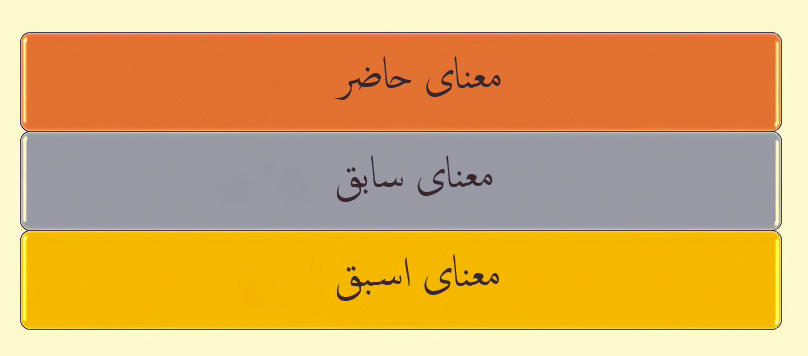
The Analysis of the History of ConceptsThe point is that the meaning of a key concept[4] in a specific time period becomes a window into the society that produced it.
Today, to know the meaning of a word, one can consult a dictionary or similar references. [In this context,] the earlier meaning of concepts [compared to the other two layers] may be more ambiguous and misleading. Sometimes we find the answer in old dictionaries or encyclopedias, but more often we are unable to orient ourselves and find the right path. In any case, we, as historians of concepts, are never merely seeking to extract the history of a word; rather, our aim is to understand the broader historical transformation that shifts political, social, cultural, and economic relations and connections. Our focus is on the two-way connection of conceptual-social change.
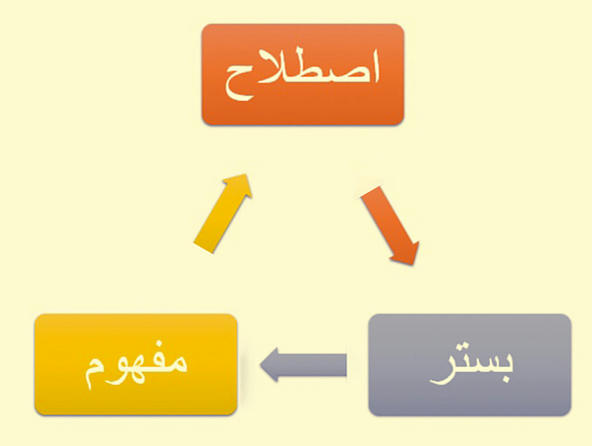
The relationship between concepts and society is shown in Figure 2. The word term is the specific word that gives particularity to the concept we have in mind. For example, in democracy, titles such as public and majority or the role of the masses can be seen, based on time, place, and political inclination. But in all these cases, what we are talking about is the very concept of democracy. Even more interesting, however, is its meaning, which often indicates the way we receive and define the concept. As a rule, to decode meaning, we need to understand the historical context[5] of the concept. [For this purpose] it is necessary to examine the political, social, economic, and cultural context[6] of the concept.
An Example: The Concept of Democracy
For many Germans who lived between the two World Wars, the Weimar Republic (or the first German democratic state, established at the end of World War I in 1918 and destroyed by Hitler in 1933) was a source of great disappointment. Simultaneously with the establishment of democratic governance, a predatory economy, social and political crises, and a rigid atmosphere stemming from the cultural and psychological traumas of the Great War were at work. For this reason, democracy was considered an inefficient political system, incapable of providing security, a fitting status, and a satisfactory livelihood for the common people. In fact, the concept of democracy derived its meaning from its historical context. The Nazis actively sought to create this very perception of democracy, but their success cannot be reduced solely to Hitler's oratory skills or military governments filled with intimidation and violence, even assuming both of these contributed significantly to it. In addition to that context, the defeat in World War I truly equated to a humiliating settlement, a widespread economic crisis along with the crushing pressure on Germany, the fear of communists among the German middle class, the lack of a democratic political tradition in the country, and many other matters. Context constitutes the meaning of the concept. However, when a concept takes on a specific connotation[10], it also frames the context. When democracy is a tasteless comedy, bad faith, and crisis, it can no longer be said to be a good system. Perhaps democracy is no longer a suitable political option for the people.
But when we are not even able to find definitions corresponding to the era, how do we examine the interaction between concepts and society?
Focusing on Opposites
In practical terms, providing a precise definition of many common concepts is difficult. For example, what truly is the word "feminine"? Very well, this word is certainly conceived as the direct opposite of "being masculine." What is the true essence of our national culture? Determining its clear boundaries may be difficult, but we assume it is something contrary to the "foreign cultures" of other nations. Many concepts cannot simply be defined in a way that precludes ambiguity. But an essential characteristic of concepts is that they derive their meaning from what they are not, that is, their opposites. This is what we call counter-concepts[11].
In analyzing the history of conceptual change, examining the opposites of the concept in question is often beneficial. The German historian of conceptual change, Reinhart Koselleck (1923-2006), considered a number of opposites, as shown in Figure 3.
Figure 3. Antonyms
Concept/Antonym
Inside/Outside
Friend/Enemy
Up/Down
Before/After
[Now] looking again at the concept of democracy, one can discern that its antonym is dictatorship. Hence, in different historical circumstances, various opposing concepts have prevailed. (For example, Western democracy has been contrasted with Fascism (1922-1945), Communism (1917-1991), and Islamic Theocracy (1978-?).)
The opposing concept reveals the meaning of the [opposing] concept. Following this, we can examine who the concepts of "inside" and "outside" refer to. In our example, who are considered the true allies of democracy and who are its violators? Who is in favor of the right to vote and who is not?
By emphasizing antonyms, we can distinguish friend from enemy. Who are the enemies of democracy and who are its defenders? Is this concept understood as a threat, and if so, for whom does it constitute a threat?
It would also not be irrelevant to examine the internal hierarchies of concepts. In our chosen context of democracy, who determines the upper and lower classes? Who rules and over whom? How are political roles divided among groups? What is the manner of elections? Ultimately, it may not be amiss to examine our concept's share of time, in the sense of a "before and after." Christianity is built upon a narrative of the Fall from Paradise and the Resurrection through salvation. This idea is the story of a lost ancient state and condition that will be restored on the Day of Judgment. The Nazis, too, used the term Third Reich (Empire) for their German state with the intention of tracing their lineage to the Holy Roman Empire (962-1806) and the German Monarchy (1871-1918). The key concepts of our age are also based on a conception of time. For instance, many people distinguish democracy as the political system of modernity, a system superior to the primitive systems of other regions of the world, which are often considered "medieval."
Essentially Contested Concepts [12]
As we observe, the meanings of concepts are neither glued to time nor nailed to place. And their value can likely differ remarkably in various historical conditions. This variability may be the result of gradual and often invisible historical developments, or perhaps the outcome of politically biased interventions. Hitler posited the title of the Weimar Republic as an opposing concept to the term Reich; the latter term refers to the period before 1914 during the spread of national euphoria and the principle of totalitarianism. This underscores how the variations and disputes over definitions hold political significance. This matter is as important today as it was in the chaotic and turbulent years between the two World Wars and the subsequent misery of humanity.
About the author: Anders Hassing teaches history and politics at Ørestad College in Copenhagen and works as an editor and publisher of educational books. He is a co-author of the book From Past to History (Columbus 2013), a Danish-language textbook presenting various approaches to the discipline of history[13].
.
.
[1] . Conceptual History
[2] . Anders Hassing
[3] . School
[4] . Note the distinction between "meaning" and "concept."
[5]. Historical Setting
[6] . Context
[7] .Term
[8] .Context
[9] . Concept
[10] .Connotation
[11] .Counter Concepts
[12] . Contesting Concepts
[13] . From Past to History
.
.
Article “What Is the History of Conceptual Change?”
Author: Anders Hessning
Translator: Ebrahim (Pezhman) Ranjbar
.
.
PDF file of the article “What Is the History of Conceptual Change?”
What Is the History of Conceptual Change (translated into Persian)
What is Conceptual History A Hassing? (original language)
.
.


Discussion0 comments
No comments yet; let yours be the first voice.