Sociology
Who Are Influencers and How Did They Rise?
Influencers are hollow idols who have risen to fame in an atmosphere devoid of reason; Kaveh Behbahani and Ehsan Hamidizadeh, in a roundtable discussion, examine the reasons behind the emergence of this phenomenon and the nihilistic condition dominating social media.
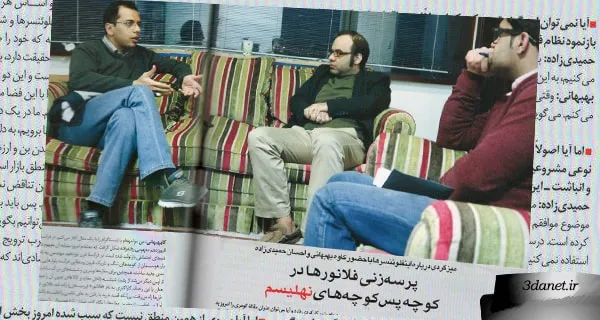
Ehsan Akbarpour / Who are influencers and how did they rise? What category within the social system has faded, such that a portion of its trust has been drawn to these hollow idols? Deluded idols who, in an atmosphere devoid of reason, have risen from obscurity to fame—or added to their fame—through the drivel of luxury lifestyles, fashion, and buffoonery. To answer this question and the why of the rise of influencers, we held a roundtable with a young philosopher and a young sociologist, both from Shiraz and both critics of the current state of social networks, one viewing one of the most prominent manifestations of today's social system through the lens of philosophy and the other through sociology. Kaveh Behbahani, a philosophy graduate, and Ehsan Hamidizadeh, a sociology graduate, sat opposite each other on an evening in late autumn 2017 in Shiraz, and each, from their own perspective, addressed the pathology of virtual networks, especially Instagram, and the reasons for the existing decline in this space.
*The subject of our roundtable is the pathology of the influencer phenomenon. Nevertheless, I will begin the first question with the nature and function of the social network Instagram. Douglas Gomery has an article titled "Hollywood as Industry," in which, quoting Janet Wasko and Thomas Guback, he explains that "Hollywood is controlled by financial institutions" and "it would be misleading to characterize Hollywood as a mere industrial center." In your opinion, what is the nature and function of Instagram in Iran, and can the title of Gomery's article be applied to Instagram today? A social network whose basis was sharing personal photos and videos, but today, heavily prominent economic aspects, the dominance of certain types of lifestyles, and the emergence of strange phenomena such as influencers are observed in it. Especially since, according to statistics, Instagram has about 20 million users in Iran and is one of the most popular social networks in the country.
Ehsan Hamidizadeh: In my opinion, the current use of social networks in Iran is not much different from how they are used in the world, but I believe there is a significant difference between us and them in terms of function. This significant difference mostly goes back to the media environment prevailing in Iran and the lack of transparency in society. Therefore, I believe social networks, including Instagram, are first and foremost an opportunity to breathe, to speak for a pluralistic experience, and for tolerance and forbearance. So, despite all the criticisms leveled at Instagram, I still have hope for this social network. Although I myself have not used Instagram for over a year, I look at this social network with the approach that, in any case, some people are earning income from it in this chaotic space of employment and work. But the question of what happens in terms of content on this network is debatable and can be criticized.
*If we consider a significant part of Instagram consumption to be "leisure time consumption" or, in Baudrillard's terms, "the possibility of wasting time by consuming unproductive time," in your opinion, is Instagram today what Adorno calls a "degenerate current" that is "the consequence of the intermingling of amusement and culture"?
Kaveh Behbahani: I will begin my encounter with Instagram with an example. In nineteenth-century France, a concept gradually took shape that I believe has been reproduced today in social networks. In nineteenth-century France, an engineer named Baron Haussmann built boulevards with new architecture from the narrow, dark medieval alleys of France and created large display windows and glass panes for shops. From then on, one could see inside the shop and its goods from behind the glass. Simultaneously with this event, a character called the "flâneur" (stroller) was born. The flâneur walked the streets without intending to buy anything or go anywhere specific; he only wanted to look at shop windows, see the new Haussmannian street, and stroll; purely for the sake of watching. Incidentally, Baudelaire wrote poems about flâneurs and described them. Flâneurs usually wore stylish hats, were well-dressed, indifferent to everything, lived like bohemians, had no particular job, and their occupation was strolling and adventuring in the streets. My belief is that today, in the current situation, the flâneurs of real streets have transformed into flâneurs of virtual space, and we are now faced with the flâneurs of virtual space. For instance, one of the things I myself do on social networks is precisely this strolling; on Facebook, YouTube, and Instagram. I usually do not know what awaits me in this strolling, but I always see strange things. Baudelaire has a poem called "Mademoiselle Bistouri," and at the end of this poem, he says when you stroll in the street, what innocent monsters you will see; and today, exactly such a situation exists on social networks, and in your strolling, you will see astonishing examples of characters with strange words and dispositions. In this sense, my first encounter with social networks was understanding this concept: observing characters who are very queer. But the reality is that we are trapped in this situation; you quoted Baudrillard in your question, and I think we can refer to another part of his thought to explain this situation.
Baudrillard, as we know, believes that in the new post-industrial structure, we are trapped in a situation that is a simulation (simulacrum) and repeated copies of phenomena, meaning that instead of facing the original phenomenon, we encounter their copies; and sometimes we even face the copy of a copy of a copy of phenomena. For example, this situation can be clearly seen in university entrance exam preparatory books. For instance, Newton has a book called "Mathematical Principles," its copy becomes "Halliday Physics," and the copy of the copy of the copy becomes the very flashcards that exam prep institutes give to students for test practice. We live in a world where we face repeated copies of things, and in Baudrillard's own words, "these copies have become more real than reality." In this sense, it no longer matters who Trump really is, what he does, etc.; what matters is how he is represented in the media. If the logic of the modern world is the logic of that Baudrillardian world of simulacra, some have realized that the presentation of oneself is apparently far more important than the essence of what we are; so a possibility or space is needed for self-presentation. And when this possibility and space reaches a country like Iran, meaning that suddenly an opening appears in which there is the capability for self-display and expression, a situation is created that I call the "nihilistic situation governing social networks." In this sense, there is no longer any index, value, or even concern for finding a relationship with reality there; what matters is how I present myself, even if it means putting on a display that, by virtue of being utterly foolish, seems queer, and others, because they have not seen such follies, turn to it and watch them. I completely agree with Mr. Hamidizadeh that the solution to this situation is not blocking and filtering, etc. — indeed, it is these very factors that have caused the emergence of such a nihilistic situation — on the one hand, virtual space and social networks are certainly a useful space for those who want to make reasonable use of them; but the reality is that in this space, we also encounter such strange phenomena.
*Mr. Hamidizadeh, do you agree with the interpretation of nihilism governing social networks?
Hamidizadeh: This nihilistic concept is a bit vague to me; I mean that perhaps if we look at social networks with a single indicator, approach, or a selective theory and viewpoint, we might arrive at such an interpretation. However, I believe that social networks increasingly promote that essence of flânerie and practically take away our ability to choose. One of the reasons I closed my Instagram account and limited my use of social networks was that I practically found myself compelled to wander. Perhaps because if we follow the course of change and evolution of social networks, we see that the groundwork for more flânerie has been laid, and it seems there is no escape from it. I agree with the criticism that the content raised in cyberspace and social networks often lacks a scientific basis and may even create false consciousness and an illusion of knowledge; nevertheless, I still believe that in a society where the level of reading is this low, the very possibility that, for example, the general level of awareness about categories such as hygiene, health, etc., can increase through these social networks is probably a blessed thing.
But in terms of content, I completely agree with Mr. Behbahani. I have always wondered whether these strange individuals we see on social networks are hidden layers of the social system or the general public. What I concluded was that the closed media space and the arena of Instagram have provided an opportunity for peculiar individuals to emerge more prominently; on the other hand, we see that this phenomenon seems to have become a norm, and these individuals have turned into role models and idols for others who try to become like them. But why is this so? I have not yet found an answer to why, and this situation is so painful to me that I prefer not even to engage in thinking about it. Nevertheless, I still believe that social networks have somewhat changed the meaning of the culture industry that existed up until the era of television and have increased the possibility of choice—although the culture industry still dominates and reproduces the ideas of the capitalist system.
*Don't you think that social networks have merely reproduced the constructed models of the culture industry in a new form and with greater quantity?
I agree that the form of the culture industry has changed somewhat, but I believe that social networks have even managed, at least in some areas, to make stereotypes less prominent. Like gender stereotypes; as long as television existed, the media was a reproducer of certain stereotypes about women, but the creation of social networks both changed the stereotype of women's presence and increased women's power to choose content. This possibility became available in other areas as well; however, I also agree that currently, on the internet and social networks, we are exposed to directed messages in a different way. For example, each of us is shown advertisements that have been selected and displayed based on the detection of our tastes. All that said, today the user has greater power of choice compared to previous mass media.
Kaveh Behbahani: In my view, we live today in a world where we encounter only isolated bits of information and never reach the deeper layers of knowledge, and this is a significant problem. Let me elaborate. I usually consider three levels of knowing: the first level is having information, for instance, knowing that Descartes was born in the seventeenth century, and so on. The second level is when we possess a piece of knowledge, we believe certain things and have reasons for their truth; in fact, Plato's tripartite definition: "justified true belief." This level is higher than the first, and in the modern world, this value has typically been highlighted in epistemology. But above this level is a value that has been lost in modern epistemology, one that some epistemologists like Linda Zagzebski have also pointed to, and that is the value of "understanding," which constituted wisdom for us. We do not have access to this third level, and at best, we either receive and present bits of information, or we can reproduce a measure of knowledge (true beliefs for which we have found reasons), but these things have never settled into our souls within an overall network, and we have not understood them. In other words, we no longer have sages in the modern world; and the same condition prevails in the virtual space. That is, understanding in that sense no longer reigns, and we are faced only with bits of information, even though having these bits of information is a step above absolute ignorance.
Mr. Hamidizadeh makes a valid point regarding the issue of nihilism. Perhaps a study should be conducted to demonstrate this nihilism with statistical quantity; I do not know if this can be done, or if so, how? Sociologists and Mr. Hamidizadeh himself should explain it. But I am certain of one thing: when I look at society, I see Nietzsche's indicator of nihilism: "Values devalue themselves." And the reality is that such a condition prevails today, meaning that once the value was to be reasonable, to have presence of mind, and so on, but today, it seems one must spontaneously display oneself at every moment, in every circumstance and situation, as if there is no longer a need for reasoning, and the logic of collage has encompassed everything.
In my opinion, we experienced a similar example after the 2nd of Khordad, 1376; when the atmosphere of cinema became freer, but gradually, as the cinema space opened up, we faced the decline of our filmmakers. Freedom was supposed to give us artistic creativity, but it led to decay. I can compare Iranian filmmakers one by one, with examples and facts from their films, and prove this claim. From comparing the films of Mehjui, Tahmineh Milani, and Ebrahim Hatamikia from the 60s and early 70s with their films from the 80s, to the decline of Iranian cinema itself, which went from a brilliant work like Bahram Beyzai's "Death of Yazdgerd" to Asghar Farhadi's "The Salesman." I call this process "collapse," in an era where we go from Shamloo to poets who believe one must write poetry according to the people's taste and compose SMS poems. This situation is the devaluation of previous values and being placed in conditions of decadence. Freedom was supposed to provide a dialogical space for us, but instead, Instagram shows and stories have taken its place; and the objective, embodied manifestation of this nihilism is precisely those Instagram stories you can see while scrolling. Mr. Hamidizadeh mentioned that he was eventually forced to close his Instagram page, but the reality is that this situation becomes stranger and more bizarre every day, and sometimes describing this condition defies expression. Of course, we face another problem: when a ray of light shines into closed societies, everything is laid bare, and although the leaders of closed societies imagine everything is proceeding calmly, the reality is that society is different from what is seen from behind the closed doors of policymaking.
*It seems the situation you depicted resembles the interpretation Habermas offers of cultural consumption, referring to a time when the condition of citizen action, after the distinction between the public sphere and private life has vanished, turns into the consumption of leisure time. But let us now address a topic that has found a prominent manifestation on the social network Instagram: the rise of influencers. The new hollow idols of social networks who, by sharing photos and videos of their particular lifestyle, fashion, buffoonery, facial and bodily beauty, etc., have risen from anonymity to fame, gained millions of followers, and then, through this, achieved very high incomes (for example, one influencer with 1.6 million followers receives 8 million tomans for each promotional post on Instagram). The reality is that the number of influencers is increasing daily, and a kind of idolization has been constructed around them. My question is, why have they emerged, and what are the cultural and sociological reasons for the attraction of millions of people to them?
Hamidizadeh: Interestingly, I was reading two content analysis articles about Instagram that were conducted on the profiles of five people, including Ms. Selena Gomez, Taylor Swift, and three other famous celebrities. The analysis written on these celebrities' personal pages pointed out that the published and more popular content on these individuals' pages falls into the very categories you listed: fashion, a particular lifestyle, music, etc. In answer to your question of why these individuals have emerged, I believe that if we had a more precise selective view and made choices with greater awareness, knowledge, and education, and if that cultural lag in our use of technology had not occurred, we would not be facing this phenomenon in this way. Although I believe the function of Instagram in Iran is not significantly different from the West, the reality is that because we are not the owners of this technology and have not been exposed to the cultural contexts from which these phenomena are constructed, we have suddenly encountered these phenomena and learned how to use them ourselves; and we have created a third phenomenon that is specific to us, an Iranianized Instagram. Like the imitation of start-ups in Iran, where we see no connection or relation between their monetization and function in Iran and the West. Hence, I believe the use of Instagram within the structure of the capitalist system is a meaningful behavior, and its context exists, but in Iranian society, where a cultural structure based on chaos prevails, and people use their common sense to solve their problems, not rationality and rules; the conditions become culturally unpredictable and make the emergence of such phenomena [influencers] entirely meaningful. You may well see such individuals acting in this way and making a business out of it. I consider this situation the dominance of common sense over Iran's social system.
*Is this volume of nonsense and drivel that influencers share and their followers consume, as Bourdieu says, born of the "closing of the door to creativity" in the social system, or does it have another reason?
Hamidizadeh: On the contrary, I believe the element that is intensely active within common sense is boundless creativity. Creativity that is not within the framework of rationality, and if creativity is not within the framework of rationality, it creates chaos. Indeed, the chaos that prevails in common sense is due to this creativity devoid of rationality, and this common sense appropriates everything, even beliefs and values, and with creativity devoid of rationality, it concocts a mishmash that is neither predictable nor rule-conforming.
Behbahani: It seems to me that today we are faced with a situation called the market, and there is no place outside the market; that is, there is no Archimedean point where we can stand and say we are outside the market and want to fight the culture industry or anything else that the market fosters. In my belief, one can only fight the market with the market and promote rationality and reasonable values. In other words, what Marx calls the "process of commodification" has today taken a form where, in this very room we are sitting in now, probably except for the air we breathe and for which we currently pay no money, everything is a manifestation of commodification and is potentially or actually buyable and sellable. And in these conditions, where there is no place outside the market, one cannot fight the market except with the logic of the market. Mr. Hamidizadeh is right that a technology has been created and we lack the ethics for using that technology, but if we want to make that technology ethics prevail, we must transform this ethics into packages presentable in the market that can compete with the current nihilistic packages; and this means following the logic of the market.
*The first problem in confronting this solution of yours is that we are in a consumer market and are not producers ourselves.
Do you know why we don't produce? Because we fundamentally consider the market matter to be vulgar and futile, and now we want to stand against this big machine. We only say this machine is very bad and negate it, whereas one must fight it with a machine similar to that machine, and one cannot defeat it by condemning the market machine. Following Daniel Kahneman—the contemporary economist and psychologist—who says that in the external world there are hooks that pull us in and force us to behave as they want; I believe that major commercial brands do the same thing and pull us in through the channel where we are unreasonable or irrational animals. Kahneman also starts from here and says that, as it happens, the human is not a rational animal but a mad ape that sells its goods in bulk. The science of behavioral economics precisely addresses this issue of how the market uses our irrational drives and pulls us in. So we have no choice but to use that hook, but hooks that lead us to the thinking room and rationality and elevate the popular passion. Mr. Hamidizadeh is quite right, the popular passion we see is vulgar and must be constantly revised. In other words, we must create cavities within this all-encompassing market, and this cavity incidentally follows the same logic of the market; the only difference is the content within this logic.
*But we also do not possess the means of production, and fundamentally, we do not even recognize them.
Behbahani: The fundamental question is precisely here: what is the means of production? We are not talking about building a mobile phone factory here; rather, today this tool is universal. In the sense that Instagram has been produced and has given me and Instagram influencers an equal opportunity to roam in this space. If they attract more audiences, they have understood the logic of the market better. Mr. Hamidizadeh pointed out an important point that creativity does not arise from nowhere. My interpretation is that we must have a number of established traditions, and then, in relation to these traditions, we can say we have been creative. Today, these traditions do not exist for us. For example, we cannot say we have competed with Instagram influencers by cultivating rational thoughts and marketizing intellectual packages. Aren't intellectual institutions doing the same thing today? Aren't they selling their classes, books, and intellectual products? Why do they suffer heavy defeats? Because they do not know the logic governing the market and are caught in a logic of duality: on the one hand, they have no choice but to be in the market, and on the other hand, the market is something they must condemn; well, we lose in this game because the market imposes its logic on us, and we, as individuals, cannot change that logic. So we must have a strategic advantage and make these same intellectual productions competitive. The final point is that I think this nihilistic atmosphere that prevails today is not strange; because the nihilistic aspect that has opened up is the same nihilism that prevails in the IRIB; in fact, the secular alternative and translation of that aspect of the IRIB becomes this very nihilism of Instagram stories; and both reproduce this nihilism. Because we have not been able to make the teaching of rationality attractive enough for users to click on us instead of clicking on influencers.
*Can it not be interpreted that Instagram is fundamentally a representation of our society and a reflection of our cultural system?
Hamidizadeh: Yes, exactly. In a sense, when we examine social data, we conclude that Instagram is a representation of Iranian society.
Behbahani: When someone criticizes why Instagram is like this, I am surprised. I say, is it any different in the streets and alleys?
*But can one fundamentally fight the market with the logic of the market? Is this act not itself a form of legitimizing the market system and falling into the trap of the same logic of capital and accumulation—this time under the pretext of producing rationality and so on?
Hamidizadeh: As long as we have no alternative, what other choice do we have? I agree with this point, and I also mentioned that the virtual space has provided a pluralistic opportunity. It is true that it has given this opportunity to that sector, but the fact that we do not use it is our problem. But the question for me is, what necessity is there at all for us to want to create an option that can compete with them?
*Perhaps because, for example, one of the favorite areas for influencers and celebrities, and their followers, is consumption and the desire for consumerism, and on the other hand, vulgarity and mockery.
Hamidizadeh: Practically, the capitalist system and the free market have turned everything into a commodity and something that can be bought and sold. The reality is that we have no escape even from what social networks and internet companies offer as cultural commodities. It is true that Adorno and Horkheimer [in their essay on the culture industry] make distinctions about types of art and culture, but I believe the dominance of the capitalist system is such that the various types of transcendent art are no longer distinguishable and discernible, and all of them have been dissolved in this space and turned into a commodity. Therefore, I believe we must choose another perspective for analysis and can no longer suffice with merely labeling it consumerism. Because we ourselves are involved in this process today. How do we live today? We ourselves are consuming this culture, hence I believe this viewpoint must be changed.
Kaveh Behbahani: It is clear that we are faced with consumerism, but in the logic of old consumption, we exchanged goods that had use-value for other goods; therefore, a commodity had no more than two values, and Marx, in the chapter “Commodities and Money” in Capital, best calls and analyzes them as “use-value” and “exchange-value.” Today, however, commodities have acquired a third value, and that is the “sign-value” of the commodity; it no longer matters what use-value and exchange-value brands offer us their goods with, what matters is where they place us within a social network. We no longer have the opportunity to get to know the other and reach the depths of their being; we must very quickly place them in a network of signs, categorize their position, and determine from within this network of signs what kind of interaction we should/should not have with them. We are faced with an all-encompassing market outside of which there is no place.
But why should we compete with this market? Because the foundation and basis of every civilization is a concern for truth and respect for truth. I believe influencers and Instagram “shākh”s promote a kind of nonsense, with the justification that they are presenting themselves honestly; but the reality is that a human being who has a concern for truth must think. Yet this nonsense prevails in our real and virtual spaces, and these two spaces are not separate either. On the one hand, this space has become marketized; if we oppose this space, we have no alternative but to arm ourselves with its own tool, which is the market. We are caught in a harsh duality: on the one hand, we must go to war against this nonsense, for the simple reason of respect for truth (because a group is sitting on a branch and sawing it off, devaluing truth), and on the other hand, the logic we must equip ourselves with is the logic of the market, but we reject the logic of the market with an intellectualist posture. Whereas with this contradiction, we cannot go to war against the market and we are constantly and systematically defeated. So we must produce cultural packages that are competitive; if we succeed, we can say we have done something other than grumbling. Perhaps this is why, in the West, the promotion and teaching of rationality is completely marketized, and universities are all economic enterprises that sell rationality and compete intensely with one another.
*But isn’t following this very logic what has caused a large part of our universities to become fee-paying today, and as a result, a significant portion of the lower social classes to be deprived even of studying in higher education institutions? Let alone benefiting from cultural packages and so on.
Behbahani: That is completely correct, and deprivation is the harm of this method, but I know of no other way.
*But on the one hand, this is also a paradox; a culture that is supposed to disseminate rationality itself becomes a commodity that can be bought and sold.
Behbahani: Marketization is not an ugly thing in itself.
Hamidizadeh: If it is to be that we want to compete and change the atmosphere, I agree with Mr. Behbahani. But my question still stands: why should we intervene? We can have our own lives, and others can live with their own populist fervor.
*Perhaps one of the reasons is the public trust that has been built in social media celebrities. Because one of the harms of the objective aspect of the current situation is the transformation of celebrities and influencers into hollow fetishes for a part of society. For example, during the Kermanshah earthquake, we witnessed that instead of helping public institutions like the Red Crescent, people donated to celebrities, some of whom, incidentally, were seeking more fame out of a disaster.
Hamidizadeh: I see the reason for this as the absence of a dynamic and open civil society. Civil society is always a precise and reliable intermediary between the people and the government, and its continuity and strength create social capital. One of the important foundations of social capital is public trust. When civil society is absent, the relationship between the government and the people becomes massified, and it is precisely in such a space that the opportunity is provided for celebrities and influencers to exploit the chaotic atmosphere. That idolization you refer to arises in this context, not that Instagram alone has this capability. If we had a civil society, everything would be systematic and organized, and such a thing would not occur.
Behbahani: I consider the discussion of public trust that Mr. Hamidizadeh pointed to as very important, and I quote from Ms. Zagzebski, who says why bullshit should not become prevalent in society. In her belief, society must be built upon a degree of trust, and public trust is an important asset of the social system. To explain this situation, consider two possible worlds: a world in which there is much bullshitting and people merely express themselves without having reasoned sufficiently. The alternative world, however, is one in which there is more reasoning, people are more mindful, and they make decisions based on rationality. It is clear in which of these two worlds the degree of trustworthiness is higher. Therefore, reducing the world of bullshit and nonsense, and moderating the nihilistic atmosphere, causes the desirability of our lives to also increase.


Discussion4 comments
ایرادات ملانقطی وار را رها کنید اصل مطلب را دریابید اصل مطلب آسیب شناسی پدیده ی موسوم به شاخ های اینستاگرامی است که اوج ابتذال فرهنگیست. فرهنگی به این دلیل که بعضی از این موجودات تا چند میلیون دنبال کننده دارند که مشتاقانه رفتار و گفتار احمقانه آنها را مشاهده میکنند و تاثیر آنها فراتر از حوزه زندگی شخصیشان است.
اگر به آغاز سخن افراد تحصیلکرده توجه بفرمایید همیشه به جای طرح مسأله عبارتی حاوی نقل قول از یک فرد اروپایی در آن دیده می شود .واقعاً چرا بایست بجای طرح عقاید خود از هان ابتدا نقل قول ذکر شود؟ " موضوع میزگرد مادرهی آسیبشناسی پدیدهی اینفلوئنسرهاست. با این حال پرسش نخست را از ماهیت و کارکرد شبکهی اجتماعی اینستاگرام آغاز میکنم. داگلاس گومری مقالهای دارد با عنوان «هالیوود بهمثابه صنعت» و در آن بهنقل از جانت واسکو و توماس گوباک توضیح میدهد که «هالیوود را نهادهای مالی کنترل میکنند» و «گمراهکننده خواهد بود اگر هالیوود را بهعنوان یک مرکز صنعتی صِرف معرفی کنیم».کارکرد شبکهی اجتماعی اینستاگرام آغاز میکنم. داگلاس گومری مقالهای دارد "
لطفا یک جوانمرد، ترکیب "کیست اند" را از نظر دستور زبان فارسی برای من توضیح دهد.
جناب بهرنگ گرامی! «کیست» یعنی «چه کس یا کی است» و «کی» وقتی به «است» متصل میشود به صورت «کیست» نوشته میشود. و در حالت جمع هم میتوان گفت که «چه کسان یا کیان اند» یا «کیستند». حضرت سعدی می فرمایند: که پس آسمان و زمین چیستند؟ بنی آدم و دام و دد کیستند؟ و از نظر دستوری، کیست «جملۀ پرسشی» است و از «ضمیر + فعل» ساخته شده. اما از نظر رسم الخط، «کیست اند» درست نیست و باید نوشت «کیستند» چونکه قبل از «اند» حرف صامت آمده، باید الف «اند» را حذف کرد. به هر حال، اگر «کیستند» را نمی پسندید، میتوانید از «کیانند یا چه کسانند» استفاده کنید. با حترام.