Literature
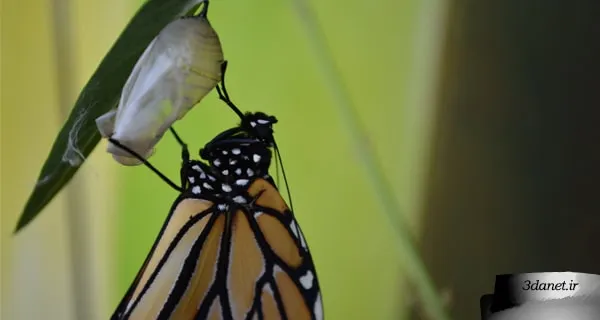
Worms That Become Butterflies!
Love expands the circle of being and leads from the false self to selflessness. We must be grateful to those we have loved, for they turn the worms of our existence into butterflies and, in loss, prepare the ground for a new birth.
Seddiq Qotbi:
How good it is that we love someone. We should be grateful to those we love, for they expand us and allow us to taste the unique flavor of “selflessness.” The mystics tell us that when we are with ourselves (our false selves), we are a “prisoner of a cloud of sorrow” and “frozen like autumn.” When we become selfless, we sit beside the moon and our days turn to spring. That breath when you are with yourself is a prisoner of a cloud of sorrow, And that breath when you are selfless, the moon comes to your side. That breath when you are with yourself, you are frozen like autumn, And that breath when you are selfless, yesterday comes to you like spring. (Rumi)
Loving someone enlarges the circle of one’s being. When they eat, it is as if you have eaten. When they drink, it is as if you are quenched. Their sufferings and discomforts spread to you as well. You worry like a mother and care like a nurse. The circle of your sorrows expands. You understand well why the Buddha said to love the world as a mother loves her only child.
We should be grateful to those we love or have once loved. Sohrab said: “And love / only love / ... carried me to the vastness of the sorrow of lives.” With the wings of affection, we can find release from stagnant air and still waters and experience dimensions of sorrowfulness that we could not before. The experience of loving makes us kin to the trees. Trees that grow weary of stagnant air: “I am of the lineage of trees. Breathing stagnant air wearies me.” (Forough)
That we have loved someone is a kindness we have done to our own soul. By loving, we have first and foremost served our true self. We should sincerely tell all those we love or have loved how grateful and appreciative we are for having found this possibility and for their companionship in enabling us to love them.
It is true that loving walks shoulder to shoulder with sorrow, deprivation, and longing. It is true that when we lose someone we love, we feel we have been brought to our knees. We feel we have lost everything. But even this occurrence is, from certain aspects and perspectives, very precious. The very fact that an event causes us to feel we have lost everything becomes the ground for a new birth. A second life in which you learn not to define yourself by your possessions, and at the end of your life, only one sentence narrates your life: “They loved...” “O world, when I pass on, keep this word for me in your silence: ‘We have loved.’” (Rabindranath Tagore)
Then death can take nothing back from us, for we have become one with loving: “One day I shall know this: that death never has the power to snatch from us what our soul has found, for its findings are one with it.” (Rabindranath Tagore)
Loving wears a person out, disintegrates them, and flays their skin. But the mystics welcomed this shedding of skin: “One day someone complained, saying: ‘A certain scholar told me he would flay my skin.’ Rumi replied: ‘Bravo to that man! We long day and night for our skin to be flayed, to be freed from the nuisance of the skin so we may reach the mercy of the Friend. Beware, lest you flee, and let it deliver us from our skin.’” (1) Make me selfless, for in that state there are freedoms; I am a servant of that command by which they are freed from themselves. (Rumi)
Loving... a love that carries a person to the unexperienced vastnesses of sorrow, a love that carries a person to the heart of truth, and truth, in order to save, first puts to death: “Every true presence is wearing. What the Bible says in its tempestuous language—that no one can see God without dying on the spot—I can say in a more pedestrian, but equally definitive, language: no true encounter can take place without immediately striking us down. No encounter outside of love is true; there is no love that does not begin to put us to death.” (2)
«One must be born twice to live a little, only a little. One must first be born with the body and then with the soul. These two births resemble a single renunciation. The first casts the body into the world, the second lifts the soul to the sky. My birth began with seeing you... I thank you, Ghislain, in losing you I have lost everything, and for this deprivation I thank you.»(3)
«We can give many things to those we love: words, peace, pleasure. You gave me the most precious feeling: longing.»(4)
The art of gratitude must be learned. Grateful to those we have loved, simply because we have loved them. And also grateful to those who have loved us and, with this loving, have turned the worms of our being into butterflies:
«An ugly, filthy worm sleeps within every human being, even if that human is the most ascetic of hermits... Bend down and softly say to this worm: "I love you!" Instantly, wings sprout on this worm's back and it transforms into a butterfly.»(5)
«I think that to be alive, one must have looked at least once, have loved at least once, have been beside oneself at least once. And afterwards, when that thing has been given to you, you can be alone—solitude is not so bad. Even if no one seduces you, even if no one loves you, even if no one looks at you anymore, that which was given is truly given, it was once and for all. It is in such a moment that you can go towards solitude, like a swallow taking flight towards the sky.»(6)
«All of us are searching for only one thing in life: to be filled with it, to receive the kiss of a light in our frozen heart, to experience the gentleness of an immortal love. To be alive is to be seen, it is to enter the light of a loving gaze: no one is exempt from this law.»(7)
«I am willing for all my books and my next book to vanish except for this sentence: "The certainty that one day, someone has loved us, even just once, causes the heart to definitively take flight in the light." Everything may be taken from me, but this sentence is inscribed in me as much as it is in my books.»(8)
Loving, more than being loved, makes our heart the host of luminous kisses and white songs... Those we love have a great claim upon us.
We can love, and this happiness is enough.
.
.
1. Manāqib al-ʿĀrifīn, Shams al-Dīn Aflākī, edited by Tahsin Yazıcı, Tehran, Donyā-ye Ketāb, 1375 2. Weariness, Christian Bobin, translated by Pirouz Sayyār, Āgāh Publications, third edition, 1385 3&4. Beyond Being, Christian Bobin, translated by Mahvash Qavimi and Samira Sadeghian, Āshiyān Publishing, 1393 5. The Saviors of God, Nikos Kazantzakis, translated by Monir Jazani, Amir Kabir, eighth edition, 1390 6. A Passing Life, Christian Bobin, translated by Bafanesh Farahmandi, Ketāb-e Pārseh Publishing, 1395 7. The Unexpected, Christian Bobin, translated by Negār Sedghi, Māhriz Publishing, fifth edition, 1385 8. The Light of the World, Christian Bobin, translated by Pirouz Sayyār, Āgāh Publishing, 1385
.
.


Discussion0 comments
No comments yet; let yours be the first voice.