Philosophy
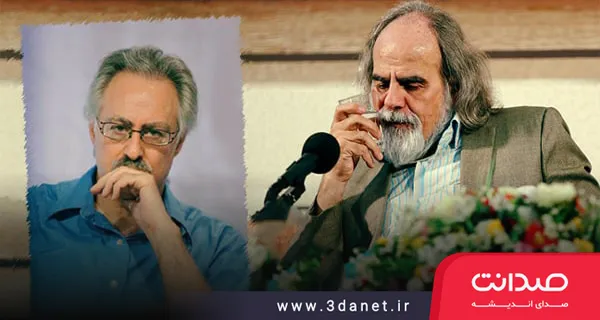
Yaser Mirdamadi in Conversation with Dariush Ashouri: The Path to Iranian Modernity Passes Through Hafez
Dariush Ashouri sees the path to Iranian modernity in re-reading tradition and understanding Hafez, and considers the modernization of the Persian language part of this project. He examines the challenges of encountering modernity and the consequences of the collapse of Eastern structures.
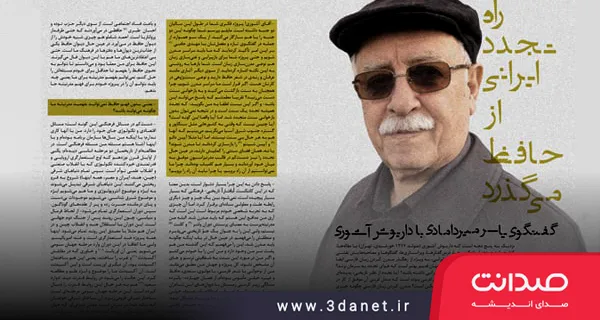
Yaser Mirdamadi: For nearly five decades, Dariush Ashouri (born 1938, Tehran) has played an undeniable role in constructing Iranian modernity, especially through the modernization of the Persian language, with his articles, books, translations, coinages, lectures, editorial work, conversations, and interviews. But is the new world actually better than the old one, that we should be so preoccupied with modernity? Why should modernity for Iranians have an Iranian flavor? Is modernity, historically speaking, a Western phenomenon, or was it a phenomenon with a trans-Western beginning, of which the Western model proved successful? How is constructing Iranian modernity even possible? What is the modernization of the Persian language, and what connection does it have with Iranian modernity? Why does Hafez hold such a special place in Ashouri's works regarding the construction of Iranian modernity? To what extent is purism defensible in the modernization of the Persian language? Is religious reform possible and desirable? What is Ashouri's relationship with religious intellectuals, and does he have any advice for them? In the interaction of the predominantly Muslim Iranians, and the Islamic world as a whole, with Western modernity, what role does the wound of the occupation of parts of Palestine by Israel play, and what is Ashouri's view on this matter? On these questions and others of this kind, I sat down for a conversation with Dariush Ashouri on a semi-cloudy afternoon in the summer of 2016, in a café in the heart of Paris. In this conversation, I tried to address the less explored aspects of Ashouri's works and some critiques of his approach.
Mr. Ashouri! Your intellectual project over these years has had two aspects. I would like to ask how you reconcile these two aspects. On the one hand, you have always emphasized, including in your recent and extensive conversation with Mehdi Jami[1], that we must become thoroughly modern, and even your project for the rehabilitation and enrichment of the language is a kind of language modernization. You have pointed this out clearly many times. On the other hand, you have works like Mysticism and Roguery in the Poetry of Hafez, and there is a kind of tradition-studies in your work. If we are to become thoroughly modern, why do you still return to tradition and engage in re-reading tradition? I am almost certain the answer could be—and if it is not, please tell me—that modernity is always the modernity of a tradition, and consequently, one cannot become modern without re-reading tradition. But is this really the case? Is it not so that when we look at countries like Singapore and the Southeast Asian region, we see that they, too, are not without tradition. But have they, for instance, reconstructed Daoism[2] and Shinto[3] in order to become modern? Or no, they more or less maintain that traditional atmosphere, while at the same time successfully introducing modernity, at least in the form of modernization, and have been very successful. Why couldn't we have taken that path, or why shouldn't we take that path?
- Answering this ‘why’ is very difficult, in the sense that in this historical-cultural context, which is very, very complex, one cannot establish a simple cause-and-effect relationship between one thing and another. But what relates to my own personal experience is that yes, I am an advocate of the need to become modern. Of course, I am not a worshipper of modernity in the sense of idolizing the age of Voltaire[4] and Kant[5], but I accept it as a historical climate and I understand its logic. At the same time, regarding how one should become modern, I understand that this past of mine also exists behind me and I drag it along with me, and if I do not achieve clarity regarding this tradition and its place is not determined, my entire project and world remains suspended. From adolescence, I was very intimate with Persian poetry, with Rumi, Saadi, Hafez, and so on. From the age of fourteen or fifteen, I was constantly grappling with the divans of these poets under the winter korsi. The history of Sufism and Sufi terminology is not very difficult. Understanding Attar and Rumi was not very hard, but Hafez was a very great enigma. Especially now that we have encountered the modern world and modern ideas, understanding and interpreting Hafez has become much more complex and contradictory. Consider, for example, Mahmoud Houman[6] and his interpretation of Hafez. He had gone to Germany to study and was familiar with German philosophy, and he wanted to make Hafez resemble Goethe and Nietzsche. Someone like Kasravi[7] said this Hafez was a filthy, impure individual, disbelieving in everything, and a cause of social corruption. On the other hand, the Tudeh Party and Ehsan Tabari[8] were producing a Hafez who was even a supporter of the proletariat. Ahmad Shamlou[9] was also extracting something resembling himself from Hafez’s Divan. At the same time, the Divan of Hafez is one of the most captivating divans and collections in our culture. Even the most disbelieving among us take auguries with this divan. This Hafez was an enigma for me, and I knew that until I could somehow understand Hafez, at least to resolve the issue for myself, I could not understand what modernity means for us. I must be able to place it within my own project for understanding modernity.
So without understanding Hafez, you cannot understand what our modernity could be?
At least in cultural matters this is the case; economic and technological issues are another matter. I have nothing to do with those; although I spent years in the Plan Organization and am familiar with them, my concern is a cultural one. In my study of our history, I have observed two fundamental stages: one from the early nineteenth century, the peak of European colonialism and the dazzling power of technology combined with the Industrial and Scientific Revolutions. Then, all the Eastern worlds (China, India, Iran, and Egypt—all of them) begin to collapse. These Eastern worlds become the object and subject of anthropology, and we too become the object and subject of Orientalism. We become helpless, despairing creatures, full of envy and various complexes. Then the era of colonialism ends—formally and politically, as this process follows the Second World War. This era concludes with India's independence, the Chinese Revolution, and in Iran, for instance, with Mosaddegh. These are all anti-colonial and anti-imperialist projects. Yet, it is precisely in this period that we enter the Third World stage. That is, the Orient[10] and the East, against which they constructed the Occident[11] and the West—meaning this too was a construct of the Occident, the one being the Orient and this the Occident. That Occident made us the subject and object of its science and study. This condition can be seen in power relations. Edward Said[12], in any case, has also traced these power relations. This Third World stage is one in which the Eastern structure collapses. Our own Eastern structure, over which the shadow of God looms—the Eastern world that is a mystical and Islamic world, where the shadow of God is also cast over earthly power—collapses for us in the late nineteenth and early twentieth centuries. In Iran, this is realized with the Constitutional Revolution, in China with the revolution of Sun Yat-sen[13], and so on. Then this Western colonialism also presents us with a form, the post-colonial[14] form, and that form is the modern nation-state.
And this is the beginning of the era of gaining independence and emerging from under domination.
But we were not prepared to fit into this form. Our crisis continues to this day.
And that top-down modernization that after ...
— ... Yes, that does not work either, because society and culture do not become modern in this way. The culture is still largely Eastern. The shadow of God, the ‘Shadow of the Almighty,’ still looms over it. Now we have even found our own latest Shadows of the Almighty. My question was: what is the meaning of all this turmoil and chaos in our intellectual space? And then my obsession was that I must somehow solve the riddle of Hafez.
Hafez is, in fact, a kind of far-reaching symbol of this culture, one whose Divan, as you say, from the non-believer to the believer, is found by the prayer rug and beside the tavern; and this Hafez is a shared cultural capital.
Yes. How can the enigma of Hafez be solved? Our literary scholars, who go and read him line by line and interpret him line by line, can never penetrate the structure that is the horizon of the worldview of a person named Hafez of Shiraz. All our literary scholars, like the most famous among them, Mr. Khorramshahi[15] and the rest, are like this. They read line by line, and because they read this way, they do not see the connection of the parts to the whole, nor do they see within the horizon of the Hafezian worldview. I wanted to understand this worldview more. Let me give an example. Consider this verse by Hafez: ‘I, the bewildered one, was also once among the people of well-being / The snare on my path was the twist of your Hindu tress.’ By examining Hafez’s text, nothing can be understood from this verse, unless we want to forcibly inject something into it. But I conducted research and found that this relates to the myth of the creation of Adam. In fact, the entire foundation of the anthropology and theology of our Sufi culture, especially the human-God relationship, draws from the myth of human creation. The Sufi hermeneutic interpretation of the verses related to the creation myth is very illuminating. Through this, you can grasp the horizon of Hafez’s gaze. Regarding this very verse I mentioned, who is this ‘I’ in the verse? Why is Khwaja Hafez of Shiraz bewildered? In the myths, it is said that when God expelled Adam from paradise, Adam lamented at God’s court for 400 years. The word and expression used there is: do not abandon me in this bewilderment. As long as you are in paradise, the matter is clear; it is a world that has no lack or deficiency, and eternal pleasure and enjoyment are established there. But when you come to the earthly world, these questions arise: where is this place, and what have I come for? Then he says, ‘I was among the people of well-being’—what does that mean? It means I was a person of the ‘Abode of Peace.’
The Abode of Peace, paradise.
I was a person of the Abode of Peace. From there, I emerged bewildered; this is the story of the Fall. ‘The snare on my path was the twist of your Hindu tress.’ Whose Hindu tress caused him to leave being among the people of well-being and become the bewildered ‘I’? Then you go to the symbolic interpretations of the Sufis, and after delving into ‘tress’ and ‘curl,’ and putting all of these together alongside the rest of Sufi and poetic literature, you arrive at the understanding that the tress, the blackness of the tress, the restlessness of the tress, and the twists and turns of the tress, are a symbol of the earthly world: ‘When shall I reach the end of the dark night of your twisting tress’s path / Unless the reflection of your face lights my way with a lamp.’
This was where, in Hafez’s intellectual system, you found the concept of ‘Rendi’ as a kind of key for rereading this tradition and its link with modernity.
I arrived at the point that the axis of this matter is the story of creation, but with a specific reading. Here we encounter numerous conceptual transformations, including how, in our culture up to the fifth century AH, there were ascetics and mystics who wrote books of asceticism, and then how does it come about that the ‘ascetic’ becomes a figure of ridicule? Strange hermeneutic turns occur here. Another issue is that until a certain time and period, the angel was considered superior to Adam. This is to a large extent influenced by Christian culture. Because the goal in Christianity is to return to the angelic realm, but these figures no longer want to return there; at least by the time we reach Saadi and Hafez, they no longer want to return to the angelic realm. Why does the existential status of the human become superior to the angel? Why does the human find a direct connection with God that the angel no longer possesses? Why does the angel only know the ‘majestic aspect of God’? Why does it only know God’s attributes of ‘the Subduer’ and ‘the Compeller,’ but not His being ‘the Forgiving’ and ‘the Beautiful’? You see that a very fundamental and essential turn emerges. It was here that I realized the story of ‘intertextuality’[16] emerges.
‘Intertextuality’!
Yes, of course, I myself say ‘intertextual’; this intertextual relationship is the key to entering this Divan. Then, what I had read and understood of hermeneutics came to my aid here, and it became clear to me that Hafez and those like him can be brought into the context of the modern world. Naturally, I cannot return to Hafez and his world and, for example, see the angel (does the angel even exist, anyway?!), but his world can be understood with its own logic, and this logic is attained with modern tools.
After you examined the enigma of Hafez with these intertextual hermeneutic tools, if our concern is modernity, what use is Hafez's concept of rendi for constructing Iranian modernity?
You have two personages[17] present throughout poetic literature from Sana'i onward, who perhaps have their strongest presence in Hafez. You see a confrontation between a being called the rend and a being called the zahed. These two are constantly at odds, and Khwaja Hafez of Shiraz says that he sides with the rend. Why? Who is the rend? Who is the zahed? When you read Sufi literature, you see that the Sufis have moved in this direction: that the descent from the higher world to the earthly world is fundamentally not a divine curse, but a divine mercy: "O Lord, may eternal grace be the escort of this caravan"—this is "eternal grace." And essentially, the perfection of existence demanded that such a descent occur. Because an angel cannot attain such perfection, and God wants His beauty to be manifested, and the manifestation of divine beauty is not in the heavenly world, but in the earthly world, and it is here that the human being finds ontological necessity. At the same time, this human, whose father "sold the garden of paradise for two grains of wheat," is the first sinner. So the rends are sinners, in contrast to the zahids who are sinless. Of course, earthly zahids put on the airs of angels. They cannot be angels; they are human beings, with human desires and instincts, lust and the will to power, but they hide it behind the veil of pretending that we want nothing from here and wish to return to the heavenly world and only attain the beatific vision. It is here that in the realm of existence, the human being finds a higher station and receives an ontological mission.
The human being's ontological mission is to remain rend-like and not fall into the trap of zahed-like pretense, which is contrary to human nature.
Yes, and of course, "Though sin was not our choice, Hafez / You tread the path of courtesy; say it is my sin."
He takes the sin upon himself out of courtesy, meaning he makes no claim to sinlessness, nor does he claim special privilege.
Yes, in this case that "original sin" becomes "eternal mercy" for humanity. And then Satan becomes the leader of the zahids. Because the angels are zahids, and it is these rends who overturn everything but whose hearts are with Him, and it is here that I can claim that with modern logic and tools I have been able to understand what Hafez is saying.
And is this also useful for Iranian modernity?
In my view, it is one of its necessities. We have a technological modernity, where, for example, we wear suits and eat Western food and have telephones, factories, and industry, like the examples you gave, South Korea and so on. But their cultures—to use a term I employ, and I don't know if it's correct or not—are not like the monotheist[19] religions.
Their metaphysics is not heavy.
Yes, the metaphysics of these three monotheist religions—Judaism, Christianity, and Islam—is very heavy.
Meaning that in these religions, modernity cannot take root without cultural modernization?
Look, for example, at the transformations of the Christian world from the Middle Ages to the modern world—what tumultuous, difficult, and heavy transformations they were! What conflicts and struggles they entailed. Modern ideas arrive and subject the principles and branches of theology to devastating questions, completely turning the image of the world upside down in the human mind. With Copernicus[20] and Galileo[21] and scientists like them, a fundamental transformation occurs in the theoretical and philosophical realm, without which Western modernity was impossible. That is, without bringing the Church to its knees or at least limiting the scope of its authority, modernity could not be achieved. Islam is also going through this stage and crisis. That is, it is experiencing a crisis similar to 16th-century Europe and the Hundred Years' Wars.
Some argue that “reform” in Islam is impossible. One can mention Aramesh Dustdar[22] as an example, who believes that the very essence of Islam is anti-intellectual and averse to thought, and that no reform can ever take place within it. You do not sympathize with them, correct? You yourself have previously said that you are not personally aligned with religious intellectuals, but you are not unsympathetic to their project either.
No, I am not unsympathetic at all. In my view, the path to Iranian modernity is precisely the one that religious intellectuals are taking. If we are to achieve at least a peaceful and reasonable transition from the world of tradition to the world of modernity, a transition that is deep-rooted and lasting, this transition is not possible unless a fundamental part of our culture and our world comes along with us and is not left behind. Otherwise, it will become the foolish modernity that the guerrillas wanted to bring. They had even constructed its entire theoretical and intellectual apparatus. They had answers to all questions, but it did not work in society. Perhaps it was too simplistic. That entire philosophical apparatus, when it encountered a fundamental or ontological question, how badly it limped. This apparatus apparently takes hold through the force of police, terrorism, a machinery of killing, and such behaviors, but it does not take hold inwardly. The Soviet experience demonstrated this.
There is a common perception of our relationship with the arrival of Western modernity. According to this perception, we Easterners suffered a decline, and as Mr. Shayegan[23] put it, we went on a centuries-long holiday from history. Then modernity arrives, and later, in the form of colonialism, we become an object of research; primitive societies become the object of anthropology, and we become the object of Orientalism. This is a common perception, not only among the general public but even among the elites. However, there is an alternative perception of our relationship with modernity. For instance, Mr. Tavakoli-Targhi[24], a history professor at the University of Toronto, has developed this alternative perception in his book titled “Refashioning Iran”[25]. His view of Iran’s relationship with modernity is different. He argues that modernity had a comprehensive and global beginning in the 15th and 16th centuries, especially in our region, India and Iran. Then, Western modernity gained greater speed and later returned in the form of colonialism, stifling Eastern modernities. Tavakoli tries to unearth some Indian and Iranian texts that are examples of the first vanguards of our modernity. One could probably consider the Safavid era as a kind of Iranian Renaissance in that period. What is your opinion regarding this alternative relationship between us and modernity?
I do not believe this. That is to say, the fundamental historical turn in the realm of thought that emerged in European countries, with the advent of science and a philosophy founded on the subject, with the arrival of Kant and Descartes and their like, never happened for us. It is true that during the Safavid era we had a great economic boom, we had Shah Abbas, and in many respects, we had a very prosperous and, in any case, successful empire. But that notion some people have about the period from the 5th to the 7th centuries of Islamic history—when mathematics, theology, medicine, astronomy, and so on saw remarkable growth—in this Safavid era, science never became the foundation of the worldview. However, the result of what came and was formulated with 16th-century Europe was that the outlook on the world became a scientific outlook. One could say the unseen realm was pushed back and packed its bags. But in the Safavid era, such a thing never happened, nor in India. Of course, there are elements we can consider similar, but to say that modernity was a widespread seed, one falling to the ground here and another there, and that here the ground was not favorable so it bore no fruit while there it grew—I do not believe in such a thing. I do not believe the current of modernity was universal. Although in that same pre-modern era, China was also in a high period of civilizational and cultural flourishing, and the Chinese were, technologically speaking, the most technological nation in the pre-modern world, and also the most artistic nation in the world. But that revolution in the outlook on the world and existence never occurred. The Copernican revolution is no small event. The crisis it created shattered Christian cosmology from within. But in our world, nothing emerged that would shatter Islamic cosmology.
In examining your oeuvre, I emphasize the term “intellectual project.” Because, as you yourself have rightly said, seeing Ashouri as a translator is an injustice. Of course, a caveat can be added to viewing Ashouri as a translator. You can be considered a “thinker in the guise of a translator.” Thinking in the form of translation is itself an intellectual genre. If we name thinkers in the guise of translators as a genre, then you definitely fall into this genre. Setting that aside, in your intellectual project, on the one hand, you consider the influence of modern Western culture to be pervasive; for instance, you say that we even learn the critique of the West from the West itself. But on the other hand, you are enamored with Nietzsche[26], and Nietzsche is fiercely hostile to liberal democracy and has an affinity for Islam. Because in his view, Islam is not reconciled with liberal democracy and is a religion of power. How do you reconcile the effort to expand modernity on one hand and the interest in Nietzsche on the other?
- Yes, one might say that this contradiction exists within me. The matter of encountering Nietzsche was perhaps a chance occurrence. Let me recount a bit of the personal story of my acquaintance with Nietzsche. At the age of 15 or 16, I was drawn to Nietzsche through an old translation by Hamid Nayeri. I had a Pan-Iranist friend. Pan-Iranists had sympathies for Germany and were particularly interested in Nietzsche, and their notion was that Zoroaster was Iranian. Then this friend of ours talked about these things, and perhaps I came to know this book through them, and this was a time when I also had relatively strong nationalist sentiments. After that, I connected with Marxism. I have zigzagged quite a bit in my life, and I think it hasn't been bad. I have experienced many different worlds. In these zigzags, I went towards the Third Force and Khalil Maleki[27] and socialism. And earlier, from the age of 12, I was a supporter of the Tudeh Party and we read dialectical materialism and historical materialism. Later, this acquaintance with Nietzsche happened in such a way that I remember I had this book by Hamid Nayeri and had written this verse by Hafez on the back of it: “I am a slave to those words that kindle fire / Not that pour cold water on a blazing fire in speech.” In fact, for me, it was something that kindled fire and answered my adolescent excitements. But later, I had become disillusioned with politics and ideology, and by the age of 23, I had learned English to some extent and could also read books in English. I had found a copy of Thus Spoke Zarathustra in a bookstore on Istanbul Street. I bought it and started reading. I saw that I didn't understand it; its language was poetic and symbolic. I started translating it to see if I could translate it. This is how I was drawn towards His Excellency Nietzsche; one part of the matter was also a linguistic experience for me. From childhood, I had a good linguistic flair and was also very familiar with Persian poetry. This became a ground for me to utilize my linguistic flair. Then, the further I went, the more I was drawn to him; the first edition of Thus Spoke Zarathustra was published after six years of my work on it. After that, I edited it five times over 4-5 years. The last time was just last year when I went back and corrected some parts. This was a book that, in a world of bewilderment from everything and disillusionment with partisan and political ideologies and these talks, suddenly became a temptation for me, and one of the reasons was that Nietzsche teaches one to stand on one's own feet and dare to be oneself.
Meaning that the Kantian maturity and autonomy, which is the essence of modernity, can be seen in Nietzsche.
- Yes, as it happens, Nietzsche has a motto that says, “Become who you are!” Of course, there is a paradox in this statement too. That is, the very essence that is within you should manifest, and Nietzsche gave me the possibility, to the extent that was within my human capacity, to be myself and think independently.
But Nietzsche is hostile to liberal individualism.
Yes! Those stand on their own ground.
Those anti-modern aspects that postmodernists later took from Nietzsche, did they never affect you?
Why, yes; in fact Nietzsche never desires a return to the Middle Ages. He desires a passage beyond modernity, meaning that, in terms of spiritual essence, he considers modernity even lower than the Middle Ages and the world in which God is alive and present.
And do you believe that modernity is lower than the essence that existed in the Middle Ages and was filled with the glory of the gods?
Well, I can’t put it too bluntly either, but in a way I do believe that, yes. Nietzsche recounts this matter of God being dead in a very tragic manner.
Yes, he doesn’t say it with joy; he even asks somewhere, “Tell me, how did God die?” He asks with regret, asking for that moment to be explained, and he is upset.
The murderer of God is the ugliest man.
Is that why modernity, which is the murderer of God, is so base and low?
Yes, but at the same time, that God who looked into my solitude and saw the depths of my being must die. In reality, a kind of modern human remains who is captive to his own base desires and instincts. Of course, our passage to the “Übermensch”[28] [Overman] leaves much room for discussion and debate.
How central is it in Nietzsche’s thought?
In my view, it is a very important concept, a kind of becoming a substitute for God. It is, in fact, accepting responsibility for the world. In contrast, Zarathustra comes to the marketplace and gives a speech, saying, “I want to teach you the Overman,” and speaks about the Last Man as the most contemptible being that has ever appeared. This is a kind of decadence, and Nietzsche sees this in modernity and, in fact, warns this humanity that is heading toward the Last Man.
Meaning that when modern man kills God, he himself is also eliminated. It is as if he too is killed along with Him and has no replacement.
In the book The Gay Science, Nietzsche tells the story of a madman who comes to the marketplace with a lantern, among the crowd of market-goers—who are also a symbol of the spirit of the modern world and modern man—and it is daytime.
Is he referring to Diogenes?[29]
Yes, someone like Diogenes. I have also written an interpretation about this. It is an article about the structure of style in Nietzsche’s semantic world, how the style of writing affects the understanding of meaning in Nietzsche’s works. I have interpreted this very passage; the article is on my blog. Yes, there the people laugh at him. He says, “I want to find God.” The people laugh, and he says, “No, I know that you have killed God, and now the gravediggers are burying him, don’t you hear?” And he recounts this matter in a very tragic way. Then he says that another world is coming, where man experiences a different kind of liberation, the world after the death of God. It is a very beautiful passage, and I have offered an interpretation of it. In any case, Nietzsche expresses the problem of the deadlock of modernity very profoundly and tragically. In these respects, Nietzsche is a great thinker. The passage beyond modernity is a very complex and difficult stage that we are living through. In any case, I have no guidance or solution for it. It is Western philosophy that seeks a solution for it. Nevertheless, that thing we experienced in the return to our own Middle Ages—you saw how everything fell apart!
This return to our own Middle Ages was, in fact, to avoid the “nihilism[30] of modernity,” but it created something that can be called “religious nihilism.” ISIS beheading people in that manner is the epitome of religious nihilism. The religion that was supposed to save us from nihilism itself gives rise to a terrifying religious nihilism.
Yes, and it showed that such a return is impossible. The desire for a return is a futile notion.
On this basis, is the return to the God of the day-after-tomorrow of history a joke?
In any case, a kind of expectation for another world can exist, and in my view, the modern world is not the final word. At the same time, I accept modernity as my historical destiny and try to understand it and be transparent toward it.
What place does the project of reconstructing or refining the Persian language have in the project of striving to construct Iranian modernity? As you have said, presumably, unless our language emerges from what might be called a state of natural language, we cannot have cultural modernity. In contrast, languages like English, German, and French are resourceful languages and languages of modernity. That is, for us to be modern, language must become modern, and for language to become modern, as you say, must it emerge from a state of natural language, or in other words, a spontaneous and unproductive state?
Language must emerge from its medieval habits and from its medieval artificiality—an artificiality that is the product of the mental structure of medieval man and is most manifest in language.
Can you give a few examples?
Ashouri: You begin with Kalila and Dimna, which is in fact artificial prose. I have also discussed this in an article titled "The Language of Modernity"[31]—that, in any case, every world has its own language and constructs its own language. This technological and modern world, just as it has built technology, has also treated its language technologically. I have studied these subjects for several years and have proposed the theory of the "Open Language."[32] I have now sent the second edition of this book to Iran for publication. Its summary is that with this language, we cannot, at least in terms of translation, cope with modern philosophy and science, and ultimately we are compelled, naturally at first in an imitative manner, to pursue the language of modern philosophy and science and to import a series of biological, chemical, physical, and other terms into our language. From the study I conducted on the history of European languages, particularly following English and to some extent French and German, I concluded that a fundamental linguistic turn occurred there. As they emerge from the Middle Ages, even up to the 18th century, Latin is dominant, and scientific books are still written in this language. Until then, the English language is a vernacular. I have given an example that in the 16th century, there is discussion about the English language, and many physicians oppose it, saying this language is the language of swine. I am reminded of Naser Khosrow's verse: "I am not one to pour before swine / This precious pearl of the Dari tongue." English was called the language of swine and the language of the common people up to the 19th century, and in their view, this vernacular language could not become the language of modernity. Until they came and built this scientific-technological apparatus, and this work is a completely technological-linguistic task. For example, they recently coined a word for Britain's separation from the European Union: "Brexit," which is made from combining "British" with "exit" and has become established, and next year it will go into the Oxford Dictionary. This type of combination in language has occurred in the modern world, but it has not occurred in our world.
So you believe the Persian language has the resourcefulness to be enriched. You do not think, like Heidegger[33], who says, for instance, that one can only philosophize with Greek or German and not with other languages? More specifically, a group of those who advocate for changing the script say that at least the Persian script has reached the end of its history. Do you not hold this view?
No. We sent so many people to the Academy of Language to get PhDs in linguistics, and not one of them asked themselves: what is the difference between European languages and ours? Their gaze is full of wonder and awe, and in the end they say nothing can be done with this language. Even the linguist does not ask himself what happened in European languages, so that I might go and research it. But since I had the motivation and passion for this work, I went. I should also say that in my youth I had the good fortune to study under an exceptional person, Gholamhossein Mosaheb,[34] He had recognized this technology of language and had adapted himself to the Persian language; for example, compounds like 'barghātisi' for 'electromagnetic' and other examples were among his coinages. I saw these for the first time there, but since I had a linguistic taste and linguistic curiosity, even after I left Mosaheb, this thought stayed with me, so much so that I pursued this project of the Dictionary of Human Sciences. I myself have coined several hundred words that have been approved by the Academy of Language. Of course, what I did was with literary taste, and for that reason it is more readily and easily accepted. But the work done in the natural sciences, like the experiments of Mr. Heydari-Malayeri,[35] has not yet become established.
Heydari-Malayeri's work is very purist, even more purist than your work. It is more like the work of Adib-Soltani.[36]
He was a student of Adib-Soltani. In any case, it is an experiment he is testing. In my opinion, one should not interfere too much in the field of experimental sciences. Because the basis is that linguistic technology is international, and in European languages, from English and Italian to Czech and Russian, they all use a single Latin-Greek basis. They make a phonetic and grammatical adaptation,[37] and each, with its own grammar, for example, forms an adjectival derivative or an adverbial derivative using its own grammar. Suppose in English they make adverbs with 'ly,' in French with 'ment,' and in German with 'lich.' I have discussed these in the book Zaban-e Baz (The Open Language). In any case, I have tried to make the theoretical foundation of the theory clear, and when the theoretical foundation is clear, its solutions gradually emerge.
And without enriching the language, our path to modernity is not open? Some propose that we take the 'word' as the unit of language reconstruction, and this is the view you lean towards. But a group believes this unit should be the 'sentence' or 'paragraph.' It may not be possible to translate a story word-for-word, but it can be expressed with explanation. Isn't the emphasis on the word and word-coinage a one-sided emphasis?
Of course, I have not worked only on words; one aspect of my work that I consider important, and which I learned at great cost, is working on language style and writing style, and emerging from the convoluted and strangely obscure style under whose yoke we have been. For several centuries, writing in an obscure manner in Persian was a sign of understanding and erudition, whereas in the modern world, clarity of language is a principle. I have discussed this in the article “The Language of Modernity,” how we engaged with Western languages. When Naser al-Din Shah went and learned French, it was in fact a linguistic turn away from Arabic, which for twelve or thirteen hundred years had been the inspiring language, the prominent language, and the source of linguistic borrowing. Then we suddenly turned toward the French language. This is not merely a turn of language; it is a turn from one world to another. And we must understand that the French language brought another world with it, and that very technology, physics, chemistry, engineering, the army, and sports all came from another world and brought their own language with them, and the absolute clerical or doctrinal language and the scribal style no longer suffice, and the language must adapt itself. In the first stage, we were still coining words and translating with the same old linguistic habit, and I have given examples of this. Consider how “extraordinaire”[38] in French becomes “fawq al-‘āda,” and we coined such terms for years, and we can find them in old Persian dictionaries; a language that was constructed and elaborated from the mid-19th century. Later, in a stage with the advent of the Reza Shah period and Iranian nationalism, linguistic nationalism also brought with it a tendency toward the Persian language. It is in the first Academy that we coin Persian words, and this itself becomes another turn. In my view, when we look at this historical process and understand it, what must be done becomes clear.
In your own approach to coining equivalents, you are not entirely purist, but you are not very far from pure purism either. Colloquially speaking, it seems that in coining equivalents, you do not bring in an Arabic word unless the knife reaches the bone. For example, in the Dictionary of Human Sciences, for equivocality you have put “do-pahlū,” but you have not brought “mushtarak-i lafẓī” as an equivalent. Whereas it seems that only when we bring in the equivalent “mushtarak-i lafẓī” is this word understood in Persian by someone familiar with logic. But “do-pahlū” and the like do not convey this meaning.
- I am not saying that whatever I have said is the final word, but my point is that the Persian language must return to its natural foundation. Of course, this language has the right to borrow from any language it wishes, including Arabic; it should be noted that among the thousands of words that have entered Persian from Arabic, there are many redundant and unnecessary words that we do not need and can easily be replaced with Persian words. This tradition that the more Arabized we write, the better, has ruled for a thousand years and settled in our minds, but I by no means believe that all Arabic words must be expelled. This is neither possible nor correct; but as far as possible, one must strive and gain some experience. Through experience, it becomes clear what is necessary and what is unnecessary. I propose what I myself have found based on these experiences and theoretical foundations. For example, one of the most famous of these is the word “guftimān,” which even now, whoever wants to curse me, curses this “guftimān”! But this word was coined based on a very simple linguistic logic. A term coined in biology, for instance, they come to linguistics, take the same model, and coin another term based on it. I have discussed this point in detail in the second edition of Zabān-i Bāz and have sent it to Iran to be published. Now, how can we coin words based on existing analogical structures? For example, some verb roots in Persian have also taken on a suffix-like role, for instance, “varzīdan”; we had “adab-varzī.” Now, with this “varzīdan,” we can do a great deal.
- For example, instead of religiosity, we could say “dīn-varzī.”
- Yes.
Here, you do not bring “tadayyun” as an equivalent?
Of course, perhaps in a very professional context; where it is necessary for this equivalent to demonstrate its own history, I have no objection to it. But at the same time, the Persian language has been contaminated for centuries and has become immensely dark. This darkness prevents us from entering the space of the modern world and the modern mind, whose language is transparent and clear. One of Descartes' points is precisely this: the clarity of language. Words are like a dark glass we hold before our eyes, through which the light of objects cannot pass, and we must construct a language that possesses complete clarity.
In a conversation with Mehdi Jami, you explained that your childhood was full of the realms of jinn, magic, and sorcery, and that you emerged from it very quickly. But in the conversation we just had, you said, perhaps for the first time, that you might agree with Nietzsche that the ancient world, full of gods and divine wisdom and majesty, was perhaps more enchanting than the current disenchanted world. Yet, of course, this new world is the compulsion of history, and we have emerged from that old world, and there is no way back.
Let's not deceive ourselves either.
Yes, and we have also traversed and tested all the paths of return, and seen that it is bloody and illusory, and from this very point where we stand, it pushes us even further back, without any actual return to the past taking place.
It is barbaric.
Precisely. At the same time, as you mentioned, you have sympathy for the project of religious intellectuals, although you are not personally aligned with them. Now, by linking these three points, I want to ask you a question. The story is that perhaps many of us feel nostalgia for that mythical medieval world; I personally have this nostalgia. In your view, what kind of theology, if cultivated by religious intellectuals, could better reconstruct that nostalgia for us, without falling into the bloody and barbaric delusion of returning to the past? Is such a thing even possible? Given your familiarity with Nietzsche, which keeps that nostalgia alive in you, do you have any suggestion for religious intellectuals in this regard?
This is a project that people of faith must think about.
But religious intellectuals need to consult with someone who is personally not aligned with them but is sympathetic to their social project, and to receive advice from such a person.
Yes. In any case, not only do I bear no enmity towards the project of religious intellectualism, but I also feel a sense of friendship. During the revolution, I had, and still have, great respect for Engineer Bazargan; in my view, he was an authentic person, and the path he took represented the utmost of his intellect and understanding, and that path would not have led us to this dead end. I am also friends and comrades with the other religious intellectuals, and I even see Mr. Soroush[39] as a very effective person in this inevitable transition. The same goes for Mr. Kadivar. But this notion you mention, I have never even thought about how I could also offer an idea about what you religious intellectuals should do. Those who pursue these projects have themselves been deeply religious people, and in a sense, they still want to be so and are preoccupied with this issue. They do not want to easily abandon everything. I, who have abandoned everything, this is no longer an issue for me, and I cannot offer an idea. Religious intellectuals want, after all, as much as possible, to somehow preserve the last drop of this empty cup for themselves, their society, and indeed for humanity. Consequently, with the state they are in, they must gather those who share that same state and be able to advance such a project together. I cannot. If, in translating Nietzsche, I can elevate the Persian language to the highest level, to the level of a refined language that is modern, my head will touch the sun!
Mr. Ashouri! Today, as we sit together in this café in Paris, it is “Quds Day” in Iran. You have a very famous article in praise of Israeli kibbutzim[40] and Shariati wrote a sharp piece criticizing you. Shariati’s critique had a harsh tone, but if we set aside his harsh language, it seems the core of Shariati’s view on Israel is still valid. Although the kind of modernity we might admire existed among the generation that built Israel, and this point—setting aside the issue of occupation—may indeed be worthy of praise, the issue of occupation is a wound that prevents Islam and modernity from reconciling, and perhaps one of the greatest obstacles to the reconciliation of Islam and modernity is the Palestine-Israel conflict and the issue of occupation. Now, after forty-some years, how do you view that article?
At the time I wrote that article, it was a kind of reaction to things some people were saying—a number of them were my own friends—a very radical kind of anti-Semitism had taken hold, which in my view was very wrong and dangerous. After that, the Arab countries, with all their claims, got themselves involved in a story they could not handle, and indeed they did not. Even Egypt had all its planes on the ground, and Israel was able to destroy them. This was a sign of the Arab countries’ immaturity. But two years after that article, I was invited to the “Tehran Jewish Youth Association” and gave a speech there. We had not paid attention to certain aspects of the Israel issue, and in that speech I drew attention to those aspects. I later published my speech at that association in a collection, which is now available on the internet.
“Gasht-ha” (Excursions)?
Yes, it is in this “Gasht-ha.” However, someone needs to put it back on the internet; if you folks take the initiative, that would be good. That very article is the answer to this group that still reproaches me for that article after forty-some years. Of course, those who reproach me are also aware of this article and know it, and it is also in my files at SAVAK. I have seen that they sometimes refer to it, but they ignore it because they want to bombard me with the accusation of being a Zionist.
But you did not directly respond to Shariati’s critique?
No.
Why?
Firstly, Shariati’s critique was published later, that is, after his death. Incidentally, Shariati himself had become curious to meet me around the years ’66 and ’67. I had just started writing and had gained some notoriety, and he had become curious. There was also a young man from Mashhad whose surname was Mohaddes. He had suffered from rickets [osteoporosis] for years and walked with a cane. He would go to see Shariati and came with him twice to a café to visit me. In any case, Shariati was curious to see who I was. When that article was published, a large group was encouraged to attack me. The main theme of what I had said in that article was: do not pursue anti-Zionism and look at the other side of the matter: the Arab governments acted unwisely by getting involved in this way, and without having any proper reckoning, they proceeded on their emotions. There was absolutely no defense of Israel in that article. It is clear that I did not and do not agree with, say, throwing the Jews into the sea, but I do agree that there must be peace. And then, at the “Tehran Jewish Association,” I delivered that critical speech, which was not well received by the Jewish association, so much so that the session chair cut the speech short. This too is available on the internet. How about reproducing this article?
That would be good, actually. Thank you very much.
You’re welcome. I have also read your articles and benefited greatly from them. They are mature, good articles.
- I have been greatly influenced by your writing and even your proposed orthography. My bedside book when translating is the Farhang-e Olum-e Ensani (Dictionary of the Humanities); it is one of the few books I marked up thoroughly and brought with me from Iran.
.
.
[1]. To view and listen to this conversation, see:
https://tavaana.org/fa/1Ashouri
https://www.youtube.com/watch?v=OilrX1IOBj4
To read the text of this conversation, see:
https://tavaana.org/fa/content/ma-va-moderniyat-daryoush-ashouri
[2]. Tao or Dao (Taoism/Daoism) is one of the ancient Chinese religions, which took shape in the 6th century BCE with a collection of beliefs, religious rituals, and certain philosophical attitudes and mystical insights. Its founder, Lao Tzu/Lao Tan, is one of the greatest philosophers after Confucius.
[3]. Shinto (meaning "the way of the gods") is the ancient religion of Japan, which considers the sun goddess the guardian of the ancestral land and regards the imperial family as descendants of this deity and her embodiment. The worship of national gods and the emperor, veneration of and sacrifice for the dead, patriotism, and a form of chivalry are among the rites of this religion. The Shinto religion has also been reformed many times; for example, the emperor abolished his own worship in 1946. Today in Japan, this religion is practiced alongside Buddhism.
[4]. Voltaire (21 November 1694 – 30 May 1778) was a renowned French philosopher, writer, and playwright of the Enlightenment. His extraordinary wit, opposition to the Catholic Church, advocacy for freedom of religion, freedom of speech, and the separation of church and state, along with his courage in expressing his views, brought him fame.
[5]. Immanuel Kant (22 April 1724 – 12 February 1804) was a central thinker in modern philosophy. He synthesized early modern empiricism and rationalism. His ideas in metaphysics, epistemology, ethics, political philosophy, aesthetics, and other fields remain influential to this day.
[6]. Mahmoud Houman (1908, Tehran – October 1980, Tehran) was a professor of philosophy and chemical engineering at the University of Tehran, Tarbiat Moallem University, and the University of Tabriz. In 1933, he began teaching inorganic chemistry and principles of chemical analysis in the chemistry department of the Faculty of Engineering at the University of Tehran. Houman later went to France and received a doctorate in philosophy from the University of Paris. From 1948, he taught philosophy and the history of early Islamic centuries in the Faculty of Literature at the University of Tabriz, and later taught philosophy at Tarbiat Moallem University. Abdolali Dastgheib (author of the book Dr. Houman's Lectures), Esmail Khoi, Bagher Parham, Abdolhossein Naghibzadeh, and Samad Movahed were among his students.
[7]. Seyyed Ahmad Hokmabadi (1 October 1890, Tabriz – 11 March 1946, Tehran), who later adopted the surname Kasravi, was an Iranian historian, linguist, researcher, jurist, and thinker. He was a professor of law at the University of Tehran and a lawyer in Tehran. Kasravi was active in various fields such as history, linguistics, literature, religious sciences, journalism, law, judiciary, and politics, and was the founder of a socio-political movement called the Pakdini (Pure Religion) movement, aimed at constructing a secular Iranian identity, which took shape during a period of Pahlavi rule. Ahmad Kasravi's stances against religious and moral institutions, traditional and cultural sects and values, and his attacks on religious and cultural beliefs—from Shiism and Baha'ism to the poetry of Hafez and Saadi—were among the things that provoked much opposition against him. His works comprise about 70 volumes of books in Persian and Arabic.
[8]. Ehsan Tabari (8 February 1917, Sari – 29 April 1989, Tehran) was a writer, poet, prominent Marxist-Leninist theorist, senior ideologue, and member of the Central Committee of the Tudeh Party of Iran during the years of the Iranian Revolution. From the early 1950s until 1983, when he was imprisoned, he was recognized as the most prominent theoretical figure of the Tudeh Party of Iran. During the reign of Mohammad Reza Pahlavi, he was twice sentenced to death in absentia by a military court. After the 1979 Revolution, he returned to Iran along with other Tudeh Party leaders and continued his political activities in favor of the party. With the onset of the suppression of the Tudeh Party in the spring of 1983, he was also arrested and imprisoned. Later, like some other leaders of the Tudeh Party of Iran, he participated in televised interviews arranged by the intelligence organizations of the Islamic Republic and ostensibly expressed remorse for his past actions and beliefs. He left behind more than 15 authored works, three poetry collections, and several translations.
[9]. Ahmad Shamlou (12 December 1925, Tehran – 24 July 2000, Karaj), pen-named A. Bamdad or A. Sobh, was an Iranian poet, writer, journalist, researcher, translator, lexicographer, and one of the founders and secretaries of the Writers' Association of Iran both before and after the revolution. His fame stems from his innovation in contemporary Persian poetry and composing a kind of poetry known as blank verse or Shamlou-esque poetry, which is now one of the most important poetic forms in Iran. He first abandoned meter in the poem "Until the Red Blossom of a Shirt," published in 1950 under the title "The White Poem of Forgiveness," and shaped a new style in contemporary Persian poetry. In addition to poetry, he engaged in notable journalistic activities, research, and well-known translations. His Book of Alley is considered the greatest research work on the folklore of the Iranian people. His works have been translated into Swedish, English, Japanese, French, Spanish, German, Russian, Armenian, Dutch, Romanian, Finnish, Kurdish, and Turkish.
[10]. Orient
[11]. Occident
[12]. Edward Wadie Said (1 November 1935, Jerusalem, British Mandate of Palestine – 25 September 2003, New York) was a Palestinian-American literary theorist, cultural critic, and political activist. He was a graduate of Harvard and Princeton Universities and a professor of English and Comparative Literature at Columbia University. Said was one of the founders of postcolonial theory and the originator of the theory of Orientalism.
[13]. Sun Yat-sen (12 November 1866 – 12 March 1925) was a Chinese physician, writer, philosopher, politician, and revolutionary leader in the overthrow of the Qing dynasty during the Xinhai Revolution (1911). In early 1911, the revolutionary forces of the National People's Party, led by Sun Yat-sen, defeated the Manchu Empire. With the establishment of the Republic of China in 1912, he became the country's first president. He subsequently founded the Chinese Nationalist Party and led it until 1921.
[14]. Post Colonial
[15]. Baha' al-Din Khorramshahi (born 1945, Qazvin) is a writer, translator, literary researcher, Quranic scholar, Hafez expert, editor, journalist, satirist, lexicographer, poet, and university professor.
[16]. Intertextuality
[17]. Personage
[18]. Ontological
[19]. Monotheist
[20]. Nicolaus Copernicus (19 February 1473 – 24 May 1543) was a Polish astronomer, mathematician, and economist who developed and scientifically formulated the heliocentric theory of the solar system. He was able to prove that the Earth is not at the center of the universe, but rather that the Sun is at the center of the solar system and that other planets, including Earth, revolve around it. This is one of the most brilliant discoveries of the Renaissance, which both inaugurated modern astronomy and transformed humanity's view of the cosmos.
[21]. Galileo Galilei (15 February 1564 – 8 January 1642) was a renowned Italian scientist and inventor of the 16th and 17th centuries. He was proficient in physics, astronomy, mathematics, and the philosophy of science, and was one of the founders of the scientific revolution and the transition to the era of modern knowledge. Part of his fame is due to his confirmation of the Copernican theory that the Earth is not the center of the universe, which led to his trial by the Inquisition. Galileo observed the heavens with a telescope he built himself and was able to observe details of the Moon's surface.
[22]. Aramesh Dustdar (born 1931, Tehran) is an Iranian philosopher and intellectual. His most famous work is the book The Impossibility of Thinking in Religious Culture, which met with numerous reactions. In this book, he coined the term "religion-prone culture" to describe Iranian culture after Islam. Four books and several articles and translations by him have been published to date.
[23]. Dariush Shayegan (1935, Tehran) is a contemporary philosopher and thinker. Most of his works are in French and in the field of comparative philosophy. He wrote the novel Land of Mirages, which won the prize of the French Writers' Association. He was awarded the Grand Prix de la Francophonie in 2011 and 2012.
[24]. Mohamad Tavakoli-Targhi (born 24 May 1957, Tehran), a graduate of the universities of Iowa and Chicago, is Professor of History and Middle Eastern and Eastern Civilizations at the University of Toronto. Since 2002, he has been the editor of the journal Comparative Studies of South Asia, Africa and the Middle East at Duke University, and is also on the editorial board of the journal of the International Society for Iranian Studies.
[25] .Refashioning Iran: Orientalism, Occidentalism, and Historiography, Palgrave Macmillan, 2001, 216 P.
[26]. Friedrich Wilhelm Nietzsche (15 October 1844, Prussia – 25 August 1900, Germany) was a German philosopher, poet, cultural critic, composer, and classical philologist, and a professor of Latin and Greek. His works have had a profound influence on Western philosophy and the history of modern thought. About twenty of his books and writings have been translated into Persian. Twilight of the Idols (Agah Publishing, 2003, Tehran), Beyond Good and Evil (Kharazmi Publications, 2000, Tehran), Thus Spoke Zarathustra (22nd edition, Tehran: Agah Publications, Spring 2005), all three translated by Dariush Ashouri.
[27]. Khalil Maleki (1901 in Tabriz – 1969 in Tehran) was a contemporary Iranian politician, one of the Fifty-Three, and a leader of the Tudeh Party who later split from it. He was also one of the founders of the National Front; he was active in the nationalization of oil and during this period led the Third Force party. He had differences of opinion with Dr. Mosaddegh on many issues, but remained among his close associates until the end. In addition to his political work, he also has translations of some Western works about the Third World to his credit: The Poor Nations by Pierre Moussa, A World Between Fear and Hope by Tibor Mende, The Third Camp and World Issues by Rammanohar Lohia, and The Unfinished Revolution by Isaac Deutscher.
[28]. The German word Übermensch, for which these English words have been suggested:
Overman Superman, Superhuma, Hyperman, Hyperhuma
[29]. Diogenes (c. 412 – 323 BCE) was born in Sinope in Asia Minor. In his youth he went to Athens and studied philosophy. He was an advocate of simple living. It is said that his possessions consisted of a staff, a cloak, and a jar.
[30]. Meaninglessness, in the sense of denying that the existence of the world has meaning and value. Meaninglessness is also called nihilism (derived from the Latin nihil, meaning nothing). Nihilism refers to any philosophical view that rejects the existence of an objective foundation for the human value system. This thought is usually closely associated with deep pessimism and radical skepticism. Perhaps the Greek sophist Gorgias in the fifth century BCE can be considered the first nihilist thinker; but the nineteenth-century German philosopher Friedrich Wilhelm Nietzsche elaborated nihilistic beliefs more than anyone else.
[31]. http://ashouri.malakut.org/Language-of-modernity.pdf
[32]. The first edition of this book (full title: Open Language: An Inquiry into Language and Modernity) was published in 112 pages in July 2008 (ISBN: 978-964-305-958-3) by Nashr-e Markaz. The book went through subsequent printings in a short time and sparked debates among Iranian linguists. In a roundtable at Shahre Ketab, the book was critiqued by figures such as Ali Mohammad Haqshenas, Ali Solhju, and Kamran Fani. Dariush Ashouri responded to these criticisms with an article in the newspaper Etemad-e Melli.
[33]. Martin Heidegger (26 September 1889 – 26 May 1976) was one of the most renowned and influential philosophers of the twentieth century. He reflected on Being in a novel way and was a follower of the Nazism of the Hitler era and an accomplice in racial purification. His thinking mostly concerned ontology, metaphysics, art, ancient Greek philosophy, technology, language, and poetry.
[34]. Gholamhossein Mosaheb (born 1910, Tehran – died 13 October 1979) was an Iranian mathematician and encyclopedist. Owing to his efforts in promoting modern mathematics in Iran, he is considered the "father of modern mathematics" in the country. His extensive list of publications includes works in various branches of mathematics (such as mathematical logic, algebra, the history of mathematical sciences, trigonometry, and technical drawing) as well as articles and research on encyclopedism and studies on Omar Khayyam.
[35]. Mohammad Heydari-Malayeri (born 1947, Malayer) is an Iranian physicist and astronomer, a senior researcher at the Paris Observatory. One of his achievements concerns the maximum mass of stars. He leads a group of international astrophysicists studying the formation of massive stars and their impact on their surroundings. He is also interested in linguistics and history, is familiar with Old Persian, Middle Persian, Parthian, Avestan, Sanskrit, Greek, and Latin, and has researched and studied about twenty dialects of the Persian language.
[36]. Mir Shamsoddin Adib-Soltani (born 1931, Tehran) is a physician, philosopher, linguist, painter, writer, and translator of important literary and philosophical texts. He is the translator of Aristotle's Organon, Kant's Critique of Pure Reason, and also Wittgenstein's Tractatus Logico-Philosophicus into Persian. He is proficient in English, German, French, Greek, Arabic, Italian, Russian, Hebrew, Armenian, Latin, Middle Persian, Parthian, Avestan, and Old Persian languages. His works include around 15 authored books and translations. He is famous for his extensive use of Persian vocabulary and maintains that for the Persian language to be up-to-date in the world of science and technology, there is no choice but to utilize all the resources of the Persian language and its relatives and ancestors (Old Persian and Middle Persian).
[37]. Adaptation
[38]. Extraordinary
[39] . To listen to the roundtable "Intellectualism in Contemporary Iran" at the University of Toronto, featuring Abdolkarim Soroush and Dariush Ashouri, visit this address:
https://www.youtube.com/watch?v=4O6vJXiMQX
[40]. A kibbutz (meaning "cooperation") is a type of "communal village," of which it is said there are now about 250 examples in Israel. In a kibbutz, everyone works according to their ability and benefits from the public income according to their needs. Everything in the kibbutz belongs to all the inhabitants of that community, and at the same time belongs to none of them. In the kibbutz, there is no "private property," and ownership is only "communal."
.
.
PDF File of Yaser Mirdamadi's Conversation with Dariush Ashouri
PDF File from academia.edu
.
.
Yaser Mirdamadi in Conversation with Dariush Ashouri: The Path to Iranian Modernity Passes Through Hafez
Source: Ghalamro Monthly, Issue No. 2
.
.

Discussion1 comments
سلام . لطفا مطالب داریوش اشوری ودایوش شایگان را ماهنامه اندیشه پویا در سال اخیر در وب سایت قرار دهید لطفا . باتشکر