Philosophy
A Look at Professor Fazlur Rahman's Hermeneutic Approach to Quranic Interpretation
Fazlur Rahman sought to enhance the efficacy of religion through his double-movement theory of Quranic interpretation and his critique of Islamic studies methodology. An analysis of the theory's hermeneutical presuppositions and their affinity with the principles of classical and neoclassical hermeneutics elucidates his intellectual project.

Fazlur Rahman was one of the Muslim neo-thinkers who sought, through the critique and analysis of the methodology of Islamic studies, to enhance the efficacy of religion in the contemporary world and to smooth the path toward the realization of a religious society. In this article, after outlining the nature of Fazlur Rahman's intellectual project and stating the position of the Quran in his thought, his interpretive method, known as the double movement theory, is presented, and some of the hermeneutic presuppositions of this theory and its affinity with the foundations of classical and neoclassical hermeneutics are pointed out.
Introduction
The importance of discussing the methodology of Quranic interpretation and the necessity of presenting methods capable of meeting new needs in this field makes the examination of modern interpretive theories essential. One of the angles of such examinations is the study of the foundations and teachings that have played a fundamental role in the crystallization of these methods. Dr. Fazlur Rahman[1] is among the thinkers who attempted, by adopting an appropriate interpretive method, to provide answers arising from authentic Quranic teachings to the emerging questions and needs of modern man. In order to present his interpretive method, which is famous as the double movement theory[2], he not only studied the historical methods of exegetes and the scholarly heritage of Muslim theologians and philosophers, but also drew upon the views of Western scholars, especially in the field of hermeneutics, and for the first time employed the term Quranic hermeneutics[3]. He tried to distance himself from the methods of ossified fundamentalists and modernist innovators, moving toward an authentic Islam capable of solving the problems facing humanity today. His ideas attracted the attention of a wide spectrum of reformist revivalists, especially among thinkers of the Indian subcontinent, Southeast Asia, and Turkey. Despite the fact that his ideas are known in many universities and Islamic studies centers around the world, several reasons caused his thoughts to be less introduced and considered in Iran. Out of nearly 100 books and articles that Fazlur Rahman authored, only the introduction and chapters of 2 books and 3 of his articles have been translated into Persian so far, and fewer than 10 articles about his views have been published.[4] Since the aforementioned articles do not outline a comprehensive diagram of Fazlur Rahman's intellectual project and interpretive method, and its hermeneutic sources have not been subjected to the necessary scrutiny, this article therefore attempts, by looking at the nature of Fazlur Rahman's thought, to explicate the double movement theory and draw a comprehensive diagram of his intellectual project and interpretive theory, and then to examine some of the hermeneutic presuppositions of his interpretive theory.
Biography Dr. Fazlur Rahman was born in the millennium of Pakistan. He learned the preliminaries of Islamic sciences from his father, Mawlana Shahab al-Din, and alongside his jurisprudential, theological, and exegetical studies, continued his university education until obtaining a master's degree in Arabic literature from the University of Punjab. After defending his doctoral dissertation on the philosophy of Ibn Sina at the University of Oxford, he spent eight years teaching Islamic philosophy at Durham University in England. From 1958, he began his activities at the Institute of Islamic Studies at McGill University, learning Latin, Greek, German, and French, and studying and researching Western philosophical texts alongside his research on Islamic philosophy. Fazlur Rahman's return to his country in 1961 profoundly affected the course of his scholarly activities. Pakistan in those years was intensely grappling with the issue of "Islam and Modernity." The establishment of the Islamic Research Institute[5] was one of the then-president's strategies for navigating this predicament. Undoubtedly, the responsibility of a center established with the aim of revising and formulating laws related to Islamic jurisprudence to advance the country's modernization program was no simple task in the traditional society of Pakistan. It was not long before Fazlur Rahman's idealistic views and modernist thoughts placed him in a fundamental challenge with certain traditional religious institutions, to the extent that in 1968 he was forced to resign and left his homeland for good, spending the remaining twenty years of his life researching and teaching at the University of Chicago. Due to his studies on Islamic civilization, he succeeded in receiving the Giorgio Levi Della Vida Award and passed away in 1988, being laid to rest in a cemetery in the city of Damascus.[6]
The Nature of Fazlur Rahman's Thought Fazlur Rahman's tumultuous life caused his personal and social concerns to become intertwined with his religious and national attachments and his academic and scholarly pursuits. The not-so-pleasant experience of his tenure at Pakistan's Islamic Research Institute and his direct encounter with the challenges facing religious reform drew him out of immersion in academic jargon-mongering and romantic mental abstractions, and compelled him to reflect upon and trace the roots of the intellectual problems that had beset religious thought in Islamic societies. After that time, he devoted his efforts to reconstructing the foundations of religious knowledge, placed the category of method at the center of attention, and considered the success of any reform movement contingent upon rethinking and reforming the methodology of Islamic studies in light of a correct and systematic understanding of the Quran. Despite praising reformers like Muhammad Abduh for promoting reformist ideas and figures such as Hassan al-Banna and Abul A'la Maududi for confronting extremism in Islamic modernism and defending Islam against secularism, Fazlur Rahman criticizes all of them for lacking a method appropriate to this age and for the improvised nature of their proposed solutions. Instead, he dedicates most of his intellectual energy to devising a new Islamic methodology, because, in his belief, traditional methods cannot adapt Islamic thought to the intellectual framework of the new era. He directed his efforts toward the methodological expansion and rethinking of the historical criticism of the Islamic sciences' heritage, understanding the conditions governing contemporary humanity, and, above all and before anything else, rethinking the methods of Quranic interpretation. He writes on this matter: "You may be surprised, but in my opinion, the discussion about Islamic intellectual life revolves around the search for a correct method of interpreting the Quran... but Muslims have not adequately addressed the fundamental issues of the method and knowledge of exegesis... The result is that Islamic intellectual life has not yet been realized." (Rahman, 1982, 10-11) In this way, he pursues his intellectual project by refining the method of Quranic interpretation and hopes that, by linking rationality and ethics, he can formulate the theory of forming an ethical-religious society and an Islamic education system: "Islamic education, meaning the intellectual life of Islam and not the means and implements of education and its methods, is the essence of sublime Islamic education. Islamic intellectual life is the product of a pure, authentic, and efficient Islamic thought that must show the correct way of judging an Islamic education system." (Ibid, 10-11) Fazlur Rahman, who had begun his intellectual journey from philosophy, laments the philosophers' lack of attention to ethical issues and thinks to himself: "It seems that philosophers were so enamored with the grandeur of metaphysical discussions that entering into ethical discussions was considered beneath their dignity." (Denny, 1989, 87-88) Of course, this complaint does not mean a rejection of philosophy on his part, for in his intellectual system, the tent of ethics is pitched upon the pole of Quranic metaphysics, which, in his belief, none but the philosophers can erect. In any case, his goal was to formulate an ethical system, and he considered the correct implementation of jurisprudential rulings contingent upon having such a system, believing that ethics is the quintessence of the Quran's teachings and the connecting thread between theology and jurisprudence. (Rahman, 1982, 154) He considered the method of historical criticism in all areas of Islamic sciences, especially jurisprudence, exegesis, and theology, to be the first step on the path of methodological renewal. In his view, this criticism must clarify the degree of incompatibility between the Quranic worldview and what is presented in theological discussions, and open a way toward a new theology. He outlines examples of this historical criticism in his book Islam and Modernity as follows: "Theological ideas suffered the greatest loss due to a failure to understand the inherent coherence present in the Quran, which was the product of a specific worldview. While in the field of jurisprudence, due to the relative absence of such an insight, the use of foreign heritage had been popularized to an acceptable degree, such an approach in the field of theology, at least among the Ash'arites, yielded disastrous results... In the twelfth century CE, when this theological school (Ash'arism) encountered the philosophical-rational metaphysics of Muslim philosophers, which had a Greek foundation but strove hard to conform to Islamic traditions, it more or less shattered it with its absolute power. Thereafter, philosophy took refuge in the intellectual-spiritual environment of Shi'ism and flourished there, or assumed the enlightened guise of Sufism. The philosophers and most Sufis had realized the coherence of the Quran, but this understanding had not resulted from their own examination." (Rahman, 1982, 2-3) In his critical view of history, he directs the arrowhead of his criticism toward past ages.
In his view, the decline of Islamic societies began not with Western encroachment in the eighteenth century—as many Muslim reformers have claimed—but much earlier. Intellectual stagnation, the replacement of knowledge with one based on commentaries and exegeses, the closure of the gate of ijtihad, and the grounding of Islamic sciences in mere imitation of the predecessors led to this decline. He directs his sharpest arrows of criticism at the body of Ashʿarism and considers their belief in predestination and hope to be a serious blow to the image of human free will. Of course, in his analyses, he separates pure Islam from historical Islam, regards the essence of these two categories as different, and calls upon Muslim reformers to deeply understand this issue and pay serious attention to the background of Islamic thought. He speaks well of figures like Muhammad Shibli Numani[7], who were pioneers of such an approach. In this vein, he wrote a book titled Islamic Methodology in History[8] and pointed to the historical transformations of the Islamic sciences. It must be said, however, that he did not pay much attention to the philosophical assessment of historical knowledge, and therefore scholars like Frederick Denny[9] have considered the three domains of philosophical-theological, ethical, and socio-religious thought as his intellectual arena, without making prominent reference to his historicist dimension. (Denny, 1989, 5-21)
The Qur’an in Fazlur Rahman’s Thought Fazlur Rahman lamented that Muslims, in a complacent obliviousness, had turned the Qur’an—a life-giving book—into a merely sacred object instead of acting upon its sublime themes. He viewed the Qur’an as the wellspring of a life of faith and therefore devoted all his effort to presenting an effective method for uncovering the Qur’an’s ethical structure and its life-giving messages. In his view, scholars had not paid due attention to the general spirit and the unity governing the Qur’an’s messages, and consequently, atomistic approaches[10] had been on the rise, especially in the contemporary era. The prevalence of such an approach had led to most rulings being derived from verses that had no legal intent whatsoever (Rahman, 1982, 2-3); hence, formulating a suitable hermeneutic method for understanding the Qur’an as an interconnected whole seemed necessary. He did not accept the common view that the Qur’an is a book of rulings, and he expressed regret that jurists, instead of establishing a legal system based on lofty ethical principles and incorporating legal rulings in line with that harmonious system, had treated jurisprudence as a secondary matter rather than one subordinate to ethics. He considered the source of this error to be a lack of attention to the cultural-historical context of the time of revelation, a point he reiterates in most of his works. For example, in Major Themes of the Qur’an, he writes: “Every legal or quasi-legal statement in the Qur’an has a rational-legal explanation. To understand this explanation precisely, one must grasp the socio-historical context of the utterance … Traditional jurists, although they have sought to understand the rational explanation of issues, their legal rigidity leads them to imagine that even if a ruling was issued for a specific situation, it must have universal validity.” (Rahman, 1980, 48) And in Islamic Methodology in History, he states: “The revelation and the practical conduct of the Prophet were never detached from historical exigencies and never dealt merely in abstract generalities. Although God’s Word was revealed at a specific historical juncture and the Prophet’s particular actions were issued in specific historical circumstances, God’s Word and the Prophet’s conduct did not belong solely to that particular historical juncture.” (Rahman, 1965, 9) Also, in Islam and Modernity, he writes: “Wherever exegetes have attempted to derive legal rulings solely through the Qur’an—for instance, in the domain of criminal laws called ḥudūd—a satisfactory result has not been achieved.” (Rahman, 1982, 2) Since he did not undertake a verse-by-verse exegesis of the Qur’an based on his interpretive theory and in many instances confined himself to stating general criteria and requirements for Qur’anic interpretation, one cannot clearly discern his positions on verses such as those concerning the creation of the seven heavens, the sun setting in a muddy spring, the driving away of devils by meteors, the rulings on amputation of the hand, the killing of polytheists and apostates, the halving of women’s share of inheritance and blood money, and so on—issues that are among the perplexities of modern Qur’anic interpretation. Nor can one clearly understand his view on matters such as the narratives of the Qur’an, the teachings of the scriptures of the two Testaments, the miraculous birth of Jesus, the doctrine of the Trinity, verses concerning the unseen world, God’s speech, angels, and the like. However, given that Fazlur Rahman believed that God, in expressing Islamic teachings and crystallizing them in the form of Qur’anic verses, adopted a method that does not conflict with the cultural-historical context of the age of revelation and the intellectual beliefs of the revelation’s initial audience, and also given the proximity of his thought to Muʿtazilite ideas and Islamic philosophers, one can to a large extent surmise his opinions on these matters. Jurisprudence is one of the few areas where Fazlur Rahman provides concrete examples, and as a case study, he analyzes the issue of polygamy. In his view, based on the Qur’anic verses, men should not take more than one wife if they cannot maintain justice among all their wives, and he explicitly adds that no matter how hard they try, it will still be impossible to adopt a perfectly just conduct. Yet, on the other hand, the Qur’an has permitted men to have four wives. In his opinion, the way to reconcile these verses is to say that the Qur’an aimed to maximize happiness in family life and, for this goal, considered marriage to one wife as desirable; but at the same time, it had to reconcile this ethical objective with the reality of Arabian society of that day, where polygamy was so deeply rooted that abolishing it without negating the ethical objective itself was never feasible. Therefore, the Quran accepted polygamy at the jurisprudential level but limited it by including conditions, while at the same time stipulating that, in order to move towards the Prophet's original goal, a monogamous society is desirable. It also decreed that marital life should be based on mutual love and affection, and that spouses should be like garments for one another. (Rahman, 1966, 111) In Fazlur Rahman's view, the connection between revelation and the cultural and social context of the society in which the Quran was revealed was lost after several centuries, and this very fact caused a cultural rupture that has been the source of numerous disruptions in the process of formulating Islamic theology and jurisprudence. A natural consequence of adopting traditional concepts of revelation without considering its socio-historical context was that the rulings of the Quran were assumed to be applicable in all times and places, and many scholars supposed that since the Quran is from God, who has knowledge of the past, present, and future, everything within it must also be compatible with all times and places. The minimal attention paid by jurists to the occasions of revelation stems from this same misunderstanding. (Saeed, 2004, 43-45) In his opinion, the rulings stated in the jurisprudential verses of the Quran are suited to the specific conditions of the era of revelation, and extending them to all ages without considering the cultural-social exigencies of various peoples and nations and their temporal and spatial conditions does not help in realizing the lofty goals of this divine book. Therefore, he says: "Today, the injunctions of the Quran cannot be put into practice and implemented in society literally and piecemeal, because this may prevent the realization of many of the Quran's objectives." (Rahman, 1966, 127) Of course, this statement cannot be considered absolute. Attention to the intellectual coordinates of Fazlur Rahman shows that his remarks here concern certain Quranic verses that contain jurisprudential themes. In his view, the Quran must be understood based on the specific cultural-historical context of the era of revelation, and after deducing the general principles and the spirit governing the Quran's message in that historical moment, those principles should be applied in a manner suited to the current conditions of society and the exigencies of contemporary humanity. He speaks of two levels of Quranic ethico-legal rulings: the ideal and the contingent. Abdullah Saeed refines Fazlur Rahman's view regarding these two levels as follows: "The ideal level may or may not be achieved at the time of revelation, but the contingent is what was attainable at the time of revelation, taking into account the structural limitations of the Prophet's society and the conditions of that era. The Quran's strong connection with the existing conditions at the time of revelation necessitates that its teachings address the issues of that time and the specific conditions of its people, while at the same time embodying the ideal situation that Muslims should strive for in other conditions and times. Fazlur Rahman argues that the best available tool for understanding the ideal and the contingent in Quranic statements is historical criticism... He points out, however, that in the structure of Islamic jurisprudence and Quranic exegesis, little importance has been given to the distinction between the ideal and the contingent." (Saeed, 2004, 59-61) Fazlur Rahman considers understanding the Quran's message at the time of revelation to require attention to two matters: 1. Attention to the Quran's impact on the culture of the people of that time, which gradually manifested itself in the form of the Sunnah and the Muslims. (The living Sunnah) 2. Attention to the mental structure, personality makeup, behavior, and speech of the first recipient of revelation (the Prophetic Sunnah). He considers a correct understanding of the living Sunnah to be contingent upon having a pre-understanding of the macro-situation of society, religion, customs, institutions, and, in principle, the lifestyle in Arabia during the Prophetic mission, as well as knowledge of the impact of the conflicts between Persia and Rome and its effect on interactions within the peninsula, alongside mastery of the magnificent literature and strong Arabic language and familiarity with the views of scholars of the early Islamic centuries. He regards the lack of attention to the constituent elements of this living Sunnah as the source of issuing rulings that have hindered the vitality and dynamism of Islam in the world today. Since he considers the living Sunnah to be the same as the Prophetic Sunnah that has been creatively expanded and interpreted, he therefore deems further reflection on the category of revelation and prophethood, and attention to the spiritual conditions and personal and personality characteristics of the Holy Prophet (PBUH), to be necessary. He criticizes those who approach the understanding and interpretation of the Quran without referring to the Sunnah, and says: "The notion that the Quran can be understood without paying attention to the actions and behavior of the Prophet is completely unreasonable.
چیزی چون حیات روزمره پیامبر و اوضاع و احوال او به اموزههای قرآنی، انسجام نمیبخشد و این که در قرن بیستم چنین بیانگاریم که مردمان اطراف پیامبر میان قرآن و تمثل آن در پیامبر تفکیک قائل بودند، تصوری کودکانه است.» (Rahman, 1962, 10) در نظر او پس از وفات پیامبر، مسلمانان از طریق سنت زنده، مطالب بسیاری را به مجموعه محدود سنتی که به آنها رسیده بود، افزودند و اجماع امت، به این سنت زنده مشروعیت بخشید. بدین ترتیب اجماع، حدیث را از محدوده سنت جدا کرد و سنت زنده را تا حدی نظاممند و منسجم ساخت. (Ibid, 5-21) او از گفتمان فلسفی کسانی نظیر فارابی، ابن سینا، ابن رشد و ملاصدرا و آراء دانشمندانی مانند ابنحزم، ابنتیمیه، غزالی و شهرستانی در تبیین مسأله وحی و نبوت بهره میگیرد. علی رغم این که رساله دکتری او پیرامون فلسفه ابنسینا بود اما جهتگیریهایش با نقطه نظرات ابنرشد نزدیکی بیشتری دارد. علت این امر شاید این باشد که ابنرشد نیز به واسطه تکیه بر مسند قضاوت همانند رئیس سابق مؤسسه مطالعات اسلامی به طرح مباحث صرفاً نظری در حیطه عقلانیت فلسفی بسنده نکرد و دغدغههای فقهی- حقوقی نیز در اندیشههایش نمود داشت اما این به معنای ناچیز انگاری گفتمان فلسفی در تأملات احیاگرانه فضلالرّحمان نبود. او در شیکاگو چندین مقاله پیرامون فلسفه ملاصدرا منتشر نمود و به این وسیله، ادامه حیات فلسفی جهان اسلام پس از ابن رشد را که مورد غفلت بسیاری از صاحب نظران غربی قرار گرفته است، گوشزد کرد.[11] او هر چند که در ابتدای مسیرِ شدنِ خویش، تنها همان تلقیات فلسفی- کلامی رایج در خصوص وحی و نبوت را در ذهن داشت ولی پس از دوران ریاست مؤسسه مطالعات اسلامی پاکستان و در مصاف با صاحبان تلقی سنتی، سنجههای آکادمیک و فیلسوفانه را کنار نهاده و رویکردی احیاگرانه و اصلاحطلبانه در پیش گرفت. از آن پس وی به دنبال تدوین طرح یک زندگی مؤمنانه بود و قرآن را نه مانند مزرعهای متراکم از احکام و رویشگاه انبوهی از آراء کلامی، بلکه به سان درخت واحد و تنومندی میدید که انسانها میتوانند در سایهسار آن به زندگی مؤمنانه فردی و اجتماعی بپردازند، درختی که «تؤتی أکلها کل حین بإذن ربّها»[12] است. وی در اینباره میگوید: «روش تفسیری که من از آن سخن می گویم آن گونه فهمی از پیام قرآن است که مؤمنان به آن را که میخواهند در بعد فردی و اجتماعی در سایه قرآن زندگی کنند قادر میسازد تا این کار را منسجم و هدفدار انجام دهند در این تلاش صرفاً معرفتی غیر مسلمانان هم به شرط داشتن همدلی و صداقت لازم، میتوانند در برخی حوزهها با مسلمانان سهیم باشند اما ایمان که انگیزه لازم را برای زیستن در سایه قرآن فراهم میآورد فقط ویژگی مسلمانان واقعی است. انکار نمیکنم که ایمان میتواند ثمره خود همین تلاش و معرفتی باشد و یا به بیانی واضحتر ممکن است و باید به چنین تلاشی منجر شود.» (Rahman, 1982, 4)
The Two-Movement Hermeneutic Theory Fazlur Rahman's most important methodological reform strategy is the presentation of the two-movement theory[13] for the hermeneutic interpretation of the Quran, which we will elaborate on later in this writing. According to this theory, the act of interpretation takes place in two movements. In the first movement, the interpreter travels from the present time to the age of revelation, and in the second movement, returns from the age of revelation to the present time. The first movement comprises two stages. In the first stage of the first movement, through a historical understanding of the socio-cultural milieu of the age of revelation, the message of a specific proposition of the Quran is understood, which is, on the one hand, related to the specific case to which the said proposition was a response, and on the other hand, is in harmony with the general spirit governing the Quran's messages. In the second stage of the first movement, in order to obtain universal ethico-social propositions, general principles are abstracted from the particular responses by paying attention to the historical context, the philosophy and causes of legislation. In the second movement, the interpreter must breathe the spirit of those general principles into the specific conditions of their own society in the present age, so that they can obtain a religious answer to today's specific questions from the Quran and state what meaning verses that were revealed yesterday, within that social structure, would have today, within this structure. It is fitting that we hear a more detailed elaboration of this theory from its originator: "The Qur'an was a response that God showed to the socio-moral situation of Arabia during the Prophet's time, particularly regarding the problems of the commercial society of Mecca, a response that manifested in the Prophet's mind. The Qur'an is a response to those conditions because most of its verses contain social, religious, and moral content that answers the problems of a specific historical period. Sometimes the Qur'an's answer to issues and problems is simple. But usually, the reason for issuing the answers is stated explicitly or relatively explicitly. Although it occasionally also declares specific general laws, by examining the historical conditions, one can even understand the reason for those simple answers and consequently deduce general rulings from them, which the commentators have done correctly and clearly for the major part of the Quranic verses. So, the first stage of interpretation has two parts: first, the meaning or message of a specific proposition of the Quran is understood by studying the conditions or the historical problem to which the said proposition was a response. Of course, before the historical study of the Quranic texts, a brief study must be conducted on the way of life and its main characteristics, including the society, religion, customs, and traditions of the Arabs on the eve of the emergence of Islam, especially in and around Mecca. The second step is generalizing those responses and expressing them as general ethico-social goals and objectives, which can be obtained from the Quranic texts considering the social and historical background and the reason for issuing those responses—which is stated in most cases. In fact, the first step, i.e., understanding the message of a specific part of the Quran, itself necessitates the second step and guides us to it. During this process, necessary attention must be paid to the general concept of Quranic teachings as a unified whole, such that every message understood, every ruling stated, and every goal formulated is in harmony with the rest, because the Quran, as a unified whole, has a specific worldview and a particular outlook on life. At this stage, one must move from the general understanding obtained from the previous stage to an understanding that can be presented and realized under current conditions; that is, that general understanding must be cast in the mold of the current historical and social situation. This requires a careful and renewed study of the current conditions and an analysis of their constituent elements so that, by evaluating the present conditions, applying necessary changes, and re-determining priorities, Quranic values can be realized anew. This intellectual effort or struggle, which contains elements from the past and the present, is technically called ijtihad. Ijtihad means the effort to understand the meaning of a text or a tradition related to the past that contains a ruling, and the reform, expansion, and contraction of that ruling, or in other words, its modification and adjustment, in such a way that it can be applied to newly arising problems using new solutions." (Rahman, 1982, 6-10) The framework of this theory, by its originator's acknowledgment, arises from hermeneutic thoughts, especially the idea of the hermeneutic circle[14]. The basic form of the hermeneutic circle is as follows: (Qaeminia, 1380, 11) For the first time, Schleiermacher[15], the famous Protestant theologian, articulated the structure of the hermeneutic circle in a refined manner, but attributed its idea to his contemporary scholar Friedrich Ast[16]. (ibid., 16) Of course, the hermeneutic circle was later redeveloped in the thought of other hermeneuticists, especially Dilthey[17], Heidegger[18], Gadamer[19], and Ricoeur[20], with certain modifications.
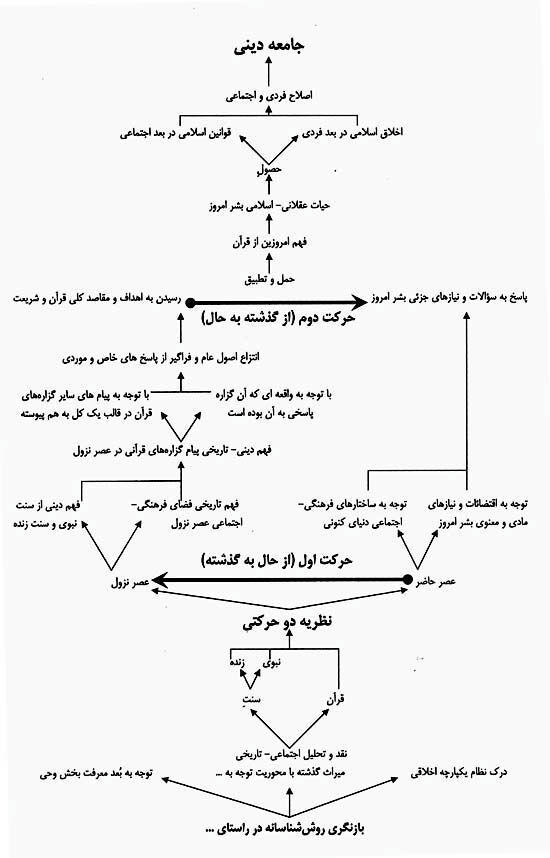
The methodical use of this idea in the field of hermeneutics has a history of 200 years, although it could perhaps be said that it has been used in various forms in intra-religious and extra-religious domains since much earlier times. The application of the process of moving from part to whole and vice versa is employed in the process of understanding the Quran, and especially in the method of Quran-by-Quran interpretation—to which contemporary exegetes have paid increased attention.[21] It appears that Fazlur Rahman, in presenting his double movement theory, also drew upon the scholarly heritage of the early pious predecessors. Parts of this theory have been articulated within the discussions that Quranic scholars have put forward regarding the definition of ta'wil, the difference between the cause and the occasion of revelation, the manner of the application and adaptation of verses, and the exposition of principles such as al-'ibrah bi-'umum al-lafz wa khusus al-sabab (the lesson is in the generality of the wording, not the specificity of the cause).[22] This not only does not detract from the value of this theory but rather strengthens its roots deep within the scholarly heritage of Islamic scholars. In any case, the importance of his theory lies in the fact that it pays attention both to the conditions of the time of revelation and to the requirements of the new era, and while preserving the sanctity and eternity of the Quranic text and devotion to it, it also maintains its connection with the real world. A schematic of Fazlur Rahman's intellectual project in proposing the double movement theory of interpretation can be seen in the diagram attached to this article.
Some Hermeneutic Presuppositions of the Double Movement Theory The double movement interpretive theory is based on presuppositions whose acceptance or rejection directly affects the reception of this theory. Among the presuppositions of this theory is that the text or tradition belonging to the past is objectively understandable and can be evaluated based on the common understanding[23] which itself has emerged under the influence of that tradition. This presupposition is accepted by classical hermeneuticists such as Schleiermacher, Droysen,[24] and Dilthey, and neo-classicists like Betti[25] and Hirsch.[26] They believe that temporal distances can be traversed and an objective understanding of historical phenomena can be achieved. In their view, "understanding" is a means of overcoming this temporal rift. Hence, they employed hermeneutics as an efficient tool for traversing this historical distance between the age of authorship and the age of interpretation, or in other words, between author and interpreter. (Vaezi, 1383, 218) This belief stands in direct opposition to the view of philosophical hermeneuticists such as Gadamer, who consider the interpretation of past texts and historical phenomena in all their forms to be arising from the interpreter's own time and hermeneutic situation, and deem reaching an objective understanding of matters related to the past as impossible. Another hermeneutic presupposition of Fazlur Rahman in Quranic interpretation is objectivism and belief in the determinacy of meaning. What is meant by objectivism is that the meaning of the text is an objective, fixed, and unchangeable matter and does not change according to the interpreter's subjectivity and the requirements of his understanding and historical horizon. Opposing this basis is the idea of relativism and the indeterminacy of meaning, which emphasizes the impossibility of objective understanding and the fluidity of understandings and their change following the fusion of the interpreter's semantic horizon with the semantic horizon of the text. (Ibid., 58-60) Based on this presupposition, if the interpreter, in the process of interpreting the text, attains the author's intention, he has reached something fixed and trans-historical. This view stands against the relativism of philosophical hermeneutics, which, due to its belief in the connection of the content of understanding with variable matters, has ruled on the historicity of understanding and its changeability. (Ibid., 434) As we can see, the presuppositions of Fazlur Rahman's interpretive theory are to a large extent similar to the objectivist presuppositions of classical and neo-classical hermeneuticists and opposed to the relativistic views of philosophical hermeneuticists. In the objectivist school, emphasis is placed on the point that in the process of interpretation, the meaning intended by the creator of the work must be found. Individuals like Schleiermacher and Betti consider the process of interpretation as traversing the path of the work's creation, with the difference that here the path of the work's genesis is traversed in reverse. In the creation of the work, the subjectivity and intentions of the work's owner are the starting point of the process of creating the work, but in the hermeneutic process of interpretation, it is the endpoint; because the interpreter intends, through interpreting the work, to reach an understanding of the subjectivity that caused its creation and to recreate the semantic world crystallized in the visage of the work. This recreation takes place in the interpreter's mind; that is, he translates the alien subjectivity of the work's owner, which is embodied in the subject of interpretation, within his own mind and rethinks and recreates it within himself. On the other hand, the relativist school insists on the impossibility of an objective understanding of anything that is historical. Gadamer considers understanding to be the fusion of the horizons of the interpreter and the work, and deems the interpreter's hermeneutic situation and semantic horizon to be constituted by his prejudices and expectations. In his view, prejudices are influenced by the tradition and history of the work. He considers the history of effect[27] to be a general characteristic and a necessary condition for every interpretation and experience. (Ibid., 317-319) If we accept his basis, no doubt remains that the principle of an objective understanding of matters is impossible. Dr. Fazlur Rahman knows well that if Gadamer's view is correct, his two-stage movement theory would be fundamentally wrong; therefore, he attempts to respond to Gadamer and says: "It is not fitting to say that an individual's consciousness of himself is the only movement that takes place within the closed circle of historical life. Nor is it logical to say that their reactions are predetermined and in principle determined by their effective histories. What seems defensible is that every conscious reaction to the past includes two moments that must be distinguished from each other.
One is the objective understanding of the past (which Gadamer considers impossible), and if the necessary documentation for it is available, it is in principle possible; and the other is the reaction itself, which inevitably includes values and what the conditions of the interpreter's time determine (not what is predetermined), and effective history is part of those conditions, while the conscious effort and self-aware activity of the interpreter is an even more important part of it." (Rahman, 1982, 9-10) Although Fazlur Rahman has not clearly specified whether his intended hermeneutic approach applies solely to juridical verses or encompasses all categories of verses, it appears that by distancing himself from extreme approaches, he often directs his hermeneutical exposition toward juridical verses. Drawing upon the Prophetic tradition and the Arab culture of the revelation era, he moves away from the time-bound particulars and instances of the verses in order to uncover the eternal messages hidden behind their outward forms. Even when confronting doctrinal verses, he considers educational doctrines and moral teachings to be the ultimate end and supreme goal of the Quran, and he employs his Quranic hermeneutics in this direction.Some Shortcomings in Fazlur Rahman's Thought While possessing many strengths, Fazlur Rahman's thought suffers from certain shortcomings. A critique of these views is itself a subject for independent research and requires a broad scope. Here, we will only briefly point to some of these instances: 1. Fazlur Rahman mostly addressed the general necessities of exegesis and avoided articulating a detailed framework, and he did not undertake a verse-by-verse interpretation of the Quran based on his theory. Hence, the practical possibility of using his interpretive method is shrouded in ambiguity, to the extent that some experts have deemed the principles he proposed as non-comprehensive and lacking practical examples. (Saeed, 2004, 65) 2. Fazlur Rahman never engaged in a philosophical explanation of the category of revelation. Despite his knowledge of the philosophies of Avicenna, Averroes, and Mulla Sadra, he did not utilize their extensive discussions on the philosophical explanation of revelation. 3. His lack of extensive knowledge of hermeneutics and phenomenology meant that his views lacked the necessary depth and his foundations and presuppositions were not properly refined. It seems Farid Esack's[28] opinion that "Fazlur Rahman is incapable of understanding the complexity of hermeneutic discussions" (Esak, 1997, 67) is not far from the truth. 4. Fazlur Rahman's Quranic hermeneutics remained at the level of the hermeneutics of the text and never reached the hermeneutics of understanding. 5. His scant attention to the history, culture, and heritage of Shiite thought and their interpretive, theological, and jurisprudential foundations has diminished the richness of his ideas. 6. His views on the truth of prophethood and the reason for and manner of the influence of the Prophet's (PBUH) spiritual conditions and personal characteristics on revelation face many ambiguities and objections. Fazlur Rahman neither provided a reasoned refutation of opposing views on this matter nor substantiated his own view with convincing evidence.
Conclusion The experience of confronting traditionalists led Dr. Fazlur Rahman to the conclusion that many religious problems are rooted in the methodology of Islamic studies, and to restore religion to its rightful place in today's world, one must turn to methodological critique and analysis. He distinguished between original Islam and historical Islam and made any jurisprudential and theological understanding of the divine verses contingent upon examining the socio-cultural atmosphere of the age of revelation and considering the impact these verses had on the individual and social lives of the revelation's initial audience. He pointed out that the jurisprudential and theological use of verses, without considering these issues, does not contribute to realizing the sublime goals of the Quran's revelation. Based on this, he presented his two-movement theory and sought to deduce general rulings and principles from religious texts, and to understand these general rulings—which secure the sublime divine goals—by considering the temporal and spatial conditions, the social and cultural exigencies of the age of revelation, and the personal characteristics of the Prophet (PBUH), and to articulate them in a manner appropriate to the needs of modern humans and the conditions of the contemporary world. The presuppositions of this hermeneutic approach are similar to those of classical and neoclassical hermeneutics, such as objectivism, and contrary to many presuppositions of philosophical hermeneutics.
.
.
References
1. Aghaei, Seyed Ali, Bibliography of Fazlur Rahman, Madrasah, Mehr 1385, pp. 94-110.
2. Babaei, Ali Akbar, Exegetical Schools, Research Institute of Hawzah and University, Qom, 1386.
3. Davari Ardakani, Reza, Comparative Philosophy, Saqi Publishing, Tehran, 1383.
4. Zarkashi, Badr al-Din, Al-Burhan fi Ulum al-Quran, Mustafa Abd al-Qadir Ata, Dar al-Fikr, Beirut, 1426.
5. Suyuti, Al-Itqan fi Ulum al-Quran, Jalal al-Din, Fawwaz Ahmad Zumarli, Dar al-Kitab al-Arabi, Beirut, 1426. 6. Qaeminia, Ali Reza, Text from the Perspective of Text, Islamic Knowledge Association, Qom, 1380. 7. Marefat, Mohammad Hadi, Quranic Sciences, Al-Tamhid, Qom, 1378.
8. Vaezi, Ahmad, An Introduction to Hermeneutics, Research Institute for Islamic Culture and Thought, Tehran, 1383.
9. Denny, Frederick. M, Fazlur Rahman: Muslim intellectual, Muslim world, 1989, lxxixii.
10. Esak, Farid, Quran, Liberation and pluralism: an Islamic perspective interreligious solidarity against oppression, oxford, 1997. 11. Rahman, Fazlur, Cansepts Sunah, Ijtihad and Ijma in the early period, Islamic Stadies, 1i, 1962.
12. Rahman, fazlur, Islam & Modernity, transformation of an intellectual tradition, The university of Chicago press, Chicago & London, 1982.
13. Rahman, fazlur, Islamic Methodology in History, Karachi: Central Institute for Islamik Research, 1965.
14. Rahman, Fazlur, Major themes of Quran, Chicago: bibliotheca Islamic, 1980.
15. Rahman Fazlur, My Belief in Action, The Courage of conviction, The Courage of Conviction, New York, 1985. 16. Rahman, fazlur, The Impact of Modernity, Islamic Stadies, 5ii, 1966.
17. Saeed, Abdullah, Fazlur rahman a frame work for interpreting the ethico-legal of the Quran In modern Muslim intellectuals and the Quran, (ed.) suha Taji-Faroukhi, Oxford, Oxford University Press, 2004.
18. Fazlur Rahman's Hermeneutical Approach to Quran Interpretation in Brief
.
.
References:
[1]. His full name is Fazl al-Rahman Malek (1919-1988), who became famous as Fazlur Rahman.
[2]. Double Movement Theory
[3]. Quranic Hermeneutics
[4]. For information on Fazlur Rahman's bibliography, see: Seyyed Ali Aghaei, 1385, 94-101.
[5]. Central Institute for Islamic Research
[6]. This section draws mostly from: Rahman, 1985, 153-159 and also: Saeed, 2004, 37-66.
[7]. Mohammad Shibli Nomani (1857-1914) was a pioneer of modern religious historiography in the Indian subcontinent. Among his works is the book She'r al-Ajam on the history of Persian literature.
[8]. Islamic Methodology in History
[9]. Fredrik M. Denny
[10]. Atomistic
[11]. For information on the reasons for Western thinkers' lack of attention to Islamic philosophers after Ibn Rushd, see: Davari, 1383, 157.
[12]. The blessed Surah Ibrahim (14): 25
[13]. Double Movement Theory
[14]. Hermeneutical Circle
[15]. Friedrich Daniel Ernest Schleiermacher (1768-1834)
[16]. Friedrich Ast(1778-1841)
[17]. Wilhelm Dilthey (1833-1911)
[18]. Martin Heidegger (1889-1976)
[19]. Hans Georg Gadamer (1900-2002)
[20]. Paul Ricoeur (1913-2005)
[21]. Among the Quran-to-Quran commentaries written in the contemporary era, one can mention Al-Mizan, Al-Furqan, Ala' al-Rahman, and Adwa' al-Bayan. For more information on this exegetical method, see: Babaei, 1386, vol. 2, 127-198.
[22] For more information on this, see: Zarkashi, 1426, vol. 1, 45-60 and also: Suyuti, 1426, 84-97 and also: Ma'refat, 1378, 100.
[23] .Normative Understanding
[24]. Johann Gustav Droysen (1808-1884)
[25]. Emilio Betti (1968)
[26]. Eric. D. Hirsch (1928-…)
[27]. Wirkungsgeschichte or The effective history
[28]. Farid Esack
.
.
A Look at Professor Fazlur Rahman's Hermeneutic Approach to Quranic Interpretation
Author: Alireza Azad
.
.



Discussion0 comments
No comments yet; let yours be the first voice.