اندیشهفلسفهخردگفتگوحکمتمعناپرسشفرهنگ
Political Science
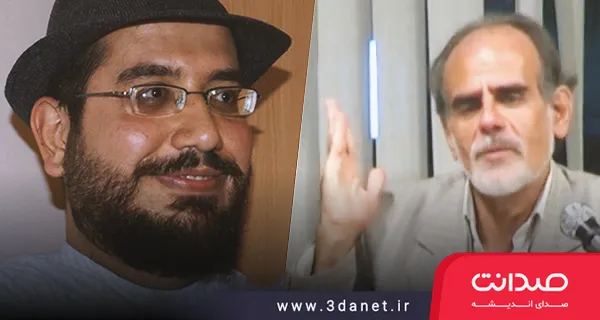
Alexander Dugin's article 'The God of Plague: The Geopolitics of the Epidemic and Empty Bubbles'
Alexander Dugin sees the coronavirus as the end of globalisation and liberalism; standards are shifting towards self-sufficiency and closed borders. He calls Iran's velayat-based system ineffective against the virus and stresses the multipolarity of the world.
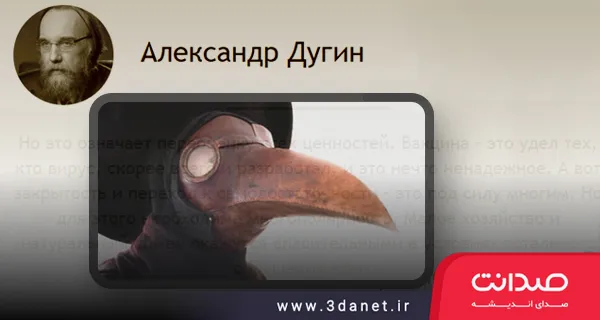
The God of Plague: The Geopolitics of the Epidemic and 'Empty Bubbles' (Higgs Bubbles)
Alexander Dugin
Source: Zavtra Weekly website (Russian language)
Translation: Seyed Hossein Tabatabai (former Cultural Attaché of Iran in Russia)
Translator's Introduction:
Alexander Dugin, the renowned and trend-setting Russian thinker, is a familiar figure to Iranians. Unfortunately, this familiarity has largely remained at the level of propagandistic exploitation of some of his extreme positions on subjects such as liberalism, globalization, Western civilizational hegemony, and his apocalyptic beliefs, and has not provided the opportunity for a logical acquaintance, analysis, and critique of his views and ideas in our country's scientific forums and circles.
This 58-year-old Russian theorist, famous for his theory of 'Neo-Eurasianism' and his book 'The Fourth Political Theory,' represents the most extreme nationalist perspective in the sphere of contemporary Russian thought and politics. Through a fundamental critique of the foundations of modern Western civilization, he presents its Eurasian alternative as a healing prescription for the pervasive international crises achieved by transcending the three political and philosophical schools of liberalism, socialism, and fascism.
The structure of Dugin's new Eurasian civilization, the centrality of Slavic Russia within this civilization, and the role and position that certain ancient civilizations, such as those of China and Iran, hold within it are important points that have been almost neglected in the explication of this Russian thinker's views in our country and have not been examined, discussed, or debated as they deserve. Hence, we see that contrary to the magnification of some of his anti-Western and quasi-apocalyptic positions in certain media in our country, his extremely radical views on the superiority of the Slavic race, his aberrant stances in the Balkan wars and his special support for the Serbs, and his expansionist civilizational perspective, which leads to the subsumption of ancient civilizations like the Iranian civilization under a Slavic-centric Eurasian civilization, are less discussed. Unfortunately, the critiques and alignments formed against him in our country have been partly influenced by intense Western propaganda against him—which more closely resembles a kind of 'Duginophobia'—and partly a reaction to the one-sided and propagandistic exploitation of some of his views and actions.
Nevertheless, Alexander Dugin is a serious theorist and thinker who, in the wasteland of today's Russia—which is almost barren of influential and trend-setting figures—is worthy of scholarly attention and examination by people of thought and opinion, so that his 'unconventional' views and ideas, which are rooted in some of the most authentic and enduring intellectual and cultural beliefs and tendencies of Russia, may be duly subjected to critique, and their various aspects and, more importantly, their diverse consequences may be examined.
In the heat of today's world grappling with the COVID-19 pandemic—which is undoubtedly a unique phenomenon in human history, and for which it may still be too early to gauge its effects on contemporary human life in many dimensions—Alexander Dugin, in an article for the weekly Zavtra, the organ of the traditional-nationalist cultural current in today's Russia, has analyzed the transformations the contemporary world will face with the spread of the coronavirus from a different perspective.
In this article, while presenting his usual assumptions focused on the end of liberalism, globalization, and the collapse of the world order, he borrows a concept from modern physics—based on which the end of the world is formulated and which is among the challenging categories of quantum mechanics and cosmology—and presents his view on the post-coronavirus world, which, in his belief, after passing through a period of shock, will continue its previous trajectory until reaching that specific point—whose characteristics he has not precisely stated and when it will arrive.
His reference to the failure of various global systems, including the system governing Iran, in dealing with this process clearly reveals the true and undisguised direction of this Russian thinker's intellectual system.
It is hoped that the translation of this article will prove beneficial in further acquainting our country's scholarly community with the views and ideas of one of today's most important and controversial Russian theorists.
Alexander Dugin
The God of Plague: The Geopolitics of the Epidemic and "Empty Bubbles" (Higgs Bubbles)
The Coronavirus and the Collapse of the World Order
In recent decades, we have been living in anticipation of a deadly, irreversible, and decisive event. Perhaps the coronavirus epidemic is precisely what will lead to that event.
It is still too early to draw conclusions, but certain processes in geopolitics and ideology have rapidly passed the point of no return.
First: The coronavirus epidemic is the end of globalization. An open society is an infection. Whoever wants to eliminate borders is preparing a territory for the destruction of all humanity. You can, of course, mock this view, but people clad in white anti-virus suits and gowns prevent untimely laughter and ridicule. Salvation lies only in being a closed and limited group. Closed in every sense: closed borders, closed economies, closed essential goods and products. Fichte[1] called it the "Closed Commercial State." Soros should be buried, but a statue should be erected for Fichte. That is the first lesson.
Second: The coronavirus closes the chapter on liberalism. Liberalism is, in every respect, a facilitator of the virus. It requires the destruction of any kind of difference. Liberalism itself is a virus. A little time will pass, and liberals will be equated with "lepers," with infectious "madmen" who engage in revelry and amusement amidst the plague. The liberal is like a peddler whose merchandise is the coronavirus, his purifier. Especially if the truth becomes known, and that it was manufactured in the "citadel of liberalism," namely the United States of America, as a biological weapon. The second lesson: Liberalism kills!
Third: The criteria for the success and stability of countries and societies are changing dramatically. In the battle against the coronavirus epidemic, neither Chinese wealth, nor the European social system, nor the absence of a social system in America—which simultaneously possesses the greatest financial and military power—will be salvific. Even Iran's religious, Velayat-oriented regime will not help. The coronavirus has cut off the peak of human civilization—oil, finance, hard currency, the market, the complete dominance of the Federal Reserve... The world's leaders are utterly powerless. Completely different criteria come to the fore:
- Possession of an anti-virus agent, and
- The ability to provide an independent livelihood for oneself and one's relatives and kin under conditions of maximum restriction and quarantine.
But this means a re-evaluation of all values. The vaccine belongs to those who most likely created the virus themselves, and therefore there is no trust in it. And this closing of borders and moving towards independence and self-sufficiency is capable of doing a great deal. However, its realization requires multipolarity. Small-scale agriculture and trade, in the context of the total collapse of everything, is something of a savior.
Therefore, what will be logical after overcoming this global virus? At best, the emergence of several closed global zones—civilizations, large spaces—or, at worst, [2] Mad Max and [Resident Evil [3. The Russian series "Epidemic" is turning into reality before our eyes.
The God of Plague
I now understand why in some societies the god of plague is worshipped. The advent of the plague gives you the possibility to completely renovate social life. This pandemic has no logic and makes no exceptions—not for particular classes, not for the rich, not for the powerful. It abolishes all discriminations and returns people to the simple, banal truth of being. The god of plague is more just. Antonin Artaud[4] wrote something on this matter and compared it to the theatre of plague. The aim of theatre, according to Artaud, with all possible violence and cruelty, is to return man to this reality that he is, here and now—that he exists, which he stubbornly and earnestly seeks to forget. The plague is an existential phenomenon. The Greeks called Apollo Smintheus the "god of mice" and attributed to him the power to bring about the plague. We all know that Homer's "Iliad" begins with this story.
This is what Apollo would do if he looked upon modern humanity: to the bankers, bloggers, rap singers, representatives of assemblies and parliaments, office workers, migrants, feminists, and so on and so forth.
Luis Buñuel has a film called "The Exterminating Angel" that is close to this theme.
So the world ends.
One can imagine a more artificial nature for this epidemic and consider it a weapon used by the West against its geopolitical opponents (a hypothesis that justifies the affliction of China and Iran, but not Italy and other countries) or even the beginning of the targeted destruction of these several billion surplus people by a limited circle that possesses its vaccine and are those who seriously pursue "development" and the "open society." In this situation, the "god of plague" may be the quite specific representatives of the global financial elite who have long been aware of the "limits to growth." But in this case—especially if it is not the beginning of a full-scale global genocide, but merely a miscalculation—the result is the same: those who pretend to be responsible for human societies are not who they want to appear to be. Liberalism is merely a pretext for mass, collective destruction, just as colonialism and the expansion of the standards and values of Western civilization have been throughout all of human history. The global elites and their local, native hand-puppets may count on survival thanks to the vaccine, but something tells us that the crux of the matter lies precisely here. And the virus may exhibit unpredictable behavior, and the processes initiated in civilizations, and even unforeseen spontaneous events, can disrupt a carefully designed and thought-out plan.
The entire global economy may not collapse within a few months, but the point is precisely here.
Everything that modern and contemporary man considers "stable" and "reliable" is a pure illusion. And the coronavirus shows this clearly and transparently. Indeed, it is fitting to gradually consider the logic of the events that are occurring, and then we will see how the world will end. At least the world we know and are aware of. And following that, the next important and priority issues will emerge.
Matter is in danger
It is a matter of curiosity and inquiry that, parallel to the coronavirus, which in a sense has become the subject of civilization, discussions have arisen in the scientific community around the "empty bubble," and certain hypotheses of the famous Austrian physicist Edward Witten, who is considered one of the main theorists of "superstrings," have been revived.
According to the theories and conceptions of contemporary physicists, an “empty bubble” can arise from a “false vacuum,” that is, a vacuum that has not reached stability and only pretends that it has. In a ten-dimensional world (4 ordinary dimensions and 6 dimensions created through compactification), the existence of such “empty bubbles” is entirely probable. If they take shape, they suck galaxies into the void and may, in a sense, swallow the universe. These vortices affect the unstable vacuum.
And again, just as happened with the coronavirus—“nothing bad is happening, everything is under control”—representatives of the academic elite assure us that: the probability of an “empty bubble” emerging is ridiculously low.
But in my view, this is not the case. On the contrary, it is highly significant and important. The modern world somewhat resembles “empty bubbles” that grow rapidly, devour meanings, and dissolve being. And liberalism and globalization are its clearest and most explicit expressions. The coronavirus, too, is an “empty bubble.”
The very nature of the virus is also interesting (I detest this concept of “nature”; nothing is more meaningless than it). It is something between a living being—it possesses DNA or RNA—and a mineral (it has no cells). But above all, it is reminiscent of a neural network and even artificial intelligence. It is a phenomenon that either is, or is not, is either living or inanimate ... precisely the “vacuum of disequilibrium” that generates the “empty bubble.”
We imagine that the vacuum of the universe is balanced, that is, it has traversed the entire possible cycle of entropy. But what if it only pretends to be so...
When you hear the story of the famous Wuhan market[5], you imagine yourself fighting bats that are fighting venomous snakes, and an intense transmission and exchange of infection occurs from their microscopic, deadly spikes and quills that are shaped like a crown, and in this state, escaping the feeling of the “empty bubble” seems impossible. This feeling arises from reports of the collapse of oil prices and the crash of stock market indices. Even war—with its specific characteristics and existential imperatives—saves nothing from the onslaught, because the motivation of contemporary wars is so deeply mired in the swamp of material, financial, and oil interests and corruption that it has lost its original purity—the direct and immediate confrontation with death. And it merely acts as an “empty bubble,” executing their instructions to drive the intended subject toward total annihilation.
The Plague as an Event
Can one count on the fact that humanity, in confronting the coronavirus—if such a thing actually happens—will reach an important conclusion, which is nothing less than dismantling globalization, casting aside the illusions and superstitions of liberalism, halting migrants, and putting an end to the ambiguous technological innovations that plunge people deeply into the delirious and endless labyrinths of materialism? It is patently obvious that no! Immediately, everyone will return to the old conditions. In the blink of an eye, and without finding the time to bury the corpses of the epidemic’s victims. As soon as—and only if—the markets revive and the Dow Jones[6] comes back to life, everything will return to normal. Anyone who thinks the situation will be otherwise is truly naive. But what does this mean? It means that the coronavirus epidemic as an event will turn into an annoying misunderstanding. No one will notice the meaning of the coming of the god of plague, and no one will think about the “empty bubble.” And this means everything will start again, over and over, and will continue to repeat until it reaches the point of no return.
.
.
[1] - Johann Gottlieb Fichte is the famous German philosopher who is considered one of the founders of German Idealism in Western philosophy. (M)
[2] - The name of a post-apocalyptic action film directed, produced, and written by the American George Miller. Some critics consider this film one of the best action films in cinema history. (M)
[3] - The name of a science fiction film with an apocalyptic and horror theme, based on the video game series of the same name, made by Paul Anderson. (M)
[4] - A 19th-century French writer, poet, actor, and theatre director, and one of the famous theorists of theatre. (M)
[5] - Many believe that the origin of the coronavirus and its global pandemic is a market in the Chinese city of Wuhan, which is a place where various animals are sold. (M)
[6] - The Dow Jones Industrial Average is a famous stock market index, compiled and published by the Wall Street Journal, and is considered a kind of economic indicator of the free market. (M)
.
.


Discussion1 comments
نمیدانم تفکر چیست؟ نمیدانم متفکر کیست؟ اعتبار سخن یک متفکر را باید کدام عیار و محک بسنجد؟ نمیدانم سخن این اقای روس گره می گشاید یا نه. سیل واژه ها است که سرازیر می شود و مرا در زیر وزنشان دفن می کند. حقیقت چیست؟ و چطور می توان بویش کشید؟ دیدش و پیدایش کرد؟