Philosophy
An Outline of Education from the Perspective of Mostafa Malekian, in a Meeting with a Group of Teachers
In a meeting with teachers, Mostafa Malekian argues that a good life does not depend on the political regime, and attributes corruption to ignorance or the failure to act on one's knowledge. He believes that doing one's work properly is a form of political struggle and the path to improving the situation.
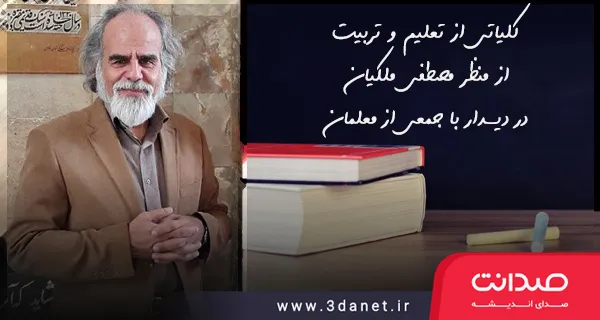
The following is a series of sessions in which an outline of education from the perspective of Mostafa Malekian was presented in meetings with a group of teachers—beginning on February 20, 2015, and concluding on January 12, 2018—and transcribed by Farzaneh Dashti. The audio and text are available below.
.
.
First Dialogue: February 20, 2015
Audio for this session from Server 1 | Server 2
Teachers' Dialogue with Professor Mostafa Malekian
Professor Mostafa Malekian: "Let demands be raised that, upon hearing them, students feel proud of their teachers."
Sokhan-e Mo'allem Report Group / Farzaneh Dashti
Breathing in an atmosphere where there is hope for change and improvement created the motivation in some teachers to pay attention to another pressing need alongside their professional and livelihood demands. A need that has perhaps not been given the attention it deserves and which we have simply passed by. The desire for connection and exchange of ideas with thinkers, and particularly experts in the fields of education and ethics, painfully drew us to the discourse of the esteemed professor Mostafa Malekian. A professor who, despite all difficulties, welcomed us with open arms. He patiently listened to our heartfelt concerns as we spoke of livelihood problems, changes in society and community, inconsistencies in the field of education, job dissatisfaction, confusions, and so on.
His response went beyond our questions, though, of course, nothing less was expected of him.
He placed four important points in our hands like keys to life's closed doors. They were master keys. We wish to present this guidance towards openness and a good, pleasant, and felicitous life as a New Year's gift to all readers.
Pleasure, Goodness, Politics
I am very happy to be in the company of dear friends. Friends who are employed and active in the important institution of education. Certainly, any pleasure in teachers is also transmitted to their learners. The more I think, I see that there is no area in which we are thriving. In every area, there is ruin and desolation. Therefore, I do not know where to begin speaking. Education, which in my opinion is the most important social institution, like other institutions—politics, religion, economy, family, etc.—needs to thrive. I will present a few important points in this short time.
First Point:
We must not make the goodness and pleasure of life contingent upon the political regime. Even if you have the best political regime, it might be destroyed tomorrow. It could be destroyed by a foreign intervention or a coup. If the worst political regime is in power, it might last a hundred years. Therefore, one cannot say that because we have the best political regime, it is a guarantee that our life will be good and pleasant, nor can one make the goodness and pleasure of life dependent on the destruction of a bad regime. For example, a ruthless regime like the Soviet Union, which destroyed half the world, lasted from 1917 to 1980, that is, 63 years.
I advise you, in a friendly and benevolent manner, do not make the good and bad of your life, and its goodness and pleasure, contingent upon the ruling political system. While you must be sensitive to the pain and suffering of the people, at the same time, in parallel, provide a good and pleasant life for yourselves and others whose lives are influenced by you. Sensitivity and alertness to the performance of the political system that dominates the people's destinies must be in parallel with attention to yourselves and the individuals under your influence. The individuals under your influence might be your family, or beyond family, your students as well. For instance, someone like Gandhi had six hundred million people under his influence. In short, although there must be alertness and sensitivity to the conditions prevailing under a political regime, do not postpone your own pleasure on this pretext.
Second Point:
فساد نظام سیاسی را در یک تحلیل می توان در دو چیز یافت. یکی اینکه مسئولان و دست اندرکاران آن، یا کاری را که بر عهده گرفته اند، نمی دانند. یا کاری که می دانند و بر عهده گرفته اند را چنان که می دانند، عمل نمی کنند. غیر این دو مورد به نظر، فساد یک نظام معنا ندارد. مثلا فرض کنید من وزیر یک وزارتخانه شدم ولی مطلقا توانایی علمی و فکری و تجربی آن کار را ندارم. کاری را اینجا بر عهده گرفته ام که نمی دانم. یا از وجهی دیگر ممکن است فردی کاری را بر عهده گرفته باشد که راه درست انجام دادن آن را بلد است ولی نمی خواهد به خاطر منافع شخصی یا گروهی آن را درست انجام دهد. مثلا می داند که ساخت سد در این منطقه نه لازم است نه مفید ولی به خاطر منافع مالی و مادی آن کار را انجام می دهد.
البته این دو تحلیل در مورد کسانی صادق است که قدرت دارند. اگر کسی در جایی قرار بگیرد که نتواند کاری انجام دهد او دیگر قدرت ندارد و نقش او صرفا نمایشی است. زینت المجلس است و فقط جلوه دارد ولی قدرت دست او نیست. آن کسانی که قدرت دستشان هست فسادشان به یکی از این دو چیز است. بنابراین به نظر می رسد که اگر کسی مسئولیت و سمتش نمایشی است یا از اول نباید وارد آن کار شود و یا اگر پیش بینی نمی کرد و بعد از پذیرش پست و سمت متوجه شد که قدرت ندارد، باید آن کار را رها کند و بند ناف امید دیگران به خودش را ببُرد.
اگر فردی با هوشیاری و حساسیت، یک رژیم و نظام را بر مبنای آن دو پارامتر تحلیل و رصد می کند باید ابتدا سعی کند کارهای خودش، مصداق فساد طبق آن تحلیل نباشد. یعنی کاری را به عهده بگیرد که از انجام آن بر می آید و توان آن را دارد. همین طور طبق آنچه می داند نحوه درست انجام آن کار است، آن کار را انجام دهد. هیچ تهدید و تطمیع در این صورت بر او موثر نخواهد افتاد. مبارزه سیاسی هر کسی این است که هر کاری را که بلد است بپذیرید و همان طور که بلد است آن را انجام دهد و تهدید و تطمیع در او اثر گذار نشود. حتی اگر به خاطر این روش به زندان هم بیفتد این زندان رفتن او، مقدس است، زیرا برای انجام دادن کار درست خودش به زندان افتاده است. مثل خبرنگاری که به دلیل انجام درست گزارش خبر و شغلش به زندان بیفتد. ولی اگر استاد دانشگاهی، معلومات، قدرت تفکر لازم، فهم عمیق، تجربه کافی برای تدریس را ندارد و همین طور اخلاق را هم رعایت نمی کند به خاطر انتقاد از یک مسئولی به زندان بیفتد، این به زندان افتادن پشیزی ارزش ندارد؛ زیرا خودش نیز جزیی از همان نظام فاسد است که به آن اعتراض کرده است. زبان حالش به آن مسئول این است که تو برو تا من بیایم. در واقع به دنبال جا به جایی قدرت است و نه انجام کار درست. شرف زندانیان سیاسی و اهمیت و الگو بودن آنان تا زمانی است که در راستای اجرای درست شغل و حرفه خودشان به زندان رفته باشند. اگر ذره بین انتقاد همیشه روی دیگران باشد و نه خودمان، با زندان رفتن، وضع بهتر نخواهد شد. باید هر کسی در راستای انجام کار خودش حساسیت داشته باشد. مثلا اگر من رفتگری باشم که کارم را خوب انجام دهم این را من مبارزه سیاسی می فهمم.
اگر هر کدام از ما بنا را بر این بگذاریم که اگر کاری را بلد نیستیم انجام ندهیم و اگر بلدیم درست انجام بدهیم اوضاع به سامان می شود. البته از کسی بیش از توان او هم توقع نمی رود. "لایکلف الله نفسا الا وسعها" فقط حکم خدا نیست بلکه هیچ عادلی نیز بیش از توان انسان از او انتظار ندارد. توانایی هم این است که کارمان را خوب انجام دهیم و اگر تطمیع و تهدید هم شدیم باز کارمان را درست انجام بدهیم.
نکته سوم:
نکته دیگری که می خواهم تاکید کنم توجه به داشتن زندگی خوش و خوب است، البته خوشی در چارچوب خوبی باید باشد. منظورم از خوبی، اخلاقی زیستن است. زیست اخلاقی هم می تواند در ارتباط با خودمان باشد هم در ارتباط با دیگران و هم با طبیعت بی جان. می توان به یک باغچه هم از لحاظ اخلاقی بدی کرد، به یک سگ هم همین طور. خوشی یعنی تا می توانیم سعی کنیم که بیشترین لذت از زندگی و کمترین درد و رنج، نصیب مان گردد البته مشروط بر اینکه قواعد اخلاقی را زیر پا نگذاریم.
Contrary to everything we have been taught, being happy is a value. One should derive the greatest pleasure from life. We should not be ashamed of being happy and hide our happiness. The only happiness one should regret is that which comes at the cost of trampling morality. Happiness is our honor and virtue in life. What is bad is to violate morality in order to be happy. The culture that says one should not be happy, and if one is happy, one must deny it, is a decadent culture. In the Quran it is stated, "La tansa nasibaka min al-dunya"—forget not your portion of the world—and the phrase "mata' al-hayat al-dunya" (the enjoyment of worldly life) is mentioned repeatedly in the Quran.
So, we must pay attention to two things: being good in the first degree, and being happy in the second. I say the good happy person, not the happy good person. That is, our life must first be ethical, and then, within the framework of being ethical, we should enjoy ourselves as much as possible. So, if for the sake of being happy I take bribes, or we engage in negligence, hoarding, cheating, usury, backbiting, and oppression, it is bad and elicits the greatest condemnation. If you commit no injustice for the sake of being happy, do no wrong, and enjoy yourself within the bounds of moral principles, this happiness is nothing to be ashamed of.
We usually behave in the opposite way: firstly, to be happy, we violate moral principles, while we do not even enjoy it; and if there is any pleasure, we hide it and adopt a complaining posture in life. Of course, there is no doubt that being good limits our happiness.
In order for a life that is both good and happy to come about, we must do three types of work. Do them yourselves and also teach them to the children at school. The education system destroys children with some of its programs. For example, the university entrance exam (Konkoor) has become an issue that occupies children from kindergarten. Passing the Konkoor has become associated with attending numerous and expensive classes, and the children's entire lives are summed up in it. We take away all the goodness and happiness of life from our own children and those of others, and out of the various dimensions of life, we fixate on something as rubbish as the Konkoor. Something that pushes individuals toward the unhealthiest competition, where rivalry replaces friendship. Children who have been raised for the Konkoor view everyone as a rival from the very beginning.
Fourth Point:
This is that for a good and happy life, one must do three types of work in life, and it is good to tell children these things from the start. First, in life, a person must have financial and material independence in order to be able to provide an ethical life accompanied by the greatest pleasure for themselves. To have financial and material independence, one must have an income. To have an income, one must have a job and a profession. To avoid falling into those two afflictions (the second point) in one's job, one must have expertise. The first task is to pursue expertise for a profession. Of course, by expertise, I do not mean an academic degree. Expertise means having sufficient knowledge in a scientific, technical, or artistic field to the extent that you want to take charge of a profession or job. It is technically called a skill. Engineering, medicine, and management are techniques. Music is an art. The first thing that must be taught to children is that their primary activity should be gaining expertise in a field. Of course, it is not necessary for everyone to go to university, or if they do, to study up to the post-doctoral level. They need just enough science, technique, and art to be able to have a job and profession through it and earn a living.
From the very beginning, remove from their minds the awe of the university and the idea that only through this path can they take charge of a job or profession. God has nowhere said that if you have a degree, I will grant you sustenance.
A second set of tasks must also be done. Each of us has inner spontaneity and self-motivation. I technically call this "interest-cultivation." That is, each of us, within ourselves, has a spontaneous and self-motivated interest in one or more things. People's interests are influenced by their personalities and differ from one another. These interests are precisely what bring you pleasure and are not dependent on a job or income generation. The English term for it is hobby. One person's interests might include reading books, another's walking, someone else's horseback riding, another's playing chess, and yet another's music.
Each of us has one, two, or several interests in our lives. If a person is inattentive to these interests, it will leave very detrimental effects on their life. A human being needs to be quenched. One's job and profession are for their income, but what quenches them is attending to their interests. Someone might be quenched by singing, and another by going to the park. Everyone has their own pursuits. Although no value judgment can be made about these pursuits, it can be said that some interests create hardships, like certain social activities that also well up from within a person. Like those who walk a tightrope, knowing that one day they will fall from it. These things quench a person. Of course, how good it is when interest aligns with one's job and profession. But usually, in countries like ours, for interests to be in line with earning a living is a rare and unfeasible occurrence. Everyone's heart is in one task and their hand in another. These pursuits also bring no income and even incur costs, but there is no alternative.
Women, especially, should pay attention that they also have duties towards themselves and should not forget themselves. Just as a child has a right to life, so too do their parents have a right to life.
In both the first task, which was income-generating, and the second task, which was attending to interests, we were dealing with our own benefits.
The third activity is giving freely. Everyone, sooner or later in their life, reaches this conclusion. Psychologists consider the age of reaching it to be around forty, although some may reach it later, and rarely, someone might reach this stage earlier. I am not stating the argument for giving freely from a religious perspective; even if someone is a pure materialist and thinks based on that reason, they will reach the same conclusion.
We did not exist from the beginning to have any demand. Rumi also pointed to this in a couplet: "We were not, and our demand was not." Meaning, what has been bestowed upon us was not for anything, not even a small demand, and whatever I have, existence has bestowed upon me freely. My deservingness did not cause the bestowal upon me. Existence, God, or whatever name you give it, whatever it has given you was without your deservingness, and if some people have not been given something, it was not due to their lack of deservingness. The givings are not based on worthiness or unworthiness. It is absolutely not based on merit or lack of merit. Whether it is physical characteristics in terms of health, physical strength, and beauty, or mental characteristics like better intelligence, memory, learning ability, speed of comprehension, strong understanding, and power of thought. Whether it is psychological characteristics like being fearful, cautious, brave, courageous, open-handed, generous, or stingy, or social abilities; for instance, which family, with which father and mother, and in which neighborhood we are born was not the result of our having or lacking deservingness. Certainly, the personality of a child who had a father who was socially regarded and esteemed from the beginning differs from a child whose father was not accounted for in society. The worthiness or unworthiness of the children was not the cause or reason for having such and such fathers. The abilities a person acquires due to the natural environment are also not the result of their merit or lack thereof. For example, whether we are born in a desert climate, a temperate one, or a verdant one causes differences in us. So, everything has been given to us freely. Someone might ask why identical twins born under the same conditions can have different futures; for example, one becomes a university professor and the other becomes a car mechanic. This shows that some things are in our own hands; for instance, with perseverance, we can change the course of our lives. You speak of perseverance. I pose the answer with this question: Who gave perseverance to one and not to the other?
Psychologists believe that a person usually realizes after the age of forty, when their life experiences have increased, that they were neither unworthy of what they were not given, nor worthy of what they were given. The more this feeling grows in you, the more a reciprocal feeling arises within you that if these things were given to me freely, I should return a part of it to existence. To give freely to those who have not been given, instead of priding myself on their lacks and using my possessions as a source of vanity and boasting. They gave to me without merit, so I should give to the one to whom they did not give, though they were not without merit. In other words, they gave to you freely, and did not give to him freely. But we usually do the opposite. So not only should we not be boastful, but we should have more compassion and tenderness of heart towards those who do not have what we have. Among blessings, those more important ones that have been given to us should cause greater compassion in us towards individuals deprived of those blessings.
Therefore, when you reach the conclusion that you have been given freely, in appreciation, you also return a part of it. This is how one can be grateful. One must appreciate what has been given to me and not to others. So, the more freely someone has been given, the more freely they should give. Giving freely is precisely ethical living. Ethics differs from legislation. Even if we have excellent legislation, it is ultimately based on justice. Justice is the safeguarding of rights. To be a good citizen, an individual must act according to the letter of the law. A just person is one who neither violates anyone's rights nor allows their own rights to be violated. This is merely law, and laws and rights make us good citizens, citizens who act according to the strict letter of the country's laws. Living ethically is superior to being a good citizen. To be ethical means I do not violate anyone's rights and I even give a part of my own right freely to others. Being ethical, in other words, is the same as giving freely. One who freely forgoes their own right performs an ethical act. Every ethical act is an instance of giving freely. If someone wants to be a good citizen, they must slap back in return for a slap, but if they refrain from it and forgive, this is an ethical act. Forgiveness is forgoing one's own right. So, living legally differs from living ethically.
Giving freely provides the goodness of life, and earning an income and attending to one's interests provides the pleasure of life. Without financial independence, one cannot live ethically, so we mentioned earning an income first, and on the other hand, until you are quenched yourself, you have no right to give to another. First, a person has a duty to themselves. Quench your own thirst, and then help others.
My eye is sated, my soul is valiant.
Children must know that university is solely for achieving the first type of work, which is earning an income. Although it is not the only way to earn an income. There are many who have not gone to university and do their job well, and conversely, some have gone to university and do not do their job well. We first tell children about the first work, which is having a job and profession, and then we present going to university as merely a requirement for attaining that job and profession. We push them into the competition of tests and the university entrance exam, and this market becomes so heated that children imagine that to succeed, they must crush some people and, to climb the illusory ladder of the entrance exam, throw some down. In this competition, mercy and compassion are destroyed. The university entrance exam has created unhealthy competition. A situation arises where it is said, "Man is the wall of man" (Sartre), or in other words, "Hell is other people."
Teacher and student are aboard the same ship, and with cooperation, this ship will move. If a teacher tells their student something they themselves do not practice, it is unacceptable. "Be callers to the people without your tongues, i.e., by your actions." Invite people through your actions. For example, if a professor spends all their time teaching to earn money, how can they advise others to pursue their interests?
If a student sees that their teacher has been able to create a balance between these three (work, goodness, pleasure), they too will learn a lesson.
The ancients called the balance between these three things wisdom. Balance does not mean dividing your time into three. Rather, it means establishing equilibrium and harmony between income generation, cultivating interests, and giving freely. If this balance exists, your children will also learn. For example, they too will not disregard their inner child, and if their inner child seeks music, they will not forgo it in pursuit of more money.
In closing, I re-emphasize two points: first, as much as you can, lower the flame of your reliance on the political regime. In parallel with paying attention to the pain and suffering of the people and socio-political issues, try to provide a good and pleasant life for yourselves and those under your influence.
Second, establish a balance between these three (work, goodness, pleasure). Not everything is money that you should sacrifice the second and third for it. There have been no shortage of wealthy people worldwide who either committed suicide or turned to narcotics and psychedelics, and derived no benefit from their wealth for the goodness and pleasure of life.
Question:
In the giving freely that you mentioned, where everything comes to us for free, your perspective was entirely deterministic. The foundation of education is effort, learning, and acquisition. Even moral vices can be corrected through education. An individual, through their own effort, can make reforms and changes. At the beginning of life, up to age three, heredity is dominant, but from around age 23 onward, the "self" can influence both heredity and environment. One can look at giving freely not with the reasoning of the universe's gratuitous bestowal upon humans, but with a loftier reasoning: that we give freely to others even what we have acquired through our own effort. In psychology, giving is considered a source of self-esteem and also brings a kind of higher-level pleasure.
Answer:
I have two answers to this question. I accept the first part of your question, where you assumed that even if nothing had been bestowed upon us for free, giving freely would still be something desirable. The discussion is not about whether giving from our own possessions is futile. On the contrary, if I give from my own possessions to others, that is preferable. But the second answer is that we must see what the reality is. We must see whether, in actual fact, things have been bestowed upon us for free or whether we have acquired them ourselves. The level of this discussion differs from the discussion raised by education.
At the level of your discussion, genetics, education, environment, and even age are all effective. I do not deny that in education, we want to remove something bad and replace it with something good. When I say tell the students such and such, it means I accept that you can remove a wrong notion from your students and instill a correct one. But look at this issue at a deeper level. The fact that one student is influenced by your teaching and another is not, what could be the reason? For instance, why can envy be eradicated in one person and not in another? Why does one person obey their father or mother and struggle against their desire to eat, while another does not?
In other words, in education, they say that the motivational system is belief-desire. For a voluntary action to be issued by a person, you must either create a belief in them or strengthen a desire. When we want to compel someone to do something through education, we must create beliefs or desires in them.
The point is that I carry out this activity for my students, but in some cases I succeed and in others I do not. Ultimately, by going deeper into the issue, we find that when we succeed in some cases and fail in others, assuming the cause has performed a single action, the difference lies in the effects. At the psychological level, we accept free will, but at the philosophical level, by going deeper into the subject, something else emerges. In philosophy, the metaphysics of levels is at issue. Thus, at one level, the matter is one way, and at another level, it is another way. For example, in elementary school physics, we say that everything is either liquid, solid, or gas. If one asks whether an atom, neutron, electron, proton, positron, or meson is liquid, gas, or solid, you say this division is correct at one level, but if you enter the subatomic world, that is, below the atom, this classification is no longer correct. Although they are bodies, they do not have these divisions. Now, if you go from the world of the infinitely small to the world of the infinitely large and ask whether the Milky Way galaxy is liquid, solid, or gas, here too this classification cannot be applied. This is called observing the metaphysics of levels. Every level in a discussion can have its own metaphysics. In psychology, they believe in free will and volition. But the question of how a desire or belief arose or did not arise in someone can no longer be raised there while maintaining belief in free will.
Question:
What is your view on the livelihood demands of teachers?
Answer:
I must point out two things. One is Maslow's hierarchy of needs, which refers to five categories of human needs, with physiological and biological needs at the base, and I accept that. If the necessities of life, which include food, clothing, drink, the satisfaction of sexual instincts, and to some extent recreation, are not met, a person does not reach the fulfillment of subsequent needs. Indeed, subsequent needs are not even born in the person. The saying that a hungry stomach has no faith refers to this very matter, meaning it does not reach the higher-level needs. The protest of teachers regarding their livelihood situation is acceptable up to a point.
But in my opinion, it would have been better if other demands were raised first. Because I think some teachers do not have problems at the level of essential needs, and a percentage of them do not have such a bad livelihood situation. So it is better to raise demands that students would be proud to hear their teachers make. If strengthening the scientific and intellectual foundation of teachers and deepening their understanding and moral development were raised at the national level, that would be excellent.
.
.
Second Conversation: December 22, 2016
Audio of this session from Server 1 | Server 2
The first issue that is good to discuss is the question of what the goal of education should fundamentally be; that is, I receive a raw material called a student. What am I supposed to deliver after thirty years? Based on what I should deliver, it becomes clear whether I have delivered correctly or not.
In our country, without the attention of experts being drawn to this point, it has seemed to them that the goal of education is to create a person who can undertake a job. This is one of the five great goals that have been stated throughout history, and today the most unacceptable theory is this very theory, yet in our country it is assumed that you hand a child over to kindergarten or school, and it is as if, in the unspoken language of the situation, you have asked the education system and institution that when you deliver this child, they should be able to undertake and commit to a job and profession. To be able, for example, to become a surgeon, a specialist in laboratory sciences, a painter, or the like. That is, they consider the goal of education to be that the exigency of the social division of labor is that everyone does a job, so we take the child to be taught a job. This is one of the five theories in education, five atoms from whose combinations—for example, the first and second, or the first and third, or the second and fourth—have been brought together and a new theory has been obtained, but its singulars, simples, and atoms are these very five theories. One theory is this very theory of job and profession. This theory is the most rejected theory in education today, and they say it is not correct, yet our country's education system seems to want to achieve this goal. I say 'seems' because it is not even successful in reaching this goal. Perhaps the best thing would be to examine what the goal of education should be. The goal of 'education'—both the part of instruction, which we call teaching, and the part of upbringing, which is training; the sum of these two is called education in English. What should its goal be?
I do not mean that you should only read my material. Whatever you can get your hands on in this regard, it is good to read so that a discussion can take place. The philosophy of education has eight main discussions, the first of which is the aims of education: what goals have thinkers proposed for it.
To the extent of one session, friends should study about this point; whatever comes to their mind and occurs to them, they should note down, or if they have read something somewhere and found it convincing, they should write it down. Then, the aims of education and the types of education will be the subject of the next discussion. The question was raised: where does anthropology fit into education?
Anthropology is discussed within the aims of education: what the actual human being is, and what the human being we want to reach after education will be.
.
.
Third Conversation: March 3, 2017
Audio of this session from Server One | Server Two
The Subject of Education
Some texts have three characteristics that make them uncriticizable, and reading them yields us nothing.
One is that they are written so well, so excellently, and in the mold of ideals that they cannot be criticized.
Second, they are so ambiguous that one cannot understand what they want to say.
Third, which is to some extent a consequence of the second factor, is that because of great ambiguity, much of the content is a repetition of previous content, and you see that one subject is repeated in several places under different titles. Because it is not written with determinate, specific words.
Therefore, it neither yields us anything, nor will we get anywhere with them.
To have a desirable life (I am not speaking of the ultimate ideal and utopian here), we need to resolve some external problems and some internal problems. Education wants to address the latter. I mean the institution of education, which includes the Ministry of Education, the Ministry of Higher Education, the Ministry of Culture and Islamic Guidance, radio, television, the press, the Islamic Propagation Organization, the Office of Islamic Propagation, orators, speakers, Friday prayer leaders, and all those who, consciously or unconsciously, willingly or unwillingly, educate and train us and influence the minds and consciences of the audience.
To have a desirable life—even if not an ideal, perfect one, but at least a good and pleasant one—we must resolve two sets of problems. One set consists of external problems, that is, those outside the mind, consciousness, soul, and psyche of the individual, and another set consists of internal problems, which lie within their soul, psyche, mind, and consciousness.
Education in its broadest sense, including the Ministry of Education and the teacher, is tasked with addressing internal problems. The internal problems that have prevented them from having a good and pleasant life are your responsibility to resolve.
External problems have other custodians. For example, familial, economic, political, legal, and religious problems. The portion of problems that, if resolved, are a necessary condition for a good and pleasant life and are internal, has been entrusted to education, whether by a kindergarten teacher or a post-doctoral professor; in this regard, there is no difference.
The internal problems we face can be specified under three headings.
Educational problems, upbringing problems, and research problems.
That is, we educate the student, we nurture them, and we cultivate research in them.
Meaning, you change what is inside the student, the audience, and the pupil.
Because you believe that internal problems are troublesome for both having a good life and a pleasant life, and the most important of these is ignorance, you educate. When you teach mathematics, you remove an ignorance from their mind and consciousness.
It is not only ignorance; that is, ignorance is not the only internal factor, otherwise your task would only be education. You also work on upbringing and research, whether consciously or unconsciously.
Sometimes you are not aware that while you are educating, you are also nurturing, or while you are nurturing, you are also educating.
If we truly want to carry out the work of education and upbringing well, we must pay attention to several points.
First, we must recognize what internal problems have obstructed their good and pleasant life.
The resolution of external problems must be undertaken by others. You have taken on the subjective problems, as opposed to the objective problems.
Although we can recognize, enumerate, and discuss subjective problems, we must note that we want to resolve the internal problems of a student who is also under the influence of three factors other than me, their teacher and educator.
If they were solely under our control, the task would be easier. Three factors other than me, the teacher, affect their problems and their transformation.
In fact, I must do two things: one is to combat the inappropriate influences of those three factors, and the other is to advance my own work, that is, to bring into being the things I want to create in their mind and consciousness.
What are those three factors?
1- The livelihood situation of the students (economic poverty, economic backwardness). A minimum threshold of economic well-being is necessary for changes and success in education and upbringing. The economic condition of the whole society, which in sociological terms is called social welfare, can become an obstacle to success in education and upbringing. You need a minimum threshold of social welfare.
2- The political system expects us to give the student the education it desires. The education system is ideological and concerned with content, and your diagnosis does not always align with that of the political system. The political system wants an education that is intensely ideological and accompanied by intellectual afflictions such as prejudice, dogmatism, rigidity, and fanaticism, and is intensely materialistic, in which rituals, symbols, and rulings take precedence over ethics. Whereas successful education must not be ideological—meaning no issue's file should be closed forever—and must not be based on intellectual afflictions, materialism, or formalism.
3- The third rival is what is received from the global public sphere (communications and cyberspace), which also has great influence among the student's friends and peers.
Often these teachings are corrupt from the ground up, like the ethical materialism that comes from the West, which from the start makes money and becoming wealthy the primary goal for a child. For instance, the first characteristic of all the celebrities in the virtual world is their wealth. From the children's perspective, these people are great, and from their viewpoint, the world is a morsel of which they want the largest portion to fall to them.
Sometimes these teachings are not corrupt from the ground up, but their overflow that reaches the child is corrupt; for example, "sexual relations" in the West, as they are in themselves, are not inherently problematic, but the sexual and physiological aspect overflows and reaches us here. These must also be fought against, especially since this factor is very influential in the arguments students have with one another.
I did not mention the family factor because a family's cultivation might be such that it even helps the teacher. However, if a family has problems, that too is a disruptive factor for successful education and is considered the fourth factor.
In the matter of capturing the hearts of students, I will, out of necessity, set aside the discussion of rivals and competition with them and turn to our own work, that is, what we must cultivate in our audience. Of course, when I say let us set this aside, we see that in practice, many of these factors are already problematic now.
If we focus on the work of teaching and the inner change we want to create in the student, the learner, and the trainee, we are faced with three tasks.
1- To create or destroy certain beliefs in their mind.
2- To create or destroy certain feelings, emotions, and passions.
3- To create or destroy certain desires.
It might seem that there are other things, but if you look closely, you will see that there is nothing besides these three. We are dealing either with beliefs, or with feelings, emotions, and passions, or with desires.
The criteria for good and bad in these three cases are not identical to one another.
In an ideal state, the positivity and negativity of beliefs lie in their being true or false; we must take away false beliefs and give them true beliefs. But we humans do not always deal with the ideal state, so in this regard, it has been said to accept two ranks lower as well. If we do not have access to the truth or falsity of a belief, we should provide the audience with justified beliefs, that is, beliefs with reasons, and take away unjustified, reasonless beliefs from them. In contrast to the unjustified, beliefs accompanied by reasons; and if this is not possible either, because in some domains even this cannot be done, we want to at least give children reasonable beliefs as opposed to unreasonable ones.
Regarding the positivity and negativity of feelings, emotions, and passions, what is appropriate versus inappropriate is at issue. The teacher must establish what is appropriate and eradicate what is inappropriate.
The positivity and negativity of desires are also divided into reasonable and unreasonable. (Reasonable and unreasonable here share a verbal commonality with the reasonable and unreasonable I mentioned in the third rank of beliefs.)
Each of these three mentioned items (beliefs; feelings, emotions, and passions; and desires) is itself divided into four categories:
That is, true beliefs about God, the self, other human beings, and the surrounding world; likewise, appropriate feelings, emotions, and passions; and reasonable desires.
Or, for example, a jurist might say that one must feel fear toward God, while a mystic might say that the appropriate feeling toward God is love. We have appropriate and inappropriate feelings and emotions regarding God. Sometimes incompatible statements are made within a culture; for instance, it has always been said to fear God. Ali ibn Abi Talib says in Nahj al-Balagha, I offer five counsels that are the five pillars of felicity, one of which is: "Let none fear anything but his own sin"—fear nothing in the world except your own sin. That is, I should not even fear God. So what state should I have toward God? They immediately add, "And let none of you place his hope in anything but his Lord," meaning place hope in no being except God. That is, have the feeling of hope only toward God. The mystics also proposed the feeling of love toward God and did not consider piety to be fear of God but rather reverence for God and courtesy in the presence of God. It is the same with regard to myself. For instance, one of the feelings, affections, and emotions widely discussed today is self-confidence. Is confidence in oneself an appropriate feeling, affection, and emotion? Or, for example, it has been said that self-loathing is an inappropriate feeling, affection, and emotion, and children should be raised so that they do not loathe themselves.
The same applies to desires: we may have unreasonable desires from God, from ourselves, from other human beings, or from the surrounding world. I want to move the discussion from an abstract state and make it tangible and concrete, more particular. Before that, let me mention two points. One is that with your statement, it seems you have presupposed the existence of God. If you do not believe in God, you believe in the non-existence of God. The object of this belief is still God. This too is a relationship with a purportedly existing entity that one person accepts its existence and another does not. Negation is also a kind of belief-based relationship. We have six types of belief-based relationships with an entity. At times we have acceptance and rejection regarding an entity, at times affirmation and negation, at times confirmation and denial, at times challenging and adjusting, and at times we emend and amend. Sometimes I pay attention to a belief and sometimes I disregard it, which depends on how much I let that belief enter into my calculations or not.
Why did I mention these relationships? Because the type of relationship with God becomes a cause for the relationship with oneself, and the second becomes a cause for the relationship with other human beings, and then this is a cause for the relationship with the surrounding nature. As a teacher, you want the student to have true beliefs imprinted in his mind and consciousness regarding God, himself, others, and the world, and for appropriate feelings and emotions and reasonable desires to be created in him.
If you succeed, because these three categories are causes for speech and action, behavior—which is the sum of speech and action—will automatically become correct.
The incorrectness of speech and action stems from the negativity of those three. I mentioned the negative and positive aspects of those three, and here too, the negative and positive of speech and action is their correctness or incorrectness. Correctness means being rational and ethical (conscientious). If we want correct speech and correct action, we must cultivate true beliefs, appropriate feelings, affections, and emotions, and reasonable desires. This speech and action organize social relations, whether the relations of the institution of economy, politics, family, or any other institution. All social relations are based on speech and action.
Now, if we call those three internal things (belief, feeling/affection/emotion, desire) the mind, and speech and action behavior, then we teachers go to the mind to correct behavior, and through behavior, to correct society. When the mind is put in order, behavior is put in order, and then through that, society becomes healthy.
Now we must see how to inculcate true beliefs, appropriate feelings, affections, and emotions, and reasonable desires.
From all the cases, let us go to these three, and we will not discuss them one by one but rather speak of their generalities. We must know the overall map. With the sum of these words, it is as if children are placed in the hands of the teacher and educator as raw material, and we are asked to shape this raw material, delivered at, say, the age of two, through exercises so that after thirty years they take form and attain the desired shape. To enter the work in a more specific way, let us enter into the ways of imparting positive beliefs, positive feelings, affections, and emotions, and positive desires to our audience, and naturally, we will begin with belief.
Your work takes precedence over the work of two other groups in society.
When in a society a father, mother, or political figure wants to steer citizens toward a particular action and away from another, they can do so by resorting to three kinds of force. The first force is the convincing force, one is the motivating force, and one is the compelling force—you carry out the first task. For example, if a government decides that people should or should not engage in a certain behavior, one way is to use convincing forces and demonstrate through reasoning that this behavior is right or wrong; that is, by resorting to the power of persuasion, it can convince citizens to perform or refrain from the act. Here, it is possible that eighty percent of citizens will behave as the government or the parents desired. But twenty percent do not fall in line, so then they resort to motivating forces—for those who were not convinced, or were convinced but did not want to comply. Motivating means rewarding; in simple terms, they entice, they arouse desire. Rewards begin in school under the name of prizes, and these prizes continue at the level of social life. But a group still does not fall in line, and then deterrent forces, which are threatening, are used.
Persuasion is the responsibility of the teacher and educator. Nevertheless, even if you do your job correctly, you may not be one hundred percent successful. Education, which creates persuasive force, always takes precedence. This is why Hitler said that whoever controls the kindergartens of Germany controls all of Germany. They do things so that one might remain anti-Jewish, anti-Gypsy, or anti-Black, or in favor of anything, until the end.
Let me add one more point. I said that the three internal ones are the cause of the two external ones (behavior), which in psychology is referred to as the motivational system. What makes a human being motivated toward a particular speech or action? The theory that has been agreed upon since William James, that is, for roughly the last one hundred and twenty years, is that the motivational system is belief-desire. That is, beliefs and desires change the want, and the want changes behavior. Belief and desire, and collectively they are sometimes called "besire." The motivational system is called besire. A change in belief and desire becomes the cause for a change in wants, and then we turn toward a specific behavior. A specific behavior means one desire plus several beliefs changes our want.
Then we proceed to action. For example, the feeling of thirst is painful; I feel pain (our physical, psychological, and mental structure is like this). To quench thirst, a desire arises in me, and N number of beliefs accompany it. A desire arises in me to quench thirst, and beliefs also come. For instance, the belief that the content of the glass is water, that water quenches thirst, that I have the power to bring the water to my mouth, that I have permission, and other beliefs. In short, it is impossible for us to undertake an action without the emergence of one desire and several beliefs. The beliefs are more numerous than they appear at first glance, but the desire is one. The motivational system is desire-belief, which impels us toward a particular speech or action. Now we come to something that is the core of education, the very essence of education. It is this: when I desired to quench my thirst, it was because of aversion to and suffering from thirstiness. Or to relieve heat, because I was not satisfied with the feeling of heat and was averse and suffering. In fact, every action indicates a dissatisfaction and displeasure with the world. Dissatisfaction is the origin of action. That is, I am satisfied with a world in which my thirst does not exist, or in which I do not feel heat. A person has as many dissatisfactions with the world as they have speeches and actions. Of course, there are many times when we do not act and are also dissatisfied because we hold certain beliefs; for example, I am dissatisfied with thirst but do not drink water because I believe it does not belong to me. If a human being were completely satisfied with the world, they would not act. In reality, we want to shift the displeasures of our learners so that they may have different speech and action. The learner and the trainee, at the hands of the teacher and educator, have their displeasures shifted. When the poet says, "I wonder your hearts are not sickened and your souls not weary / of these putrid airs and these unpalatable waters," he is saying the air is putrid and you drink unpalatable waters; I am amazed how you are not dissatisfied. I want you to become dissatisfied and take action. Action means creating transformation in the world; although action and transformation are two concepts, they have a single referent, and every action creates transformation in the world, and whatever creates transformation in the world is of the category of action.
If you are content with a situation and wish, for example, for the coolness to continue, here too the action you take to perpetuate it arises from discontent with its discontinuation and is reducible.
The final point is that behavior is the effect of the mind. So here there is a one-way causal relationship. Behavior is not the cause for the mind. Among those three that are called the mind, belief and feeling are the one-way cause for desire.
Now the question is, what is the relationship between belief and feeling, and which is the cause of the other? Four views have been offered on this matter:
- These two have no causal relationship. David Hume held this opinion.
- Belief is the cause of feeling, but not vice versa; that is, a one-way causality of belief for feeling.
- Feeling is the cause of belief, and that too is a one-way causality.
These three have almost no proponents today, and the fourth view is that these two have a dialectical relationship. Belief and feeling have a causal relationship, and each becomes the cause for the other. The mainstream of psychology today rests on the fourth theory, but within this very view there is a dispute that is still unresolved, and that dispute is: which of the two carries more weight? Here there are three opinions. That is, to the same extent that belief becomes the cause for feeling, feeling also becomes the cause for belief, and they are equal and balanced. This opinion has fewer proponents compared to the other two.
Another opinion is that beliefs are stronger than feelings, and beliefs more often become the cause for feelings. This opinion has historically led to misfortune.
The final opinion is that of William James, to which I also subscribe, that feelings and emotions have greater strength than beliefs and more often become the cause for beliefs.
This strength of belief or feeling is important because it determines where the essence of each individual's personality and character lies. Where the central core of each person's personality is. William James considers feeling and emotion to be the core, while according to the Aristotelian view, beliefs constitute the core of personality. Mystics are proponents of William James. "You are whatever you are seeking," or as Ali ibn Abi Talib said, "The worth of every man is what he excels at." The value of every person is equal to the measure of what they love. What do you love? You are worth the value of that. If you love wealth, you are worth as much as wealth; if you love knowledge, you are worth that. Your weight is determined by your feeling and emotion; see what your feeling and emotion is captivated and overwhelmed by. Our mystics used to say that the core of a human being is their quest. Tell me what you seek in the marketplace of the world, so I may tell you how much you are worth. Your seeking, your feeling and emotion, is what matters.
From the very dawn of the Abrahamic religions (Judaism, Christianity, Islam), the notion that beliefs are more important than feelings was adopted from Aristotle and entered our theology and apologetics. If you ask a Muslim, Christian, or Jewish theologian where the dividing line between believers and unbelievers lies, they will say it is their beliefs. They say their beliefs must be true. If you say someone has done a thousand good deeds, they ask whether that person believes in the existence of God and the afterlife. That is, beliefs are what matter to them. For instance, the first issue in any manual of practical rulings is that it states you cannot follow authority in the principles of religion; you can only follow authority in the branches. In the principles, every person must hold beliefs through their own power of reasoning.
Two statements, whether rightly or wrongly, were adopted from Aristotle: one was that he said man is a rational animal; therefore, what distinguishes humans from other animals is thought, which pertains to the realm of beliefs. His second statement was that not every belief is valuable; a reasoned, argument-based belief is valuable. These two statements of his were accepted in theology. They said that the first thing that separates the believer from the unbeliever is beliefs, even though the Quran does not say this—if you look closely, it never says that the line between believer and unbeliever is separated by beliefs. It says, "Behold, the friends of God—no fear shall be upon them, nor shall they grieve," meaning what distinguishes a friend of God from one who is not is that they have no fear. Or it says, "O tranquil soul," O serene soul, "return to your Lord"—meaning it recognizes you by your serenity, which is among the eighty-five emotions we possess.
If you ask the sacred texts of the three Abrahamic religions how to discern the weight of human beings, they say: look at what makes these people happy and what makes them sad. What they place their hope in and what they despair of, and what gives them peace and what gives them anxiety. I am only speaking of the sacred texts. It is only hope, joy, peace, and emotions that create the criterion. The Quran says that everyone holds belief: "Is there doubt about God, the Originator of the heavens and the earth?" This is a rhetorical question. That is, everyone knows that God exists. "If you ask them who created the heavens and the earth and subjected the sun and the moon, they will surely say, God." Even if you ask the polytheists and the disbelievers who created the earth and the heavens, they say God. Therefore, the criterion between the polytheist, the disbeliever, and the believer is not created by belief in the existence of God; what matters is whether you have an attachment to God or not, or whether you have an attachment to other than God. I have said before in the faculty of theology that all the components by which the Quran distinguishes believers, disbelievers, and hypocrites, without exception, belong to the category of feeling, emotion, and affect. Throughout history, in these three religions, this is why inquisition and the investigation of beliefs became prevalent. They did not ask what things bring peace to your heart and what things delight your heart, what things you despair of and what you hope for. If our discourse were according to the sacred texts, in that vein, an inquisition of emotions should have emerged, where, for instance, they would ask what you fear and what makes you happy. Let me give another example. How different the jurisprudential and non-jurisprudential perspectives are.
Freud, as a psychologist and psychoanalyst, believed that all human actions, through several intermediaries, originate from Eros, which he called the instinct of erotic love. Of course, by Eros he did not mean only the sexual instinct as that physiological act. Although later he also added the death instinct.
He was very much of the conviction, ideologically, that Eros plays a fateful role in life. Reports about his life by his colleagues, assistants, and patients indicate that he never sexually exploited his patients.
Jung's separation from Freud was because he said Freud's emphasis on the role of Eros was misplaced and that it does not have that much of a role. Nevertheless, it is well-known and famous that he sexually exploited his female patients. Books have even been written about it.
According to the theological or jurisprudential view, if one wants to make a value judgment, Freud is condemned because his belief is unacceptable, even though he lived a chaste life, and Jung is accepted because of the acceptance of his belief, even though they might say he also committed sins!
Theologians, and following them jurists, consider the criterion of good and evil to be beliefs, not feelings and emotions, not to mention that belief was also reduced to propositions stored in memory. If a Quranic selection were made, for instance, one would have to ask whether wealth motivates you in your work, and if so, they would reject him, or the question would be asked whether popularity among people is important to you, and if so, he would be rejected. That is, they would value feelings and emotions. It seems they consider beliefs to be the very essence, core, and character of our being, for which the rest can be overlooked, even if one commits sins. In their view, ideological corruption is more important than the corruption of feeling and emotion.
A question was asked whether we need anthropology to begin the discussion. The answer was no, it is not needed.
We later understand through education how to distinguish the correct opinion from the incorrect one. Suppose five anthropologies are presented to you; on what basis do you choose one? That is, a methodology is proposed through which we can then distinguish between anthropologies, theologies, ontologies, axiologies, and deontologies. In other words, in life we actually encounter seven types of systems. There are different ontological, theological, cosmological, epistemological, anthropological, axiological, and deontological systems, and for each, N schools have emerged. We must impart an education to the learner and trainee so that they can make the right choice among each of these systems, schools, and their rivals.
I do not begin with a specific presupposition; although you and I have our own specific anthropological and other presuppositions, we proceed with assumptions that hold true across different systems and schools.
A question was raised: does the fact that some people give greater weight to emotions indicate that those who prioritize emotion do so because of their psychological type, or is the same true of those who believe in the primacy of reason?
If something is part of one's psychological type, it is unchangeable; however, in psychological typology, no one has claimed that rationalism, traditionalism, dogmatism, or imitation are part of psychological type. When people recognize their psychological type, they know they do not have the power to change their type, but juristic reasoning or ... is a method, and it has its own knowledge, methodology, and foundations, which, if accepted, must be important to the person who accepts them.
.
.
Session Four: April 24, 2017
Audio of this session from Server One | Server Two
Education and Upbringing – Instructing and Nurturing
Education and upbringing – instructing and nurturing – are, in fact, two actions. Naturally, if an action is voluntary, two important things exist within it: one is the issue of the goal, and the other is the issue of success and failure. In the case of education and upbringing, which are two actions, the goal, success, and failure are important. Let us begin here.
In the philosophy of mind and the philosophy of action, a precise distinction is made between goal and outcome. The goal is a global, objective, and external state of affairs that the agent undertakes the action solely to bring about. Had the agent not intended to create that state of affairs, they would not have undertaken the action, regardless of whether they succeed in creating that state or not. For example, my goal in speaking might be to convey a point to you, regardless of whether I achieve this intention or not. The outcome is the state of affairs that arises as a result of the action, whether the agent wanted that state to arise or not. Both involve a "regardless of whether" and a "wanted or unwanted." In every action, two things can be discussed. Success means the correspondence of the goal with the outcome, and failure means any kind of non-correspondence with the outcome.
Success means that the state of affairs for which I undertook the action to create actually comes into being. Failure means I undertake an action for a goal, but that outcome is not achieved, meaning it does not correspond with the outcome. Success has one form, which is the correspondence of the goal with the outcome, and failure has three forms. Suppose I teach to transfer a point from my mind to yours. If this point is actually transferred to your mind, my teaching is said to have been successful. My teaching fails in three scenarios. One is if the point is not transferred to your mind; I have failed. Another is if, besides what I wanted to be conveyed to your mind, other things I did not want are also conveyed. Here, too, the goal does not correspond with the outcome, and this is also failure. The third case is when I speak to convey a point to you, but the conveyance is not complete. The difference between the second and third cases is that in the second, something extra beyond the goal was transferred, and in the third, the goal itself was not fully realized. These three types of failure must be distinguished from one another in any action.
Education and upbringing, like any other action, have a goal and an outcome. Their success depends on the outcome corresponding with the goal.
What, in general terms, can the goal of education and upbringing be? It seems that the goal of education and upbringing is, on one hand, the creation of a specific individual, and on the other, the creation of a specific society. We want individuals to become specific individuals that they currently are not. Furthermore, we want society to take on a specific form that it currently does not have. In the most general sense, we want to move towards a society that is the best society and an individual who is the best individual. Regarding the best society, it is referred to as a healthy society, but there is no consensus on the best individual. The presupposition is that the current society is not a healthy society, and we want to build a healthy society, but what do we want to make of the individual? This is where a major disagreement exists, and within this major disagreement, there are further subsets of disagreement.
Some have said the goal of education is for it to want to make the individual prosperous, and some have said it wants to make the individual happy. Happiness and prosperity. Of course, proponents of happiness and prosperity have also specified subcategories for each. The important point is that throughout the history of human culture, except for those meticulous observers who have noticed, everyone who has spoken about happiness or prosperity has used the word felicity for both and said we want to create a felicitous individual. Whereas by felicitous, some have meant a prosperous individual and some a happy individual. What is meant by happy is not its narrow sense, which includes eating, drinking, clothing, etc. This point was neglected throughout history until recently; therefore, sages, mystics, philosophers, founders of religions and sects, theologians, moral scholars, and psychologists used the word felicity, or in English, happiness, for both. They lacked the precision to see that some meant happiness by this word and some meant prosperity. Happiness and prosperity are two different things. The attribute of an ideal, healthy society and the attribute of an individual is that they are either happy or prosperous. There is disagreement over prosperity and happiness, just as there is disagreement over the components of health. My discussion here is not about instances but about concepts. The ideality of the individual means their happiness and prosperity, and the ideality of society means the health of society. The point here is: if an individual becomes ideal, does it not automatically follow that society becomes ideal? Or is it the reverse: if society becomes ideal, does the individual not automatically become ideal? If this were the case, education would no longer have two goals. When you say we want two things, it means that with the individual becoming ideal, society does not necessarily become ideal, and vice versa. If you answer either in the affirmative, the goal of education becomes a single goal, such that if one becomes ideal, the other also becomes ideal.
The assumption of those who say education has two goals, one the betterment of society and one the betterment of the individual, is that these two do not necessarily lead to one another. This will be discussed.
What are the components of a healthy society? There is much disagreement, but the view with the most proponents is that a healthy society has seven characteristics. One is security. Social security must be defined.
Second, in a healthy society, there must be welfare. Wealth is an attribute of individuals, and welfare is an attribute of society. Third is justice. Justice is a description of society. Of course, in ancient Greek and Roman ethics, justice was also an attribute of individuals. Fourth is freedom. Fifth is order in society. Sixth is social solidarity. That is, society is distinct from a crowd of individuals.
A very important book was written in the mid-twentieth century titled "The Lonely Crowd" by David Riesman, a top-tier American sociologist, in which he says America is not a society but a lonely crowd. A crowd means being packed together. In a lonely crowd, there is no solidarity. For example, all the people standing in a bread line are a lonely crowd in which there is no social solidarity. Social solidarity is the degree of readiness of an individual, that is, a member of society, to sacrifice their own interests if they come into conflict with their society. To the extent that individuals are not willing to sacrifice their interests in the event of a real and genuine conflict, we are dealing with a lonely crowd. My own interpretation, which I have used elsewhere before, is that people come together for two reasons: one is because their hearts have expanded, and the other is because their space has become constricted.
If you stand atop a tower, you see people swarming like ants. When space becomes tight, we become a crowd of the lonely. Society means being together with individuals whose hearts are open to one another. Some thinkers have included a second element under this social solidarity, which some believe should be a separate component of a healthy society: that conflicts between individual and collective interests should arise as rarely as possible. The final component of a healthy society is that the conditions for the growth of human individuality must be provided. Each of us is unique; in the words of the mystics, "There is no repetition in theophany." God has not created even two atoms exactly alike, let alone two leaves, let alone two human beings. In us humans, two things must be balanced at once: the requirements of membership in society and the requirements of individuality. Membership, individuality. Our membership in society has requirements to which we submit. For example, a requirement of our membership is that we forgo some of our freedoms, but each of us has unique aspects that must emerge from latency into manifestation—that is, to move from mere potential to flourishing, and as the philosophers say, from potency to actuality. I may have a talent for composing poetry; society must be organized so that my potential does not remain latent and leads to manifestation. Any talent that remains latent torments its possessor. You feel unwell to the extent of your unblossomed talents. To feel well, all your inner talents must flourish. Society must provide the conditions for this individual self-flourishing. Any prevention of the emergence of talents is a sign of an unhealthy society. A healthy society must be a society of individuations—meaning that in addition to each person's membership being full and complete—though this membership has its requirements—they must also be able to express their individuation, to show their unparalleled and unique aspect. If a society lacks this, everyone moves toward becoming uniform and alike. For instance, when you buy fruit, cucumbers, oranges, and bananas each have their own scent, but if you leave them together for a while, each takes on the scent of the other. That is, in a healthy society, while the conditions of membership are observed, everyone's individuality must also be preserved. In totalitarian societies, efforts are made to make individuals uniform; they want to standardize bedtime, diet, and type of clothing. In Nietzsche's terms, it becomes a mass, herd-like, flock-like society. We must see how education can fulfill these goals and how, to realize its aims, it can operationalize them in the programs it gives to members of society. On the other hand, if a society is healthy, its individuals are not necessarily happy and well-off; therefore, it is necessary, on the other hand, to cultivate people who are happy or well-off in life.
What is the difference between happiness and well-being? In simple terms, a happy person is one who attains all their wants, and a well-off person is one who attains all their needs. Wants and needs are very different. A happy person means someone who has everything they want. Someone who has whatever they want does not necessarily mean they also have whatever they need. Well-being means having whatever one needs. A well-off person may well have to flee from fame, even if it is their want.
This is one of the criticisms leveled at some versions of liberalism. In my view, this objection does not apply to all versions of liberalism, but it does apply to some versions. They say liberals promise a society where everyone has whatever they want. Such a society is not only impossible but also undesirable. For example, the want of a person with a cold is to eat ice cream, but their need is to take bitter medicine and not eat ice cream.
If you pay attention, you will see that at a certain age we understand that our wants differ from our needs, and therefore we accept that a sister or parents tell us our needs, but from a certain age, say eighteen or another legal age, we no longer accept someone telling us, "You want this, but you should not want it"—that is, "This is your want, but it is not your need." **
In brief, I say: should the goal of education be to create individuals who are happy or individuals who are well-off? To find a want, anyone can understand their want by referring to themselves. But who should determine need? There are four viewpoints, which I will discuss.
The question is whether we want to make the individual a happy person or a flourishing one. There are different views in the interpretation of the happy person, and there are also different interpretations of the flourishing person.
This is a general project, and on some of its parts various schools of thought have a consensus; therefore, a common denominator of education can be understood. How should education be in this common ground in order to be successful? In other words, the merit of this plan is its relative freedom from various schools, and there are many areas of consensus on what and who a healthy society and a happy and flourishing individual are. Note that I use "individual" and not "member." A flourishing individual, a happy individual. In society, each of us is a member, not an individual.
While this plan pays attention to theoretical foundations, it is also translatable into operational language. It is operationalizable so that the discussions are not abstract, although we may encounter social and cultural obstacles.
Books that can be recommended in this area, as far as my memory serves, include: The Sane Society by Erich Fromm (also translated into Persian), The Anatomy of Human Destructiveness by Erich Fromm (also translated into Persian). A very good book was also written by a Protestant theologian and philosopher named "The Healthy Individual in an Unhealthy Society" by Barth, which unfortunately has not been translated, and the gist of its argument is precisely this: what will happen if the ideal individual exists in a non-ideal society? Will they have more influence on society, or can the non-ideal society be effective in the individual's deterioration?
Among Western specialists in education, the one who addresses these issues best is Israel Scheffler. Six Existentialist Philosophers is his only work in Persian.
Another explanation about this plan and framework is that I have taken certain issues for granted, even though they are more fundamental, such as the necessity of education or the commitments of education, and why we should enter into the discussion of education. Whether we should have education at all, and why we should reconsider existing education.
However, the morality or immorality of education within the current framework will be discussed. If any action is voluntary, the question arises whether it is moral or not. For example, Jacotot, the French educational thinker of the first half of the nineteenth century, believed that teaching is an immoral act—though he did not say this of upbringing—and his views had supporters in Western Europe who believed we should not teach. It is called the "Ignorant Schoolmaster" theory. In his theory, he spoke about what the master should do if they must not teach. Some theories today do not consider upbringing a moral act. Jacotot's theory is not part of the mainstream, although it still has supporters in Switzerland and France.
* The difference between need and desire is explained by Mostafa Malekian in issue 112 of the quarterly Negah-e No under the title "Happiness or Flourishing? Desire or Need?".
.
.
Session Five: January 12, 2018
Audio of this session from Server One | Server Two
A Plan for the Measure of Education
Types of education consist of several categories of work done for the child, student, or youth. When we want to educate a being, we must know their dimensions to understand, firstly, whether they are one-dimensional or multi-dimensional, and if multi-dimensional, which dimension we want to educate—one, several, or all of them. How many parts education should have depends on our theory regarding the dimensions of the human being that are subject to education. There are different views, from the physicalist and materialist perspective that considers the human being one-dimensional, namely body, flesh, and form, to the dual dimensions that some believe in, holding that besides the body, the human being also has a mind, and they believe the body cannot be defined in a way that encompasses the mind. They believe that although these two are connected, each is separate.
Some people, besides mind and body, also believe in a realm of the soul, as the ancients put it, or soul, and today it is usually called the psyche, although that is not a precise term.
There have also been theories, such as the theory of the mystics, who believed in a fourth realm called the spirit. There have been other theories as well that, from the perspective of you and me today, are strange and peculiar; for example, some believed in the realms of fuʾād, or sirr, khafī, and akhfā. The late Mrs. Annemarie Schimmel, in a book called "The Secrets of God's Verses"—which does not have a good translation—in one of her articles, explained these in a very precise and profound way, that some have said there exists within us a realm called sirr, khafī, akhfā, fuʾād, qalb, lubb. Mystics in all religions and denominations usually spoke of these, and it is not exclusive to Islamic mystics.
Today, these terms fuʾād, qalb, lubb, sirr, khafī, akhfā, and even spirit in the sense that mystics use, are not part of the accepted convention of philosophers and scholars; therefore, in order for our discussion to be based on today's realities, we will disregard them. Because there is doubt, skepticism, and ifs and buts about their very existence, and no work has been done on their education and training either.
We will examine the realms that everyone accepts, for each of which we must have a corresponding education and training.
One is the realm of the body; therefore, we have physical education and training, which in Iran is called physical training, meaning physical education and training. This education and training is entirely focused on three characteristics of the body: the health of the body, the strength of the body, and its beauty. Physical education and training attends to one, two, or all three of these aspects, which it either wants to give us or, if we have them, prevent them from being taken away from us. Sport fits into this branch of education and training, and in one sense, calisthenics (if we consider it distinct from sport) also fits, but competitions do not fit into this realm. From this perspective, you see that sports champions, such as very great boxers, very great wrestlers, and very great weightlifters, have the unhealthiest or ugliest bodies, and in almost all cases, they lack physical health and the beauty of their body is also lost, because in competition, for the sake of strength, they harm the other two aspects—health and beauty. Only strength is useful in competition. So, competitions are not the subject of discussion. The subject of discussion is sport, calisthenics, and play in the sense of play, not game (game is relevant in competition), which fits into this type of education and training.
The second type is mental education and training. This type of education and training is directed towards truth-seeking and arriving at the truth—truth is intended in every science—whether this truth is simple, like whether today is Friday, or whether the truth is very complex, like whether life is meaningful or meaningless. This type of education and training asks what we should do to make the student more capable of arriving at the truth. Although the desire for truth-seeking exists in every human being, we must give its ability to our novice. Here, we want to see how we can best actualize one of the latent potentials of humanity that exists potentially.
The third type is moral education, which relates to the domain of our benevolence as human beings. There is another potential within us that desires goodness and the good. This latency exists within us, that the human being loves benevolence, whether they act upon it or not. The human being wants the good and goodness, the embodiment of which is living ethically, and this can be proven through a thought experiment. In a thought experiment, we ask an individual to choose between two ways of life: in one, they violate all moral rules and precepts, and in the other, they do not deviate one iota from moral rules and precepts, and of course, in both ways of life, whether the first or the second, they will equally attain all seven social desiderata—wealth, political power, status and position, social prestige, fame, popularity, and academic degrees. Every human being will choose the second. Transgressing morality is because we want to attain wealth, or power, or status and position, or popularity, or social prestige, or fame; otherwise, under equal conditions, every soul is inclined toward goodness. Even if you present this supposition to Pol Pot, or Saddam, or Stalin, they would certainly choose the moral life. Therefore, it is not the case that people who become Pol Pot or Saddam do not love goodness; rather, they violate morality to obtain other things. It was with reasoning similar to this that Plato demonstrated that benevolence is also an inner latency within us. In addition to being truth-seeking, benevolence is also within us, but it is not the case that I can know how I must live in order to also be benevolent; thus, we also need moral education.
The fourth type is artistic education, because we also love beauty. Besides truth and reality, and besides the good and goodness, we also love beauty and splendor. For this reason, we love poetry, novels, painting, dance, music, sculpture, architecture, photography, theater, and cinema. These satisfy our sense of seeking beauty. There are eight arts in the world, and because we love beauty, we spend money on them; otherwise, art does not tell us a truth. For the same reason, we go into nature, travel, and go on excursions. These, too, are due to our love of beauty. Therefore, we also need an artistic education so that the student and the youth understand the difference between a poem by Hafez and one by another poet. Or, for instance, if you take two lines to an ordinary person, they will be bewildered as to which is more beautiful, but if you take them to a master, they will easily understand that one line is a hundred ranks superior to the other. That is, to comprehend art and beauty, we also need education; for this reason, in music, they say one's ear must be well-trained.
There are at least eight global arts, and education multiplies according to their number. The education for dance is different from the education for painting.
The fifth type is emotional education, which I interpret as education in the area of friendship and love. Of course, love and friendship are two different things, but both are emotions. If we wish, in friendship, to benefit myself and the party I love, and in love, to benefit myself and the party who is my beloved and adored, and for my friendship and love to be lasting, I must have learned certain things and know how to perform certain actions. Friendship and love require education.
The discussion concerns three things: first, how this friendship and love come into being; how this friendship and love are preserved; and how this friendship and love attain continuity. So, the first issue is the emergence, maintenance, and permanence of friendship and love.
We also want a second education here: that in friendship and love, both I and the party of my affection benefit. This, too, requires education; otherwise, a friendship that is to the detriment of the other party becomes a bear's friendship. It is not the case that only enemies can harm me; my friends can also harm me. So that my friendship and love, and yours, do not become a bear's friendship—meaning they bring benefit to the other party and, of course, to myself as well—we need education. "The way itself will tell you how you must go" is not at all true here.
The third thing that must be taught in friendship and love is that friendship and love should not negatively affect my relations with other citizens of society. This, too, is very complex; it is usually called the conflict between love and duty, and it is very important in life. For example, if I were a judge and you, who are somehow beloved to me, came before me as a plaintiff, I should be able to look at you with the same eye as I look at your opponent. This is the third thing, and if you pay attention, its difference from the second is that there we wanted it to benefit both parties, and here we want it not to harm others. This also requires a technique and needs education and training.
Before discussing the education and training of the next section, I will mention two points here:
1- In friendship and love, some also include kinship. In my opinion, kinship is instinctive friendship. I love my father, mother, and child instinctively. If you wish, you can give it a third title, making it friendship, love, kinship—though in my view, it is not necessary.
2- Friendship and love should not be confused. In social life, this matter is often confused and creates problems; for instance, someone has been a friend but had the expectations of love, or was in love with someone but only encountered friendly expectations. It is important to understand that sometimes we are in love with someone, and sometimes we are friends with someone. These two differ in various ways. So as not to speak too vaguely, firstly, the love I speak of here is the love of one human being for another, and the love of a human for God or God's love for a human, etc., is not my subject. With this clarification, the difference between love and friendship can be expressed as follows: in love, three components must coexist for one to be able to say to me, "I am in love with you."
1- Passion, meaning fervor and rapture—though it also carries the meaning of desire, passivity, and potentiality, only fervor and rapture are meant here. (The three components are from Robert J. Sternberg; 40 years of research by his great team showed that apparently these three components must exist in love. His work has been translated in Iran under the title The Story of Love.)
2- Commitment, meaning I must find your pain and suffering to be my own pain and suffering, and your joy to be my own joy, so that I can be committed to you.
3- Intimacy, meaning I hide nothing from you. If I censor myself before you, it means there is no intimacy toward you. I must be able to make myself crystalline before you; when you look at me, it is as if you are looking at a crystal. You must be able to see all my subtleties and delicacies, to be aware of my beliefs, feelings, emotions, and desires. If I hide one thing, it means there is a flaw and defect in the third element.
But friendship is a type of social relationship in which I find one of these three things and desire to have more association and interaction with you:
1- Your very presence is pleasurable to me; when you are present, I enjoy a pleasure that, when you are absent, is withheld and missed.
2- I derive a benefit from you, not a pleasure; that is, through you I learn a science, a skill, or an art. Even if your presence is not pleasurable, I am friends with you for the second reason, because it is through you that I attain a science, a skill, or an art, like the friendship of a student toward their teacher, whether in science, skill, or art.
3- A virtue accrues to me from you. In the sense that if, for example, you are forbearing, I too become forbearing after a while, or your honesty permeates into me. A virtue reaches me from you; in reality, I learn goodness from you. A human being learns goodness through a role model. If I am with them for a while, I acquire their disposition and character; "First tell me with whom you have lived, then I will tell you who you are." Traits of the category of virtue and vice spread through modeling. This permeation goes so far that after a while, one's manner of speaking and the tonality of their voice becomes like their friend's.
In ancient Greece, philosophers realized that virtue and vice permeate completely, like a contagious disease; they are contagious. Like communicating vessels, friends become similar to one another. I have often seen in life that friends have become alike.
Friendship, in fact, does not have an exclusivist aspect; that is, I can simultaneously feel friendship toward several of you. But love, in the view of most psychologists, has an exclusivist aspect. That is, I am in love with at most one person. Today, in the multilove theory, some psychologists believe that a person can have three beloveds at the same time and possess all three components toward each of the three.
Recently, the psychology of love has expanded, and much research has been conducted.
- Rasoul Younan has a beautiful poem: "Sometimes I fall in love with several at once / Sometimes I fall in love with one twice / After all, I know love, my math is weak"
It is a reality that even if it has an exceptional state (one of those exceptions that also proves the rule, but still, this exception exists), even in normal human beings, it is usually not expected, and the expectation is that at any given moment, a person is in love with one person.
The sixth type is social education. The reason for this is the fact that our lives are very much like those of monkeys and elephants, not rhinoceroses. The rhinoceros is an animal that does not live in society and lives alone. But monkeys have a social life. We humans cannot sustain an individual life. Individual life, except in rare and exceptional cases, has not occurred in human history, and if it has occurred, it has quickly perished in quantity and quality. We have a social life. The rhinoceros is not like this; firstly, the rhinoceros's entire life with its own kind is limited to two times: one, while it is a suckling infant, it lives with its mother, then it separates its path and lives alone; and another time is the mating season, when it may find another rhinoceros, mate, and then separate again. In this respect, we are like monkeys. Although Buddha wanted us to live like the rhinoceros and be alone, we are not like that. Organizing social life also requires an education; therefore, we need a type of education called social education. Because of this, when I spoke of love and friendship, I did not mention kinship, because I wanted to place the rest of social relations in this section. The discussion of social education is not ethics. For a social phenomenon to be successful, certain conditions are necessary, and for it to be ethical, other conditions are necessary.
For example, I want to become a successful merchant. Success in business is one discussion, and at another time, I am concerned with the ethicality of my business and want to observe ethical standards; this is a second discussion that is taught in ethical education. That is, apart from wanting to be ethical in social relations, I also want to be successful, which requires social education. In this sense, in the West, they say distinguish ethics from etiquette; the former is called ethics, the latter, etiquette. Ethics seeks to make your social activity ethical, and etiquette seeks to make it successful.
Education becomes as numerous as social institutions, because our social relations take place within those institutions, and we need social education to the extent of their number.
Firstly, we live in the institution of the family, so we need an education called Family education, that is, familial education. For example, what should I do so that my marriage is successful, and my relationship with my spouse, child, or parents is successful. I said successful, not ethical, which is a separate discussion.
I also dwell in the institution of the economy, so I need economic education, so that when I buy and sell, in the production, distribution, and consumption of goods, I am successful and do not fail.
We have a third institution, which is the institution of education. Education itself also requires an education, which is called educational education; that is, we want the education we provide in those branches to be successful.
The discussion of the education of education is also called the philosophy of education, and it is very important; that is, we want the process of education to be successful.
We also hold membership in a fourth institution, which is politics. Rulers and citizens need this education, which is called political education. How the officials of a society relate to citizens, and how citizens relate to officials, requires education.
Dewey in America did a great deal of work in this area to elevate the political education of his country.
We have legal education because we are also within the institution of law. That is, what is collectively referred to as the judiciary. Here, rights are at issue.
The one who seeks justice, the one from whom I seek justice, the one who is to defend me, called a lawyer, and the one who is to say whether the claim is just or not, namely the judge—the entire judicial system and those who are the executive force of the judicial system, which is usually the police, all need education.
The sixth institution is religion and creed. We also need religious education. For example, when you teach a child to perform ablution, you are giving them religious education.
These are the consensually agreed-upon institutions, but a number of sociologists consider the number of social institutions to be more than these, and those are a matter of dispute.
The definition of an institution is this: a social phenomenon that humanity has dealt with from the very beginning of its appearance on the planet Earth until now, and only its forms have changed.
Therefore, insurance is not an institution because it did not exist from the beginning, but the economy is an institution. An institution is stable in form and unstable in content. For example, the forms of family, politics, and religion have always existed; education has always existed, meaning there have always been those who taught something to others and those who learned something. Instability in content is like the institution of the family, where at one time in history we had only polygyny for women and monogamy for men, then it became polygyny for women and polygamy for men, and then became polygyny for men and monogamy for women; now, in progressive countries, it has changed to the form of monogamy for men and monogamy for women, but all are considered the institution of the family.
Therefore, the establishments within an institution are mistakenly called institutions; for example, banking is an establishment within the institution of the economy, not the institution of banking.
Here are several important discussions that must be thought about, and thoughts have indeed been devoted to them in the world.
1- Can the number of these educations be reduced or not? If I dispense with one of them, will my life become lame? For instance, I have seen many who go to the West and see that the law is well implemented, and they say that ethics is no longer needed and law is sufficient. If people are good citizens and enforce the law, then there is no need for ethics. It is as if the institution of law has taken the place of the institution of ethics. If this were so, moral education would not be necessary.
2- Can these educations be simultaneously advanced for the child, the student, the offspring, or anyone, or must they have a temporal precedence and succession?
If you say they can be simultaneous, the quality of their simultaneity becomes a question, and if you say they must be non-simultaneous, the question arises as to which we should grant temporal precedence and which temporal succession.
3- The problems of the educations are the third discussion. Are the complexity and difficulty of the educations equal? Because if the complexity and difficulty of some are greater than others, it gradually comes to mind to instill the simpler one first and the more complex one later. Someone might say that all of these are equally complex.
4- Another very important discussion is whether all of these are ideological or not. For instance, it seems physical education is not ideological; whether you are Buddhist, Muslim, or irreligious, it appears the body gains health or loses it through certain actions. It becomes strong or loses its strength through certain actions. It becomes beautiful through certain actions and loses its beauty through certain actions. It seems physical education is not ideological, and you should not be bound to any particular ideology.
Mental education also appears to be non-ideological. It seems we must teach logic, critical and creative thinking, investigative thinking, collaborative thinking, and deliberative thinking, and impart rationality, and it seems no particular school of thought should be involved. It seems, as I said, because here too there are those who believe in ideology—for example, they say Japanese rationality differs from Iranian rationality, modern differs from postmodern. Years ago, Dr. Soroush had a discussion that we should promote Mu'tazilite rationality in Iran. As if we have a specific rationality called Mu'tazilite rationality.
From this point onward, the number of those who believe education is ideological gradually increases.
For example, in moral education, it seems you would want to say that moral education takes place differently with Christianity, Buddhism, Islam, Confucianism, Kantianism, Spinozism—with each in a different manner.
When these discussions arise, another question is raised: how can we free ourselves from the grip of ideologies in education, and if it is possible, how can we do so?
If our fate is inevitably tied to ideological educations, it seems there is no remedy for the fragmentation of humanity. It seems that in moral, social, and love- and friendship-oriented education, humanity must be fragmented. In that case, one cannot discuss all of humanity simply by virtue of being human; one must ask: the human of which religion and creed, the human of which ideology? Sweet, profound, and difficult discussions arise here.
If there is liberation from ideology, then science must organize all these educations. When I say science, I mean all sciences, not just the empirical sciences; rather, the mathematical-logical, philosophical, empirical, historical, and mystical sciences are all involved. The degree to which educations are ideological or not is also a subject of much debate.
If there is no alternative but for educations to be ideological, then ways must be devised to bring ideologies closer together, and if it is possible to be freed from ideologies, we must turn to the sciences and see whether the status of each science in the process of education is lesser or greater.
If this framework is accepted, one of the dimensions for assessing the education of any country is obtained. For example, we want to see how successful Iran is in education. Then we must judge based on these criteria. Let us see, when children earn their doctorates, whether their social education has also taken place or not.
In our country, all educations are weak; apart from physical and mental education, the other domains are extremely weak. Mental education, although not desirable, is somewhat better. For instance, moral and social education is not seen. A full professor still cannot interact properly with the office water-server—I do not mean moral behavior, but rather
I feel sorrow and regret, wishing that one day the institution of education in our country—which includes the Ministry of Education, the Ministry of Science and Higher Education, the Ministry of Culture and Islamic Guidance, radio and television, the press, lecturers, orators, and clerics—would first think about this very issue: what do we want to bring out of this raw material that is the child? When a lecturer gives a speech, they are also providing education, because we mean the institution of education, not just the Ministry of Education. We do not know what we want to do. Astonishing things are seen; for example, someone is a mathematics professor at Princeton University, yet they perform istikhara (seeking divine guidance) for their social decisions. We have created caricature-like people, with two large ears, large eyes, a large mouth, and small hands and arms; that is, our components are not proportionate to one another.
Answers to questions: Is love not a voluntary act?
A: The grounds for love are voluntary, but it is not just its creation; its preservation is voluntary.
Q: Is religious education not a paradox? Usually, in religion, instead of education, indoctrination and inculcation take place.
A: It is possible to have religious education; we do not have it. In Christianity, there is a branch called contemplative theology. There, they say one discussion is how to perform ablution, which is indeed inculcation, though this also requires teaching. Another discussion is to reflect and see what transformations these create within you, which we do not have.
Culture differs from civilization. I am fascinated by Western culture, but I detest Western civilization, meaning its material aspects. Some are the opposite; they utilize Western civilization as much as Westerners do, but they shun Western culture.
The external aspects of a society are called civilization, such as roads, buildings, inventions, and discoveries. It is possible for someone to accept the culture of a place but not its civilization. In terms of production, civilization always arises from culture, but in terms of acceptance, you can accept a culture and not a civilization, or vice versa. Of course, I have not made a value judgment about Western civilization to say whether it is bad or good, and I do not prejudge it.
Q: Is it possible for globalization to unify the six elements you mentioned in education? Might we have a global village, or because of its requirements, must we have separate cultures and consequently separate educations?
A: Many different answers have been given to this question. A branch of philosophy is called the philosophy of culture, which in one sense is the foundation of Nietzsche's report: firstly, whether it is possible or not, and if it is possible, whether it is desirable. Now, if it is desirable, what should the method be? I have not worked on this subject. But many books have been written on whether the unification of humanity into a single culture is possible or not, if it is possible whether it is desirable or not, and if it is desirable, what its method is. Mr. Dariush Shayegan is an intellectual who has had the most reflections on this question, and his answer, of course, is negative; he says it is not possible. In Iran, no one has worked on this issue as much as he has; he has written several books in French and several books in Persian, and all of his discussion is about this.
Q: Does social education relate to the human being's naturally civil disposition?
A: I understand that human beings are social, but whether they are civil by nature, as Aristotle believed, or civil by necessity, as Plato believed, I do not understand. There are two theories. Aristotle holds that human beings are made in such a way that they love social life. One theory says that human beings prefer solitude more, but if they want to live alone, they face a thousand dangers; for this reason, they are civil by necessity—this is Plato's theory. I cannot judge between these; I only understand that human beings are social.
Q: Regarding the example of istikhara you mentioned, as it appears in modern psychology, if a person, through suggestion, acts upon it and succeeds, is that a correct action or not?
A: Every task has its own way. It is as if our conception of the world is that God has created two paths for every task: one natural path that is very winding and difficult, requiring time and effort, and another path where you reach the answer with a single breath. The effect of believing in seeking omens (istikharah) is that if you undertake a task, you do so with tranquility; even if you are falling into a valley, you fall with tranquility. It does not improve the state of affairs.
.
.

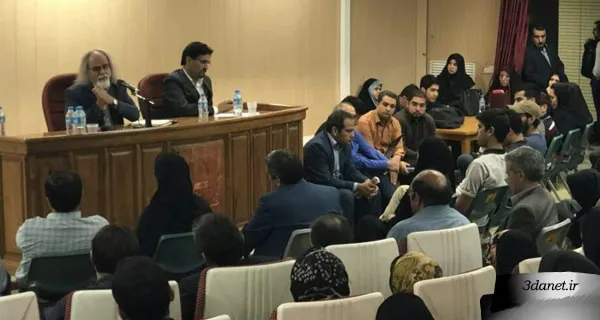
Discussion0 comments
No comments yet; let yours be the first voice.