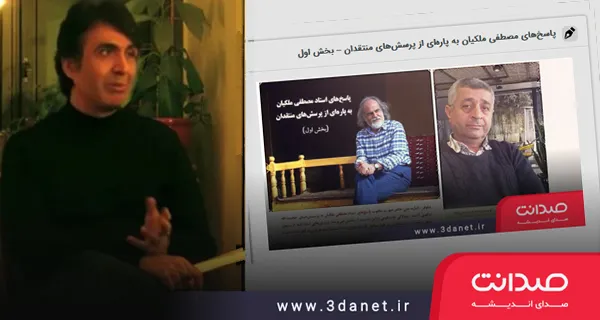
Some time ago (and unfortunately with a delay of about a year), I learned that my dear friend Mr. Mostafa Malekian, in an interview titled "Master Malekian's Answers to Critics' Questions" (Part One - Part Two), had offered some observations critiquing my views on the reasonableness of religious beliefs in the article "Critical Traditionalism in the Realm of Religion" [1]. In that interview, he briefly considered at least four main criticisms of my views. Here, out of respect for his scholarly effort, I will try to briefly express some observations in response to his valuable remarks.
(1)
First Criticism: In the article "Critical Traditionalism," I have stated that the reasonableness of religious beliefs depends on two things:
(First) Intra-religious reasonableness (meaning that the religious believer confirms their religious beliefs based on pragmatic considerations, non-propositional evidence (such as religious experience), and propositional evidence (such as other intra-religious beliefs or beliefs independent of religion));
(Second) Minimal extra-religious reasonableness (meaning that in addition to intra-religious reasonableness, the individual's religious beliefs must not have any undefeated defeaters.)
Malekian's interpretation of the above view is as if, in defending the rationality of religious beliefs, I have claimed that if opponents cannot demonstrate the falsity of my religious belief, this is a reason for the truth of my claim, and this is, of course, an obvious fallacy. He says in this regard: "Now that I cannot conclude the falsity of your claim from the weakness of your reason, I also cannot conclude the truth of your claim. Therefore, you must be agnostic. If your reason is weak, you must be agnostic, that is, say I do not know whether my claim is true or false. Mr. Naraghi's conception has been that when the reason is weak, since the falsity of the claim cannot be concluded, then the truth of the claim can be concluded. [...] Therefore, the religious person, when their reason is weak, must become agnostic, that is, say I do not know whether this claim or idea or belief is true or false."
Response: I am not sure that I correctly understand his meaning. It seems his claim is that if I cannot prove the truth of proposition A to you, then my reason for believing in the truth of proposition A is "weak," and therefore, I myself should become agnostic regarding the truth of proposition A. In other words, apparently, according to Malekian, from the fact that you consider the reason I have presented for the truth of proposition A to be weak, I must conclude that the reason I have for the truth of proposition A is also weak, and thus the continuation of my belief in proposition A is unjustified. If my reading of his statements is correct, then I think his claim is not correct. Let me give an example to clarify my point: Suppose a criminal gang has murdered Ali, and they have staged the scene so skillfully that all evidence indicates that I was Ali's murderer. The police arrest me for the murder of Ali and take me to court for trial. In court, the prosecutor presents all the evidence indicating my guilt to the jury. I clearly remember that at the time of Ali's murder, I was in solitude in the mountains and was not at the crime scene at all. But since I have no witness to prove my claim, I cannot convince the jury of my innocence. The jury (rightly) finds my reasons for the truth of my innocence "weak," and on this basis (rightly) convicts me. But does the fact that my reason for my innocence (i.e., the fact that I clearly remember not being at the crime scene at the time of the murder) is epistemically weak from the jury's perspective (rightly) imply that this reason is also epistemically weak for me, and therefore I too, like the members of the jury, should consider myself guilty or suspend my belief in my innocence? It seems clear to me that the answer is negative. I clearly know that I was not at the scene at the time of the crime, and therefore, I am perfectly entitled to believe in my innocence, even though my reason for my innocence is not sufficiently strong and convincing from the perspective of the jury members. They are entitled to consider my reason weak and to convict me, but it does not follow from this that my belief in my innocence is unreasonable, and that I too, like the jury members, should consider myself guilty or at least adopt an agnostic stance toward my innocence.
Of course, if in the above example the prosecutor can show that, for instance, I have been taking psychedelic drugs for some time, one of the side effects of which is erasing parts of memory and implanting false memories, then my belief that I clearly remember not being at the crime scene at the time of the crime faces a defeater. And if I cannot rebut this defeater, then epistemically, I must at least doubt the truth of my belief and consequently my innocence, and suspend judgment on the matter.
(2)
Second Critique: As I mentioned earlier, one of my claims in the article "Critical Traditionalism" is that religious people accept their religious beliefs on various bases, and one of those bases is religious experiences. In such cases, religious experience is the foundation for affirming religious belief and can, under certain conditions, render religious belief rationally justified (in the absence of undefeated defeaters). In criticizing this claim, Malekian says: "In the world of religiosity, we simply do not have beliefs of this type [i.e., based on experience]. [...] Outside of religion, we have such beliefs [i.e., experiential beliefs], but we do not have them in the world of religiosity." Accordingly, from Malekian's perspective, justifying religious belief based on religious experience is a "concept without a referent."
Response: Malekian's statements here are not very clear. Does he mean that, from a phenomenological perspective, there is fundamentally no such thing as "religious experience" in the realm of religious life? If that is his intention, then accepting his claim becomes very difficult. The history of religions is replete with believers' accounts of their religious experiences. From high-ranking mystics to ordinary believers, people have repeatedly reported individual or collective religious experiences. This does not mean that all or even some of these experiences were valid and veridical, or that the interpretation and report of the content of those experiences by their subjects were necessarily accurate and truthful. But it certainly means that, at least from a phenomenological perspective, many believers considered themselves to possess such experiences, and in many cases, regarded their religious beliefs as based on such experiences.
It is highly likely that Malekian would not wish to deny this historical fact that many believers have claimed religious experiences and have justified at least some of their religious beliefs based on such experiences. Therefore, perhaps we should understand his statements in another way. Perhaps he means that the believers' claim regarding the validity of religious experiences is false. That is, it is true that some people throughout the history of religions have (even sincerely) claimed to have had religious experiences, but those experiences (as religious experiences) are invalid and inauthentic; for example, they were born of the illusion and fantasy of their subjects, or the subjects of those experiences erred in understanding and interpreting the content of those experiences. This claim can, of course, be conditionally correct. For instance, if someone believes that the God of theistic religions does not exist or that the transcendent is fundamentally beyond the realm of human experience, then such a person has the right to doubt the validity and authenticity of so-called religious experiences, and to claim that in the world of religiosity, there is fundamentally no reality as an authentic religious experience, and therefore beliefs based on such experiences are in fact based on a kind of misunderstanding or perceptual error, and those beliefs cannot be considered justified (at least solely) by virtue of such experiences, even prima facie. Malekian, of course, as far as I know, has not offered any clear and convincing reason for negating the God of theistic religions or the impossibility of experiencing such a God (assuming existence). And in the absence of such reasons, his claim cannot, of course, be considered acceptable. Therefore, I defer my final judgment on this critique until Malekian explains his reasons for such a difficult and bold claim.
But perhaps Malekian's claim is much simpler than these. Perhaps he simply means that, in the real world, most religious people do not accept their religious beliefs based on religious experiences. Authentic religious experiences (if they truly exist at all) are very rare and occur only for a small group of elites. Therefore, placing the massive body of religion on the slender pillar of religious experience presents a misleading picture of the reality of religion in the external world. If this is what Malekian means, I agree with him. That is why, in the same article "Critical Traditionalism," I have repeatedly and emphatically stated that the sources of religious believers' beliefs are multiple, and religious experiences are only one of those sources (though, from my perspective, one of the most important ones).
(3)
Third Critique: Malekian believes that in the article "Critical Traditionalism," I committed the "fallacy of shifting the burden of proof onto the opponent." That is, according to Malekian's interpretation, religious believers have no reason for their religious beliefs, and instead of accepting the responsibility of providing proof and giving reasons for their beliefs, they shift the burden of proof onto the opponent, claiming that they do not need to provide reasons for the truth of their belief, but rather it is the opponent's duty to provide proof for the falsity of their belief. In explaining this fallacy, he writes: "I say 'A is B,' and then, instead of providing reasons in favor of my claim, I say: anyone who believes that 'A is not B' should provide reasons for 'A is not B.' [...] If you have no reason for 'A is B,' epistemologically you have no right to say 'A is B,' even if your saying 'A is B' is correct."
Response: Unfortunately, Malekian's formulation of my claim does not seem correct. Malekian's assumption is that, from my perspective, religious believers have no reason for their religious beliefs or cannot have one. It is not clear to me what the basis of this interpretation by Malekian is. In the article "Critical Traditionalism," I have dedicated an independent section to discussing the foundations of accepting religious beliefs from the perspective of believers, and there I have explained in detail that the religious beliefs of believers can be action-based, experience-based, and/or belief-based. And the continuation of their commitment to their religious beliefs on these foundations is rationally justified as long as these beliefs do not have an undefeated defeater. For example, suppose I have tested an experience of God's presence in my personal life, and I have also found some proofs for the existence of God convincing, and in addition, I believe that the most important critiques of belief in God's existence (for example, the argument from evil) are incapable of negating God's existence. Under these conditions, I am epistemically fully entitled to maintain my belief in God's existence. Now suppose an atheist comes along and asks me to abandon my belief in God. Here, it is entirely natural for me to ask that person to present their reasons for negating my belief in God. Does demanding a reason under these conditions amount to falling into the pitfall of a fallacy? I doubt it. Now suppose the atheist presents their reason for negating God, and I was able to show that that reason is incapable of proving their intended conclusion. Under these conditions, am I entitled to continue adhering to my belief in God? If, under these conditions, the atheist still insists that I am epistemically obligated to abandon my belief in God or suspend it, is their request justified and defensible? I think the answer is clear.
(4)
Fourth Critique: Finally, Malekian believes that the model I propose regarding the reasonableness of religious beliefs, even if it has any application, applies only to the "trans-rational" beliefs or propositions of the sacred text. But when we come to "irrational" beliefs or propositions (i.e., propositions contrary to reason) and "irrelevant" ones (i.e., propositions that have lost their relevance to our lives) in the sacred text, that model loses its efficacy and applicability.
Response: The truth is that it is not clear to me what Malekian's reason for this claim is. The examples he provides to explain this claim are not very illuminating. Therefore, I really do not know why, in his view, my proposed model is not applicable to the "irrational" and "irrelevant" cases of the sacred text. Hence, it might be better for me to explain myself why and how my proposed model applies to the cases Malekian has in mind.
Irrational Cases: Under what conditions is a belief "irrational"? As far as I understand, my belief in proposition A is irrational if that belief has at least one undefeated defeater. Therefore, when my belief in proposition A encounters a defeater, I must answer two main questions: (1) Is that defeater truly undefeated or not? (2) If that defeater is truly undefeated, then according to my proposed model, what would be the appropriate reaction to it?
My proposed model, as I have detailed in the article "Critical Traditionalism," has a clear answer for this situation: If my belief in proposition A encounters a truly undefeated defeater (or, in Malekian's terms, it becomes clear that my belief in that proposition is irrational), then the continuation of my belief in proposition A will be epistemically unjustified. Under these conditions, two paths are open to me: either I must try to obtain an alternative interpretation of that belief that is immune to that undefeated defeater, or if presenting such an alternative interpretation is not possible, then I must abandon that belief.
But I don't think Malekian has a fundamental objection to this logic. The main disagreement is probably over whether the defeater is in fact undefeated or not, and if it is, whether it is possible to offer an alternative interpretation of that belief that is immune to that defeater. For example, it seems that Malekian and I both agree that if the argument from evil is valid and sound, then continuing to believe in the God of theistic religions (i.e., an omnipotent, omniscient, and perfectly good God) would be rationally unjustified. But our difference apparently lies in the fact that, in my view, the argument from evil does not lead to its claimed conclusion (and therefore, it is not in fact an undefeated defeater against belief in the God of theistic religions, and so my continued belief in the God of theistic religions remains rationally justified), while Malekian believes that the argument proves its claimed conclusion (and therefore, it is in fact an undefeated defeater against belief in the God of theistic religions, and so my continued belief in the God of theistic religions is rationally unjustified.) But how can a disagreement over instances be considered a defeater for the principle of my proposed model regarding the rationality of religious beliefs?
"Irrelevant" Cases: But what can be said about propositions in the sacred text that are "irrelevant" to modern life?
First, "relevance" is largely a function of perspective. In other words, the relevance between two things, A and B, largely depends on the basis we choose for comparison. Suppose someone like Malekian asks whether there is any relevance between the method of repairing a chariot wheel three thousand years ago and our life today, in which the chariot plays no significant role in transportation. I think this question has no clear answer unless we first clarify from which perspective we are asking about the relevance between these two things. For example, if the intention is to ask whether, in a society where chariots no longer exist, it is rational for someone to learn how to repair a chariot wheel, open a chariot repair shop, and try to make a living this way, then the answer would probably be negative; that is, the profession of chariot wheel repair, as a means of livelihood, has largely lost its relevance to the job market in a society where chariots no longer exist. But does it follow from this that there is therefore no relevance whatsoever between these two categories? I very much doubt it. For example, it is entirely possible that studies show that the mode of thinking that underlay the invention of the wheel and the building of the chariot, or the method used to discover the problem with that wheel and fix it three thousand years ago (for instance, using a kind of inductive reasoning), still exists today at the foundation of our scientific thinking and has been the basis for the formation of modern technology, and in this respect, there is a meaningful relevance between these phenomena. The main point, of course, is that "relevance" is largely a function of perspective, and two things that appear irrelevant from one perspective may appear importantly and meaningfully related from another.
Second, let us assume that Malekian is right and some of the propositions or components of the sacred text are indeed irrelevant to our modern life. For example, we might say that sacred texts were often formed in the atmosphere of the ancient world, and therefore, they reflect many elements of that bygone world that no longer have meaningful relevance or proportion to the life of modern humans in the new world. But what conclusion follows from this claim? I think it is entirely possible for a person to accept this claim and yet assert that the totality of the text's world—that is, the world that emerges from the collection of the text's "relevant" and "irrelevant" components—still has meaningful relevance to our human condition in the new world. That is, the relevant and irrelevant elements of the text together have served to create a world that, in its totality, still reveals profound meanings to us about humanity and its condition in this world. This characteristic, of course, is not unique to sacred texts. For example, many of the cultural and social elements of Homer's world in the Odyssey have lost their "relevance" to our life in the new world. But it does not follow from this (assuming it is true) that the world Homer created in his book with the aid of ancient elements lacks profound meanings and has no meaningful, sense-giving connection and relation to our modern world.
In any case, for my part, I am grateful for Malekian's scholarly critiques, and I hope the door remains open for such critical discussions.
.
.
[1] "Critical Traditionalism in the Realm of Religion: A Theory on the Logic of Religious Thought Reform in Islam," Arash Naraghi, Tradition and Open Horizons, Negah-e Moaser Publishing, First Edition, 2016, pp. 5-71.
.
.


Discussion6 comments
هنگامی که دو گزاره اثبات صددرصدی ندارد و حتما یکی از آن ها درست است گزاره ای بهتر زیباتر و بیشتر نافع انسان است انتخاب می شود
مثال دکتر نراقی بیربط است اینکه کسی حضور خدا را در زندگیش احساس کند با اینکه کسی بداند که در صحنه یک قتل حضور نداشته بسیاربا هم متفاوت است اولی یک احساس است که میتواند خطا باشد ودلایل متعدددیگری برای چنین احساسی وجود داشته باشد ومیتواند در حالتهای دیگر برعکس انهم اتفاق بیافتد وفرد اصلا حضور خدا را درزندگیش حس نکند این حضور خدا را احساس کردن یا نکردن دلیل بر وجود داشتن یا نداشتن خدا نیست این خود فرد وذهن اوست که چنین حالتی را پدید میاورد ودلیل متقنی برای خداباوری نیست دلیل نیست ولی کسی میتواند دنبال همین احساسش هم برود ولی در حالت دوم خود ان فرد یقینا میداند که اصلا در صحنه قتل حضور نداشته پس ایندو به هیچ عنوان با هم قابل مقایسه نیستند معقول بودن یا نبودن اعتقادی منوط به مستدل بودن ان اعتقاد است اگر فردی که خداباور است درمقابل یک خدا ناباور جوهر استدلالش بخشکد ونتواند خدایش رامستدل اثبات کند اعتقادش به خدا عقلانی نیست اما میتواند ایمانی باشد وبگوید که قلبا به منبعی که موجد هستی بوده ایمان دارد ومومن به خداست در حالیکه دلیلی برای اثبات ان ندارد
آقای حجت جانان شما به موضع دکتر نراقی را متوجه نشده اید. حس دکتر نراقی با احساسی که شما می گویید متفاوت است. اگر یک خداناباور در برابر یک موحد استدلالش بخشکد چه؟ این که استدلال نیست توهم است.
باسلام و آرزوی توفیق برای همه اندیشمندان حقیقت جو و روشنگر که استاد ملکیان و دکتر نراقی از مصادیق بارز آن هستند. درباره پاسخ دکتر نراقی به نقد اول استاد ملکیان به نظر می رسد مراد استاد این نیست که اگر کسی برای باور به صدق گزاره ای از نظر خود دلیل موجهی داشته باشد اما طرف مقابل او آن را از منظر خود ضعیف بداند نباید به آن گزاره باور داشت و نهایت انکه نسبت بدان لاادری بود بلکه مراد استاد این است که اگر طرف مقابل بتواند ضعف دلیل او را نشان دهد به گونه ای که او نتواند اشکالات طرف مقابل بر دلایل خود را رفع کند از لحاظ معرفت شناختی باور به آن گزاره موجه نیست مگر آنکه آن شخص اهل تعصب یا جزم و جمود باشد. در ضمن مثال دکتر نراقی هم برای پاسخ به نقد استاد ملکیان مناسب نیست چون از جمله اموری است که در آن دلایل طرفین منطقا محال نیست یعنی هم دلایل هیأت منصفه و دادستان بر علیه متهم به قتل ممکن است و هم دلیل خود او بر بی گناهی اش امکان پذیر است اما بحث بر سر آن است که اگر شخصی بتواند نشان دهد که دلیل ما برای اثبات یک ادعا منطقا نتیجه بخش نیست و ممکن نیست که آن دلیل به آن نتیجه بیانجامد در آنصورت نباید همچنان بر آن پافشاری کرد. به امید آنکه روزی را شاهد باشیم که بتوانیم با رعایت موازین اخلاق نقد و گفتگو زندگی خوبتر و خوشتری برای خود رقم بزنیم باشد که چندان دور نباشد...
بهترین کلاس برای آموختن اخلاق نقد از نظر یاسر میردامادی این پست است. همانطور که با اسم سعید هم این نکته را متذکر شده اند.
سلام جناب دکتر نراقی همچون همیشه تلاشی نیکو داشته اند که به وضوح دیدگاه خویش را درخصوص مبحث مدنظر ارائه دهند که موفق هم بوده اند چه نیکوست تضارب آرای افرادی همچون استاد گرانمایه ملکیان و اندیشمندی همچون دکتر احمد نراقی نسیمی از دوران مجلات مدرسه، نقد و نظر (در آن دوران) و کیان وزیدن گرفته به امید باز رسیدن ایامی خوش با نسیمهایی خوشین