Why this book?
- You will become acquainted with Hossein Masoumi Hamedani's views on writing, translation, and editing.
- You will examine the issues of the Persian language and its challenges in the contemporary world from an analytical angle.
- You will read essays on the ethics of authorship, freedom of expression, and the responsibility of the text.
- You will encounter examples of the author's critical and functionalist view of language and culture.
About the book
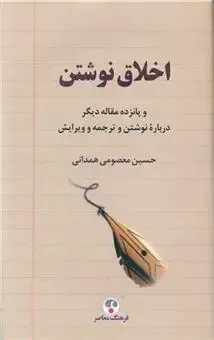
The book The Ethics of Writing is a collection of selected essays by Hossein Masoumi Hamedani, published over four decades of his professional activity in specialized journals. Despite their differing subjects, these essays all address aspects of language, reading, writing, translation, and editing, offering an overall picture of the author's concerns about working with the Persian language.
The book has four main sections: "Culture," "Writing," "Translation," and "Editing." In the Culture section, there is an essay on the concept of culture; the Writing section deals with topics such as reading and writing, linguistic corruption, the difficulty of authorship, cultural journalism, and the ethics of writing; the Translation section includes writings on terminology selection, the translation of scientific and philosophical texts, and the impact of translation on the Persian language; and the Editing section is dedicated to various issues of editing and the relationship between author, editor, and text.
In these essays, Masoumi Hamedani strives to present specialized topics in clear and comprehensible language. His view of language sees the past as a valuable heritage but does not consider it beyond the need for critique and functional assessment. This book is useful for writers, translators, editors, humanities students, and anyone interested in the quality of the Persian language and the culture of writing.
Specialized journals are an important part of the scientific and cultural landscape of any country, providing a suitable platform for the exchange and clash of experts' opinions, as well as allowing students and researchers to benefit from the views of leading figures and specialists. Many of the articles published in specialized journals are not appealing or comprehensible to the general audience, and this is entirely natural. A consequence of this natural characteristic is that many of us—except in our own field of expertise—do not turn to specialized journals. The regrettable result is that sometimes articles that could also be read in a more public sphere and are useful for a non-specialist audience remain neglected, unread, and unheard. The only way to escape this situation is for the publisher or author to publish a selected collection of articles; articles that are more general and appealing and can find readers and audiences outside the specialized sphere. The book The Ethics of Writing is considered an example of such collections.
From the table of contents
- 1Culture
- 2Writing
- 3Translation
- 4Editing