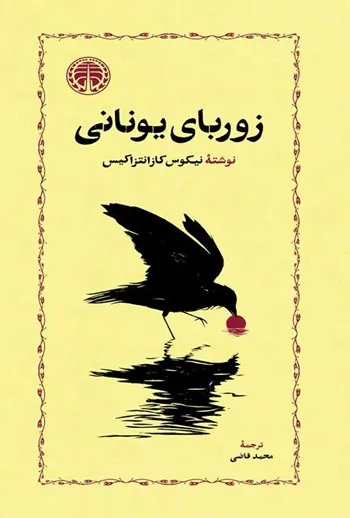
Why this book?
- To understand the contrast between abstract rationality and the living experience of life.
- To encounter one of the most enduring philosophical novels of the twentieth century.
- To see how freedom, love, and work acquire meaning in everyday life.
- To experience Kazantzakis’s prose through Mohammad Ghazi’s classic and readable Persian translation.
- For readers interested in philosophical literature, the meaning of life, and the vitality of living.
About the book
The novel Zorba the Greek is the story of a confrontation between two intellectual and existential modes: the narrator, a young intellectual immersed in books and abstract thought, decides to go to the island of Crete to work in a lignite mine, and along the way meets Alexis Zorba—an illiterate old man brimming with experience, zest for life, and an unmediated knowledge of existence. The contrast between these two characters is, in fact, the contrast between written thought and the living, tangible embodiment of life.
Zorba represents the human being free from the shackles of clichés and complex philosophical systems, responding to the world through dance, the santur, manual labor, and love. In this work, which is in a sense a manifestation of the ideas of Bergson and Nietzsche in narrative form, Kazantzakis shows how excessive rationality can sever a person from the most vital moments of existence, and conversely, how an unmediated presence in the moment can be redemptive.
With its brilliant and fluent translation by Mohammad Ghazi, this work has held a special place in the reading culture of Persian speakers for years. Reading this novel will be a profound and awakening experience for all enthusiasts of philosophical literature, existentialism, and those seeking a renewed understanding of the relationship between reason, faith, freedom, and the passion for life.