Why this book?
- To read one of the most concise literary critiques of tyranny and derailed revolutions.
- To understand the role of propaganda, fear, and the distortion of language in consolidating power.
- To encounter a classic work at the intersection of literature and political science.
- To experience a short, clear novel that remains alive in today’s political debates.
About the book
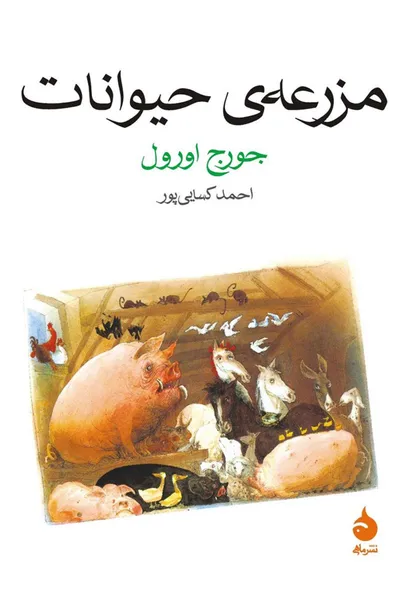
Animal Farm is one of George Orwell’s best-known works and one of the most important political allegories of the twentieth century. The story begins with the animals of a farm rebelling against their human owner; a rebellion meant to bring freedom and equality, but one that gradually turns, under the shadow of ambition, fear, propaganda, and the rewriting of collective memory, into a new oppressive order.
Orwell uses a simple, fable-like structure, and that very simplicity gives the work its lasting force. The characters and events of the story clearly refer to the Russian Revolution and the rise of Stalinism, but the novel’s meaning is not limited to that historical setting. Animal Farm is about any situation in which emancipatory slogans become tools of a new rule.
This book is suited to readers interested in political literature, the critique of ideology, the history of revolutions, and the question of freedom. Ahmad Kasaeipour’s Persian translation, published by Mahi, is a suitable choice for Persian readers because of its fluent and readable prose.