Literature
Introducing Two Books by George Orwell on Sleeping Rough
In addition to his novels, George Orwell wrote two ethnographic monographs drawn from lived experience. Down and Out in Paris and London and The Road to Wigan Pier are classic examples of serious, unsentimental inquiry into the lives of the lower classes.
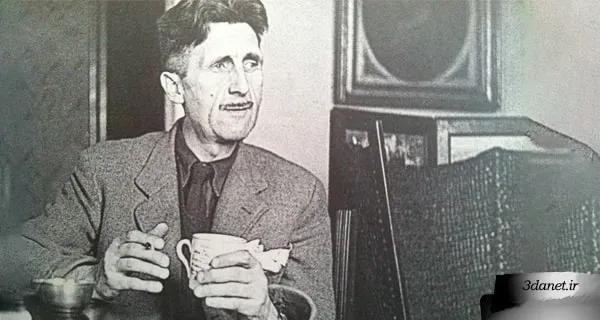
Gholamali Keshani: Orwell ( here and here ) is one of my favorite writers. Yesterday, April 25th (5th of Tir, 1395), was his birthday, but I neither had any news of it nor do I pay attention to the birthdays of famous people. I felt the need to write this text four days ago, after reading his book (Down and Out):
Orwell writes simply. He writes critically, he is sharp-eyed, but above all:
He writes in a way that is shocking and bitter, yet also profound, so that you cannot pass it by without thinking about what he says again; why? Because he himself comes from the depths, even though he has a very analytical and dry exterior. His style was "nightmare of the countryside" versus "dream of the countryside," and the "clue-led novel" style about real life, and satire. His writings were generally anti-fascist, anti-communist, in defense of the capacities of social democracy, literary criticism, and polemical.
According to many, he was one of the finest essayists in the English language.
His essay "Shooting an Elephant" (1936) in Burma became very famous. In this essay, he showed the impotence and humiliation of the colonizer before the native people, and this led him to resign from his police job.
..
… You can follow some of his other essays on the Persian Orwell blog: ( here ) and
Critics have numbered five of his important essays.
One of these five is "Reflections on Gandhi," which has been translated into Persian twice before, and the latest one, I have reluctantly perpetrated myself. ( here )
Another one is Politics and the English Language, which discusses the language of writing (taken from the site of M. Ghaed and with the mastery of his pen).
Another is the four long essays in the book Why I Write. Translated by Anahita Kazazi, Aydin Publishing and older than all, the valuable book A Collection of Essays by George Orwell by Akbar Tabrizi, who years ago made a valuable effort and introduced people to the current of Orwell's thought.
But in addition to his main profession, which was essay writing, Orwell also wrote novels. His novels or stories became very famous.
- "The Ownerless Animal Farm": or Animal Farm, which in this land, due to the copyright-free nature of the authorship and translation, its translations are approaching a hundred.
 Animal Farm with the good translation by Amir Shahi
“A book with very simple language and prose that any language student who hasn't seen a book could be assigned by an idle publisher to prepare in a week for delivery to the printing house, thus saving the publisher from turning his business into a sandwich shop. Its first translation, by the dear Amir Amirshahi, is perhaps its best translation. (Meanwhile, the institution that should say a couple of words of legal sense to these 'bread-snatching' publishers is absent. But the 'book-snatching' institution, God knows there's plenty of them!)
-The novel 1984, which again has several translations.:

– A Clergyman's Daughter:

The analytical-narrative report “Homage to Catalonia”, with more than one translation (Tribute to Catalonia or In Honor of Catalonia or Salute to Catalonia or Homage to Catalonia -Memories of the Spanish Civil War)

And a book about Orwell himself called George Orwell translated by Pirouz Siavashi, Nasl-e Qalam:

But regarding his ethnographic and anthropological monograph, we had not heard of his fame.
Now I want to introduce you to two of his great masterpieces in this very field:
“Down and Out in Paris and London”, George Orwell, Bahman Darolshafaei, Mahi Publishing:

–“The Road to Wigan Pier”, George Orwell, Reza Fatemi, Beh Sokhan Publishing:

I devoured both of them.
Twenty or thirty years ago, I saw a translation of Down and Out and started reading it. I couldn't follow the text and put it aside. It was unreadable. A noble, compassionate, Orwell-loving translator had rendered it, but for me, it was not readable or followable.
Until Mr. Bahman Darolshafaee, who is also an Orwell lover, like this humble one, rolled up his sleeves and, with the encouragement of translators like Mr. Khashayar Deyhimi, brought the work to completion.
I learned about the book's publication from the internet. I went after it. First, I had my child read it, and we read it in turns. You can't put it down. Once you pick it up, it takes you to the depths. It shows you the very bottom and then sets you free. Because he lived the story himself. The translation is very fluent and very close to colloquial language, very much so! Kudos to the translator. That is, the main part of the work comes down to his command of the Persian language. The book, however, lacks the necessary explanations.
The reader is not familiar with the relative values of the monetary units and small change. Many aspects of London and Paris, and French and English people that are unfamiliar to us, needed to be explained in footnotes, but the translator fell short. I hope he completes the work in the next edition; like myself, who tries as much as possible to introduce the ins and outs of the text's atmosphere to the reader so they can proceed more easily. But what is the content of this work that distinguishes it from the author's other works?
It was also Orwell's first work in his literary life. A work that publishers "reject," and a luckless Orwell gives the manuscript of this eternal masterpiece to a friend to burn and be rid of it. But that friend does not burn the book…
And now this classic work is in our hands!
What does this book have that makes reading it necessary and essential even in all high schools and universities in Iran? What does this book have that it should be placed alongside the greatest classic works of philosophy, economics, sociology, anthropology, class studies, and even fiction writing, travel writing, and field reporting?
Monographs on people's lives have also been done in Iran. Some of them, like the work of Al-e Ahmad or the work of Sa'edi or Reza Daneshvar or Mohammad Borqa'i or Mahmoud Zand-Moghaddam or other sharp-eyed observers, are ethnological or economic in nature. Some of them are travelogue-anthropological, like the work of Islam Kazemiyeh or Mahmoud Zand-Moghaddam or, again, Mohammad Borqa'i. But we are very much lacking in work that is very serious and from the inside.
Another work in this field exists by the late "Marzieh Ahmadi Oskoui," a People's Fedai Guerrilla, which was lived and written with all her being and love, but is overflowing with the guerrilla sentimentalism (wailing and lamentation) of the 50s. Most of our documentary films, too, which, with a thousand pains and hardships, when they enter these kinds of discussions, again approach the realm of sentimentalism and leave one with only a possibly fleeting feeling (the works of Revayat-e Fath, Bashagard, are among the first examples of this documentary style in the modern era). We lack serious, non-romantic, non-sentimental, and at the same time, insider research.
But both of Orwell's works are serious, research-based, and of course insider, classic works, from which other researchers should take a model and complete its methodology.
Orwell was a "fiercely socialist" leftist, and it was for this reason that he wrote Animal Farm and 1984 and Homage to Catalonia; because his heart ached for his ideal and he saw that it was being lost through an experience of the Stalinist type. Orwell remained this way until the end.
There has also been talk about his relationship, late in life, with his country's intelligence apparatus for providing information, which is not unlikely from such a person.
A person who considers Russophiles linked to the "Stalinist Soviet Union" to be traitors in practice, it is natural that he would report their news to the "authorities."

He lives to be 47. He is born in India. In England, by chance, he studies at one of the best elite-training schools (Eton). Then he goes to Burma and becomes a policeman.
At 27, after realizing the odiousness of being a colonial policeman in Burma, he resigns. He comes to London. He can't find work and, thinking of a job, sets off for Paris.
Let us remember that his family was not very wealthy, but he finishes Eton secondary school anyway, meaning an elite-training place like Alavi and Refah high schools, which trained the future political-economic players in England and had a 500-year history (please reflect upon the stability and social order of that place).
So he could have, in London, like our own great writer Sadegh Hedayat, gone searching through the Foreign Office, political parties, and the like, looking for connections; tried to secure a decent, white-collar job for himself.
But after resigning in Burma, his mental state is disturbed by such occupations, and he prefers freedom in earning a living.
And he introduces himself to himself as a freelance writer. But he cannot find work in London. He goes to Paris. There, he gets by for a few days on the two farthings a friend in London had given him. He tries to write articles for newspapers. But he is not very successful. Now his money runs out. From this point on, he must pay rent for a room (or a hovel), pay for food (that is, money for stale bread and margarine) just to stay alive. This is where the story begins.
And the whole story is the tale of lice and bedbugs and hunger (having no money for that same stale bread and margarine) 365 days a year, the food that is the fare of an unemployed dishwasher, a dishwasher who works 17 hours and sleeps on filth, and the smoke-filled air of the city, when he emerges from the hellish basement of the hotel kitchen, is the scent of paradise to him; and it is the story of filth and grime and expensive Parisian food, where the kitchen worker, for the sake of God, usually squeezes the dirty water from the rag he uses to slightly dry the stinking, filthy floor, neatly and directly, into the finest and most expensive Parisian dishes being served in one of the good hotels of Paris. A dishwasher for whom sleep is not rest; it is lust; yes! It is lust.
The rule: the more presentable and expensive the food, the more spit, phlegm, and filth. It is here that Orwell reminds us of the corollary rule:
The higher the price of the food and the restaurant, the more inedible and filthier its fare!
He considers this a universal law. And at the end of his book, he says some shocking sentences:
“I can enumerate one or two things I have definitely learned from poverty.
-I will never again think that rough sleepers are drunken scoundrels, -I do not expect beggars to be grateful to me for the coin I have placed in their palm, -I am not surprised if an unemployed man lacks energy and strength, -I do not approve of the Salvation Army (an institution that, with noise and religious propaganda, claims to bring charity to the hungry.),
-I do not pawn my clothes to get money for bread and garbage called margarine, I do not refuse the hand of someone distributing leaflets, and
-I do not enjoy my food in a fancy restaurant.
This is just the beginning.”
In this book, Orwell himself is severely destitute, yet at the same time, enough awareness remains in his mind to reflect on the human condition and situation of the destitute. But in the other book, “The Road to Wigan Pier,” whose translator, Mr. Reza Fatemi, has kindly shared Orwell’s experience with us; the author is not a wretched man, but he has gone to live exactly like the destitute. He eats and sleeps with them and is inseparable from them. But he observes carefully and gifts the world of human thought one of the finest demographic, anthropological, and class-based monographs.
However, the second book needs to be edited again to be cleared of certain errors. Errors that should not exist in a classic work like The Road to Wigan Pier (for example: Trade Union Movement was translated as “United Commercial Movement.” Which we know is the trade union movement, more famous in the English language than the devil’s blasphemy).
The book The Road… is the story of a step-by-step journey the author makes to the living quarters of England’s coal mine workers. He eats, sleeps, and lives with them, and gives us a detailed account of these forgotten fellow human beings, which should serve as a lesson for some Iranian anthropologists, demographers, sociologists, ethnologists, and economists, and especially the new Iranian left, so they do not see, write, and draw conclusions haphazardly; so they do not write sentimentally, with burning passion, sighs, tears, and laments; so they calculate the costs objectively and seriously, and provide statistics seriously, without exaggeration, and “neither more nor less,” so that perhaps later, better works may be created for the well-being and welfare of these human beings who are born on the margins, live on the margins, and die on the margins, and ultimately, the pain and suffering of a few people or a class may be lessened.
With these two works, Orwell proves that he was a steadfast socialist, both in his first long piece of writing and in The Road to Wigan Pier, which he wrote in 1937, that is, at the age of 34. In 1936, he goes to Spain to have gone to the aid of the anti-Franco Republicans, like all the leftists of the world.
He is wounded. In the throat, no less. The effect of the wound remains for the rest of his life, and he bids farewell to the world due to tuberculosis related to the wound.

But larger wounds from this war remain in his soul:
– The savagery of man: In the book Homage to Catalonia, Orwell shows a scene where he sees a Francoist soldier on the enemy side, who has gone to relieve himself early in the morning. His white undershirt is pulled up, and Orwell could easily shoot “an enemy” with a single shot. But he does not shoot and grows to hate everything about war, because he sees that the enemy is something exactly like us! He eats, relieves himself, a mother will mourn him, and…
– And the second: the falsehood of socialism of the totalitarian Stalinist-party variety!
George Orwell flees from Stalin-ravaged Catalonia (Spain) in destitution and terror of being shot on the accusation of being an agent of Franco and imperialism, because the extensions of Muscovite policy were in pursuit of hunting down every last survivor of the leftist groups that did not offer absolute obedience to Moscow.
He writes the following book in memory of that painful experience. He shows us the story of the escape in disguise from the “manhunters” of the Muscovite government of Madrid in this very book:

From then on, he feels his duty is to explain this new understanding of existence and the ongoing history of the world, and he writes again. It is from this point onward that, in later years, he arrives at Animal Farm and 1984.
The novel 1984, due to its reference to a calendar year, had a somewhat predictive gaze. Such that in January of that very year, Britain's neoconservative and Iron Lady Prime Minister, Mrs. Margaret Thatcher, in a televised New Year's greeting, swelled with pride and said:
"In Orwell's blind eye, we have seen 1984, and it did not turn out at all as he said."
The next day on BBC radio, a reporter pointed to the British police's "database," which at that time held hundreds of thousands of photos of ordinary citizens and several thousand cameras in public spaces. He responded thus: "Dear Auntie Maggie, so are these photos and cameras just to keep Scotland Yard employees from being idle, or..."
In his novel, Orwell depicted a world where the walls of its rooms have "wide screens," meaning a television on which "Big Brother" can constantly appear on the screen, ask how you are, and also see you; and on all the walls of houses, except for a few exceptional blind spots. The story, too, rises and is propelled forward from that very point of exception.
Now, if you look at a text on this same site called "Is the Web Dying Soon?" and the subsequent text "The Nothingness of Modern Man, ...", you will see that Orwell was not at all off the mark, and the control of governments and corporations over the ordinary lives of people has almost become like his imagination.
Orwell's financial situation never improved until the end. To cover his living expenses, he was a scribbler, an article writer for newspapers, waiting for the little money they would give him to meet his usual costs. He was a person of simple living and a lover of nature. But he was fanatical about his strong, bitter tea and would not compromise, such that his eleven secrets of "making a good cup of tea" are among his famous writings. The wound from Catalonia (Spain) also remained in his lung until the end of his life, and officially, from a tuberculosis-related illness linked to that same wound, he closed his eyes on the world in 1950.
I am putting several very important sections of the book Down and Out in Paris and London, which are relevant to this site, here as a PDF ( here ), to invite you to buy both of these very respectable books. So that you may hold them and not put them down, and finish the pleasure of understanding them, but also roll up your sleeves to, even a little, truly empathize with the wretched, and to the extent of your means, wherever and however, do something for the real reduction of misery, near and far!


.
.
Introducing Two Books by George Orwell on Sleeping Rough
Author: Gholamali Keshani
.
.


Discussion0 comments
No comments yet; let yours be the first voice.