اندیشهفلسفهخردگفتگوحکمتمعناپرسشفرهنگ
Sociology
Chaharshanbe Suri (Social Capital Gone Up in Smoke)
Chaharshanbe Suri has devolved from a spiritual rite into a harmful phenomenon that breeds fear and insecurity instead of joy. The failure of families and education to transmit culture has turned this tradition into an arena for emotional release and the consumption of dangerous goods.
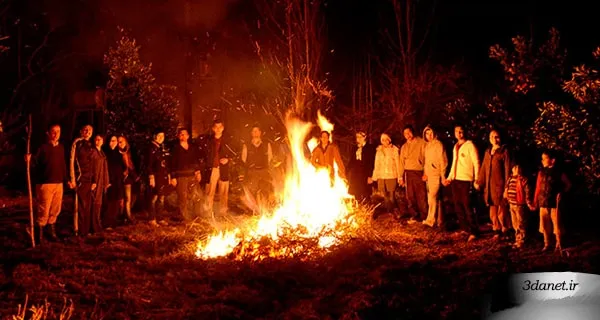
Our traditional culture possesses diverse elements that, due to their individual and social functions and their ability and potential to bestow meaning upon human actions within a historical context, have grown, developed, and remained stable, and despite changes, have been transmitted from one generation to the next, yet have still endured.
Chaharshanbe Suri is among the traditions that have both roots in sanctimonious and religious relations and have had socio-cultural functions; while expressing humility and ideological-spiritual displays, it has fulfilled needs such as the need for recreation and entertainment at a specific calendrical time (the last Tuesday of the year). Numerous positive social characteristics can be enumerated for this tradition and its customs, including: generating motivation, inspiring hope, strengthening social beliefs and values, social education, the continuity of social values, collective joy, and so on. It is such that this ancient tradition, while heralding the beginning of a new season in daily human life, engages individuals in a group joy; and of course, these ceremonies were conducted while preserving social and individual health and protecting the environment at all stages of their performance.
But today, only a superficial form of that commendable tradition has reached us, and with the utilization of various modern tools, many of the rich forms of its aforementioned characteristics have become fainter and fainter, to the extent that not only does it not provide a suitable platform for joy, but we also witness the ground for undesirable habits such as keeping up with the Joneses and even a kind of competition in the forms of "ridiculous childishness," "adolescent playfulness," and "youthful shows of power" within the framework of this occasion, which bears no resemblance to the philosophy of its traditional formation and continuity, and in many cases, a counterproductive and destructive (physical and social) outcome results from it.
The issue is that social change is inevitable and has been continuously ongoing in the context of time and generations, and this socio-cultural characteristic flows unpredictably in intercultural and civilizational relations, and especially with the dominance of Western culture, it has taken a more non-spiritual and economic direction. This means that if in the past these occasions were formed and continued with spiritual-religious and sanctimonious purposes (fulfilling the psycho-spiritual need of the actor), today they are viewed as a cultural commodity, and behind the scenes of the performers, as with most cultural and economic commodities, lies the market of supply and demand and material profit and benefit. And since it is an arena for the consumption of goods needed for this ceremony, the desired goods are supplied to the market and delivered for consumption by the agents of this ceremony. In this way, producers of firecrackers and incendiary tools and materials play a role and, by exploiting (redirected) cultural needs, sell their goods, and accordingly, before performing a valuable act (which was common in its traditional form), the consumption of goods and the economic dimension of what has been produced is considered.
The Chaharshanbe Suri ceremony, like a social phenomenon, has been accompanied by changes in action norms and the form of performance from the past, but the closer we get to the present day, the more these changes have distanced themselves from their essence, and with unclear orientations in groups and individuals, have found unpleasant and inappropriate consequences. This means that on the last Tuesday evening of each year, families, youth groups, and other gatherings across various age and situational spectrums, using firecrackers and other incendiary and noise-making tools and devices in various forms and in different places (from alleys and streets to the embrace of nature), begin to make noise, set off fireworks, and explode firecrackers and other pyrotechnic materials, creating widespread air, noise, and environmental pollution. A kind of social fear and psycho-social insecurity prevails, which each year causes loss of life, physical injuries, and numerous psychological and social damages, to the extent that it emerges as an "inappropriate," "unpredictable," and "uncontrollable" phenomenon, and it is unclear with what objectives it is carried out, taking more the form of a collective release of emotions and excitements, and in most cases, has resulted in social fear, social insecurity, and collective anxiety.
Thus, a spectrum of human actors involved in this matter is debatable and causally traceable:
- In the absence of opportunities for recreation and joy, individuals and actors across different age groups seem to find a license for violent, disproportionate, and inappropriate acts in the public sphere, and thus express their emotions by making noise or setting off fireworks, etc., using manufactured and industrial tools (as opposed to the natural form of lighting a fire), thereby displaying a notion of performing joy in which no characteristic of being joyful or making others happy, in the psychological and sociological sense, can be witnessed.
- Regarding the individual, this issue takes the form of expressing emotions, catharsis, and similar phenomena, and it is evident that if the individual (usually a youth or adolescent) lacks awareness of the cultural roots and the proper way of performing this social tradition, they become a dynamic agent in the continuation of the transformed, agent-driven form and play a role in transmitting it to subsequent generations, a role of which they are usually unaware.
- In the context of the family and its relation to this subject, the discussion of "relations between spouses" (parents), "relations between parents and children," and "relations between children" can be raised; meaning that the values governing family relations have been tarnished, and another type of interaction and relationship has emerged, which is a function of global culture, such that in all three aforementioned types of relations, the dominance of the global culture of domination (capitalist and with values in conflict with traditional-indigenous culture) justifies the resulting actions, so that the needs that created these relations are such that the youth and adolescent, before paying attention to the wishes of parents and other family members and their own psychological and emotional needs, are influenced by satellites, media, and social networks, and then by peer groups, etc. It is here that cultural continuity regarding the subject under discussion (Chaharshanbe Suri) encounters a cultural rupture, and the social role of past generations in transmitting it is minimized, replaced by agents and promoters of other cultures. This means that if one of the family's duties is raising children, and here it should engage in cultivating the proper way of performing and familiarity with the historical roots of Chaharshanbe Suri, other agents, who usually have economic and profit-seeking motives, take its place, and thus this crucial duty is not carried out.
- One of the main duties of the educational institution is cultural transmission from one generation to the next, such that in relation to the subject under discussion (Chaharshanbe Suri), according to the duty of this institution, familiarity with this ceremony should naturally be achieved through textbooks, school programs, and teachers and professors, and intergenerational education should be performed. Furthermore, education can also play a role in this area through social control, yet in none of these cases is the requisite action observed from it.
- The absence of civic organizations (with their necessary characteristics) in third-world countries is an evident matter, such that although organizations (whether environmental or other forms) have been formed, they usually suffer from a lack of knowledgeable human resources aligned with the goals of such organizations, a lack of deep-rooted motivation for their purpose, inexperience, and most importantly, a superficial and formulaic formation. On this basis, behind the scenes of carrying out such activities, they pursue goals other than what they claim, and therefore do not achieve what they profess.
- Among the fundamental factors in this area are the officials and subordinate departments, which legally and administratively have communicated duties in this field and should naturally be able to engage in appropriate cultural cultivation. In this regard, the lack of belief in the effectiveness of organizational activities in guiding these ceremonies, the absence of competent officials in positions of authority, and the failure to utilize social potentials in this direction are noteworthy.
Now, with a brief glance at some of the actors in this arena and as this day approaches, no meaningful and beneficial activity (from individuals, groups, organizations, and relevant officials) is seen in society, and most of these efforts are perfunctory and for show, rather than the foundational groundwork and cultural cultivation that is required.
- The media, whose scope today is far broader than radio, television, and even satellite networks, has paid only cursory attention to this important matter, and even when programs or discussions are presented, they have not been able to turn the pages toward a proper cultural foundation for the cultural transmission of this tradition. And although engagement with social networks has now become the primary activity of most people, it does not seem to be very effective in shaping this transformed phenomenon appropriately.
Although the social, cultural, and other involved spectrums are far more numerous than those mentioned above, it must ultimately be said that a consolidation of the actions of the factors influencing the performance of this ceremony is required so that we may witness appropriate changes in this regard. Furthermore, it is necessary to note that human phenomena are historic and time-consuming, and to confront them, skilled human forces in every field must be utilized to elucidate the nature and history of that phenomenon (in this case, the Chaharshanbe Suri ceremony) and to demonstrate the proper way of performing it, taking into account the spirits of the youth, adolescents, and other involved groups. It also requires the (social, technological, and psychological) prerequisites for offering a suitable solution; this tradition can be a platform for joy, recreation, entertainment, and the fruitful filling of leisure time, originating from our rich culture.
Finally, it must be said that the nature and quality, and the manifestation of the social reality of Chaharshanbe Suri and its issues and problems, take place within the heart of society. Whatever ultimately takes shape is the result and outcome of the interplay of the actions (conscious or unconscious, as well as direct and indirect) of the following components, which bear social responsibility (official-administrative duty and moral obligation) in this regard:
- Families
- The education system and schools
- Professors and teachers
- Official media (national broadcasting and official newspapers) and unofficial media
- Internet-based media and social networks
- Reference groups and elites
- People's elected representatives (members of parliament and councils)
- Government officials
- Non-governmental organizations (NGOs)
- ...
.
.
.
Chaharshanbe Suri (Social Capital Gone Up in Smoke)
Author: Dr. Hassan Rashidi (Sociologist)
Source: Haje
.
.
.


Discussion1 comments
ارعاب و تهدید عمومی هم مضمرست، چراکه نه، نسلی ترسو آماده و مستعد اطاعت بیشتری هستند. برجسته کردن مناسک و اعیاد آرام و ایمن مذهبی، در برابر مراسم و سنن آشفته اجتماعی با لوث کردنش، میتواند از علل رواج خشونت ایدولوژیکال باشد. وگرنه در همه جای دنیا مراسم آتشبازی از زیباترین و شگفت ترین مراسم تلقی میشود