Religion
Contextualism in Jurisprudence: An Essay by Hossein Valeh
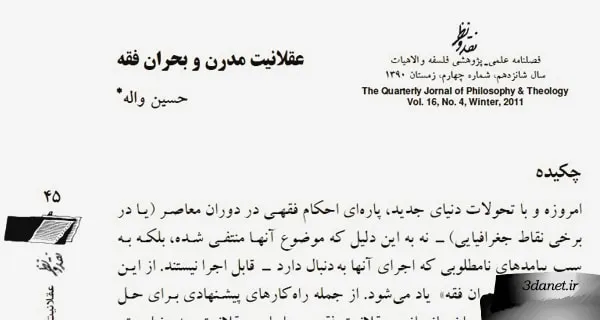
An atomistic approach to ijtihad produces a jurisprudence of unenforceable rulings with no clear connection to the purposes of Sharia; by contrast, contextualism yields a criterion-based juristic system that resolves crises and continues the Usuli path against the Akhbari.
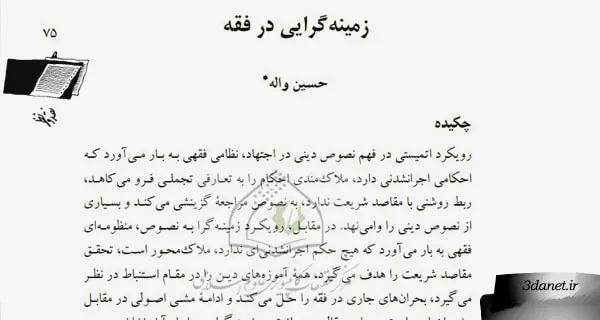
The atomistic approach to understanding religious texts in ijtihad yields a jurisprudential system that produces unenforceable rulings, reduces the criterion-based nature of rulings to a decorative convention, lacks a clear connection to the purposes of the Sharia, engages in a selective reference to texts, and abandons many religious texts. In contrast, the contextualist approach to texts yields a jurisprudential system that has no unenforceable rulings, is criterion-oriented, aims at realizing the purposes of the Sharia, takes all religious teachings into account in the process of inference, resolves the ongoing crises in jurisprudence, and is a continuation of the Usuli method as opposed to the Akhbari method. In the essay “Contextualism in Jurisprudence,” after explaining contextualism and its dimensions, we show that contextualism is a continuation of that very Usuli method.
Machine Summary:
"Assuming that each individual ruling of the Lawgiver is independent of every other ruling, and that a single verbal proof expresses one ruling, and that in expressing that ruling there is no need for other texts of the Sharia, and that we are left with the proofs of the rulings, what do we know of the criteria of the rulings? Naturally, a prior proof establishes one ruling and a subsequent proof establishes another, and when a conflict arises between them, inevitably either specification or abrogation will solve the problem. But if we base our approach on the idea that a legal ruling becomes meaningful within a system of legal rulings, and a verbal proof becomes expressive in the shelter of other verbal and non-verbal proofs, and our theological foundations must manifest in our inference, then we examine a prior proof not only in view of a subsequent proof, but in the light of all religious texts. And by seeking help from the rational rule that rulings follow real interests and harms in the subject of the ruling, and the goodness of God's charging of servants with what is in their best interest, we understand it this way: both the prior proof and the subsequent proof are an indicative disclosure of a binding interest that is the cause of the ruling, but the change in objective conditions in human life has caused a qualification to be added in one of these two cases. Third, the position of the majority of Usulis in the discussion of the authoritativeness of certainty and conjecture, and the restriction of validity to specific conjectures, coupled with this presupposition in ijtihad that we do not know the criteria of rulings in their entirety, and therefore have no choice but to content ourselves with transmitted conjectures, caused the relationship between the ruling, the criterion, and the purposes of the Sharia to be completely eliminated from the domain of jurisprudence."
.
.
PDF file of the essay Contextualism in Jurisprudence
.
.
Author: Hossein Valeh
Source: Naqd va Nazar, Summer 2011, Year Sixteen - Issue 2 (32 pages - from 75 to 106)
.
.





Discussion0 comments
No comments yet; let yours be the first voice.