Religion
Modern Rationality and the Crisis of Fiqh: An Article by Hossein Valeh
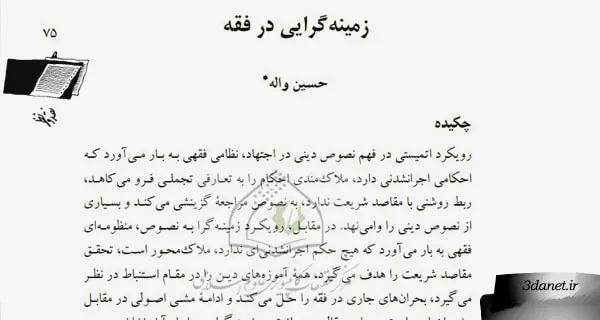
The failure to implement certain jurisprudential rulings due to their undesirable consequences in the modern world is termed the 'crisis of jurisprudence.' Hossein Valeh critiques the solution of replacing traditional rationality with modern rationality, arguing that both approaches share an atomistic view of legal deduction.
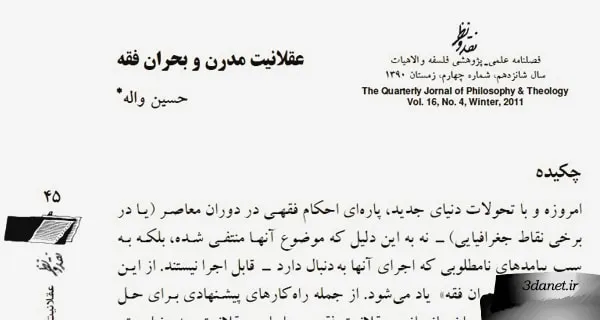
Today, with the transformations of the modern world, a number of jurisprudential rulings in the contemporary era (or in certain geographical regions) — not because their subject matter has ceased to exist, but due to the undesirable consequences that their implementation entails — are no longer enforceable. This issue is sometimes referred to as the "crisis of fiqh." Among the proposed solutions for this apparent crisis is the reconstruction of jurisprudential rationality on the basis of modern rationality. This solution, due to its heavy epistemological commitments, revision of established principles of jurisprudence (uṣūl), and improper use of certain theological rules, holds little appeal for traditionalists. Moreover, rather than solving the problem, it merely pushes it one step back. This solution shares one common point with the core problem: an atomistic approach to the derivation of legal rulings.
Various solutions have been proposed for the crisis of fiqh. The debate on this matter continues. What we mean by the crisis of fiqh is that a number of jurisprudential rulings in the contemporary era (or in certain geographical regions) — not because their subject matter has ceased to exist, but due to the undesirable consequences that their implementation entails — are no longer enforceable. For example, the prohibition of usury (ribā) is among the established rulings of fiqh and perhaps one of the necessities of Islamic jurisprudence, yet few doubt that the modern economic system would collapse entirely with the elimination of usury from banking transactions, economic competition and the productivity resulting from competition would be disrupted, monetary and economic management and control systems would be lost, and national and global production growth would be harmed. There are numerous other rulings in various chapters of fiqh that are subjects of similar disputes, such as the inheritance of men and women and of the dhimmī unbeliever, the right to divorce, certain rulings on apostasy, retribution (qiṣāṣ), and prescribed punishments (ḥudūd).
Many efforts have been made to solve this problem, which are classified into two main categories. One category, in defense of these rulings, focuses on the necessity of changing objective conditions and making them favorable for the implementation of jurisprudential rulings. The other category proposes changes in the jurisprudential rulings themselves. The second category has pursued different paths. In this article, we will introduce and critique a solution presented by contemporary religious intellectualism in Iran and developed by Mr. Abolqasem Fanaei in his scholarly book Ethics of Religious Studies. This approach proposes replacing traditional rationality with modern rationality.
.
.
Article Title [English]:
Modern Rationalityand the Crisis of Feqh (Islamic Jurisprudence)
Abstract [English]:
Among the solutions proposed for the current crisis in Islamic traditional Jurisprudence (Feqh) stands out the suggestion to reconstruct jurisprudential rationality on the basis modern rationality. This solution involves too heavy epistemological commitments, a revisionist approach to some of the received theorems in the science of Osul and misuse of some the theological principles accepted almost unanimously by Muslims. Therefore it fails to attract the attention of traditionalists. It fails also because it merely shifts the kernel of the problem rather than solve it. This solution shares the traditional approach it criticizes in one principal failure that is responsible for the crisis; failing to adopt a contextualized approach to jurisprudence rather than the atomistic.
.
. References
Amoli, Mirza Hashem (1395 AH), Majmaʿ al-Afkar, Qom: Ilmiyya Printing House. Ibn Sina, Husayn (1404 AH), al-Taʿliqat, Beirut: Maktabat al-Aʿlam al-Islamiyya. ——— (1375), al-Isharat wa al-Tanbihat, Qom: al-Balaghah. Isfahani, Muhammad Husayn (1404 AH), al-Fusul al-Gharawiyya, n.p., Dar Ihyaʾ al-ʿUlum al-Islamiyya. Behbahani, Vahid (1415 AH), al-Fawaʾid al-Haʾiriyya, Qom: Majmaʿ al-Fikr al-Islami. Bahmanyar, Ibn Marzban (1375), al-Tahsil, Tehran: University of Tehran Press. Hilli, Hasan ibn Yusuf (1379), al-Asrar al-Khafiyya, Qom: Islamic Propagation Office Publications. Khorasani, Muhammad Kazim (Akhund Khorasani) (n.d.), Kifayat al-Usul, Tehran: Islamiyya Bookshop. Razi, Fakhr al-Din (1411 AH), al-Mabahith al-Mashriqiyya, Qom: Bidar Publications. 10_ Razavi, Masoud (1379), Afaq-e Falsafeh (Horizons of Philosophy), Tehran: Farzan-e Ruz Research Publication. 11_ Shahrazuri, Muhammad ibn Mahmud (1373), Sharh Hikmat al-Ishraq, Tehran: Institute for Cultural Studies and Research. 12_ Shirazi, Muhammad ibn Ibrahim (Mulla Sadra) (1981), al-Asfar al-ʿAqliyya al-Arbaʿa, Beirut: Dar Ihyaʾ al-Turath. 13_ Tusi, Nasir al-Din (1383), Ajwibat al-Masaʾil al-Nasiriyya, Tehran: Institute for Humanities and Cultural Studies. 14_ ——— (1361), Asas al-Iqtibas, Tehran: University of Tehran Press, 3rd edition. 15_ Abedi, Ahmad (1376), “Maslahat in Fiqh,” Naqd va Nazar Quarterly, no. 12, Autumn 1376. 16_ Fanaei, Abolqasem (1389), Akhlaq-e Din-Shenasi (Ethics of Religious Studies), Tehran: Negah-e Moaser Publication. 17_ Qatifi, Sayyid Munir Sayyid Adnan (1414 AH), al-Rafid fi ʿIlm al-Usul; Taqrirat Dars-e Usul-e Ayatollah Sistani, Qom: Maktab Ayatollah al-ʿUzma al-Sayyid al-Sistani Publications. 18_ Montazeri, Husayn Ali (1415 AH), Taqrirat Dars-e Ayatollah Borujerdi, Nihayat al-Usul, Qom: Tafakkor. 19_ Mirza-ye Qomi (1378 AH), Qawanin al-Usul, Qom: Ilmiyya Islamiyya Bookshop, 2nd edition. 20_ Valeh, Hossein (1390), Naqd va Nazar, vol. 16, no. 2, Summer, pp. 75-106. 21_ ——— (1390), “Epistemology in Islamic Rational Sciences,” Shenakht Journal, no. 6. 22_ ——— (1390), “Contextualism in Fiqh,” Naqd va Nazar Journal, vol. 16, no. 2.
23_ Dancy, Jonathan. (2010),A Companion to Epistemology. 2nd ed. ChichesterWest Sussex, U.K. ;MaldenMA: Wiley-Blackwell. 24_ Meister, Chad, ed. (2007),The Philosophy of Religion Reader. New Ed. Routledge.
.
.
PDF file of the article Modern Rationality and the Crisis of Fiqh by Hossein Valeh
.
.


Discussion0 comments
No comments yet; let yours be the first voice.