Religion
Masoud Sadeghi's Critique of Abolqasem Fanaei's The Ethics of Religious Studies (Part Three)
Masoud Sadeghi critiques the classification of religious rulings into the rationally acceptable, the rationally elusive, and the rationally repugnant in Fanaei's book The Ethics of Religious Studies. He finds the criterion of 'independent reason' ambiguous and questions the necessity of accepting rationally elusive rulings in religious devotion and their very nature.

Invoking the category of “independent reason” is not a firm and suitable point of reference or distinguishing criterion for separating reason-accepting, reason-eluding, and reason-conflicting rulings; not to mention that Fanaei uses the singular word “reason” instead of the term “reasons,” which points to a multiplicity of proofs and evidence, and this itself causes misunderstanding and a kind of illusion.
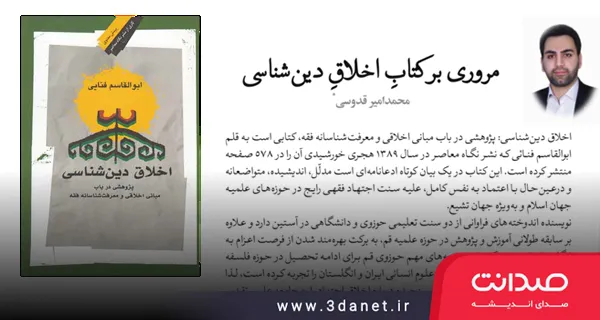
Bibliographic details of the work under review: The Ethics of Religious Studies, an inquiry into the ethical and epistemological foundations of jurisprudence, Abolqasem Fanaei, Tehran, Negah-e Moaser, 2010.
This book, totaling 604 pages, contains, in addition to a relatively lengthy preface, 7 chapters under the following titles: Chapter One, Replacing Ethics with Jurisprudence; Chapter Two, Jurisprudence and the Challenges of the Modern Age; Chapter Three, Traditional Rationality and Modern Rationality; Chapter Four, Jurisprudential Rationality and Conventional Rationality; Chapter Five, The Theoretical Contraction and Expansion of Jurisprudence; Chapter Six, The Expansion of Prophetic Jurisprudential Experience; Chapter Seven, The Cultural Translation of Religious Texts.
Critique of Chapter Four: Jurisprudential Rationality and Conventional Rationality
This chapter is the most organized and, at the same time, the most concise chapter of the book The Ethics of Religious Studies. The author’s aim in this section is to critique the rationality or research ethics prevalent in traditional jurisprudence. Fanaei considers the rational and ethical critique of religious and jurisprudential thought to be the most important duty of religious reformers and new thinkers (Fanaei, 2010, 260). In his view, those who accept the epistemological and ethical foundations of traditional jurisprudence can ultimately only critique the “outcome” of jurisprudential inferences, and these inferences and outcomes will also be entirely parallel and equivalent to common and traditional fatwas (Fanaei, 2010, 261). Fanaei claims that the solution must be sought in the “external pillar of religious knowledge”; in this vein, he attempts to divide Sharia rulings and jurisprudential fatwas into three categories based on their relationship with rationality:
1. Reason-Accepting Rulings
By this title, the author means those rulings and fatwas for which there is an independent rational or empirical reason in their favor (Fanaei, 2010, 262). Fanaei considers rulings such as “oppression is forbidden,” “breach of trust is forbidden,” or “lying is forbidden” as instances of these rulings.
2. Reason-Eluding Rulings
Fanaei’s intention here is those rulings and fatwas for which no independent rational or empirical reason can be offered, either for or against them. He considers rulings such as the obligation of fasting in the month of Ramadan or the three-unit nature of the Maghrib prayer as examples of this type of ruling (Fanaei, 2010, 263).
3. Reason-Conflicting Rulings
The author considers reason-conflicting rulings to be those against which there exists an independent rational or empirical reason. He cites the inequality of political and social rights between Muslims and non-Muslims, Shia and Sunni, men and women, and jurists and non-jurists as examples of reason-conflicting rulings (Fanaei, 2010, 263).
Regarding this tripartite division and the examples Fanaei enumerates for them, there are several fundamental observations:
A) What is meant by “independent reason”?
Fanaei does not clarify what he means by the existence or absence of an independent reason; he probably means by a reason being independent, its independence from religious texts; that is, a ruling that, apart from any religious recommendation or emphasis, can be understood rationally or through experience. The added ambiguity lies in the fact that we are usually not faced with a single decisive and independent reason in such domains, but rather, so to speak, we dwell in the “abode of reasons”; that is, in situations where multiple reasons, each from certain aspects and with different criteria, are rationally and empirically demonstrable and citable. For example, consider the ruling on religious hijab: this ruling may seem entirely rational from one perspective, in that no man or woman has the right to practice nudity and, outside the family framework, cause the sexual arousal of others and disturb them, and so on. Yet at the same time, this very ruling can be considered reason-evasive from other aspects and by another criterion. Someone might believe that the exposure of women’s hair alone is not sexually arousing, disturbing, or contrary to the requirements of chastity. From another perspective, some may consider the ruling on hijab to be reason-opposed, because it causes or exemplifies social differentiation between men and women, imposes greater hardship on women than on men, or, hypothetically, according to some empirical surveys, does not reduce rates of sexual assault or deviance.
In other words, invoking the category of “independent reason” is not a solid and suitable anchor or point of differentiation for separating reason-accepting, reason-evasive, and reason-opposed rulings; not to mention that Fanaei, instead of the word “reasons,” which points to the multiplicity of proofs and evidence, uses the singular word “reason,” which itself causes misunderstanding and a kind of illusion; because, as we said, every situation should be considered an “abode of reasons” from this perspective, a place where a set of correct reasons are arrayed against incorrect ones, and depending on the criterion or criteria we prioritize, they can make a ruling or phenomenon appear rational, irrational, or supra-rational.
B) What is the criterion and meaning of reason-evasiveness?
In light of the previous point, this point can be better explained; Fanaei considers reason-evasive rulings to be those for which there is no independent rational or empirical reason for or against them. He considers the obligation of fasting in the month of Ramadan or the two-rak’ah nature of the dawn prayer to be instances of this, but there are several important questions in this regard:
1_ Why, in the position of religiosity, should we be obligated to accept reason-evasive matters?
Whatever answer Fanaei gives to this question, he cannot deny that, firstly, in all religions, including Islam, there are some reason-evasive rulings; secondly, one of the requisites and signs of religiosity (and perhaps one of the differences between religiosity and certain forms of irreligiosity and rationalism) is belief in and commitment to reason-evasive and supra-rational propositions; thirdly, whatever is not reason-accepting is not necessarily reason-opposed; fourthly, a significant part of religiosity, self-purification, and piety depends on belief in and practice of matters (devotional and supra-rational) that, as it happens, are not reason-accepting!
2_ Is it merely “the obligation of fasting in the month of Ramadan” that is supra-rational and reason-evasive, or is the principle of fasting and its religious form and context also, in fact, supra-rational? In another example, is it only the four-rak’ah nature of the noon prayer that is supra-rational, or is the principle of prayer and its religious rulings and form also reason-evasive?
Whatever answer Fanaei gives to this question, he cannot deny that the components of Islamic prayer (and perhaps any type of prayer) are entirely reason-evasive, and not just the number of its rak’ahs or the time of its performance, but the reason for and manner of the obligation of its content and substance is also such. Fasting follows the same pattern; not only in the blessed month of Ramadan, but many aspects of fasting in Islam are not “independently explicable by reason or experience”; why must fasting be from the dawn call to prayer until the dusk call to prayer, and why must one not drink even a sip of water during it, and many other whys.
3_ Are reason-evasive matters in religion inherently reason-evasive, and can they never find a reason-accepting alternative?
Whatever answer Fanaei gives to this question, he cannot deny that a significant portion of the primary and specific behaviors in the capacity of religious practice—such as prayer, fasting, and Hajj—either should not be performed at all, or, if formulated in any other way, still face the question of why they became this way and not that way! For example, in the matter of Hajj, reason and experience fundamentally do not know and do not say why one must go to Mecca, let alone want to explain and weigh its opportunity, timing, rituals, and rites.
4_ Is this irrationality a merit for them, a flaw in them, or are these matters fundamentally outside the scope of such evaluative judgments?
Whatever answer Fanaei gives to this question, he cannot deny that a religious person, as long as they are religious, cannot consider the irrationality of a religious ruling to be a flaw and defect, and consequently, to remedy this defect, seek to replace them with rationally acceptable rulings; because this attitude, firstly, challenges the individual's faith; secondly, it introduces reason into a supra-rational domain outside its purview.
c) Are all acts of worship irrational, and is it only acts of worship that are irrational?
It seems the author wanted to place devotional rulings under the title of irrational rulings in order to exclude them from the scope of his rationalistic perspective and thereby protect acts of worship from potential harms, just as all of Fanaei's examples for irrational matters in religion and in our jurisprudential tradition fall under acts of worship. However, there are several main considerations in this regard:
1- What reason and criterion is there for us to pursue irrational rulings only in the domain of worship?
2- If we do not consider all acts of worship to be supra-rational and irrational, why, and according to what criterion, do we make exceptions for some of them?
In this humble opinion, regarding supra-rational and irrational categories in religion, it can be said:
Irrationality, like rational acceptability and rational repugnance, is a gradational concept. Sometimes all or some of the elements and details of a religious matter are irrational, but its totality is rationally acceptable (like prayer), and sometimes the totality of a religious matter is irrational, but all or parts of its details are rationally acceptable (like Hajj). The more we move towards acts of worship, the more irrational they become, and the more we move towards transactions and interactions, the less irrational they become. In the nature of irrational religious matters, a kind of "test of faith" is embedded. The difference between believing in irrational matters in religion and outside of religion is that religion is based on rationally acceptable propositions (rational proofs) and guides us to believe in and act upon irrational matters, whereas outside of religion this is not the case. It must be emphasized that raising the above questions and points is by no means because Fanaei opposes the presence of irrational rulings in religion; on the contrary, we want to say that for the same reasons Fanaei considers the existence of this type of ruling in religion justified, he can logically accept the presence of some "apparently rationally repugnant" rulings in religion, rulings which, like supra-rational phenomena, although not fully explicable by modern reason, can nonetheless be judged as worthy of belief and preservation for reasons. Reasons such as:
Some religious rulings (especially in the modern world), when considered in isolation and detached from the overall system of religion, may appear contrary to reason, yet they become comprehensible and justifiable within the overarching framework of the religion's educational or ethical system or its legal rights and duties. For instance, certain dissimilar or unequal rights between men and women fall into this category; if analyzed alone and apart from the totality of rulings, they might seem unjust, but they are compensated for and set right under other rulings. In light of the previous point, it can be said that in many cases it is not clear whether a rational, extra-religious alternative can be found for apparently irrational religious rulings. For example, apart from religiously mandated hijab or nudity, if we define any other measure or criterion for the clothing of men and women, we will face the problem of why and according to which rational or empirical basis we have set such a limit. Continuing the discussion, the author addresses a critical question: why, despite the fact that the Sharia in the realm of reality lacks irrational rulings, do the actual religious texts contain irrational rulings? Fanaei attributes the entry of irrational rulings into the Quran to imposition and generalization (Fanaei, 1389, p. 264); that is, if a Quranic ruling is irrational, it is either because it was "imposed" on the Quran from outside, or because the ruling was in fact temporary but was mistakenly "generalized" and considered eternal. Regarding narrations, Fanaei also mentions the possibility of "distortion" as another factor in addition to the two previous ones (Fanaei, 1389, p. 265). Although this point is in a way a summary and another exposition of Soroush's view on justifying the entry of unreasonable rulings into the Quran (according to his opinion, of course), there are several considerations regarding it:
a) What is the precise meaning of "imposition of a ruling," and how can we distinguish it from non-imposed matters and rulings? Should every Quranic ruling that conflicts with the prevailing opinions of the time be considered an incongruous patch imposed upon the sacred text?
b) Is the reason of contemporary humanity immune from imposed rulings?
c) Fanaei's reasons for the temporariness and non-generalization of certain Quranic rulings seem insufficient. He believes that the "assumption of the immutability of religious rulings" is motivated by reasons rather than supported by evidence, and its primary cause is the religious community's need for identity, unity, and continuity, not belief in unseen interests and harms (Fanaei, 1389, p. 282). In this humble writer's opinion, it is more the case that Fanaei's assumption of the non-immutability of rulings is motivated by reasons and unsupported by evidence than that the assumption of immutability by Muslims is so motivated; for he believes that given the prominence of national identity and interests in the political sphere and the diminishing of religious identity, there is no longer a need to assume the immutability of rulings to preserve unity and identity (Fanaei, 1389, p. 282). He even goes further and believes that prioritizing religious identity over national identity is rationally permissible only if the other party (or, as Fanaei says, other Islamic countries) would, if necessary, prefer religious identity over national identity.
Firstly, it must be said in this regard that if the world over the past five centuries—rightly or wrongly—has officially prioritized national identity over religious identity, it is now clearly moving towards prioritizing human identity and the global economy over national identity and interests. Perhaps the rise of genuine or spurious waves of Islamism and the emphasis on the concept of the Islamic Ummah is a reaction to this very process.
Secondly, if one country's prioritization of religious identity over national identity is contingent upon other countries' prioritization of religious identity over national identity, then one could erroneously say that a government's observance of universal human rights is conditional upon the observance of these rights by other governments!
Thirdly, as it happens, the very example the esteemed author has cited to explain the danger of generalizing and considering irrational rulings in the Quran as eternal is a suitable instance for explaining a phenomenon in him and many other religious new thinkers, which can be called the phenomenon of "chronocentrism." The modern world and humanity have suffered the greatest harms from the emphasis on the category of national identity and its centrality, the most obvious consequence of which has been two great world wars. Even if we assume that the misuse of religion and nationality can be equally dangerous and destructive to humanity, since the diversity of nations and identities is far greater than that of major, community-building religions, war among nations is both more probable and more dangerous than war among religious communities.
At the end of chapter four, Fanaei once again refers to the role of the master–slave model in discovering religious rulings and, without offering a single reason, traces the root of many reason-defying fatwas to this model (Fanaei, 1389, 283)—a claim whose direct relevance to the subject under discussion is never clarified, nor is its why or how.
Critique of Chapter Five: The Theoretical Contraction and Expansion of Jurisprudence
In this chapter, Fanaei presents a lengthy, hundred-page description and analysis of the theory of the theoretical contraction and expansion of the Sharia; of course, as the esteemed author himself states, he examines the results of Soroush’s contraction and expansion theory only in the domain of jurisprudence, even though the theory itself concerns the entirety of religious understanding (Fanaei, 1389, 288). Any point the present writer makes in critiquing the content of this chapter will in fact be an entry into a critique of the contraction and expansion theory and an analysis of Soroush’s view, not Fanaei’s; for this reason, it seems we must confine ourselves solely to analyzing the analysis that Fanaei offers of the contraction and expansion theory.
In the chapter’s conclusion, the author expresses his sympathy and agreement with the general thrust of Soroush’s theory and contents himself with stating the explanatory point that jurists’ acquaintance with extra-religious and contemporary knowledge must be conscious and voluntary; otherwise, mere acquaintance with non-religious sciences will not bring about transformation in the religious sciences (Fanaei, 1389, 388). It seems that although this point does not, in theoretical terms, constitute a significant supplement or expansion to the contraction and expansion theory and is essentially implicit within it, it is a kind of methodological emphasis and intensification that calls upon jurists to pay methodical, prescriptive, and systematic attention to extra-religious knowledge and rational and empirical conjectures.
Some of the noteworthy and explanatory points presented by Fanaei in elucidating the contraction and expansion theory are as follows:
The subject of the contraction and expansion theory is religious knowledge as realized, not religious knowledge as defined (Fanaei, 1389, 294). It can be claimed that the contraction and expansion theory is, at one and the same time, both an epistemological theory and a reformist theory (Fanaei, 1389, 306). The immutability of religion is one of the accidents of the contraction and expansion theory, not one of its essentials, and therefore, for this theory to be true, it is not necessary to assume the immutability of religion (Fanaei, 1389, 308). Dr. Soroush’s emphasis on the immutability of religion in the contraction and expansion theory apparently has a more defensive aspect and is intended to dispel the illusions of critics (Fanaei, 1389, 311). The contraction and expansion theory merely seeks to explain the contraction and expansion that occurs as a result of the transformation of the “external pillar” of religious knowledge, whereas the “internal pillar” of religious knowledge may also undergo change and transformation, and the effect of this change and transformation on religious knowledge also requires explanation and elucidation (Fanaei, 1389, 309). As long as the epistemological values of religious scholars do not change, change and transformation in other branches of knowledge will have no effect (Fanaei, 1389, 320). Contraction and expansion is a philosophical theory, not a scientific-empirical one (Fanaei, 1389, 332). Contraction and expansion is a theory of the evolution of knowledge in general, not a theory of the evolution of religious knowledge in particular, and if this theory contains a recommendation—which it does—that recommendation will not be addressed solely to religious scholars; scholars in other branches of human knowledge are, to the same extent and for the same reasons, obliged to balance and harmonize their non-religious knowledge with their religious knowledge, and there is no priority or posteriority involved here (Fanaei, 1389, 385). Among the points above, the third and seventh are in some respects more noteworthy, for emphasizing them further illuminates some of the largely neglected angles of the discussion concerning the contraction and expansion theory. Before embracing the theory of the expansion of prophetic experience, Soroush repeatedly stressed the immutability of religion, though he later extended the fluidity and changeability of religious knowledge to religion itself. Fanaei’s effort is to show that: first, despite Soroush’s past emphasis on the immutability of religion, belief in the immutability of religion is not a requisite for accepting and validating the contraction and expansion theory; second, the theory of the expansion of prophetic experience and belief in the historicity and fluidity of religion are compatible and reconcilable with the contraction and expansion theory and belief in the transformation and evolution of religious understanding.
One of the important questions in this regard is that if, according to the theory of the expansion of prophetic experience, religion is inherently mutable and, consequently, religious knowledge will also be mutable, then what, fundamentally and henceforth, is the new and useful point of the theory of contraction and expansion regarding religious knowledge? To put it more clearly, given the theory of the expansion of prophetic experience, what does the theory of contraction and expansion seek to say, and what use is it? The validity of this question will become apparent when we, like Fanaei, acknowledge that:
By accepting this theory (the expansion of prophetic experience, or belief in the gradual and historical expansion of religion in the realm of reality), which is an "ontological" theory about the "nature" of Sharia and its perpetual fluidity, we are compelled to recognize "juristic experience" as one of the fundamental pillars and components of juristic ijtihad, which is an epistemological theory about the "nature" of juristic ijtihad (Fanaei, 1389, 389).
Critique of Chapter Six: The Expansion of Prophetic Juristic Experience
The esteemed author's aim in this chapter is, after comparing two methods of ijtihad, which he calls "rule-oriented" ijtihad and "model-oriented" ijtihad, to ultimately demonstrate that model-oriented ijtihad is appropriate and required for human beings living in the era of the seal of prophethood. To achieve this goal, Fanaei endeavors, based on a more refined and revised reading of the theory of the expansion of prophetic experience belonging to Dr. Soroush, to explicate the "expansion of prophetic juristic experience." First of all, it must be said that in this section of the book, several major and critical questions remain unanswered or ambiguous:
*Why is prophethood a kind of experience?
A question that Fanaei, even in the form of a quotation from Soroush or anyone else, does not wish to provide a precise answer to is: why should prophethood be considered an experience? He apparently tries to do this, however, and under the heading "Prophethood is a kind of experience," using Soroush's words, offers a few lines of explanation. The most telling statement the author makes regarding the subject and title under discussion is this: The characteristic of prophets is their possession of revelation, which is a kind of religious experience, and this constitutes the personality and prophethood of the prophets and is their sole capital (Fanaei, 1389, 392).
Upon reading the above passage, the only things that remain unclear to us are: first, what is religious experience? Second, why is revelation also a type of religious experience? Third, why is prophethood reducible or reducible to experience/religious experience? The ambiguity in this matter, in fact, challenges the entirety of the theory of the expansion of prophetic experience; because as long as it is not precisely and clearly determined what the experiential nature of prophethood means, consequently, the evolution of this experience, the relationship of the prophet's person and personality with this experience, and the meaning, method, and possibility of its expansion also remain shrouded in ambiguity.
* What is the difference between other types of religious experience and prophetic experience?
Although Fanaei apparently considers prophetic experience equivalent and synonymous with revelation and the Quran (Fanaei, 1389, 394), he does not adequately explain its similarities and differences with other types of religious experiences. The presence or absence of this ambiguity is extraordinarily influential in our understanding and conception of this theory. Citing a statement from Soroush, Fanaei explains the difference between the religious experience of prophets and others as follows:
The difference between prophets and others who possess spiritual and mystical experiences is that prophets, as a result of this experience, become obligated to guide and lead the people and are commissioned to convey God's message, whereas the experience of others is a personal and private experience, and therefore, merely having a religious experience does not make one a prophet (Fanaei, 1389, 392).
The ambiguity we spoke of is evident in the passage above; because, first, an individual can be a prophet without being obligated to the general and widespread propagation of a specific mission; therefore, the difference between prophetic experience and non-prophetic experience does not lie in its being private or public. Second, an individual can be the direct recipient of revelation without being a messenger or even a prophet. Third, an individual like the Infallible Imam can have a religious experience and, based on it, consider themselves obligated to guide the people, yet not be a prophet; therefore, being commissioned to guide the people based on religious experience is not the difference between prophets and non-prophets.
In other words, contrary to the view of Soroush and Fanaei, merely having a religious experience, considering that experience universal, and being tasked with guiding people based on those religious experiences is not the defining characteristic or distinguishing feature of the prophets/the Prophet of Islam.
*Is the prophetic experience of the prophets not exclusive to the prophets?
Fanaei presents three reasons for the shareability and non-exclusivity of the prophets' religious experience:
1- Mystics, Sufis, and saints also possess such experiences to a greater or lesser extent; for example, the Quran also speaks of the descent of angels and the descent of revelation upon non-prophets (Fanaei, 1389, 395).
2- According to Ghazali's views, non-prophets' possession of religious experience enables them to understand the truth of prophethood and helps them to recognize the prophets (Fanaei, 1389, 396).
3- In principle, religious experience is the ultimate goal of religiosity and the philosophy of worship and spiritual disciplines (Fanaei, 1389, 396).
Regarding Fanaei's three arguments, it must be said: Firstly, the meaning of revelation in the Quran is broader than its common and conventional meaning in theology (kalam), just as in the Quran, according to verse 68 of Surah An-Nahl, even the honeybee is the recipient of revelation. If we consider any kind of inspiration or revelation in the general sense to be a prophetic experience or revelation in the specific sense, we would have to say that even non-human beings are engaged in expanding the prophetic experience! Secondly, even if Fanaei considers revelation in the specific sense of the word to be a type of religious experience, he should not regard other types of religious experience as a form of revelation or prophetic experience; for not even all the religious experiences of the prophets possess revelatory and binding value, let alone the religious experiences of non-prophets. Hadith Qudsi is a fitting example of the religious experiences of a prophet like the Prophet of Islam, which, although having a divine origin, is by no means considered equal to the Quran.
One of the peculiar points and passages Fanaei raises regarding the common and traditional conception of the Finality of Prophethood is this: The traditional conception of finality entails the end of religion; because, according to this conception, with the seal of prophethood, the gates of heaven are closed, God's relationship with human beings is severed, and He will no longer speak to them thereafter and cannot play a living role in human life. But if God's hands are not tied in the realm of legislation, and if He is always active in this domain as well, then necessarily, religion in the realm of establishment and the world of legislation is always expanding and evolving, God is always speaking and revealing, and the Quran is always undergoing expansion and elaboration (Fanaei, 1389, 427).
It seems that in the above passage, Fanaei, using imprecise and poetic phrases, tries to present a black-and-white picture of the differences between the common conception and his own view; as if his perspective seeks to open God's hands and open the gates of heaven to the earth and strengthen the bond between servants and their Lord, but the dominant conception of finality has prevented this and seeks to bind God's hands and the gates of heaven. Unfortunately, the feeling sometimes arises that the esteemed author has completely forgotten or overlooks the category of Imamate and its characteristics in Shiism; otherwise, according to the dominant belief of Shiites, firstly, the earth will never be empty of God's Proof (Hujjah), and if only two people remain on earth, one of those two is the Imam, and the death of the last Imam will lead to the occurrence of the Resurrection (Kulayni, vol. 1, 253). Secondly, the souls and spirits of the Imams are the place of the coming and going of angels, the center of knowledge, and the tree of prophethood (Kulayni, vol. 1, 320).
It can be said that the true expansion of the prophetic experience is, in fact, the very current of Imamate, which, alongside other duties and functions, has and continues to bear at least the following two responsibilities in actuality:
First, the infallible interpretation of the Quran; second, establishing the connection between the earth and the heavens.
When Fanaei wants to positively express his desired meaning of the Finality of Prophethood, he says:
The seal of prophethood does not mean the end of religious law and religion; the meaning of the seal of prophethood is that no new religious law will come after the Sharia of Islam, not that the Sharia of Islam will remain fixed forever and no change or transformation will occur (Fanaei, 1389, 427).
What, really, is the precise meaning of this statement? Who believes that the finality of prophethood means the simultaneous end of both religion and sacred law? There are, of course, those who consider the age of religions to be over, but are these the same people who, like the overwhelming majority of Muslims, regard the sharia of Islam as the final divine law? The esteemed author, in a cunning manner (and perhaps inadvertently), seeks to construct strange and convenient dichotomies; otherwise, there are few Muslim thinkers who, like Fanaei, conceive the end of sacred law as signifying the end of religion.
For example, Fanaei understands the end of sacred law and the common conception of the finality of prophethood to mean that with the cessation of prophethood, God's aspect as "Lawgiver" is suspended and His name "the Guide" (al-Hādī) has no new manifestation (Fanaei, 1389, 425). In this humble writer's opinion, lawgiving and legislation are only one of the manifestations and instances of divine guidance, not its sole meaning and referent. If someone says that God no longer wishes to institute new laws or add new restrictions to previous limits and constraints, has one thereby declared the termination of guidance and the suspension of God's attribute of guiding? The guidance of creation through the Imams, the hidden, heartfelt guidances and graces bestowed upon people, the charismatic gifts of the people of spiritual reality, and so on—all are instances of divine guidance that will never be suspended and fundamentally have nothing to do with the enactment of new laws or their stability or change. To put it better, as far as we know, it is "the Guide" (al-Hādī) that is among the Divine Names of Majesty, not "the Lawgiver" (al-Shāriʿ) or "the Legislator" (al-Muqannin)! In this vein, it can be said that God's lawgiving (as one of the manifestations and instances of God's guidance) can be temporal and, in a sense, come to an end, without His guidance ever declining. In sum, in critiquing this part of Fanaei's statements, one can say: first, the finality of prophethood means the end of sacred law, not the end of guidance; second, lawgiving is merely one of the instances and forms of guidance, not its only form.
In the concluding sections of the sixth chapter, after laying the groundwork he deems necessary, Fanaei proceeds to the final discussion and analyzes the reasons for the superiority of what he calls model-based ijtihad over law-based ijtihad. He also considers and labels law-based ijtihad as text-based, an ijtihad that, in his view, sees religion as a human school of thought whose founder has passed away, leaving behind only a set of teachings to be followed blindly. Among the consequences of this method is that God's hand becomes tied in legislation, and the personality of the Prophet and his role as a model become meaningless (Fanaei, 1389, 443). In Fanaei's view, law-based ijtihad says one must act upon the "previous" commands of God and the Messenger, whereas model-based ijtihad says one must put into practice the "current" commands of God and the Prophet (Fanaei, 1389, 438). Model-based ijtihad necessitates inviting the Prophet into the present age and establishing a fresh connection with God, while law-based ijtihad strives to return to early Islam and see what God said in that era and how the Prophet acted (Fanaei, 1389, 444). Fanaei explicitly states that in model-based ijtihad, the decisions the Prophet made in the past do not have "intrinsic authority" (mawḍūʿiyya) but rather "instrumental value" (ṭarīqiyya). What is important and transforms the Prophet into a model for believers are the "principles" of his decision-making, the "method," "manner," and "mechanism" through which the Prophet arrived at his decisions (Fanaei, 1389, 445).
It can be said that the model-based ijtihad Fanaei pursues is, in reality, more an extension of human experience than an extension of the prophetic experience, and rather than infusing heavenly revelation into human life, it imposes earthly human life upon revelation. Regarding Fanaei's views on this matter, one can say:
The place of the category of Imamate in the theory of the expansion of prophetic experience is very ambiguous and has been largely neglected, and for this reason, model-oriented ijtihad, which seeks to be established on the basis of this theory, will face problems for Shiites from at least two directions: a) If the Imams (peace be upon them) are also considered models of ijtihad, then why has their name and status not been clarified in Fanaei's explanation of the matter? This gap becomes more apparent when we acknowledge that the expansion of Islam/Shiite Islam and Islamic civilization occurred to a great extent during the time of the Imams or its foundations were laid then. b) Shiites believe that the exemplary nature of the Imams and its various aspects, including their infallibility and purity, are closely related to their competence to interpret the sacred text and to adapt and regulate it to the requirements of the time, and this means that one can believe in model-oriented ijtihad but limit the authority of this ijtihad to the Imams.
Model-oriented ijtihad, from Fanaei's perspective, entails an implicit negation of the finality of prophethood and its wisdom. Fanaei, with an ambiguous expression, tries to explain his conception of finality; for example, he says: The eternity of religion does not mean the eternity and formal stability of its rulings, but rather the eternity of the Prophet's personality and the eternity of the model that religion provides for human beings on how to live. The seal of prophethood also means that the Prophet is a comprehensive, multi-dimensional, diverse, and flexible personality, such that in all times, places, under any conditions, situations, and circumstances, he can be brought onto the scene, questioned, asked for guidance, and answered (Fanaei, 1389, 445).
How is it possible to question the Prophet, ask him for guidance, and receive an answer from him in the present age and other ages? The simple form and the gist of Fanaei's words is that the Prophet respected reason and custom, and a significant portion of religious rulings are based on the custom of the Prophet's time and compatible with the rationality of that era; therefore, we must set aside these rulings that are disproportionate to our age and, with the help of reason and experience, replace them with other rulings if necessary, and if these new rulings conform to the criteria and requirements of theoretical and practical rationality, they will, in truth, be as religious and pleasing to the Prophet as the rulings contained in the Quran and Sunnah. Now, if someone asks in what sense and why the Prophet of Islam should be considered the last divine prophet, the answer will be that the Prophet, as a model, taught us how to benefit from the reason and experience of the time, and this act is exactly the same as speaking with God and hearing His new, contemporary words; therefore, there is no longer a need for the sending of a new prophet. In fact, contrary to the claim of the esteemed author, it can be said that the finality of the Prophet, from Fanaei's perspective, means more the finality of religion; because ultimately, this way of thinking will lead to granting authority to rational conjectures and stripping authority from Quranic and narrational rulings. Overall, it can be said: a) The expansion of prophetic jurisprudential experience practically reduces religiosity to a formal glorification and honoring of the name of God and the Messenger. b) This proposal takes authority and centrality away from the Quran and gives it to vague and unregulated matters such as "prophetic experience," whereby the purpose of expanding this meaning of prophetic experience is nothing but the expansion of extra-religious and secular rationality.
In conclusion, and as a reminder to Mr. Fanaei and learned readers, it must be said that jurisprudential rulings in the era of the Prophet, may God's blessings be upon him, whether those included in the text of the Quran or those implicit in the prophetic Sunnah, were not, contrary to Fanaei's claim, necessarily agreeable and pleasing to the people or the product of the rationality of the era. For example, even in the time of the Prophet, the legal punishment for adultery was considered a very severe punishment that was incompatible with the reason and sentiments of many, or the ruling prohibiting wine and gambling provoked many reactions. The best proof for this claim is that:
a) These rulings, because they were unexpected, were not enacted and announced all at once and abruptly, but took their current form over several stages.
b) Specifically regarding the punishment of adulterers, it is stated in the Quran: "Do not be taken by pity for them in the religion of God, if you should believe in God and the Last Day" (Nur/2); meaning that even at that time, there was a serious concern that a significant number of people would feel compassion for the criminals and not tolerate this ruling.
c) Regarding the prohibition of wine and gambling, these two matters were so intertwined with the understanding of the Prophet's era that he was repeatedly questioned about them, to the extent that these objections and questions were even reflected in the Quran: "They ask you about wine and gambling. Say, 'In them is great sin and [yet, some] benefit for people. But their sin is greater than their benefit.' (Al-Baqarah/219)"
In other words, the Seal of the Prophets (peace be upon him and his family) was not, in his time, a mere follower of, or submissive to, the rational conjectures and probabilities of the intellect of the age; he looked to the heavens and the Quran, and for this very reason, the true expansion of the prophetic experience cannot and should not lead to anything other than this. If Fanaei truly seeks, beyond the Prophet's decisions, the "prophetic method and mechanism," he must note that the Prophet's method was to follow the ruling of the Quran, even if that ruling was incompatible with the conjectural understanding of the era. How fitting it is to place three verses from the beginning of Surah Al-Ahzab as a witness to our words and the conclusion of our discussion in this section:
O Prophet, fear Allah and do not obey the disbelievers and the hypocrites. Indeed, Allah is ever Knowing and Wise. (1) And follow that which is revealed to you from your Lord. Indeed Allah is ever, with what you do, Acquainted. (2) And rely upon Allah; and sufficient is Allah as Disposer of affairs. (3)
.
.
Masoud Sadeghi's Critique of Abolqasem Fanaei's The Ethics of Religious Studies (Part Three)
Is Fanaei's Belief about Irrationality and Anti-Rationality Correct?
Author: Masoud Sadeghi (PhD Candidate in Ethics)
.
.
Related Articles:
Masoud Sadeghi's Critique of Abolqasem Fanaei's The Ethics of Religious Studies (Part One)
Masoud Sadeghi's Critique of Abolqasem Fanaei's The Ethics of Religious Studies (Part Two)
Masoud Sadeghi's Critique of Abolqasem Fanaei's The Ethics of Religious Studies (Part Three)
Masoud Sadeghi's Critique of Abolqasem Fanaei's The Ethics of Religious Studies (Part Four)
.
.


Discussion0 comments
No comments yet; let yours be the first voice.