Political Science
Democracy in Shayegan's Thought
Dariush Shayegan saw democracy not as a final ideal but as the least harmful method of politics grounded in pluralism. Distancing himself from traditionalists, he considered the transition from a subject mentality to citizenship and a reconciliation of modernity with tradition essential for its realization.
Hassan Salami: In his writings, Shayegan has analyzed democracy from the perspective of political philosophy, addressing the value and domain of “freedom.” He has shown his inclination toward democracy by emphasizing its pluralistic aspect. As he says: “I believe in democracy because I know of no other way or alternative. Moreover, since I am a person of multiple-mindedness (pluralist), I love the opinions and diversity within democracy. A single party is to me like a single political spirit, which, no matter how transcendent and sublime, fills me with fear and trembling.”(1)
Despite choosing democracy as one of the best methods and procedures of politics, Shayegan does not conceal that for him, democracy is not the ultimate and ideal desideratum, and he expresses his awareness of the critiques leveled against democracy in the West as follows:
“I know that democracy is not the best solution, but its harm is less than the rest. I also know that democracy is difficult to transfer to another place (for example, another country), because it requires the possession of a civic and social culture that many countries lack, as they have not undergone a similar historical process. I also know that democracy has lost its initial appeal; is it not so that these days there is talk of democratic melancholy? Yes, most of these points are justified. But precisely because the utopian burden of democracy is light, almost nonexistent, and because democracy is like a neutral ground in which other tendencies manifest and flourish, I therefore believe in democracy.” (2)
Shayegan considers democracy a product of the Enlightenment and the critical gaze, one that is more compatible with the “social human.” He takes democracy into the realm or arena of “cultural analysis” and says that democracy requires a change in cultural spirit and mental procedure:
“That is, a spirit of tolerance, acceptance of the other, and a multi-party, pluralistic system that has taken root in people’s conduct and behavior. Also, one must emerge from a state of subjecthood and transform into a subject—an ‘I.’ One must change from that collective ‘self,’ dissolved in the shapeless mass of the crowd, into an autonomous citizen possessing rights.” (3)
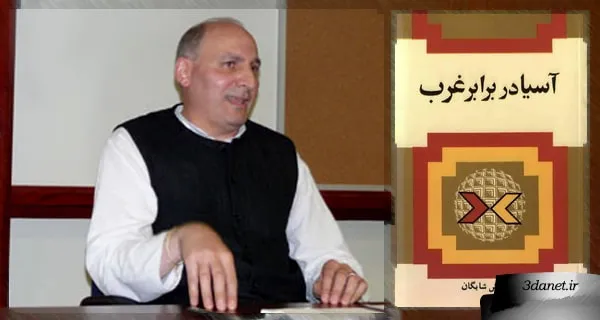
After the Islamic Revolution, Shayegan parted ways with traditionalists such as Ahmad Fardid and Seyyed Hossein Nasr, who negated the West, modernity, and its achievements, including democracy, and he revised many of his views in the book “Asia Against the West.”
Acknowledging the flexibility of cultures and civilizations, he declared that he does not support the view that the West, modernity, and its achievements are in decline and should be abandoned. Instead, he came to believe that “today, the problems of the West are no longer confined solely to the West but have become problems of planet Earth; they are our problems too, and these problems will only be solved through the convergence of efforts from all sides.”(4)
Elsewhere, regarding the issues and problems of the Islamic world, he says: “The problem of the Islamic world lies in its defensive reactions, in its intellectual blockages or closures, and above all in this claim that it has ready-made answers for all the world’s problems. We must learn a little humility, a little understanding of the relativity of values.” (5) Shayegan spent years of his scholarly life trying to reconcile modernity and its achievements, including democracy, with religion and tradition, and to link the myth-making Eastern worldview with the rational and profound-thinking Western world.
.
. Endnotes:
1. Dariush Shayegan, Under the Skies of the World, translated by Nazi Azima, Tehran, Forouzan Publishing, 1376, p. 46
2, 3, and 4. Ibid., pp. 47, 130, and 289
5. Ramin Jahanbegloo’s conversation with Dariush Shayegan, Kelk Magazine, No. 53, 1373, pp. 271-303 .
. Author: Hassan Salami (Researcher and Journalist)
Source: Last page of Iran newspaper, dated 12 Bahman 96
.
.

Discussion0 comments
No comments yet; let yours be the first voice.