Philosophy
“The Ideologization of Tradition” by Dariush Shayegan
In this essay, Dariush Shayegan examines the relationship between ideology, myth, and tradition, showing how tradition, once it enters the arena of modern political and philosophical competition, unwittingly adopts the logic of ideology. Through a critique of false consciousness, vulgar Marxism, and unreflective Westoxification, the text argues for the necessity of a critical stance toward the ideologization of religious and traditional thought.
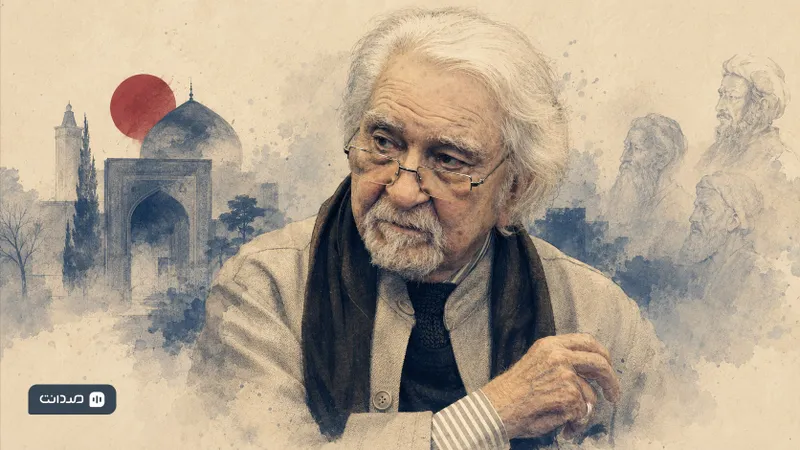
Dariush Shayegan
AuthorThe Ideologization of Tradition
Author: Dariush Shayegan
Translator: Mehrdad Mehreban
Source: Kiyan, Year 4, Khordad 1373, No. 19
Note:
Much has been said and written about the Islamic Revolution, its preliminaries, concomitants, and developments, in the realm of thought and the arena of practice. But it goes without saying that not all of these writings are on the same level in terms of theoretical richness and enlightenment; moreover, even among works that have looked at this issue with a deeper vision, there is no agreement or consensus, and at times the differences of opinion are so great that they make any kind of balance, at any level, impossible. Thus, the diversity of perspectives in this field provides the necessary basis of legitimacy for fueling this discussion.
Without any particular inclination towards any of these views, Kiyan considers the diversity of opinions as the groundwork for a useful and necessary discussion and wishes to dedicate a number of its pages to a forum for such discourse. With such an approach, quibbling over the details of these discussions, including the text below, pales in comparison to its general benefits and loses its significance.
1. What is Ideology?
The first point that can be made is that ideologies in the contemporary world play the same role that myth played in the ancient world; on the one hand, they fill and satisfy the collective spirit or mind of a group with the conception of a closed society, and on the other hand, they claim to be scientific and therefore consistent with experience and reality.
Every ideology possesses a great emotional charge that makes it akin to passion and pathos, and also has a logical-rational apparatus that gives it a scientific and philosophical appearance; nevertheless, ideology is neither science, nor philosophy, nor religion.
In fact, if science is a precise, impartial, and experience-based system, ideology, in contrast, is founded on dogma and does not care whether its presuppositions and premises have empirical precision or not, because it accepts these as a priori truths. In other words, ideology does not seek to subject what it proclaims to test and scrutiny. In this regard, Jean Lapierre says: "Scientists pay particular attention to experiments that could show the falsity of their hypotheses, whereas ideology does not want to know at all that there is something that could demonstrate the falsity of its dogmas."
Ideology is not philosophy either, because every true philosophy is in fact a question about the fundamental problems of existence and the conditions of human life. The questions that philosophers pose and the answers they obtain constitute the dialectical process of the course of philosophy, whether this process is the gradual objectification of spirit or mind in history or its concealment. But ideology is a closed and internally sealed system whose "central core is formed by a few half-truths that are presented as truths possessing universal and absolute value and validity, and this despite all the reasons that can prove the opposite."
Ideology is not dialectical thought either, because it fears negation and is imprisoned within the limits of the internal logic of its own prefabricated ideas and the deductions arising from them. Hannah Arendt says: "Ideology is precisely what its name indicates: the logic of ideas... Ideology treats the sequence of events as if this sequence followed the same lawfulness that the exposition of its idea presented." Elsewhere, Arendt says: "The accepted axiom of ideologies is that, in a discussion proceeding from a premise, a single idea is sufficient to explain everything, because the coherent course of logical deduction itself contains everything."
For example, if the core idea is that only the race that is superior should survive, because it is naturally more deserving; or that only the class possessing a historical mission should triumph; or that only those things stated in sacred texts are true, then, based on the reductionist logic of ideologies, one can conclude that, in the first case, the "unworthy" and "inferior" races must be eliminated; in the second, the "decadent classes" must be destroyed; and in the third, the world must be cleansed of the existence of infidels.
Although the logical apparatus of ideology is rational, the premises upon which it is built are irrational and are not only not "self-evident and clear ideas," but also originate from fanaticism (Fanatisme). In other words, while ideology follows a binary logic (logique binaire), its driving force arises from the logic of dreams; meaning that although ideology, in its external aspect, adheres to the principle of the excluded middle, its internal driving force is constituted by magical categories. It is from here that ideology's resemblance to myth arises, which we will address later.
Thus, in ideology, we witness the superimposition of two types of thought, each of which alters its own mold and adapts to the other.
Finally, ideology is not religion either, because it negates transcendence (transcendance) and any form of revelation and inspiration. Ideology can, in a sense, be called the "illegitimate child of the Enlightenment."
Consequently, ideology can neither extend its influence into a realm whose traditions have been sanctified, nor into a world governed by philosophy. Ideology enters the field when these two worlds have reached an impasse; that is, when negation is negated and philosophy is sidelined from the vital center of social life, and when the force of religion weakens. The success of ideology is born from fulfilling two basic and vital human needs: the need to believe and the need to explain and justify this belief.
A: Ideology and False Consciousness
Joseph Gabel is a researcher who has researched and reflected more deeply than others on the concept of ideology and its relations with false consciousness. He has, by his own account, striven to create a coherent intellectual tableau in this field. To this end, he draws on Max Weber and his theory of ideal-typing: "By the one-sided accentuation of one or more points of view, and by synthesizing a mass of diffuse, discrete, more or less present and occasionally absent concrete individual phenomena, which are arranged according to those one-sidedly emphasized viewpoints into a unified analytical construct, an ideal type can be formed."
Joseph Gabel, furthermore, mentions the reifying nature (nature réifiante) of ideology, whose task, in the view of François Châtelet, is "to perpetuate the existing state of affairs"; he then addresses its Manichaean nature, whose task, from the perspective of Maxime Rodinson, is the idealization of one's own group and the demonization of the opposing group; and finally, he turns to Lucien Goldmann and finds in him two other aspects that, in his view, play an essential role in constructing an ideal type: one is the detotalizing vision (Vision détotalisante) and the sub-dialectical (Sous-dialectique), and the other is egocentrism; thus ideology can be considered the expression of an illusion of centrality. In this way, there is a striking symmetry between reification, self-idealization, egocentrism, and the degradation and weakening of the dialectical characteristic.
Joseph Gabel concludes that: "Ideology is a system of ideas that is sociologically linked to economic, ethnic, and partisan groupings and expresses, in a more or less conscious manner, the interests of the group in an unconscious form, by resisting change or by disintegrating systems. Therefore, ideology is the theoretical crystallization of false consciousness."
To put it simply and clearly, ahistoricism in ideology leads to a "political Eleaticism" in which identification and homogenization play a fundamental role. Joseph Gabel considers the ideology of Stalinism a model and exemplar in this regard and writes: "In the world of Stalinist thought, granting a central and privileged position to the Party—or, more precisely, the triad of Party, Soviet Union, Stalin—entails a Manichaean vision of history; for it understands history as a battle between two cohesive, uniform, and monolithic groups. It is here that the tendency to identify the elements of the outgroup with one another originates, and likewise the tendency to explain history as the triumph of a conspiracy and a transhistorical faction."
Nevertheless, although identification and homogenization constitute a valid technical epistemology, it is also an anti-dialectical technique. Thus, the foundation of ideology rests upon a fundamentally anti-dialectical thought. [...]
On the other hand, ideology, due to its tendency toward homogenization, bears a striking resemblance to the categories of mythical thought. Just as the structure of these categories bears no resemblance to the order of dialectical reasoning and intellect—since in these two realms, space, time, and causality possess different qualities—ideology, too, has its own spatial, temporal, and causal categories. To become acquainted with an example of mythical homogenization, we turn to Ernst Cassirer. He writes: "Scientific cognition can only connect elements on the condition that it first separates them through a critical movement, whereas myth, in principle, rejects anything that impairs its indivisible unity." Cassirer adds: "The sole principle upon which mythical thought rests is that the whole of the mythical substance manifests itself in the part."
In ideological thought, too, homogenization and identification play an important role. Gabel says of Nazi ideology: "The Jew, whose identity is always Jewish, is sometimes identified with the capitalist, sometimes with the socialist, and sometimes with the Zionist; and in any case, is always regarded as the sole transpatial cause of everything negative that can be found in history." This recalls the descents of Vishnu, who sometimes appears in the form of a boar and sometimes as Krishna, yet in all his forms and incarnations throughout the cosmic ages, always preserves his identity.
Juxtaposing ideological categories with the categories of mythical thought can undoubtedly demonstrate that both originate from a common unconscious source. But if the unconscious can, in the world of myth, be a suitable instrument for externalization through embodiment in the symbolic projections of the human mind and spirit, ideology, by contrast, can be seen as the irrational and sometimes delirious manifestation of a repressed unconscious that emerges haltingly and by detours, seizing mind and spirit and producing a "false consciousness"—a consciousness based on schizophrenia and egocentrism, severed from external reality.
In other words, ideology interprets and construes reality within its own specific conceptual and perspectival limits; a domain in which "essences are obtained through an egocentric path and find a privileged logical position in a dogmatic manner." Ideology is therefore a closed and dogmatic thought that shuns empirical verification. For this reason, according to Joseph Gabel, ideological thought is an anti-dialectical and ahistorical thought whose nature is constituted by homogenization and identification. In other words, as Gabel puts it, the egocentrism of ideology transforms time into a spatial dimension.
B: Ideology and Political Myth
Cassirer explains, regarding the relations between politics and ideology, that the new political myths are strange, paradoxical things; for in them we witness the juxtaposition and proximity of two forces that seem to negate one another. The new political man must play two different and incompatible roles at once; he must be both homo faber and homo magus; he must be both the preacher of a new, irrational religion and propagate this religion in a systematic manner. In this way, ideology is the point at which the myth of reason and the myth of life—logos and bios—meet, and rational and natural matters join together and become one; for the myths of the modern age, however rational they may be, are still based on a mixture of mythical and allegorical conceptions that draw from both logos—reason—and bios—life. In them, alongside utilitarian reason (raison utilitaire), one can always see an essential element of a wild naturalism.
To complete the discussion, it can be added that ideology lies on the border between the unconscious and the conscious; its magical and irrational categories arise from the symbolic or allegorical role of the unconscious, and the functioning of its rational apparatus is the instrumentalization of reason.
Thus, the irrational force of ideology comes from the repression of psychic suggestions and projections; that is, from an unconscious that has lost its natural symbols and allegories and is a storehouse of fragments of shattered mirrors. But since "whenever an important part of consciousness loses its value and consequently disappears, a counterpart emerges in the unconscious to take its place," this compensatory characteristic causes ideology to possess an emotional charge almost equivalent to faith. Nature and history, thanks to the emotional charge the unconscious bestows upon them, acquire a more or less numinous power (puissance quasi numineuse). An unconscious deprived of its suggestive power and its symbolic and allegorical force can sanctify any external idea in order to satisfy its need, even through deviant means.
It is for this reason that there is talk today of political myths; that is, of ideologies that, by dint of their power and emotional impact, have taken on the sacred character of a myth. These ideologies or political myths can, as Hermann Rauschning says, be divided into three groups: 1) those that, as myths of justice, freedom, equality, and progress, use reason in this very form; 2) those characterized by biological myths, such as the myth of the folk or people, race, strong and healthy humans, and also by the stirring myths of the life force; 3) those that appear as instruments for giving reality to an existential void, such as the myths of the state, revolution, the majority, socialism, and communism.
Rauschning adds that, in the midst of this, the only thing that has been done is "the deification of means" (die Mittel zu vergöttlichen) and the making of an absolute entity out of everything that is intermediary; now it is the political system itself that turns everything relative into an absolute.
C: Ideology as a Two-Faceted and Reductionist Structure
The word ideology was first used by Destutt de Tracy, a pioneer of positivism and heir to Condillac's sensualism, in 1796. By ideology, he meant the investigation of ideas as objective things, independent of any metaphysical coloring; a kind of natural science of ideas, like botany and zoology, a study both empirical and logical of their origin and their relations with one another.
Ideology is the natural offspring of a fundamental rift; a rift between faith and knowledge, between religion and philosophy; a rift that inevitably, as a force of negation and, therefore, as a force of nihilism, causes the collapse of the human being's ontological vision. Consequently, ideology is a form of thought that strives, in a reduced space, to satisfy both the capacity for creating ideals and the requirements of reason. In this way, ideology, as a structural framework and mold, is a thought that is reductionist at its foundation and based on the sublimation of instinctual material. Ideology, which is fundamentally monistic (unitary), leads to Manichaeism or pure dualism.
Through differentiation and opposition, within a general causality (whether this cause is the "libido" or sexual instinct, the "will to power," or the "mode of production") it can, for example, in the context of psychoanalysis, become the two figures of the "ego" and the "superego" at the dawn of the unconscious world, and in Marx, take the form of its own socio-economic infrastructures and superstructures. [...]
The core of all ideologies must be considered illusion in its Freudian sense. When what dominates the world is neither dialectical philosophy nor the language of myths, but ideological thoughts, all the interpretations that the various strands of thought offer us in this regard, and all critical and evaluative approaches to the process of ideologization, are valid in their own perspectives; for they all help us to reveal that "false consciousness" which constitutes the structure of all forms of ideology.
It is for this reason that Janine Chasseguet-Smirgel is right to write: "I define illusion (as a type) precisely thus: believing in the possibility of reuniting and recovering the unity of the 'ego' and the 'ideal'; the possibility of regressing until reaching the lost perfection. In my view, at the heart of all ideologies lie illusions of this kind: the times will change, our needs will be met, our thirsts will be quenched, the Aryans will rule the world forever, dawn will break, tomorrow will be full of songs and anthems, and... and finally the world will be filled. Thus, the common core of all ideologies is nothing other than the illusion of the possibility of recovering humanity's original perfection." All these views are correct, because the "ego" and the "superego" have always been the superstructural forms of an instinctual force (Id), which is illusion itself; that is, the privileged form of the reality-testing of denial and repression. [...]
Thus, it can rightly be said that ideology is "a system of thought that appears rational, but in truth promises the reality-testing of illusion."
2. The second consequence is that ideologies can only emerge and assume such a role in a world where cultural systems (canons culturels) have been shattered; a world where beings, which should reflect Being, have become shattered mirrors, and the link between Being and beings, the link that makes one the manifestation of the other, has disappeared and been replaced by dispersed beings that can only reflect the various aspects of Being through the distorting prisms of their delirious structure.
In this way, any mental effort in relation to totality will yield an inverse result; that is, it will lead to a totality-shattering (infra-dialectical) vision of truth and, from there, to a self-centered consciousness cut off from reality. To speak in the language of Carl Gustav Jung, the collective unconscious of ideologies is an unconscious that, due to the repression of the allegorical or symbolic forms that were previously embodied in the objective structure of cultural systems, no longer has an ontological counterpart in the world; such that, deprived of its symbols, it turns again to reified objects such as class, state, history, etc.; objects that, by virtue of this renewed investment, acquire a more or less sacred charge and become false gods.
At this moment, beings have lost their original form to be elevated to the level of an absolute—an absolute that has been re-sacralized—and are integrated, in their final forms, into totalitarian myths in which "the means has become God" and "the relative has become absolute." In other words, ideologies take a fragment of Being, endow it with divinity, and seek to attain a totalizing vision, but end up with a shattered (Sous-totalité), alienating, and delirious vision. [...]
Today, from Habermas's perspective, what legitimizes domination is technological ideology. Consequently, ideology appears as the final link in that chain of historical substitutions to which Nietzsche alluded. Habermas says: “We have reached a level of generalization where we can say that what Max Weber called secularization has three distinct levels: the traditional worldviews have lost their power and potency 1) as myth, official religion, public rites, justificatory metaphysics, and broken tradition, and have instead been transformed: 2) into ethics and subjective beliefs that reinforce the obligatory and private nature of the new orientations with values; and finally, these worldviews are manipulated, reinterpreted, and transformed into: 3) constructs with a dual role, both justifying domination and weakening the contents of tradition, thereby rendering them psychologically usable... It is only then that ideologies in the strict sense of the word emerge. Ideologies assume the role of legitimizing domination, yet at the same time they present themselves as proponents of modern science and knowledge and opponents of ideology, thereby justifying themselves.”
In this process, the autonomy of knowledge and science is lost and replaced by the dependency of science; such that the technologization of science leads to the scientization of all knowledge and increasingly encroaches upon the realm of culture and the human sciences. Thus, in the final analysis, technology becomes a legitimation for both post-industrial capitalist systems and socialist systems. This is the very process of convergence between East and West that Habermas refers to with the term “convergence theory.”
3. But if, as Max Weber rightly says, ideology is born of secularization and is the consequence of new forms of substitution, then how can it be a point of convergence not only between East and West (according to convergence theory), but also between the West and the Third World (as political ideology)? For ideology is as much anti-religion as it is anti-philosophy, and is as far removed from Eastern mysticism as it is from the dialectical dynamism of Western thought; and since it stands between the two, it possesses the flaws of both.
The third consequence is that, as Jules Monnerot says, “ideology is a thought charged with emotion in which each of the two elements [reason and emotion] corrupts the other.” And one might even say it is a hybrid thought in which, just as emotion corrupts and perverts reason, reason also paralyzes emotion. Similarly, from a typological and anthropological standpoint, it is the point where, in the words of Ernst Cassirer, homo magus encounters homo faber. And just as in this confrontation the place of the human being who possesses both of these aspects is empty, so too in the reductionist structure of ideologies, the place of a world as an autonomous truth independent of thought is empty. [...]
D: The Instrumentalization of Reason
The fourth reason is that although ideology can appear as a reasoned, rational, and coherent discourse, its reason and rationality bear no resemblance to reason and rationality in philosophy; it is neither the Platonic Idea (Form), nor the Logos, nor the Active Intellect of the divine sages (intelligence agente des théosophes), nor the primordial intellect of Samkhya (Mahat buddhi du Sâmkhya); rather, it is an instrumental, stupefied, distorted, and therefore subjective and formal reason.
Horkheimer says in this regard: “Reason that loses its autonomy becomes an instrument, and in its formal aspect as subjective reason, which positivism further reinforces, the absence of a relation to an objective content becomes ever more conspicuous... Henceforth, reason is completely subjugated to the social process; its sole criterion is its operational value and its role in dominating human beings and nature.”
Nevertheless, the great philosophical systems (Plato, Aristotle, medieval Scholasticism, German Idealism, etc.) were founded upon what Horkheimer calls the objective conception of reason. This conception constituted a harmonious and hierarchical whole that encompassed all beings, and the subjective reason within it was in fact considered a partial and limited expression of universal reason, its criteria derived from it. Hence, the emphasis there was placed on ends, not on tools and means.
Thus, it is necessary to distinguish this reason, which is an intrinsic part of intelligible reality and is in fact one with the order of the world's being, from that other reason; that is, from the reason that is nothing but the mental faculty of the human spirit for calculation and for "coordinating the appropriate means to achieve a given end"—in other words, from reason that has "lost its being."
This concept of reason can be found in the past, during the Renaissance, in thinkers such as Machiavelli and Bodin; that is, at the time when the bourgeoisie overthrew the feudal system, which was governed by faith and logos, and introduced an instrumental system that, meanwhile, sought to present this concept as if it were universal and total reason. The English thinkers Locke and Hume later also employed this same concept of reason.
However, one should not assume that the relationship between these two kinds of reason was irreconcilable and hostile, for from the very beginning, both the subjective and objective aspects were equivalent, and "a long evolution was necessary for the primacy of the former to become established." The crisis began when thought was emptied of its metaphysical content and reached a point where it negated them and then deemed them illusions; such that the fundamental concepts, emptied of content, became mere formal shells. Reason, as it becomes subjective, becomes formal. This formalization causes reason, for which any content, end, or goal—good or bad—no longer makes any difference, to turn into a fetishized (fétichiste) reason.
Reason, whose task was to guide the relationship between ends and means, now becomes indifferent to ends and thus becomes its own end and purpose. Consequently, it can serve inhuman ends, become a weapon of repression, and accelerate the process of descent into barbarism. Reason emptied of its content destroys itself and "by destroying all concepts, also destroys its own concept"; and thus, by becoming instrumentalized, it becomes irrational and submits to the interests of privileged groups in society.
Horkheimer believes that the representatives of the Enlightenment, by attacking religion in the name of reason, in fact destroyed not only the Church but also the concept of objective reason. All the great ideals, such as justice, happiness, tolerance, and forbearance toward the opponent, which were previously viewed as intrinsic and immanent components of reason, have lost their rational roots. "They are still ends and purposes, of course, but there is no longer a rational arbiter to evaluate them and place them in connection with an objective reality." Now the only authority that exists is science, which is itself considered as the classification of facts and the calculation of probabilities.
Nevertheless, the enfeeblement of reason harbors another danger: the more reason loses its authority, the more foolish and instrumental it becomes, and to the same extent, it becomes more alienated from its roots and origins and more subject to the abuse and manipulation of the instincts and Manichaean tendencies of the human spirit. Such that the progress of enlightenment itself gives rise to a new myth. "Every philosophical, ethical, or political idea, when severed from its historical ideas and origins, can become the nucleus of a new myth." It is this very point that causes the progress of enlightenment, at certain moments, to tend toward a regression into superstition and paranoia.
This dialectical relationship between myth and reason is the subject of a book entitled Dialectic of Enlightenment (Dialektik der Aufklärung), which Horkheimer co-authored with Adorno.
E: The Dialectic of Myth and Reason
If reason, in becoming instrumental, lapses into a natural state in a regressive course and causes nature, in retaliation as it were, to return reason to a pre-historical era, it is because, from the very beginning of the Enlightenment, myth itself is in fact reason. These two theses, namely that "myth is already reason and reason reverts to myth," are explained in the discussion of Horkheimer and Adorno.
In the first thesis, the dialectic of myth and reason is examined in Homer's Odyssey, since this epic is one of the earliest documents "representative of bourgeois civilization." The second thesis concerns thinkers such as Kant, Sade, and Nietzsche, who pushed reason to its ultimate conclusions and thereby made the self-destruction of reason possible; that is, the regressive course of reason into a natural state and, finally, its self-destruction in totalitarian systems.
From the perspective of Horkheimer and Adorno, the myth of Ulysses is the first starting point of the Enlightenment. In fact, the cunning Ulysses, by escaping the trap of magic and the sorcery of priests and fleeing the clutches of the mythical, evades sacrifice, although he only seemingly submits to it. This cunning in the face of the forces of nature is the origin of Enlightenment reason. By asserting his existence and emphasizing his "self," Ulysses overcomes myth and stands up against it. But the story of this victory is also the story of the sacrifice of this sacrifice. If man overcomes myth only by sacrificing his nature and only by emphasizing his "self," which emerges from him as enlightened reason, then nature also rises up in rebellion and vengeance against man, turning his reason back into myth and making it an instrument in the service of instincts and private ends; a goal that does not escape the confines of reason itself. In short, it brings it under the subjugation of the unconscious forces of nature. [...] The more man employs nature, the more he lapses into a regressive course toward nature.
Thus, "the spell of inevitable progress is inevitable regression." Any attempt to shatter the bonds and coercive force of nature inevitably leads to a more domineering subjugation to a type of nature. And so it is that "Western civilization has gone astray." Abstraction, which was the tool of reason, now shares the same fate as the object of its cognition, the very concept of which it has annihilated. This is an action for which no name can be found other than a settling of accounts and total liquidation. Liberated human beings, under the domination of a leveling abstraction according to which everything in nature is reproducible, and under the domination of the industry for which abstraction organizes this reproducibility, have themselves become a "herd" which, according to Hegel, is the "product of reason."
This organized abstraction incapacitates human beings; for nature, by sacrificing the human faculty of thought and rigidifying and reifying it into a calculating machine indifferent to the ends it serves, takes revenge on man and degrades him ever more to the level of a predatory animal. Moreover, the more man forgets reason, the more reason seeks vengeance on the one who has forgotten it: the fulfillment of reason is ever more delayed, for not only does it not flourish, but on the threshold of the new age, it leads to a technological ideology that no longer exempts any part of life, not even the private part, from its encroachment; that is, it leads to a fall into the depths of the instincts.
Such is the dialectic of the Enlightenment, which places critical thought in a situation as if it were crossing a razor's edge; thought must avoid the homogenizations of new societies and know that "dialectic is a rigorous method based on non-identity and this-not-that." Therefore, it must refrain from any leveling of the individual with this or that collective form, such as the Hegelian totality, the classless society, and the like, and on the other hand, absolutely guarantee the totality of the human individual with regard to its nostalgia. This is where a Kierkegaardian leap becomes necessary.
Horkheimer, too, ultimately arrives at this same nostalgia. In 1970, on the threshold of death, in an essay depicting the course of critical theory over nearly fifty years, he writes: “We must cling to the nostalgia that the injustice and barbarism ruling the world are not the final word, but that there is also an Other; and this is something we tell ourselves through what we have named religion.” And he concludes: “In that case, what does Adorno’s prediction, in which I also consider myself a participant, consist of? It consists in this: that one must, despite everything, strive to do what one can and give reality to that which one believes to be true and right; and in this, the principle is: to be despairing in the realm of theory and optimistic in the realm of praxis.”
But leaving this point aside, the question still remains as to what the dialectic of myth and reason is in our belief, and whether we can apply the same reasoning to the great spiritual and intellectual structures of traditional societies.
This reason that reverts to myth and is thereby transformed into ideology already presupposes a split in the human spirit and mind; a split that is in fact the very rift we spoke of earlier; for this rift separated philosophy from religion, the soul (l'âme) from the spirit (l'esprit), and objective categories from subjective ones. In fact, its starting point was a disintegration that some Renaissance thinkers named; the loss of the human being's ontological framework and, in other words, demythologization. Each of these ruptures was in fact a subtraction and diminution from the world, from the spirit, and from the mind, and in short, from the spiritual-religious universe of humankind. And it is perhaps in this sense that we must consider the denial of nature or the sacrifice to which Horkheimer and Adorno refer.
This degradation and these subtractions and diminutions also encompassed the talents and faculties for allegory-making, which in the vision of the mystical human being possessed a non-abstract reality. The exemplary content of time, the essential forms of nature, intuitive knowledge and the allegorical aspect of knowledge in exemplification and engagement with the archetype, the godlike nature of the human being—all of these declined and vanished. This caused the spirit, bereft of being, to enter the service of the instincts and, in a regression toward the very nature it sought to deny but imagined it had tamed and domesticated, to slide back. Nature, in turn, took its revenge and ideologized its own magical categories.
What we can say by way of conclusion is that ideology, insofar as it puts the mind at ease beneath a rational and historical veneer by providing simplistic explanations of phenomena, and insofar as it is a hybrid form of thought, has become the only form of Western thought that is digestible in other cultural spheres, such as the Third World, which did not participate in the second leap of the age of science and technology. This point clarifies why leftist, utopia-laden ideologies have found so many adherents in the Third World, and why myth, which is the intrinsic cause of ideologies, so readily conforms to the religious spirit and mind of Third World civilizations.
Third World civilizations can only become secularized through ideologization, because they have not traversed the age of science and technology, the era of Enlightenment, and the adventurous course of the dialectic of reason. Only the critical consciousness that in the West can prevent excesses in dogmatic thinking and is in fact an antidote to the process of ideologization has no effect on them.
The severe shocks that the Iranian Revolution created, both in the thought and values that were dear to us and in our daily habits, must give us cause to rethink the relations between civilizations. This does not mean looking at these civilizations as if they were two different worlds that stand geographically opposed to one another and are also culturally opposite poles. We must consider them as two constellations whose stars are constantly merging into one another, one entering the other, thereby creating hybrid and indeterminate concepts that, in the eyes of the astute researcher, reveal the incompatibility of the ideas that exist at the foundation of each.
اما تشبهناپذیری این دو جهان هنگامی باز هم بیشتر نمودار میشود که آنها را در شکل نابشان مورد توجه قرار دهیم؛ یعنی همهٔ شباهتهای دروغین را که مفهومهای بنیادیشان را پوشانده، کنار بزنیم. اما این شکل ناب را تنها در متن تاریخی میتوانیم دید و نه در وضع کنونی این تمدنها؛ زیرا در اینجا فراوانی برخوردها چنان آب را گلآلوده کرده که برای آنکه بتوانیم نص صریح و راستین ایدههایی را که همه با هم یکی شدهاند بیرون بکشیم و ناسازگاری آنها را با یکدیگر نشان دهیم، باید همه چیز را زیر و رو کنیم و از بسی رمز و رازها پرده برداریم.
یک مثال بزنیم: اصطلاح «انقلاب اسلامی» چه معنایی دارد؟ در اینجا با دو واژه روبهروییم که در نگاه نخست به نظر میرسد با هم سازگارند، زیرا ظاهر امر حکم میکند که بگوییم ایدههایی که این دو واژه حامل آن هستند به واقعیت پیوستهاند. این دو واژه نه مایهٔ جا خوردن شرقیانی میشوند که آنها را به رخ دیگران میکشند و نه غربیانی را برمیانگیزند که آنها را به مقولههای جاری ذهن خویش تشبیه میکنند.
اما به راستی این دو واژه چه معنایی دارند؟ اگر به واژهٔ «انقلاب» بیندیشیم، ناگاه رگباری از ایدهها بر ذهنمان باریدن میگیرد: ایدههای دوران روشنگری که مقدمات این انقلاب را فراهم کردند، اصحاب دایرةالمعارف، اعلامیهٔ حقوق بشر؛ و بعد، به زبان هگل، ناپلئون بناپارت، این «روح جهان» سوار بر اسبی سپید؛ ضرورت تاریخی که از هیچ چیز درنمیگذرد و هیچ چیز جلودارش نیست؛ و سرانجام، به زبان کارل مارکس، مبارزهٔ طبقات و سرنوشت پرولتاریا که نجات بخش بشر است. از دیدگاه فلسفی هم به یاد نیروی نفی میافتیم: ساختار دیالکتیکی خرد در ذهنمان نقش میبندد؛ خردی که در نفی خویش از خویش برمیگذرد و به یمن سنتزهای برین به آزادی ذهن، به خودمختاری خرد و به خودآگاهی میانجامد.
و اما از اسلام - یعنی تسلیم بودن به ارادهٔ الله - چه به خاطرمان میآید؟ به قرآن میاندیشیم، به این کلام مقدس، به وحی و الهام، به روح رسولالله، به سلسلهٔ انبیا، از آدم، نخستین انسانی که در شباهت با خدا آفریده شد، تا محمد که خاتمالانبیاست؛ سلسلهٔ کاملی که مظهر تام و کمال حقیقت محمدی - لوگوس - است و انبیای پیشین تنها تظاهر جزئیاش بودهاند... و در پایهٔ این سلسله، واقعهای ازلی یا متاتاریخی: پیوند با خدا، بار امانتی که از روز ازل بر دوش آدمی نهاده شده است؛ امانتی که پیامبران پیوسته با آن تجدید عهد میکنند تا نوبت محمد فرا میرسد و او برای همیشه سلسله را میبندد.
و سرانجام، اگر دین مورد توجهمان تشیع باشد، به یاد سلسلهٔ ولایت میافتیم که درست هنگامی آغاز میگیرد که سلسلهٔ انبیا به پایان رسیده است. در ولایت، روح رسولالله از این امام به آن امام میگذرد تا به امام دوازدهم میرسد؛ و غیبت کبرا و بازگشتش در آینده برای برپایی عدل و داد در جهان.
بنابراین، این دو اصطلاح، با این دو جهان - انقلاب و اسلام - هیچ خویشاوندی هستیشناختیای با هم ندارند. هر کدامشان در کهکشانی دیگر قرار دارند، نقطههای مرجع و نیز محوری که به دورش میگردند رنگ و بوی متفاوت دارند و دارای استقلال مختلفی هستند. اگر آنها را با هم مقایسه کنیم، خواهیم دید آنچه در اولی میگذرد، ماجرای ذهن است در زمان؛ زمانی که دارای حضوری هستیمند است و به تاریخ چنان ساختی میدهد که در آن، انقلاب تبدیل به پیامد مستقیم و برگشتناپذیر نفیمندی (négativité) خرد میشود؛ حال آنکه دومی، یعنی اسلام، در بیرون از دایرهٔ نگرانیهای تاریخ حرکت میکند و به ارزشهایی سرمدی (ازلی-ابدی) معتقد است؛ ارزشهایی که نه در یک گسترهٔ جغرافیایی میتوان پیدایشان کرد و نه در دورانی تاریخی.
به بیان دیگر، دلیل وجودی واقعههایی که اجزای وجودی اسلام را میسازند، نه در یک ضرورت تاریخی، بلکه در پیشامدهایی است که در اینجا شکل دیگری به خود میگیرند و دارای بار معنایی باطنی میشوند؛ زیرا پیشامدهای تعیینکنندهٔ آن در بستر روزگار تاریخی روی ندادهاند، بلکه در یک زمان روایتگرانه یا مثالی روی دادهاند. به عنوان مثال، جبرائیل در عالم روح بر محمد ظاهر شد و قرآن از این راه معجزهآمیز به پیامبر اسلام وحی شد. در واقع، تفاوت اسلام و انقلاب در اختلاف عقیده و روش نیست، بلکه تفاوتی است بسی اساسیتر میان دو کهکشان.
But one might ask: what has happened that Western thought is no longer content with its geographical borders, namely Europe; that it spreads everywhere, overruns borders one after another, and becomes a pervasive thought present everywhere, in the public and even private lives of people? The answer is clear: it is the era of the clash of galaxies. Yet some questions remain unanswered: in the term “Islamic Revolution,” which of the two words is more active and decisive? Revolution or Islam? Is it religion that transforms the revolution and grants it sanctity? Or is it the revolution that gives religion a secular aspect, turns it into a political religion, and, in short, transforms it into an ideology? The truth is bitter, but in any case, the ultimate victor has always been planetary thinking. It is this thinking that pulls the other out of its own orbit, draws it into its own field of gravity, and imposes its own laws upon it.
It is not the revolution that aligns itself with the Resurrection or the Hereafter, or takes on an Islamic attribute; rather, it is Islam that becomes an ideology and enters history in order to eliminate the infidels, that is, the proponents of ideologies that are better equipped and, in any case, more compatible with the spirit of the age. But in doing so, it falls into the trap of the “cunning of reason”: it wants to stand up to the West, and itself becomes Western; it wants to give the world a spiritual and sacred dimension, and itself takes on a secular and worldly aspect; it wants to negate history, and itself sinks deep into history.
But has it always been this way? Why have all cultures that existed outside the Western world ultimately been compelled to accept the rules of the game as determined by the West?
3. Vulgar Marxism as an “Ideology Established in Space”
We said that a large part of humanity was left out of the current of the second cultural leap that began with the age of technology and science. This part neither witnessed the discovery of the natural sciences, nor became acquainted with progress, nor with the crises resulting from these transformations, nor did it benefit from their consciousness-raising process. Suddenly, the movement of history fell upon it like an avalanche: first through colonialism, and then with a wave of wholesale and superficial Westernization.
Everything indicates that the genealogy (généalogie) of thought and its developmental sequence remained concealed from this part of humanity [the Third World peoples]. Of course, it received scraps of this or that intellectual tendency, of this or that school, of this or that fashionable movement, but it could never participate in the motion that propelled this thought forward. Both the force that linked the various stages of this progress remained hidden from its sight, and the ontological inquiry that, with each leap forward, determined that this entire intellectual metamorphosis, from Plato to Heidegger and from Heraclitus to Nietzsche, is indeed an unbroken chain of persistent thought.
In other words, the only thing this part of the world’s people could connect with were the last links of this chain; consequently, it was impossible for them to trace the continuation of this chain back to its beginning, that is, to the dawn of the emergence of Greek philosophy, in the course of their own lives, and to grasp the lineage and genesis of the Western intellectual tradition.
The reaction of non-Western civilizations to this forced current was to adopt an extreme mode of confrontation: either they became fascinated and infatuated with the Western world to the point of self-alienation and accepted it wholly and unconditionally; or they rejected it outright and, by reviving the nostalgia of the past, regressed into populist and religious movements. Although an endless variety of different reactions can be seen between these two extreme poles, there is no doubt that the framework of vision and the categorical nature of all these tendencies express their structural homogeneity in understanding issues.
To the extent that one can say this structure, which is an inseparable part of the social mentality of the era, is itself the groundwork for any kind of thought. In other words, it is the form or mold that has placed all these reactions within its framework; that is, the lens through which we view and comprehend the real world. Just as, according to Kant, time and space are a priori categories for any perception, this dominant characteristic of the era’s mentality is also an a priori form for our worldview. The more we rage against the currents of our era, the more, without knowing it, we become their victims.
What circulates in societies as Marx's ideas is in fact a kind of dogmatic, vulgar Marxism, filtered through Leninism and distorted; a Marxism that, at best, does not go beyond the Communist Manifesto; a Marxism whose prophetic tone in the Manifesto—"The history of all hitherto existing society is the history of class struggles"—is simple and catchy, and like a religious principle, bewitches one and turns into a magical apparatus for explaining everything.
This phenomenon has several immediate ideological consequences: the demonization of the bourgeois and the deification of the proletarian—never mind that in such societies the bourgeois and the proletarian exist only in embryonic form—and, as a result, a Manichaean vision of the world; a vision in which capitalism, that is, the entire Western world, plays the role of fate; exploitation is equated with sinfulness; the bourgeois represents the demonic forces and the proletariat is the redeeming angel; revolution is the promised resurrection and the classless society is paradise lost and regained.
Thus, every mode of struggle in these societies takes on a tinge of revolutionary romanticism. For example, Marx's statement that philosophy cannot be abolished without being realized, and cannot be realized without being abolished, fuels all sorts of hopes and desires. A haphazard Marxism, like an established ideology, fills the air: a Marxism entailing the primacy of praxis, nostalgia for past revolutions, class struggle, the certainty that progress is the unquestionable result of social upheaval, and the positing of history as a lord directing the affairs of men.
These are the various components of the spirit of our age and, in a sense, its infrastructure; for this framework, which can of course take different forms within the context of this or that society, constitutes the skeleton of all religious and non-religious tendencies that seek to establish themselves in the socio-political system; tendencies that either rise up in the name of tradition under the banner of leftist doctrines against the West, or under the flag of their religious traditions, imagining they can take a shortcut through history and spread justice and equity in the world.
But as soon as these traditions assume a specific political and even philosophical form, they unwittingly and unknowingly become part of the current categories we have described. Then, through these sociological lenses, they view and reinterpret values that, at their foundation, have always lain outside the domain of their social and economic transformations. In this way, revolution, relations of production, the teleology (téléologie) of history, and the utopia of a uniform (classless) society form an immutable framework that can accommodate any creed or thought.
The crucial point is that as soon as this content becomes the ideological infrastructure of our time, it leaves its own galaxy, slips into another orbit, follows a different logic, and couples with colors, scents, and ideas that correspond to the concept of revolution, not to the religious framework to which that content originally belonged. Within this framework, traditional content can resonate anew, but it will never create new meaning or structure. The elements introduced into it can be novel and even spiritual, but they do not go beyond the local narrative of a universal form (Gestalt universelle); a form whose universality is now particularly widespread because it is a form of unconscious Westoxication. The result of this process is always a form of ideology.
The reasons for this are many. We will mention three:
1) The forms of imposed thought no longer possess their original purity, but manifest in extremely rigid and extremist forms. For example, if we become Marxists, our Marxism is vulgar and, at best, Leninist, and we can never grasp the scope of Marx and his humanist ideas, which were formed in connection with German Idealism and, therefore, in connection with the entire heritage of the West.
2) The imposed forms we accept have themselves already turned into ideological structures; that is, into philosophies that have become bloodless, petrified, exhausted, rigid, and lifeless.
3) These forms, devoid of any critical possibility for "assessing their various positions," allow magical content to transform itself within them and create the illusion that a genuinely new philosophical form has emerged. Throughout these homogenizations, there is a process of unconscious Westoxication, and more regrettably, those who rise up against these dominant forms are the very ones who, without any resistance, are fascinated by them and are thus deceived more than anyone else, thereby unwittingly invalidating the principles they believe themselves to be following.
The reason for this is also clear: ignoring the sea for the glow of counterfeit mirages, or in other words, rejecting these ideologized thoughts, requires a monumental task; that is, demythologization, ontological destruction, and critique on two fronts: one in the field of imported ideas, and the other in the field of ideas that some wish to elevate and turn into a specter to rival our times. On the other hand, the influence of this unconscious Westoxication not only prevents seeing the true scope of Western thought, but furthermore, with its mesmerizing allure, it also obscures the entire content of traditional ideas, such that the legacy of the past, in connection with the form of vision dominant today, is transformed only into that which actualizes first and foremost in a degraded form.
For example, freedom, democracy, the republic, and human rights are the emancipatory achievements of modern civilization. However, traditional thought, even before its ideologization, also claims to be equally egalitarian, equally in favor of individual freedoms, equally seeking justice, and that the solutions it proposes not only bring a cure for all the ills of our time but also, moreover, provide the conditions for the emergence of a new human being in a society free from wrath and conflict, in a "unified" society; and this for the simple "reason" that everything has been foreseen and written in the sacred texts. Therefore, the content of the sacred texts can only be justified if it meets the material and spiritual needs of our time, or at least if it satisfies these needs better than imported ideas.
In this way, tradition seeks to rival current ideas. But when it rises to compete with them, it has no choice but to accept their logic, and when it accepts that same logic, it inevitably changes its galaxy, emerges from the battlefield of ideology, and itself becomes ideology. In other words, it is always the very ideologies that tradition claims to confront that, in the final analysis, justify the form of tradition itself, and not the other way around. These ideologies strive to sanctify secular ideas; conversely, religions that see themselves as militant seek to secularize sacred ideas.
These two tendencies, which are two sides of the same coin, can easily be considered part of the dualistic and contradictory structure of ideologies, for ideologies, in turn, can be compatible with both a magical-religious vision and with so-called scientific rationalism.
Horkheimer foresaw this danger:
«At present there is a general tendency that seeks to revive the old theories of objective reason in order to provide a kind of philosophical foundation for the hierarchy of generally accepted values—a hierarchy that is rapidly disintegrating. What is now justified in its application, that is, in the modern era, is not only semi-religious, semi-scientific spiritual therapies, spirit conjuring, fortune-telling, astrology, or the counterfeit and worthless substitutes for classical objectivist philosophies, but also the ontologies belonging to the Middle Ages; but let us not forget that the transition from objective reason to subjective reason was not an accidental one [...]. If subjective reason, in the form of the Enlightenment, destroyed the philosophical basis of beliefs that were an essential part of Western culture, we must note that it was able to accomplish this only because that basis itself had become very weakened. And if that basis had become weakened, the reason was again that humanity had made a great cultural leap that led it to conquer the world through the creation of a vast network of communications encompassing the entire globe; but the dialectic of ancient religions in connection with the birth of this new human can only be this human's dialogue with itself. When the consequence of any objectification of the religious world is nothing but the fall of the sacred into the trap of history, deliverance can be achieved neither by taking a shortcut nor by categorical rejection; the only way of salvation is to adopt a critical approach toward this false consciousness; false in a double sense: for it both distorts and deforms the imposed ideas that we receive as ideological packages, and also the thoughts that are our own, but which we reinterpret entirely through the prism of a false vision. This is a vision in which all the essential defects of ideology, from the instrumentalization of subjective reason to self-centeredness and the distorted perspectivization of realities, exist in an indissoluble bond. [...]»
Notes
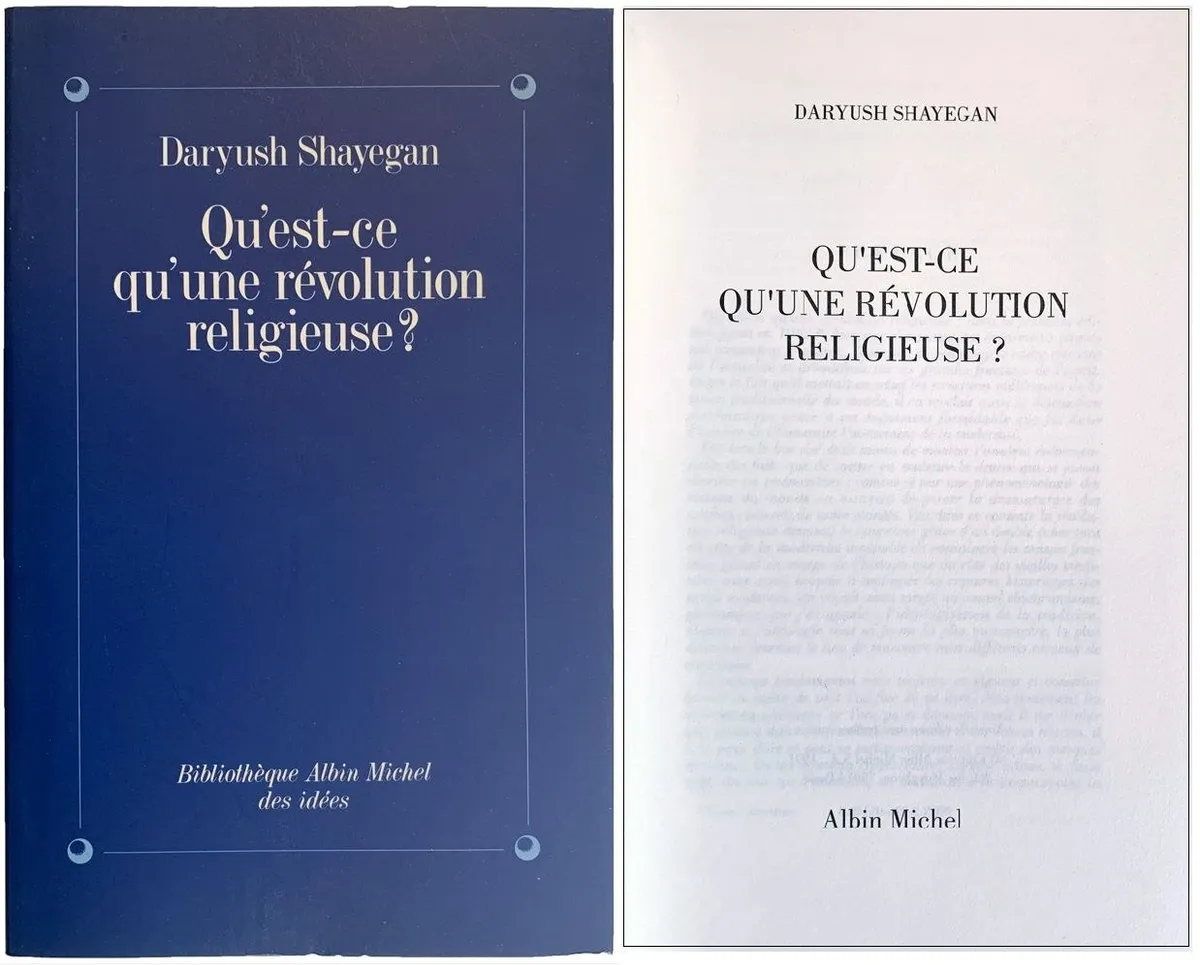
* This work is a translation of the first two sections of the fifth chapter of the book “What is a Religious Revolution?” by Dariush Shayegan, written and published in French:
Daryush Shayegan: Qu’est-ce qu’une révolution religieuse?, Ed. Les presses d’aujourd’hui, Paris, 1982.
To arrange the aforementioned sections as an independent article, with the author's consent, I have removed pieces of the text and placed the [...] sign in their stead.
In the work of translation, I have endeavored as much as possible to remain faithful to the original text. I have used existing Persian equivalents wherever I found them suitable, and wherever I found them inadequate or found no equivalent, I have coined a word myself.
Although I accepted a number of corrections the author suggested after reading the translation, the text is on the whole written in my own style and according to my own writing taste, so the responsibility for its possible errors is mine, for it is clear that if the author himself had wanted to translate or rewrite it into Persian, he would have adopted the writing style of his own liking.
The translator's explanations, whether in the text or in the notes, are either placed within [ ] or marked with “M.”
۱. Jean-William Lapierre, “Qu’est-ce qu’une idéologie?”, in Les Idéologies dans le monde actuel, Paris, 1971, p. 11.
۲. Arthur Koestler, Le cheval dans la locomotive, trad. Georges Pradier, 1968, p. 217.
۳. Hannah Arendt, Le Système totalitaire, trad. J. L. Bourget, R. Davreu et P. Lévy, Paris, 1972, pp. 216-218.
۴. Fanatisme in religious terminology is a tendency that considers itself inspired by God's revelation and therefore the only rightful tendency. — Tr.
۵. In binary logic (logique binaire), a proposition is either true or false, and any third possibility is excluded. — Tr.
۶. Max Weber, “Essai sur la théorie de la Science”, cité par J. Gabel in “Idéologie”, Encyclopaedia Universalis, Vol. 8, Paris, 1968, p. 719.
در مورد تفکیک مفهوم خاص ایدئولوژی از مفهوم عام آن نزد مانهایم، ن.ک.:
Ideology and Utopia, Harvest Book, New York.
۷. J. Gabel, “Idéologie”, in Encyclopaedia Universalis, p. 719.
۸. Eleatisme بنا به فلسفهٔ زنون و پارمنیدس ایلیایی، هستی چنان که هست، هست و میماند. ایلیاییان بر این باور بودند که دگرگونی و حرکت محال است و همانندی و یگانگی بر سراسر جهان هستی حکمرواست. ـ م.
۹. Ernst Cassirer, La philosophie des Formes Symboliques, trad. Jean Lacoste, Tome II, La pensée mythique, Paris, 1977, p. 88.
۱۰. Gabel, Idéologie, op. cit., pp. 65-66.
۱۱. Ibid., p. 287.
۱۲. Gabel, La fausse conscience, Paris, 1962, p. 71.
۱۳. Ernst Cassirer, The Myth of the State, New Haven, 1975, pp. 281-282.
۱۴. Herman Rauschning, Masken und Metamorphosen des Nihilismus, in Der Nihilismus als Phänomen der Geistesgeschichte, Darmstadt, 1974, pp. 108-109.
۱۵. C. G. Jung, Problèmes de l’âme moderne, Buchet/Chastel, Paris, 1960, p. 180.
۱۶. H. Rauschning, op. cit., p. 112.
۱۷. J. W. Lapierre, op. cit., p. 8.
۱۸. Janine Chasseguet-Smirgel, “Quelques réflexions d’un psychanalyste sur l’idéologie”, in Pouvoirs, no. 11, Paris, 1979, p. 35.
۱۹. Ibid., p. 39.
۲۰. Jürgen Habermas, La technique et la Science comme idéologie, trad. Jean-René Ladmiral, Paris, 1973, pp. 33-34.
۲۱. Cité Gabel, Idéologie, op. cit., p. 719.
همچنین نگاه کنید به:
Jules Monnerot, Sociologie de la révolution, Fayard, Paris, 1969, p. 178.
ایدئولوژی از سازش میان «تفکر عرفانی» و «طرز تفکر» و «منطق و تجربه» نتیجه میشود.
۲۲. Max Horkheimer, Éclipse de la raison, trad. Jacques Debouzy, Payot, Paris, 1974, p. 30. Theodor W. Adorno, La Dialectique de la raison, Paris, Gallimard, 1974, p. 18.
۲۳. Max Horkheimer.
۲۴. Adorno, Dialectique négative, Payot, Paris, 1978, p. 13.
۲۵. “La théorie critique hier et aujourd’hui”, in Théorie critique, Payot, Paris, 1978, p. 361.
۲۶. M. Horkheimer, Éclipse de la raison, trad. Jacques Debouzy, Paris, Ed. Payot, 1974, pp. 70-71.

Discussion0 comments
No comments yet; let yours be the first voice.