Philosophy
Ramin Jahanbegloo Discusses “Asia Against the West” at Tehran Book of the Month
The eighth session of Tehran Book of the Month was dedicated to Dariush Shayegan's Asia Against the West. Babak Mina and Ramin Jahanbegloo analyzed Shayegan's place in Iranian intellectual discourse and the relationship between conservative tradition and the Enlightenment.
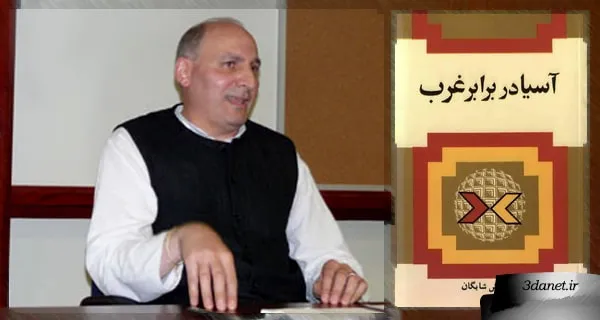
The eighth session of the Tehran Book of the Month in Khordad 1392 (June 2013) was devoted to an examination of the book “Asia Against the West” by Dariush Shayegan.
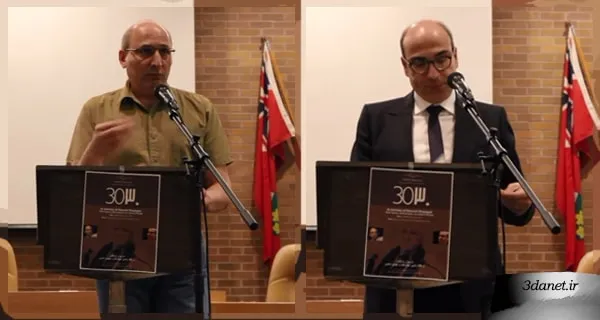
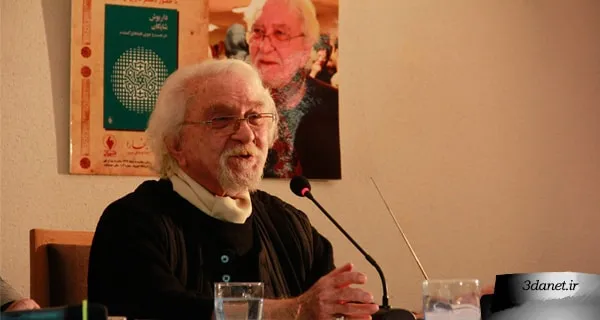
Tehran Book of the Month is held on the last Friday of every month, planned and moderated by Fereshteh Molavi, in one of the rooms of the North York Civic Centre, and as it progresses it attracts more and more enthusiasts. Fereshteh Molavi opened the session with a brief introduction to the book under discussion.
“With the Constitutional Revolution, and from the moment a nation awoke from a centuries-long slumber and beheld the beautiful giant of the modern West before it, the Iranian intellectual’s endeavor to know that which is ‘other’ and to introduce that which is ‘self’ began. From that time until now, every intellectual of every generation, according to their era, context, and intellectual capacity, has sought the reason for the confrontation between us, the Easterners, and them, the Westerners, in the struggle between tradition and modernity. Dariush Shayegan, the philosopher and Indologist, is among the renowned intellectuals of Iran’s contemporary history who has seriously engaged with this concern.
The intellectual Shayegan, in search of an answer to the above question in the book Asia Against the West, speaks of the historical destiny of Asian civilizations in their encounter with the course of evolution or the historical destiny of Western thought. From the book’s first publication in 1356 (1977) to its latest edition in 1391 (2012), Shayegan has pursued this question and its possible answers in writing and speech. In an interview with the Shargh newspaper, he says: ‘I am constantly evolving, my thought is not static… but I have both moved past Asia Against the West and not moved past it. The latest evolution was Enchantment and the Patchwork Identity.’ At the same time, in another interview (with Ali Asghar Seyedabadi / source: Iranian Institute of Researchers of Philosophy and Wisdom) about this book, he says: ‘There have been all sorts of different readings of the book Asia Against the West; whenever anyone has an intellectual dilemma, they go to this book. Perhaps it is also a good pastime for learned critics; at least it has that merit. But when I myself read this book after many years, I see that I still agree with many of its points. Perhaps I have not evolved enough.’
Perhaps it can be said that the enduring relevance and longevity of the book Asia Against the West over a span of thirty-five years, more than anything else, indicates the tenacity of that fundamental question about the nature of our confrontation with modernity and our need to seek answers. Just as this book has managed to find readers in every generation over time, it has also been successful in attracting critics and experts. Among the written critiques of this book, the review by Aramesh Doustdar (A Balance Sheet of Our Intellectualism on the author’s website) is worth mentioning.”
Next, it was the turn of the program’s remote guest. Fereshteh Molavi introduced Babak Mina, a philosophy graduate from France, in his own words:
“I was born in Tehran; I studied anthropology in Iran and philosophy in France. I still don’t know exactly what I will do in continuing my studies. To make a living, I work in journalism. My field of interest lies between philosophy and sociology, and ‘the sociology of intellectuals’ is one of the subjects that particularly attracts me. Intellectuals turn the world into a problem, constantly theorizing about the world, or striving in art and literature to narrate something of it, a moment of it. Yet, sometimes it seems that intellectuals themselves are also a ‘problem,’ and perhaps even more question-provoking than the world. My concern is this: how can we turn intellectuals into a problem and a critical question without falling into the trap of anti-intellectualism or intellectual infatuation…”
Babak Mina, in his video lecture, called Dariush Shayegan one of the most prominent and important Iranian intellectuals and said he would speak more about the historical conditions in which the book was written than about the book’s internal content.
He first situated Dariush Shayegan’s place within the Iranian intellectual arena. According to Mina, from the Constitutional Revolution until the late 1950s and early 1960s, the principal concern of Iranian intellectuals and politicians was the acquisition of the new, modern civilization, for which they proposed various solutions.
In the late 1950s and early 1960s, a fundamental rupture occurs in Iranian intellectual discourse, which is the discourse of conservatism. This discourse grows and expands in the 1970s, becomes intertwined with the Iranian Revolution—maintaining a complex relationship with it—and after the revolution takes on other forms, continuing to the present day. Dariush Shayegan thinks and writes within this discursive structure, particularly in the 1970s and in the writing of this book.
He dissected the conservative tradition and identified it as a tradition against the Enlightenment, whose most important characteristic was the value it placed on human reason and freedom.
Mina divided the conservative tradition into three branches. The first branch is the anti-Enlightenment conservative tradition, which is the most classical type of conservatism. These conservatives are close to the Romantic tradition and are usually elitist. He placed Shayegan and Seyyed Hossein Nasr within this tradition.
Another branch is radical or revolutionary conservatism, which has both progressive and reactionary aspects. He placed Al-e Ahmad and Shariati in this category.
Rationalist conservatism was the third branch, which he also called liberal conservatives, and he placed Javad Tabatabai within this tradition.
Mina described Shayegan’s book Asia Against the West as an anti-Enlightenment book and emphasized that Shayegan changes after this book and to some extent accepts the political achievements of the Enlightenment, such as democracy.
According to Mina, two characteristics of conservative intellectuals are possessing a narrative of decline and an opposition to social objectivism.
Continuing his remarks, Mina addressed Shayegan’s discussion of nihilism and identified authoritarian modernization as one of the factors behind the absurd and the divided self, which can fuel societal fissures. He explained this with examples from the revolution and the film Peace in the Presence of Others.
In the final part of his speech, Babak Mina said: The work of intellectuals is to produce ideas, but conservative intellectuals are prone to becoming enamored with ideas and considering them independently of context and reality. This is what the book Asia Against the West does; that is, it takes its ideas from a real context but removes that real context from society’s narrative, granting the ideas an independent essence. By abstracting, eternalizing, and mystifying the historical phenomenon that is the process of modernization, the book Asia Against the West essentializes it.
In conclusion, Babak Mina described the book Asia Against the West as a dream dreamt during a period of our society’s history, and added: Our task is to interpret this dream and, through our critique, illuminate something that the book tries to conceal.
(Babak Mina has not yet posted the video of his talk on YouTube. If it is published, we will add its link to the text on the Citizen website.)
The next speaker was Dr. Ramin Jahanbegloo, professor of philosophy at York University, who is also a graduate of French education. Referring to his forty-year acquaintance and friendship with Shayegan, he said:
Half a century has passed since the writing of Shayegan’s “Asia Against the West,” yet the book remains readable. This book belongs to the first period of Shayegan’s life, before the revolution. In the second period, after the revolution, the number of Shayegan’s books is greater and they are more important than this book.
Jahanbegloo addressed the book’s content and said: Shayegan, drawing on his research on India, China, and Japan, in this book posits an Eastern identity in opposition to a Western identity.
The central issue of this book, which is written from a Heideggerian perspective, is historical destiny. And it raises this not only about Iran, but at the level of the Third World. He says our historical destiny is that we have fallen behind the history of the West. We have been afflicted with a historical destiny that is not our own but has been imposed on us by the West, an issue that has caused Asia to be alienated both from the course of Western evolution and from its own situation.
Drawing on Heidegger, who was himself influenced by Nietzsche, Shayegan places the discussion of nihilism at the center of Asia Against the West. In his view, nihilism is the most important characteristic of modern Western civilization, which begins with the negation of God in order to affirm the world, but ultimately turns into a negation of the world and a pure emptiness.
Shayegan speaks of four movements that have brought nihilism into being: the first movement is the descent from intuitive vision to technical thinking, the second movement is a descent from substantial forms to the mechanical concept, the third movement is the descent from spiritual substance or the sacred to instinctual factors, and the fourth movement is the descent from mythical time to historicism (historicity). It is these four descending movements that constitute nihilism.
Shayegan believes that Asia is not so much engaged in imitation as it is in reduction.
He says we are unaware of the true nature of Western civilization. You cannot fight the West and nihilism with the weapon of ideology. You cannot critique the West and traverse the historical distance with the weapon of ideology.
Jahanbegloo emphasized that this book was written between 1975 and 1977, and its critique is directed at the Iranian left, not the religious.
Jahanbegloo raised the question of what solution Shayegan proposes. In Shayegan's view, the solution to this crisis is establishing a connection between the human being and a superior existence. Therefore, from the very beginning, Shayegan adopts a specific intellectual trajectory in which there is no political philosophy or thought whatsoever, no discussion with Iranian intellectualism, and no reference to Iranian history; rather, it takes place in another climate, which he himself calls the climate of presence or spirit.
In Shayegan's view, those who can establish a relationship between East and West are those who, like himself, know both the West and the East from within.
At the end of his talk, Dr. Jahanbegloo addressed the theoretical differences in Shayegan's early books and his more recent ones. Pointing to the influence Seyyed Hossein Nasr had on Shayegan, he also enumerated the intellectual and perspectival differences between the two.
.
The Complete Talk by Dr. Ramin Jahanbegloo:
Audio of Ramin Jahanbegloo's Talk | Video of Ramin Jahanbegloo's Talk
Q&A Session with Dr. Ramin Jahanbegloo:
Audio of Q&A with Ramin Jahanbegloo | Video of Q&A with Ramin Jahanbegloo
.
.
Related Content:
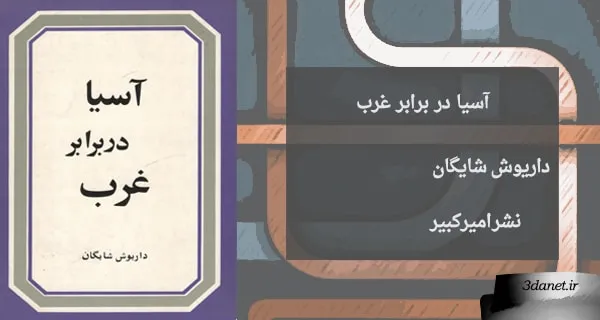
Introducing the Book Asia Against the West by Dariush Shayegan
.
.

Discussion0 comments
No comments yet; let yours be the first voice.