Philosophy
Holidays in History
The concept of 'rupture' is the keyword that draws Dariush Shayegan to write about Charles Baudelaire in The Madness of Consciousness—a conversation on the relationship between thought and art, the experience of cultural schizophrenia, and the idea of a 'holiday from history' in the encounter with modernity.
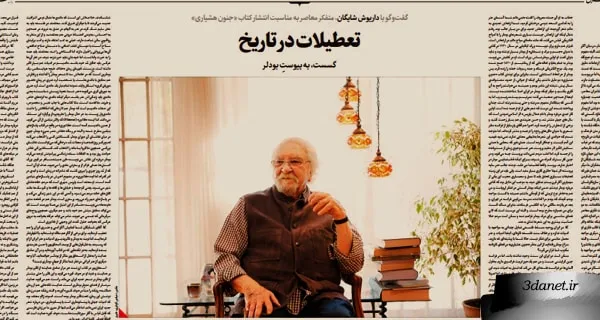
Shima Bahremand— “The Madness of Consciousness,” a study of the thought and art of Charles Baudelaire, perhaps holds a singular place among Dariush Shayegan’s other works. The concept of culture, of course, casts its shadow over all the works of this contemporary thinker. He was never a stranger to literature and art; proof of this claim, apart from the precise and abundant literary and artistic references in his works, lies in the articles and positions that reveal his relationship with literature and art. “The Madness of Consciousness,” however, stands in both continuity and rupture with his other works, and for this reason occupies a different position. He himself believes that “one learns more from literature than from philosophy.” Dariush Shayegan has now turned to one of the most important modern poets, the founder of modernity and modern poetry. And although Baudelaire’s fragmented and contradictory personality had preoccupied Shayegan’s mind since his youth, the concept of “rupture” is the keyword that prompts Dariush Shayegan to write about Baudelaire: “Baudelaire is both rupture and revolution and beginning.” A rupture that brought about modernity and modern poetry. Shayegan, too, confronts rupture or “cultural schizophrenia” in another way. In a book titled “The Broken Gaze or Cultural Schizophrenia,” he traces the concept of rupture or duality within the context of his own culture and thought and that of his contemporaries. And he speaks of the idea of “holidays in history” :
“When I look at the content of history, I see that it has come into being in my absence. Just as I did not participate in the formation of this history, I am not responsible for its consequences either. I only know this much: that this new world has an iron logic and imposes its structure upon me.”
Shayegan unveils an epistemological void: that our intellectuals and thinkers no longer have the capacity to create discourse or capture people’s minds. Just as it appears in “The Fusion of Horizons”:
“Exhausted and worn out, we set about consuming ideas, objects, and methods whose mechanisms we knew nothing about. We realized that in a world conquered by the force of technique, our old knowledge was no longer effective, just as our thoughts were gradually failing.”
These are the continuities between Shayegan’s recent work and his other writings. But by choosing Charles Baudelaire, the poet of contradictions, he surprises the reader on two counts. First, in our contemporary intellectual tradition, few philosophers have engaged with literature, let alone in a book so extensive and the result of years of meticulous attention and pursuit. And second, Shayegan’s abundant interest in and highlighting of thinkers seemingly different from his own intellectual mold in “The Madness of Consciousness” confronts us, to some extent, with another Dariush Shayegan. Walter Benjamin is a clear example of this type of thought. And of course, in dealing with Sartre’s critique of Baudelaire, Shayegan also sides with Bataille and Blanchot. In any case, apart from his characteristic openness, which one experiences in encountering him, he also shows in this book that he is an open thinker who, in addition to mastering the opinions and thoughts of thinkers from every persuasion, has the capacity to hear criticism, and from this perspective, his cultural duality becomes more apparent. For in these times, such approaches are hardly expected from our intellectuals and writers. It goes without saying that this thinker’s precision and meticulousness are always unparalleled in his scholarly works, and this can be understood from the multitude of apt references and footnotes in this single book alone. Shayegan can perhaps be called a philosopher of culture, and perhaps it is this very approach that is the subject of critique and the question of our current intellectual impasse. But we believe that, in any case, one cannot cross this “desert of ennui” without thought. Sartre rightly said that “the intellectual is, above all, a phenomenon of divided societies, and at the same time their witness; thus, it is a historical phenomenon, and no society can complain about its intellectuals without accusing itself.”
We sat down for a conversation with Dariush Shayegan on the occasion of the publication of his valuable work, “The Madness of Consciousness”:
The book The Madness of Consciousness is shocking for the reader, especially those who are more or less familiar with your works. The reader expects the book to establish an explicit and clear relationship with Dariush Shayegan’s intellectual framework and project—with the world of “Religions and Philosophical Schools of India” or “Under the Skies of the City” and “The New Enchantment, Patchwork Identity,” and so on. At first encounter, it seems we are faced with a reasonable and mostly theoretical book, but as we proceed, we increasingly see it as a captivating text which, given its numerous sources and references, is, as you mentioned in the book, the fruit of your years-long preoccupation. And of course, by the end, connecting lines with your other works and thoughts emerge. Apart from this, it seems the experience of the last half-century has made the Iranian reader, more than ever before, receptive to understanding Baudelaire’s world. Tell us about the reasons for writing The Madness of Consciousness.
Dariush Shayegan – André Suarès wrote in a book published in 1938 that today, after the Old Testament and the Four Gospels, no book has been translated as much as Les Fleurs du mal. It is very strange that a poet should have such influence; of course, there has been no shortage of influential writers. We know, for instance, that the powerful resonance of Shakespeare captivated the expanse of the world. But for a poet to transcend his own linguistic borders and write sonnets crafted in the French language with a pure style of writing like Hafez, and to have such influence throughout Europe, is a very rare thing. Baudelaire is not innovative in form, but he is highly innovative in content. Baudelaire’s influence in England was astonishing, likewise in Germany, Italy, and even in Russia, where Symbolism began with Baudelaire. Well, this impact and influence was very astonishing to me. Later I understood that this is a “rupture,” and this degree of freshness and novelty is because Baudelaire said things that no one until that time had either felt or had the courage to express. Poets spoke of flowers and nightingales and nature, and it is Baudelaire who, for the first time, speaks of the city; of the great metropolis of Paris. He witnessed the transformation of the city, when Haussmann, by order of Napoleon III, modernized Paris. In those days, the railway had just arrived in Paris; the city was still medieval, the alleys were narrow, and the transformation of the city began with the demolition of the old quarters of Paris, followed by the construction of grand boulevards and the installation of gas lamps, plumbing, and gas piping, and so on, just like a modern city today. Well, Baudelaire witnessed this process. But another aspect of Baudelaire’s importance is that he is the only poet who, before Freud, like a diver, plunges into the deep psyche of man and dissects the masochism and sadism of the human soul. Verlaine says Baudelaire is a poet who leads us to the path of the stars, but first drags us with Dante to the depths of hell. Interestingly, the first person to recognize how different Baudelaire was from others was Victor Hugo.
Baudelaire became a poet when the entire horizontal space was occupied by four great French poets: Lamartine, Hugo, Alfred de Musset, and Alfred de Vigny. So he had to be different from them. Upon reading Baudelaire’s first poems, “The Little Old Women” and “The Seven Old Men,” Victor Hugo addressed him with that famous sentence:
“I do not know with what sinister ray you have illuminated the sky of art; you have brought a new shudder to the world of poetry.”
This new vibration was very interesting to me. I went in search of what this vibration is. Many compare Baudelaire's poems to electric waves, which, like a wavy substance, are in constant vibration. Earlier, Mario Praz, the great Italian writer, had written extensively about Baudelaire in 1930 in a book titled The Romantic Agony, and perhaps one could say he is the first great Baudelaire scholar. In his book, he writes that Baudelaire sent an electric wave to all the remnants and dregs that had accumulated from Romanticism since 1820 and revived all the dormant sediments. So Baudelaire is exceptional in every respect. Therefore, I had two reasons for writing the book The Madness of Consciousness. One was that since my youth, for about sixty-odd years, I have been fascinated by this poet and always wanted to do something about him, and the other is that Baudelaire is not known at all in Iran. Here they talk about everything; modernism, postmodernism, etc., but the person who is the founder of the concept of modernity and even postmodernity has not been much addressed. It is true that some of his poems have been translated. The first serious work on Baudelaire was Paris Spleen by Eslami Nodushan, published in the 1340s. And Hassan Honarmandi also took great pains and translated some of his poems. Recently, Mr. Parsayar has also translated and published a volume of poetry from the French titled The Flowers of Evil. But I realized that reading these poems alone is meaningless; one cannot understand who this person is and what he did. Just as Sahabi, with admirable dedication, translated Proust's immense work, In Search of Lost Time, but most people do not know what Proust is saying and become lost in such a monumental work, because they lack an effective compass—Proust truly demands a compass. The interesting work In the Shadow of Proust by Shahla Haeri is a very useful effort, but much research must be realized in this field for the depth and strange architecture of this, one of the most important works of the twentieth century, to become apparent. It was for these reasons that I wrote a book about Baudelaire. Moreover, Baudelaire represents a rupture in European thought, and I, due to the kind of upbringing I had since childhood, was always confronted with rupture. When I was a child, they put me in the Saint-Louis French school in Tehran, and then at fifteen they sent me to England. So the issue of rupture has always been present for me. And of course, it is true that now a suitable atmosphere for understanding Baudelaire has been created, and people may now show more sensitivity to these poems.
Bahremand - In Iran, the dominant philosophical spirit has little inclination to engage with literature, and contrary to the continental philosophical tradition, here literature and art are not a suitable vehicle for thought. Now, with your background, you have turned to Baudelaire. From this perspective, where does The Madness of Consciousness fit in your written oeuvre? Shayegan- This tradition may not exist in Iran. But in France, such a tendency exists, and I also have a sort of French upbringing. As the Germans say, in France, a philosophy blossoms that turns into literature. It is true that the French have a great passion for philosophy, but they are essentially literary people. I was recently reading a book by Gilles Deleuze on Proust that is incomparable. If I were to define myself, I too am influenced by this French tradition that does not separate literature from philosophy. In addition, one learns much more from literature than from philosophy. Great novels have more to teach. I learned more from Dostoevsky, Thomas Mann, Flaubert, and Proust than from the great philosophers. Perhaps we can arrange such a path: first the poets say something, then the artists follow, and the philosophers finally appear to offer a theory about that issue.
Bahremand - This view comes close to Hegel's theory of the death of art and Nietzsche's critique of it. In parts of the book, Baudelaire also emerges as the figurehead of the anti-Hegelians or the critics of Hegel in the nineteenth and twentieth centuries. Baudelaire and his works made it clear that literature and art do not step aside in favor of philosophy. From this angle, does the book The Madness of Consciousness not carry specific implications for the Iranian reader?
Yes, I took this from Nietzsche. Contrary to Hegel, who speaks of the death of art and its replacement by philosophy, art is in fact replacing thought. And this is the exact inverse of Hegel's theory. The book also mentions that Baudelaire, fleeing the horror of philosophical apostasies, dreading the perpetual rejection and negation of philosophical systems which, like a curse, compulsively demands the invention of a new apostasy, makes a decision unlike his peers. He himself says, "I turned to humility with arrogance: I contented myself with feeling. I resolved to seek a refuge in pure and unadulterated innocence." This shows that Baudelaire, first of all, makes "sensations" the starting point of his work, the very thing Nietzsche also did in a way. In the face of schools that each have their own say and construct theories that sometimes do not match reality, Baudelaire returns to the essence of the matter. How I see the world for the first time, as if you were blind and your eyes were suddenly opened, or as Baudelaire says, like a child for whom everything possesses a special novelty and freshness. He wants to see with this gaze. This is, in a way, anti-Hegelian, like Nietzsche himself, and in this respect they resemble each other. The young Jules Laforgue, when he discovers Baudelaire's works and reads Hugo's interpretation, namely the "new shudder," dissects the concept of firstness and writes, Baudelaire was the first person who did not claim to be under inspiration; he wrote of his pains, spoke of his wounds, talked of his ennui. André Gide also says, Baudelaire, though highly innovative, could not define his own innovation. And perhaps the drama of his life originates from this. Gide believed "Baudelaire was incurably without arrogance." Baudelaire writes somewhere, "Our neighbors constantly flaunt Goethe and Shakespeare before us. We can, in turn, say Victor Hugo and Théophile Gautier," then André Gide says, "No, the one the Germans envy is not Gautier, nor Leconte de Lisle, nor even Victor Hugo; it is you, Charles Baudelaire." So Baudelaire knows he is saying new things but cannot define it, perhaps he also lacks sufficient self-confidence.
Bahremand - One could infer that you wish to introduce us to another tradition of modernity, contrary to our understanding of the Hegelian and Marxist tradition over the last half-century. On the other hand, given the authorial nature of the work and its Persian-speaking audience, you have minimized the discussion of Baudelaire's language and also pointed out that Baudelaire's innovation is not in form. Can it be said that, just as a new reading of Nietzsche emerged in post-war France (you also mentioned Deleuze), you are laying the groundwork for such a tendency in this book?
Shayegan – Yes. If we want to discuss modernity from an artistic perspective, Baudelaire plays a fundamental role, and there is no avoiding a confrontation with him. Baudelaire was highly innovative, both in his poems and in his art criticism. The word modernity had appeared in texts before Baudelaire. Chateaubriand and Madame de Staël also used it, but in a negative sense. Baudelaire is the first to give this word a new prestige. And he says, very beautifully, that half of the modern work is fashion, transient, disappearing as soon as it appears, and the other half is eternal and enduring. So the true artist tries to show both the present day and what lies beyond it, and this is precisely what makes a work classic or ancient. Baudelaire, in fact, sees the world like a car's side mirror; when you drive, you see both what is ahead and what is behind. That is, you have a view of the past and a view of the future. No one has dissected this as much as Walter Benjamin. Recently, a thousand-page manuscript by Benjamin, written about Baudelaire, was found, discovered by Agamben, seventy-five years after Benjamin's death. Everyone thought that because Adorno did not want the Baudelaire project, Benjamin had abandoned it and only worked on the book The Arcades Project, unaware that he had continued his project, which of course remained unfinished. The fact that a thinker, under such difficult circumstances, devotes his entire life to this project shows that Benjamin found something in Baudelaire he could not escape. In this book, Benjamin refers to 'Baudelaire the allegorist' and believes: Baudelaire is the poet of high capitalism. He is right, because in Baudelaire's time capitalism had reached its peak, and he is the poet of the city, seeing these contradictions and trying to express them in the form of 'shock.' And this is a shock that exists within the poet himself. Because he is confronted with an industrial world in which objects no longer have an aura, and now he tries, through allegorization, to bestow a new aura upon these ruins. This is Walter Benjamin's thesis. He himself also believes that in the industrial world, the aura of objects is destroyed, and exchange value has replaced the ritual value of things. This displacement is deeply agonizing for Baudelaire. He was the only one who, as a modern poet, understood this. Just recently, precisely when I was writing The Madness of Consciousness, a book came out titled The Age of Baudelaire by Yves Bonnefoy, the French poet. He writes:
'Everyone says the nineteenth century is the age of Marx, the age of Nietzsche, and later the age of Freud, but it is also the age of Baudelaire, at least in the world of poetry.'
In my opinion, if you were to name three people in the nineteenth century who present everything in a different way, in philosophy it is Nietzsche, in poetry Baudelaire, and in the novel Dostoevsky. These three share a kind of mental kinship.
Bahremand – In the book, you have brought up Sartre's criticisms, who calls Baudelaire a reactionary figure, and among the critics of Sartre's view, you mentioned Georges Bataille and Blanchot, who defend Baudelaire. Bataille, in the late sixties, writes a controversial book titled Literature and Evil, in which he overturns the relationship between good and evil, and the first example is, in fact, Baudelaire. You have developed this in a different way in the book, and perhaps for this reason you have passed over Bataille. In fact, the scope of using 'spiritual wayfaring' in your book is extensive and is constantly repeated in every chapter. But your intention is the inverse of the conventional meaning of this term. In fact, you also establish a relationship between spiritual wayfaring and evil in Baudelaire. But you have dealt with Rilke in detail. In the chapter 'Rilke and Baudelaire,' you recount a memory from your student days: visiting Rilke's grave, and then you explain how Rilke frees himself from the heaviness of the German language through French. And of course, Baudelaire himself does not enjoy such fortune... .
Shayegan – Yes, in the chapter 'Baudelaire, the Nexus of Contradictory Traits,' I have referred to Sartre's criticisms and the views of Blanchot and Bataille. But regarding Rilke, the first parts of his The Notebooks of Malte Laurids Brigge are essentially Baudelaire's 'Parisian Scenes.' Rilke himself writes in a letter, I woke up at night and searched for my beloved book, read the piece 'One O'Clock in the Morning' (Baudelaire's work in Paris Spleen) aloud. And it was as if Baudelaire himself was present there. Then he says:
“I would repeat his words like a child. What an intimate circle reigned between him and me—the very same helplessness, perhaps the very same dread.”
After writing the novel The Notebooks of Malte Laurids Brigge, Rilke fell into a depression for about ten years. In a letter he wrote in French, he tells his correspondents to read this book in the opposite direction, because reading it makes life impossible. But then he leaps toward a kind of mysticism. Toward the end of his career he also wrote many poems in French, but he did not change his language because of his turn to mysticism. The French language was, in fact, a kind of play or diversion for him, a way of catching his breath, or a sort of leisure, a release from the heavy burden of the German language. Friedrich Bollnow, the German philosopher, in an important book he wrote about Rilke, discusses Rilke’s change of language at length, but he believes that Rilke’s important works are not in French and that “borrowing the French language seems to free the poet from the heavy constraint that the German language imposed on his poetry.” Yet he has a few fragments of poetry about the rose in French that are truly beautiful. The rose on his gravestone is also in German:
“Rose, oh pure contradiction, delight / of being no one’s dream under so many eyelids.”
Bahremand – In the opening chapter of The Madness of Consciousness, you wrote about the experience of encountering Baudelaire during your studies in Geneva, and how “the magic of his language and the classical perfection of his poetic form on the one hand, and the strange themes that had no equivalent in the works of other poets” took hold of your being, and from that time you wished to write about this astonishing poet. And then, upon reading the poem “Correspondances,” you perceived in Baudelaire an inclination toward the invisible world, a metaphysical dimension, and a mystical pain. Elsewhere you also trace a mystical dimension in Baudelaire and a kind of mystical illumination. Was it not this discovery that prompted you to write about Baudelaire?
Shayegan – Much has been written about Baudelaire’s poem “Correspondances.” Of course, it seems it has been translated into Persian as “Similes” or “Harmonies,” which is incorrect. This poem is very strange. Part of the poem is vertical, then suddenly it becomes horizontal. And then it returns to the “fusion of the senses” or “synaesthesia.” How sound and music and taste and all the senses intermingle and create new sensations. In fact, Baudelaire took the concept of correspondences from Swedenborg, the great Swedish mystic. So there is undoubtedly a metaphysical, vertical dimension in Baudelaire. For example, in the poem “The Carcass,” he says, addressing the carcass:
“Tell the worms who will eat you with kisses / that I have preserved the form and the divine essence / of my decomposed loves!”
So this aspect is strong in Baudelaire, and while he possesses this metaphysical pain, he also has an analytical mind. See how beautifully Paul Valéry says of Baudelaire:
“Baudelaire is filled with the monster of consciousness, with the genius of analysis and the invention of the newest and most captivating combinations of logic with imagination, mysticism with calculating rationality, alongside a kind of literary engineering based on the application of all artistic possibilities.”
Even as he descends into madness, Baudelaire looks at everything consciously and lucidly, and this dimension of Baudelaire is very French. Baudelaire believes that a true poet cannot fail to be a critic; he must be one. They have objected, asking why Wagner writes and analyzes things about his own works; Baudelaire says he must analyze them—essentially, the true artist must also become an analyst and a critic. Oscar Wilde’s famous essay “The Critic as Artist” is also influenced by this view of Baudelaire’s. After Wagner’s concert in Paris, Baudelaire writes him a letter and then a detailed and valuable article titled “Richard Wagner and Tannhäuser in Paris,” which Wagner is astonished to read. Nietzsche also becomes acquainted with Baudelaire through these writings, and, well, he also takes a jab somewhere, saying that Wagner had written that letter to Baudelaire in a wretched French.
Bahremand – Despite your mention of a personal attachment to Baudelaire, it seems that discovering this dimension in the poet opened a path for you that extends the intellectual project you have pursued over these years. Unlike your other works, where the reader encounters the book’s idea right from the title—Asia Against the West, The Confluence of Horizons, or The New Enchantment, Hybrid Identity—this book, at first glance, appears to be a study of Baudelaire. Yet it seems that Dariush Shayegan, wittingly or unwittingly, is also in dialogue with his other works in this book. Portraying Baudelaire’s contradictory face shows the link between the madness of lucidity and your other works, especially Hybrid Identity and later The Confluence of Horizons. And the inclusion of sentences from The Confluence of Horizons: “your adventurous and convoluted experiences of this declining century,” on the book’s cover, is not without symmetry. At the same time, your recounting of memories and references to how you encountered Baudelaire -apart from explaining the work’s raison d’être—carries another implication, namely establishing a connection between the Baudelairean condition and our present. That the enigma of Baudelaire, in the book’s totality, is the relationship between spirituality and evil, and this relationship, from the Iranian reader’s perspective, becomes intertwined with our situation. What is your view on this?
I have a book titled The Broken Gaze and Cultural Schizophrenia, which has been translated into many languages but has not yet been granted permission for publication in Iran. In it, I spoke of my own schizophrenia and that of my generation. I see a similar schizophrenia in Baudelaire, albeit on a much vaster scale and within the context of Western culture. I am bicultural, but Baudelaire is monocultural, European. As I said, I am very interested in “rupture.” When someone enters a new arena that has no connection to the previous one. From this perspective, Baudelaire represents a great rupture in European literature, and that is the reason for his influence across Europe. Poets are not translated very much; of course, great poets may be read, but it is not the case that a poet, within thirty or forty years of his death, could turn up in St. Petersburg, in Rome, or in Vienna, London, and other European cities. This is an exceptional event, which shows that Baudelaire had a message that everyone was waiting for but did not know how to articulate. This rupture might also be of use to Iranians. In fact, the shocks that Baudelaire’s poetry delivers to us, and which Walter Benjamin also speaks of, are the main issue and our point of connection. Even now, after one hundred and fifty years, Baudelaire’s poems still deliver a shock. And because they carry a human pain, the twenty-first-century person is as sensitive to it as the nineteenth-century person was. Of course, in the nineteenth century, there were also those who cursed and added, who is this madman who speaks of carrion?
Bahremand – This rupture, as you pointed out, may be related to the historical context in which Baudelaire lived. From 1848, when Haussmannism was introduced in Paris, the city became split in a way. On one hand, there were ruins, and on the other, the city was undergoing renovation. And this duality also found its way into Baudelaire’s poetry.
Shayegan – Yes. Baudelaire lived most of his life during the era of Napoleon III, and he was born on the very day Napoleon I died; in 1821. Most of his life and work took place during France’s Industrial Revolution, when the city of Paris took on the shape it has today. If Victor Hugo or Baudelaire were to return to Paris today, they might see a tower and be astonished, but the fabric of the city is the same; it is not like Tehran, where you can no longer recognize an alley within a week.
از طرفی میدانید که بودلر دورانی خیلی داندی بود. هفتادوپنج هزار فرانک ارث از پدرش به او میرسد که آن موقع خیلی پول بود و او در عرض دو سال، سیوپنج هزارتای آن را به باد داد. چون رفت در ساختمان پیمودان در جزیره سنلویی مثل یک «داندی» زندگی کرد. بیشتر کارهایش را هم همان موقع کرد. شعرهای بودلر پیش از آنکه چاپ شود، دستبهدست میگشت، و زمانیکه شعرها را چاپ کرد بین نخبگان کاملا شناختهشده بود، البته مردم نمیشناختندش. اما بعد از آنکه او را تحت قیمومت قانونی گذاشتند و برایش مقرری کمی تعیین کردند، بودلر دائم مقروض بود و زندگی فلاکتباری داشت. عمری هم نکرد، چهلوهفت سالگی مرد و چهلوپنج سالگی هم که بیماری آفازی (زبانپریشی) گرفت و دیگر نتوانست حرف بزند. میشود گفت دوران شکوفایی او، ده پانزده سال بیشتر نیست.
بهرهمند- درباره داندیسم، بهعنوان یکی از مکتبهایی که به بودلر نسبت دادهاند فصلی اختصاص دادهاید. داندیسم در اصل از انگلیس آمده بود یا در فرانسه و با بودلر تئوریزه شد و چه نسبتی بین داندیسم با فلانور است؟
«داندیسم» که در اصل پدیدهای انگلیسی بود، توسط دو نفر در فرانسه تئوریزه شد. یکی باربه دورویلی است که کتاب مهمی با نام «داندیسم و جورج برامل» دارد. سالها بعد هم بودلر در «نقاش عصر مدرن» از داندیسم گفت. اینها بودند که داندیسم را در فرانسه شناساندند. خلاصهاش این است که داندیها دنبال نوعی اشرافیت جدید میگردند تا با دیگران فرق کنند، معتقدند در فلسفه باید به عقل سلیم شک کرد، در هنر به الهام، در عشق به غریزه، در همهچیز به احساس. بهنوعی انضباط درونی هم معتقدند و از این منظر به رواقیونِ سالن شباهت دارند. خیلی به ادب اعتقاد دارند و ادب برایشان سلاح است: با دوستان لطف اضافی، با دشمنان صلاح تدافعی. آنها بیپروایی را قبول دارند اما گستاخی را نه. معتقدند باید همه را به حیرت واداشت، اما خودشان نباید حیرتزده شوند. در نظر آنها هرکس باید خالق مُد خود باشد. داندیسم در ادبیات هم بسیار تأثیر داشته است. دِزِسنت، قهرمان رمان «خلاف طبع» ِهوئیسمانس، یک بودلرین است که در خانهاش سه تا شعر بودلر را گذاشته و رفتارش هم مطابق با داندیهاست. یا شخصیت لُرد هنری در رمان «تصویر دوریان گری» اسکار وایلد، نمونهی تمامعیار یک داندی است. لُرد هنری به دوریان گری میگوید:
«هنر شما، نحوهی زیستن شماست.»
یعنی داندی باید زندگیاش هنر باشد. دیگر اینکه داندی به ابژههای خاص و ظریف علاقهمند است، مثلا کتابهایی با چاپ نفیس و مخصوص. این صفات داندیسم است که بودلر هم تا زمانیکه امکاناتش را داشت داندیوار زیست، به هر حال بودلر را نظریهپرداز پرآوازه این مسلک میدانند. اما ایده «فلانور» (Flâneur) که والتر بنیامین از آن میگوید، از همین داندیسم آمده است. «فلانوری» در واقع در کتاب پاساژهای بنیامین مطرح شده و البته در رسالهی «نقاش عصر مدرنِ» بودلر. چون در میان نقاشان آن دوران بودلر، کنستانتین گی را انتخاب میکند: تصویرگر روزنامهها و مجلات مُد. درحالیکه میتوانست نقاشان بزرگی همچون دلاکروا یا مانه را انتخاب کند. کنستانتین گی نقاش حوادث روز بود و به اتفاقات ساده زندگی پیرامونش توجه میکرد. بودلر درباره این نقاش مینویسد:
«این همیشهمسافر در کویر بزرگ انسانها، هدفی فراتر از پرسهزنی عادی را میجوید. هدف او آن است که از مُد روز چیزی را بیرون کشد که شاعرانه در زمان است و ابدی در امر گذرا».
اما ایده «فلانوری» در مفهومِ اخیرش در پاساژهای بنیامین آمده است. او معتقد است پاریس شهری است که مردم، خانههاشان شهر میشود، یعنی کوچهها و خیابانها و کافهها و کیوسکها مانند اتاقهای خانهی مردم میشود و آدمی که در این شهر زندگی میکند و در پاساژهای شهر راه میرود، پرسهزن است. بودلر هم در قطعه منثور «تودهها» مینویسد: «شاعر از این امتیاز بیهمتا بهرهمند است که میتواند مطابق میلش هم خود باشد و هم دیگری. همچون روحهای سرگردانی که جسمی میجویند، شاعر میتواند هرگاه بخواهد به درون هرکس که بخواهد حلول کند»، این وجهی از فلانوری است.
Bahremand – Mr. Shayegan, you have more or less followed Iranian literary and artistic works as well. You have also written articles or commented on some works. But when it comes to Baudelaire and the influence of Iranian literature and art from him, you have contented yourself with quotations from Youssef Ishaghpour or Hassan Honarmandi. Apart from the passages you have included in the book, where you describe Sadegh Hedayat, quoting Ishaghpour, as influenced by Baudelaire, is there no other aspect of Iranian art that you consider influenced by the Baudelairean world?
Shayegan – In his valuable book On the Tomb of Sadegh Hedayat, Ishaghpour speaks of Baudelaire's influence on Hedayat and his penetration into The Blind Owl, and considers this influence even greater than Baudelaire's influence on modern Persian poetry. He is right; Hedayat is full of the gloomy Baudelairean atmosphere. Hedayat also incorporated passages from Rilke's novel Malte verbatim into The Blind Owl, and of course, Rilke was also under the influence of Baudelaire when writing this novel. Edmond Jaloux believed that world literature is either pre-Baudelairean or post-Baudelairean. I do not know about modern Persian poetry. But I think the only modern work we have in the Persian language that is comparable to the works of the Surrealists is Hedayat's The Blind Owl, which incidentally also has a completely Iranian atmosphere. Bahremand – In the chapter "The Wagner, Baudelaire, Nietzsche Triangle," you have addressed the intellectual backgrounds of the formation of Wagner's Bayreuth opera. The concept of the "total work of art" is a central concept, based on which a total art becomes possible through a mixture of dramatic arts, opera, theater, music, and poetry. In the poem "Correspondences," we also see this harmony of the senses, or synesthesia, very much. Nietzsche also believed that the creation of artistic truth is not possible through a single art. Is Baudelaire's work also an example of a total work of art?
Shayegan – Yes, Baudelaire is also, in a way, the epitome of an all-encompassing art. In Baudelaire, there is a kind of "intropathy" (intropathie) or painful empathy. This aspect is very strong in Baudelaire. Because decrepit people, vagabonds, rag-and-bone men, itinerant acrobats, street performers, and everything that exists in the modern city appears in his poems, and in fact, he is, as Shakespeare said, "full of the milk of human kindness."
Bahremand – Those with a philosophical mental lineage usually have a great attachment to Baudelaire or Mallarmé. It seems you also had a deliberate intention in choosing Baudelaire: that is, Baudelaire yes, and Mallarmé no.
Shayegan – Perhaps that is the case. To be honest, I have not yet been able to master Mallarmé. You see, among the people I read a lot in my youth, one is Baudelaire and the other is Paul Valéry, who is from Mallarmé's school, and I even used to imitate his poems in French. I also loved Rilke very much. Among these poets, I spoke less about Baudelaire. Baudelaire had retreated to the background, but he would always emerge from somewhere and was like a secret. Understanding what Mallarmé is looking for is very difficult. Mallarmé is looking for the halo of the word. That the word itself must create a halo, in which he truly did not succeed and faced failure. I was recently reading in his letters that he was strangely in love with Baudelaire. Wherever he mentions Baudelaire's name, he says "the great Baudelaire." In a letter to Swinburne, while thanking him for his praise of the translation of Poe's poem "The Raven," Mallarmé thanks Swinburne again for having introduced the great Baudelaire to the English. I have seen two translations of this poem by Poe, both translated by Baudelaire and Mallarmé, and neither succeeded in conveying the strange rhythm of this poem. It is interesting to know that when I was translating Sohrab Sepehri's poems into French, he himself was sitting beside me. When I wanted to translate "We None, We Look," I saw that the Persian language, under the pressure Sepehri exerts on it, begins to groan as if it can no longer resist, but in the French translation, this problem is resolved, because this language benefits from a long history of various innovations. But the Persian language is perhaps not accustomed to these novel interpretations.
Bahremand – You have devoted considerable portions of The Madness of Consciousness to several European poets, especially in the triangle of “Baudelaire, Wagner, Nietzsche,” and you have elaborated well on the idea that “Baudelaire is a European poet.” In your view, was Baudelaire inherently a European poet, or did his contemporaries and successors elevate him to this status? I raise this question because recently in Iran some consider our literature and art to have the potential to become global, yet they believe this art and literature has been deprived of the luck and fortune to attract a global audience.
Shayegan – In my opinion, Iran is the only country where reality itself is more imaginative than imagination. The French say that reality overshadows imagination. In Iran, it is enough to describe a single cross-section of Iran’s history today—the social groups, their behaviors, the contradictions that exist—the sum of these factors and premises is sufficient for a writer to create an exceptional, surreal novel. But this has not happened in Iran, and I truly do not know the reason.
Bahremand – In the book, you have mentioned that much has been written about Baudelaire and there are many sources. Was your selection from these sources and writings based on a specific method, or did you take notes from your youth when you became interested in Baudelaire and then use them?
Shayegan – That is correct, many books have been written about Baudelaire, and a new one comes out every year. But I knew which authors and which books were truly important. I found some myself, and for others, I asked my French friends to copy them and give them to me, because some books were not available on the market. But let me tell you about an interesting coincidence that was very strange. Before writing this book, I met Roberto Calasso, the managing director of the Italian publishing house Adelphi, two years ago in Rome. He has a truly remarkable book called La Folie Baudelaire. During that meeting, we talked for hours about Baudelaire. Perhaps this meeting became a motivation to realize a dream I had harbored since my youth. While I was writing The Madness of Consciousness, four books about Baudelaire also came out in France. One of them is the last printed edition of Les Fleurs du mal before publication, adorned with the poet’s corrections and his own handwriting. You know that no manuscript by Baudelaire survives. Now, a publisher, with the permission of the National Library of France, has published the printed edition of Les Fleurs du mal with Baudelaire’s editing and handwriting in a thousand copies, and I have obtained a copy. I also placed a photograph of his handwriting in the middle of the book.
Bahremand – Mr. Shayegan, this concept of schizophrenia that you specifically worked on in the book The Shattered Gaze, is it the same concept as duality? What idea were you putting forward with this concept?
Shayegan – Schizophrenia is a psychological form of duality. My idea in cultural schizophrenia was that we are constantly in contact with two frameworks of thought, and these sometimes interfere with one another, and we cannot separate them, and this interference has become part of our worldview, and these thoughts are reflected in a distorted way. That is, we are faced with a field of distortion. And this field itself leads us further astray. One is traditional thought and the other modern thought, which have no affinity with each other; our minds are full of these interferences. We speak of Alexander, the Mongols, and others who have made us miserable, and it is always these others who are at fault, not us.
Another point is that our region has been on a historical holiday for three or four hundred years. The Ottoman Empire is a good example, because despite having one foot in Europe, it noticed neither the Renaissance, nor the Age of Enlightenment, nor the Industrial Revolution. This is our story. Therefore, I think we need a mental housecleaning; writing this book was, from my perspective, a mental housecleaning. Not that I have said the last word, of course, but as Bachelard says, posing the problem is more important than its answer.
In the book New Enchantment, there is both the concept of schizophrenia and I have moved past that stage. If you become aware of schizophrenia, it is very good because you become amphibious, you can live both in water and on land. But if you are not aware of it, it paralyzes you. In fact, schizophrenia is like a “complex” that, if you psychoanalyze and dissect it, you realize you have two worlds that do not necessarily correspond. But you can cope and play with these two worlds, though it requires different keys. If these complexes are not untied, they possess you. We see this issue in Al-e Ahmad’s Gharbzadegi and Shariati’s works. I think if one recognizes schizophrenia, not only does it cause no harm, but it also gives one new possibilities. As it happens, Octavio Paz puts this very precisely. Because Latin Americans have also had our problems to some extent. Paz says, in Latin America we have great literature but no thinkers at all, because the thinker’s work is the exact opposite of the artist’s; he must dissect issues. Vargas Llosa also writes in an essay, it is true that in Latin America there have been dictators and the army has played an important role, but more than anyone, the intellectuals “have been the cause of our backwardness.”
Bahremand- And do you agree with this view regarding contemporary Iranian history?
Shayegan- Yes, I remember what intellectuals used to say before the revolution. Fundamental issues like the economy did not matter to them. You know that “growth” is very important; everywhere in the world today, the struggle is over growth. But our thinkers were not sensitive to the economy. The economy was simply not important to our intellectuals. Regarding the automobile industry, which came to Iran before Korea, the only comment they made was: assembly. But can one build a Boeing from the start? Everyone starts with assembly, and then gradually added value is created. I mean to say our intellectuals were not very aware of the realities of the day.
Bahremand- Now, in your opinion, can one exit this “oasis of horror in the desert of ennui,” or as you put it, the schizophrenic condition, without an intellectual, without thought?
Shayegan- Look, in that era there were some intellectual mentors. Now they are no more. I think if people do read a book, it is mostly either for gaining information or paying attention to classic works of Persian literature, like the valuable works of Mr. Shafi’i Kadkani. But let me also say that I am optimistic about Iran in the long term. Iran is an important country. Kaplan, in a chapter of the book The Revenge of Geography dedicated to Iran, wrote that the only real country in this region is Iran, and the rest are all remnants of the Ottoman Empire. The only country whose borders are clear and whose cultural borders are also much wider than its geographical borders. Look at the map of this region before the First World War: India is part of the British Empire. Many countries are also part of Tsarist Russia. So on one side there is the Ottoman Empire, and on the other side, the Guarded Domains of Iran. This is why recently Iran is being included in regional issues. Because Iran cannot be ignored.
Bahremand- Could it be said that Baudelaire, in your view, is an example of a schizophrenic person who managed to overcome it through creativity?
Shayegan- Every person is schizophrenic to some extent. I used schizophrenic in the sense of two incongruous cultures. But Baudelaire makes a leap within his own culture, and in this respect, he is different from us. Baudelaire sees the signs. Due to his poetic genius, he understands from these signs that something else is in the process of formation, and that is modernity, which he not only perceives and articulates but also formulates. Not that modernity did not exist before Baudelaire; it begins from the Renaissance and continues onward. But the new, industrial modernity was theorized by Baudelaire. This is why Walter Benjamin’s works on Baudelaire are important, because he constantly points to this aspect of Baudelaire, that he is the poet of the industrial age. Regarding Baudelaire, what was important to me was this rupture and the poet’s perception of the situation, an issue we are also facing in a way.


Discussion0 comments
No comments yet; let yours be the first voice.