Philosophy
Dariush Shayegan's Speech at the Launch of In Search of Lost Spaces
At the launch of his book In Search of Lost Spaces, Dariush Shayegan invokes the influence of Baudelaire and Montaigne to discuss the cultural rupture of the fifteenth century and the transition from myth to the Renaissance. He examines modernity and art through a journey across cultures.
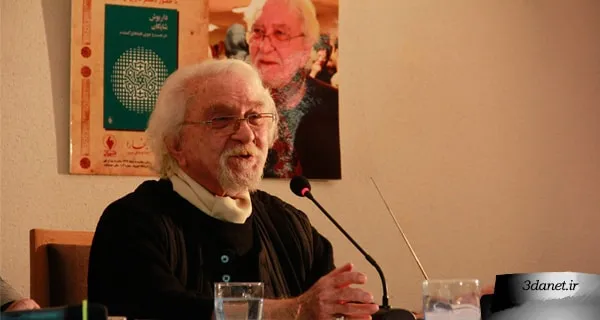
After all these compliments, I truly don’t know what to say. The whole time my friends were praising me, I honestly felt as though all the talk was about someone else. Mr. Fani quoted Montaigne, which reminded me of another remark of his: “I live in the back shop of the world,” and I must say that I have always seen myself from the back shop of the world. This is not the first time people have spoken about me somewhere and I keep thinking the words are about another person and have nothing to do with me. But in any case, I am very grateful to all of you.
What the gentlemen said was truly instructive for me. When one sees oneself through the prism of others’ eyes, one discovers oneself. Mr. Mostafa Malekian said something accurate about me when he said: on the one hand I am a relativist, and on the other, in search of something fixed. This description reminded me of a line by T.S. Eliot: “The poet is in search of the still point of the turning world.” Apparently, I too was seeking such a point, and this is what drew me toward India and sparked my interest in mysticism.
Mr. Khorramshahi, as usual, embarrassed me and called me the possessor of the Jam-e Jam. I wish I truly were the owner of the Jam-e Jam. The one who perhaps possessed the Cup of Kay Khosrow was my dear, departed friend Shahrokh Meskoob, whose memory is always cherished by me.
And what Mr. Fani said about Montaigne is entirely correct. I am also interested in Montaigne; I have always been very interested in him. Another point I would like to add is that another thinker was also influential in the writing of the essays in this book, and he is none other than Baudelaire, whom I have mentioned many times in the book. I have read a great deal of poetry and I hold poets in high esteem, whether Iranian poets or poets from other countries. Among Iranian poets, as everyone knows, are greats such as Khayyam, Hafez, and Rumi; of course, recently Saadi has also strongly attracted my attention, and I believe that he, who is undoubtedly one of our greats, has been treated unfairly and his prominence and importance have been overshadowed by other poets.
Regarding Western poets, I must say that I have learned a great deal from Baudelaire, in numerous areas, one of which is his idea concerning the city. Walter Benjamin, in one of his books on Baudelaire, says that he is “the poet of modernity.” In fact, the originator of the word “modernity” is Baudelaire, and he coined this term in the nineteenth century. Baudelaire believes that the task of the modern artist is to summon the present, or in other words, “to represent the present” (représenter le présent). But the present time, or the now, is something fleeting, elusive, and unstable, a transient state, like a mirage receding in the desert. According to Baudelaire, the goal of modernity is to extract eternity from this transient time, that is, precisely “representing the present.” If the concept of postmodernity, which caused such a stir and commotion in America, had little resonance in France, it is because Baudelaire had already introduced this concept a hundred and fifty years earlier.
In my opinion, Baudelaire’s position can best be explained by referring to a remark by Roland Barthes, who says of himself: “I like to be in the arrière-garde of the avant-garde.” To be avant-garde is to be aware of the fact that everything is in decline, and to be arrière-garde is to still love the things that are in decline. And the arrière-garde of the avant-garde, as Roland Barthes says, means that as long as you have an eye on the future, you do not lose sight of the allure of the past. An example that can clarify this position is the side mirror of a car, which moves forward while looking back and reflecting it.
“The city” is another concept to which Baudelaire pays special attention. The city of Paris is present in many of Baudelaire’s poems. Baudelaire is the first poet to have the concern of the big city on his mind. Before him, no other poet had addressed the subject of the city. Of course, the city is not the only theme that appears for the first time in the world of poetry in Baudelaire’s poems; for instance, which poet before Baudelaire rendered a scene such as a rotting carcass and the worms writhing within it into verse? It is because of these distinctive characteristics that Walter Benjamin believes poets should be classified into two groups: pre-Baudelairean poets and post-Baudelairean poets.
The book *In Search of Lost Spaces* is, in fact, a journey through culture. The first essay, titled “My Journey in the Fifteenth Century,” was written under the inspiration of a major exhibition held at the National Gallery of Art in Washington, D.C., on the occasion of the five-hundredth anniversary of Christopher Columbus’s discovery of the American continent. What was astonishing was that all the world’s cultures were present in this grand exhibition, from Japan’s Muromachi period to China’s Ming dynasty and the Ottoman Empire—at the time when the Ottomans conquered Constantinople—Timurid-era Iran, and the African continent, until we reach Europe, where Italy predominates, and then Latin America and the pre-Columbian indigenous cultures, namely the Maya, Aztec, and Inca. What stirred my thought in this journey and exploration was how it was possible that all these great cultures I was observing, from Japan to Latin America, despite their glaring and obvious differences, all shared a common space known as the space of poetico-mythical vision, yet suddenly, in one corner of the world, everything was transformed. That corner of the world was Italy, fifteenth-century Italy, that is, the glorious era of the Renaissance, and the embodiment of this transformation was none other than Leonardo da Vinci. Undoubtedly, paintings with such novel characteristics had emerged for the first time in this corner of the world; it was the first time perspective was introduced, the human body was introduced, dissection was introduced—features none of which held any significance anywhere else in the world. This subject set me thinking deeply. A little later, I came across an account by Burckhardt in his book *The Civilization of the Renaissance in Italy*. This book has been translated into Persian with very fine quality by Mr. Lotfi. Burckhardt’s sentence was: Before the Renaissance, the entire world was like a beautiful veil containing myths, poetry, gods, superstition, and illusion. Suddenly, this veil was torn, in Italy, in the fifteenth century. With the drawing aside of this veil, on the one hand, the outer world, that is, the objective world, unveiled its face, and on the other hand, the inner world, that is, the subjective, rose up with all its force. This rupture, this break, was the event I came face to face with in that grand exhibition in Washington.
The second essay of the book addresses the “Theoretical Vision of Art.” Interestingly, this hypothesis begins with the Enlightenment. As you know, in the late eighteenth century, France effectively dominated all of Europe, both in terms of economic power and in art and culture. The Encyclopedists, consisting of Diderot and his like-minded colleagues, belong to this very period. Some time later, reactions against this French intellectual dominance took shape in Germany. At this time, Germany was a fragmented country, not yet unified, and the greatest philosopher to give the Enlightenment a coherent form in this country was Kant. Yet Kant effectively locks up metaphysics and closes off the path to attaining the Absolute. It is here that the great reaction of the German Romantics emerges, who say that since the Absolute cannot be reached through philosophy, we shall take a shortcut to it through art; indeed, for the Romantics, art becomes a means of cognizing the Absolute. This theory, which is a German hypothesis, gains great importance and becomes widespread; it is disseminated in England through Coleridge, finds its way to France through Madame de Staël and Victor Cousin, and is introduced in Italy with Manzoni. In any case, the theoretical vision of art is a particular intellectual preoccupation of the Germans, raised from Schelling to Schopenhauer, Nietzsche, and Heidegger, and of course, its influence does not even spare the avant-garde artists of the early twentieth century, finding reflection in the works of artists such as Kandinsky, Malevich, Klee, and Mondrian.
In the next three essays, I have addressed the subject of space and the city, with an emphasis on two cities: Paris and Tehran. Since I also wished to commemorate some of the great figures of Iranian culture and art, I dedicated the second part of the book's articles to several Iranian artists. Sohrab Sepehri was a good friend of mine, and I translated a collection of his poems into French. This translation turned out well because, during the rendering of the poems, Sepehri himself was present, sitting beside me, and since he knew French and had even written poetry in French in his later years, I greatly benefited from his helpful collaboration in translating the poems. In some of his later poems, Sepehri puts so much pressure on the Persian language and stretches its fibers to the very limit of their endurance that the language begins to groan, as if it can no longer resist. Abolghassem Saidi, to whom I have dedicated an article and an interview, is also one of our great painters and, as Mr. Aghdashloo says, perhaps one of the greatest painters of his generation. I have also written a few pages about the late Bahman Jalali. It is a pity that he is no longer here among us. I loved both him and his work. I have also written a few lines about Abbas Kiarostami's visually stunning photo series, 'Doors of Abandoned Houses.' And the final essay is about the artistry and worldview of Aydin Aghdashloo in his paintings, which fall into two groups, Western and Eastern. I have also remembered Assadollah Behrouzan, who taught me the ways and customs of travel and exploring Iran. In the early 1960s, he took me to the School of Decorative Arts, where all of Iran's elite had gathered at that time, from Fereydoun Rahnema to Karim Emami, Bijan Saffari, Parviz Tanavoli, Sohrab Sepehri—they all taught there, and it was an exceptional place. These are the memories of that era and those days, but let me not take up any more of your time.
.
.
Book Launch Night for 'In Search of Lost Spaces'
Dariush Shayegan, quoted from Bukhara Magazine, Issue 97, December 2013 – January 2014
.
.

Discussion0 comments
No comments yet; let yours be the first voice.