Art
Mostafa Malekian's Speech at the Unveiling of Maryam Jafari's Art, Imagination, Beauty: A Reflection on Traditionalists' Misunderstandings of Islamic Art
In her book Art, Imagination, Beauty, Maryam Jafari brings aesthetic questions to Rumi's Fihi Ma Fihi and extracts the answers. At the book's launch event, Mostafa Malekian reflected on the errors of traditionalists in understanding Islamic art.
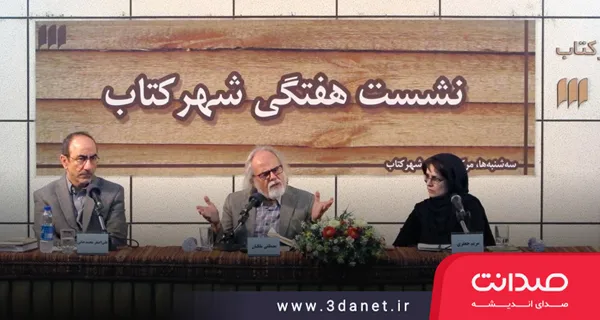
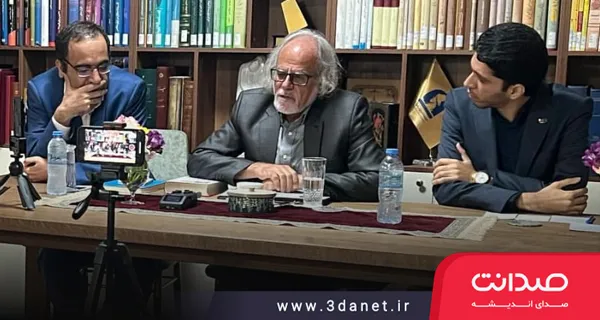
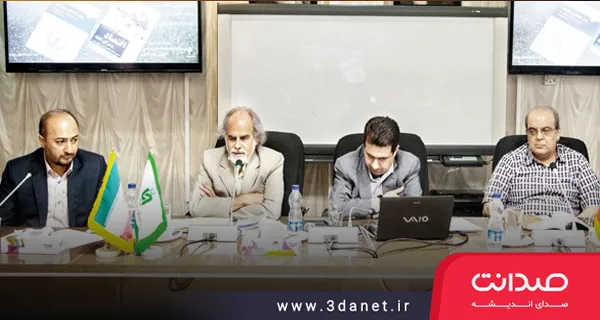
The book *Art, Imagination, Beauty* by Maryam Jafari has recently been published by Kargadan Publishing. In this book, the author presents issues in the field of aesthetics to Rumi's *Fihi Ma Fihi* and extracts the answers of *Fihi Ma Fihi* to some questions of aesthetics. A review session for this book was held on Saturday, the third of Esfand, with the presence of Mostafa Malekian and Maryam Jafari at the Shahr-e Ketab Cultural Center.
At the beginning of this session, Ali-Asghar Mohammadkhani, the cultural deputy of Shahr-e Ketab, stated: Rumi's most important work is *Fihi Ma Fihi*, which is referred to as the Discourses in the *Masnavi*. This book is a collection of Rumi's talks, addressed to gatherings or in response to the questions of others. Part of it is also addressed to Moin al-Din Parvaneh. Although all of Rumi's words are full of ethical and mystical points and the narration of subtle tales, the style of their expression in *Fihi Ma Fihi* and *Majales-e Sab'eh* is conversational. Some of the points and stories of *Fihi Ma Fihi* also appear in some of the verses and stories of the *Masnavi*; that is, these discussions are, in a way, repeated in the *Masnavi* as well. Therefore, *Fihi Ma Fihi* is also used to elucidate the contents of the *Masnavi*, it is referenced, and discussed. Probably, these dictations of Rumi were compiled in this form by his son, Sultan Walad, or his other disciples. Its initial correction was done by Badi' al-Zaman Foruzanfar, and alongside Rumi's other works (*Maktubat* and *Majales-e Sab'eh*), corrections and articles about *Fihi Ma Fihi* have also been produced in recent years.
He continued: Jafari has brought quotations from *Fihi Ma Fihi* here and, based on that, has shown Rumi's view on the philosophy of art and aesthetics. More precisely, Jafari tries to elucidate the issue of the philosophy of art and aesthetics by answering questions. By posing questions about the nature of art, the relationship between art and beauty, imitation and artistic creation, the process of artistic creation or production, to the connection between pleasure and art, the concept of beauty, and alongside it, splendor and glory, she tries to elucidate the issue of the philosophy of art and aesthetics. For example, she points to the division of beauty into objective beauty, subjective beauty, and objective-subjective beauty, and shows with textual evidence which of these beauties Rumi had in mind in *Fihi Ma Fihi*.
The cultural deputy of Shahr-e Ketab added: The book includes an introduction by Mostafa Malekian about the researcher's method in this work and five not very extensive chapters. The first part, an introduction, is about the whatness, whyness, and howness of art. The second part is dedicated to the nature of art. In this part, the negative and positive aspects of this concept are addressed. For example, in the negative aspect, attention is paid to the difference between art and science and technique. The third part is about the types of beauty based on the possessor of beauty, ethics and the relativity of beauty, and the form and method of discovering and recognizing beauty. Each of these cases is accompanied by a reference to Rumi's words in *Fihi Ma Fihi*. In the fourth part, artistic production is pointed out, and the difference between artistic production and artistic perception and criticism is stated. In this part, in a footnote, it is pointed out that the critic is for the artist and the interpreter is for the audience. Finally, the fifth part is dedicated to the conclusion. In this part, the author has arrived at fifteen propositions and has compiled the issue of aesthetics and the philosophy of art based on the book *Fihi Ma Fihi* and Rumi's perspective.
He finally noted: This new work is the result of Maryam Jafari's thesis. In this research, she focused only on *Fihi Ma Fihi* and did not consider Rumi's other works such as the *Masnavi*, nor the *Ghazals*, *Maktubat*, and *Majales-e Sab'eh*.
Ask *Fihi Ma Fihi*
Maryam Jafari, researcher and author, stated about her motivation for researching Rumi's views: Rumi is one of the greatest mystics and thinkers of our culture, who still has unknown aspects. We know Rumi, due to his poetic works, as a top-tier artist. However, we know nothing about his theory of art. For this reason, in this research, we tried to find Rumi's theory of art, as one of the great figures of our culture.
He explained his method: The method was to identify questions that have a logical structure for the mind of modern man. Then, we presented these questions to Rumi's *Fihi Ma Fihi*. And finally, we tried, through the method of analyzing Rumi's thought system, to discover what answers he would have given to our questions with that thought system, had he been present. We chose *Fihi Ma Fihi* to limit and define the scope of our work. In *Fihi Ma Fihi*, Rumi has good answers for some of these questions, fewer for others, and has not addressed some at all. Nevertheless, there may be answers in Rumi's other works for the questions that remained unanswered in this research.
He continued: Perhaps the reader of this book might think that words have been put into Rumi's mouth in this research and that Rumi did not directly address these matters. In response to this concern, it can be said that although Rumi did not speak directly about his theory of art in *Fihi Ma Fihi*, we used the method of analyzing his thought system to clarify his words and, by extracting his presuppositions, to be able to conjecture the effects and results of Rumi's words within his own thought system.
Jafari concluded: Some might object that Rumi's theory of art is marginal in his thought system. In response, it must be said that even if this discussion is marginal in Rumi's thought system or teachings, given Rumi's high status in this culture, this marginal discussion is also important to us. Some might object that Rumi himself was not bound by the manner of expression and, for example, addressed this in the story of Moses and the Shepherd, or we read elsewhere from him, "I think of rhyme, and my beloved / Says to me, think of nothing but seeing me." So, for him, the manner of expression is not so important; rather, he considers the content important. But Rumi also speaks a great deal about silence, and yet, he himself is constantly writing and, in fact, speaking. A contradiction appears here. It seems we have no choice but to employ the method of analyzing the structure of his thought system to understand Rumi's view on thinking of rhyme or silence and the like, and by clarifying his words, to extract his presuppositions and state their effects and results.
On the Distortions of the Islamic Transcendentalist Approach
Mostafa Malekian stated: I hope in this short time I can express something about this book that I consider the most important thing about it. Without exaggeration, one could perhaps speak for three hours about this book based on what I say, but I will confine myself to one point, which in my view is among the most important points about this book. At the outset of the discussion, we must separate the two phenomena of Islamic art in practice, or Islamic art in its historical realization, from the theoretical foundations extracted from the instances of this art.
He explained: Islamic art in practice, or in its historical realization, refers to the various forms in which the diverse arts in the Islamic world, from the beginning until now, have emerged; for example, how dance, music, painting, or architecture were realized in the Islamic world. These are instances of Islamic art, scattered from China to Europe, Spain, and Portugal. But the other phenomenon—namely, the theoretical foundations for these instances—is a separate discussion. Here, for instance, the characteristics of Sama, painting, or the architecture of mosques, palaces, gardens, and houses are attributed to theoretical foundations that compelled the artist to perform Sama, paint, or build mosques, palaces, gardens, and houses in that way. In other words, these theoretical foundations point to the fact that in the minds and consciousness of various artists in different arts, there existed a series of presuppositions that obliged, persuaded, or encouraged them to create works of art in that specific form, and not in another. Our discussion in this book concerns this second phenomenon: those who have looked at works of art and, in their own estimation, discovered and extracted a series of presuppositions and presented them as the theoretical foundations of Islamic art or the philosophy of Islamic art.
He clarified: The theoretical foundations of Islamic art or Islamic philosophy began to take shape and gained definition from the early nineteenth or late eighteenth century onward under the influence of Orientalism, Iranian studies, and Islamic studies. Otherwise, the term "Islamic art" is an invention of the Orientalists, and before that we only occasionally used the term sacred or divine art. However, from the early twentieth century, a second current merged with this first one, Orientalism, and profoundly influenced it. That current was Traditionalism in the Islamic world. Traditionalism, which was initially the initiative of an Eastern thinker named Coomaraswamy and later the French thinker René Guénon, gradually became an Islamic school of thought, most often referred to as "Traditionalism" and rarely as "Transcendentism." I have no quarrel with what these two thinkers said about Traditionalism, but when it came to figures like Frithjof Schuon, Martin Lings, Seyyed Hossein Nasr, Wolfgang Smith, and many others, the Orientalists' view of Islamic art was truly transformed under the influence of these Islamic Traditionalists. So much so that today, in the work of almost everyone working on Islamic art, the tendency of Islamic Traditionalists or Islamic Transcendentists is prominent. That is, the mainstream understanding of Islamic art is under their dominance. This is while the interpretation they offer of Islamic art seems, in my view, completely incorrect. And the importance of this book, as far as I know, lies in the fact that for the first time it emphasizes that Islamic art should not be approached in that way. Because that perspective is based on a series of entirely incorrect presuppositions. And these presuppositions have created a conception of Islamic art that no document, evidence, or indication confirms.
He continued: In the preface I wrote for Maryam Jafari's research, I said that this researcher's method for understanding the philosophy of Islamic art and the theoretical foundations of Islamic art is correct. I also explained the steps on which this method is based. Therefore, the positive aspect of her work is expressed there, both in my preface and in practice and execution within the text of the book itself. In this opportunity, I will address the negative aspect of the discussion. That is, I will speak about the method that has existed until now and, since the revolution, has influenced all works on Islamic art; namely, the Traditionalist or Transcendentist conception of Islamic art, which rests on thirteen presuppositions, all of which are incorrect and erroneous. In any case, this very theory is now being promoted by our art media, and unfortunately, our university professors in the field of art are also fueling the same fire and perhaps, in their own judgment, support this viewpoint.
Malekian then elaborated on these thirteen presuppositions as follows:
1. The first presupposition of this theory is that all artists in the Islamic world over these four hundred years were Muslim by identity; that is, their parents were Muslim, or in sociological terms, all these artists belonged to the historical and institutionalized religion called Islam. This is while, during the Umayyad era, Abd al-Malik ibn Marwan, according to one account, requested twenty thousand (and according to another, six thousand) artists, technicians, and craftsmen from the Roman Emperor to come to the Islamic world and create works of art, especially in the field of architecture. From that time until now, many people within the geographical and even the cultural sphere of the Islamic world have created works of art without themselves belonging to the historical and institutionalized religion called Islam. Although it must be admitted that the closer we get to our own time, the greater the number of Muslims in this current has been.
2. The second presupposition is that all Muslim artists were also genuinely devout and religious. Very often, someone is Muslim by identity but does not have a hundred percent theoretical and practical commitment to Islam. In other words, the personal religion of all of them was not Islam, and they did not live a hundred percent by the letter of the Book and the Sunnah. But the Islamic Traditionalists had presupposed that the personal religion of all these artists was also Islam, which is incorrect.
3. One of their presuppositions is that all artists of the Islamic world believed in “art for the sake of a message” and sought to convey the message of Islam through their artistic works. This is despite the fact that at no time, except that the majority of artists believe in art for art’s sake and not for a message. Most artists create a work of art to transmit beauty, not to convey, in addition to beauty, a doctrinal, sectarian, ideological, or religious, creedal, cultic, and ritual commitment. Throughout history, few have consciously believed in art for the sake of a message. Now, the presupposition of the perennialists is that all our artists sought to convey the messages of the Islamic religion through their artistic works and to teach the people the doctrines of Islam. But where can this presupposition be substantiated?
4. Furthermore, even supposing our artists believed in conveying a message, only someone who attends to Islamic theology can convey the message of Islam. But truly, how many artists do we have in the Islamic world who, in addition to skill in one of the artistic disciplines, also subscribed to Islamic theology and sought to convey the theory of “the Unity of Being” or “the Supreme Effusion” to others through their particular art form?!
5. Even supposing our artists had mastery of Islamic theology, is there only one narrative of Islam that the Islamic perennialists seek in all these works? From the dawn of Islam to our time, there exist many different narratives of Islam, and if we were to present them in a lecture, you would be astonished by the galactic distance between them.
6. They assume that the single narrative of our artists was the Sufi narrative of Islam and that all our architectural works contain mystical and Sufi messages. These individuals, from Seyyed Hossein Nasr to Martin Lings, all expect the narrative of Muhyiddin Ibn Arabi and the school of Ibn Arabi from our artists, and they put it into the mouths and pens of artists. As if all artists, whether they lived before Muhyiddin or from the seventh century AH onwards, were his eternal disciples, considered all his views the sole correct Islamic views, and sought to instill them. For example, in one of his works, Seyyed Hossein Nasr considers the bathing of Hindus in the Ganges River as an allusion by Hindus to the instability of the world, and says that in contrast, we Muslims have the Kaaba, which stands firm and steadfast, because we have reached, beyond these flux and transformations, a fixed entity which is Ibn Arabi’s “immutable essence.” Be fair! Did any one, any single person in the Islamic world ever have such a thing cross their mind? That is, Hindus seek to show the instability of the world and we seek to show the Truth? What logic is truly behind this statement?
7. One of their presuppositions is that artists were not compelled to fulfill the demands of the rulers of their time. It is as if the sultans, emirs, and governors who provided the greatest financial backing for all these artistic works merely gave money and said, “You, O mystic, just be a manifestation of Islam! In your artistic work, just manifest the pure Islam of Ibn Arabi, and we will pay for it.” No, such a thing is not the case. Rulers issued numerous commands and prohibitions and had their own stipulations and restrictions.
8. It is as if, fundamentally, the patrons and investors of artistic works grant the artist absolute freedom. As if the capitalist who approves of the design of one carpet and disapproves of another grants this absolute freedom to the artist and does not impose his own taste and preference on the work. Whereas we know this is not the case.
9. It seems that the artist's cultural and religious background prior to the Islamic world plays no role whatsoever in their works. They do not consider that someone who converted to Islam in Afghanistan or the Indian subcontinent had a history before embracing Islam that does not vanish with the declaration of faith. We must note that every artist had a long history before converting to Islam. Do we not ourselves still insist on Chaharshanbe Suri and Haft-Sin? We cannot simply forget our own cultural background. The backgrounds of all these artists, whether their ancestors converted from Christianity to Islam in Andalusia or their forefathers converted from Hinduism to Islam in Hyderabad, India, also influence their artistic vision. Thus, the works of these very artists of the Islamic world have one character in India and another in Andalusia. Cultural backgrounds, by the definition of culture, are the most stable component of social life. Among the various branches of social life, none is as stable as culture. Economy and politics transform more quickly, and among social institutions, the one that transforms the slowest is the institution of education and culture. Therefore, traces of Hindu traditions can be found in the mosques of India, because the artist is still inspired by some of their former faith.
10. Every artist also has their own individual aesthetic presuppositions and is unique. Besides being a member of a society, they are an individual. I certainly derive something from my membership in the community of Iranian Muslims, but I also derive something from my own individuality. Artists also had individual artistic taste and sensibility, and they exercised it. So, not all of their work was based on collective and ideological matters. This personal taste and sensibility also overflows and creates variations.
11. Even in the biographies of artists, stories of rivalry among them are mentioned, and this issue has been the source of many developments in our music, architecture, and calligraphy. Our top-tier calligraphers strove greatly to render obsolete the calligraphic styles of the calligraphers and scribes before them, because there was rivalry among them. But the Traditionalists do not take this into account.
12. We must also consider the materials available and at the disposal of the artist. Especially in ancient times, transportation was difficult, and every artist used the materials around them. Yet sometimes, without paying attention to the artist's access to materials and supplies, discussions are held about the choice of these. For example, Titus Burckhardt says that artists in Africa used earth as much as possible to flaunt to everyone that we are from dust! One must ask him, if these artists did not want to flaunt this to us, what should they have done? What else did they have at their disposal?
13. That I, as an artist, certainly have an ideal of music, architecture, or painting in my mind, but this does not mean that in practice I succeed in realizing this ideal. Great artists also acknowledge that they have realized only a little of what they had in mind. Simply put, a great artist is not an omnipotent artist and cannot manifest everything they desire in their painting or musical work. Most great artists are dissatisfied with their own work, because they see their own incapacity in realizing their ideal and notice the distance between their ideal and the work. This exists in all arts. But the Traditionalists do not consider my incapacity as an artist and try at any cost to analyze even that based on their presuppositions!
The Iranian thinker summarized his remarks in this section as follows: These thirteen presuppositions have led you to see things in these works that our common sense and sound reason do not permit us to accept. Now, this is seen in the works of Traditionalist commentators and some commentators who are not Traditionalists but have an affinity with them. We must now set aside these presuppositions and look at the artwork itself without them. Then we will find that every work has a world of its own. Moreover, at the beginning of my talk, I said that before the Orientalist movement, we did not have the term Islamic art; rather, we spoke of sacred art. Islamic art is a term coined by Orientalists, and its presupposition is that Islamic art has a substantial and essential difference from other arts. Meaning that Islamic art is substantially and essentially different from Christian or Jewish art. And this is itself the greatest presupposition, although it is not among the continuation of these thirteen presuppositions.
He also recommended the study of the book An Introduction to Islamic Aesthetics by Oliver Leaman, translated by Mohammad Reza Abolghasemi and published by Mahi, or translated by Nazanin Ordoubazarachi and Seyed Javad Fenderski and published by Elm, and the original English book The Formation of Islamic Art by Oleg Grabar to those interested.
A Part to Express Another Part
Malekian devoted the second part of his speech to making points about the book itself. He stated: Maryam Jafari's method in this book is a method whose best example among Islamicists we see in the work of Izutsu. Izutsu was primarily a linguist, and through that, he entered Arabic language and literature and then the understanding of Islam. Therefore, due to the teachings of Saussure and others, he is the first Western Islamicist to propose a method for understanding the theoretical foundations of any thinker. This method, the semantic method, holds that we must absolutely have no presuppositions of our own. Rather, we must set aside our presuppositions as much as possible and pay attention to the work itself. The late Tabatabai, in the first volume of Tafsir al-Mizan, considering the hadith that "each part of the Quran interprets another part of it," says that to clarify the meaning of the Quran, one must not refer to anything outside of it, and I, in Tafsir al-Mizan, want to interpret the Quran by the Quran. Of course, he does not draw our attention to the fact that, apart from the Quran, any book or lecture must also be understood apart from the opinions of opponents and proponents and the individual's prior knowledge. Here, too, Izutsu implements this very matter in practice and says that in referring to a text, nothing should be assumed; rather, one must look at the text itself.
Malekian explained: The method of work is that we have questions about a subject; for example, here we ask the questions of modern man about aesthetics from Fihi Ma Fihi, and to find the answers, we refer to the book itself. First, we doubt every word, term, and expression and investigate whether their meaning is the same as what I have in mind today or not. Then, we pose our questions about aesthetics and refer to the text. We examine the true meaning of each sentence and its relation to our question. Subsequently, we gather all the answers to each question in one place. In the end, by analyzing the totality of these, we can understand what Rumi's view on aesthetics was.
The translator and author continued: Some might object, saying, "How do you know? He did not have these modern questions in mind!" There is a difference between reading a book and discovering and extracting the presuppositions and implications of that book. We do three things with any work: report, analysis, critique. In analyzing this work, Jafari discovers both the author's presuppositions and the implications of his speech. Therefore, it is not necessary for the author himself to have said something in the written lines of the book or his writing. We take the written lines as the basis and extract the propositions he had in mind, and then, by considering and analyzing these propositions, we conjecture his views on a specific matter. Here, these analyses express Rumi's views on beauty.
He concluded by emphasizing: As it happens, beauty must certainly be pursued in the works of our mystics. Because “Jamal” (Beauty) is the sole attribute of God that only mystics discussed. Theologians and philosophers usually discuss knowledge, power, wisdom, benevolence, mercy, justice, or the like, but no theological or philosophical work speaks about the Beauty of God. Whereas mystics, due to a kind of interconnection they perceive among the three concepts of “love,” “beauty,” and “pleasure,” have spoken abundantly about beauty. Therefore, regardless of whether their own speech is beautiful or not, or whether they care about the beauty of their speech or not, the content of their discourse is devoted to it.
.
.
Mostafa Malekian's Speech at the Unveiling of Maryam Jafari's Book *Art, Imagination, Beauty*, Titled “A Reflection on Traditionalists' Misunderstandings of Islamic Art” | Book City, February 22, 2020
Download the Audio of the Speech
Listen to the Audio of the Speech on SoundCloud
.
.
Source of the Report Text: Ghazaleh Sadr Manouchehri / Book City
Purchase the Book from the Official Website of Kargadan Publications
.
.
Mostafa Malekian's Official Website
Mostafa Malekian's Telegram Channel
Mostafa Malekian's Instagram
.
.
Discussion5 comments
اقای حمید رضا مدرک تحصیلی نشان دهنده سواد یک فرد نیست دانش واگاهی او ترازوی قضاوت خواهد بود چه بسیار افرادی هستند که مدرک دکترا دارند ولی به اندازه سیکل قدیم هم سواد ندارند حتی قادر نیستند یک نامه بنویسند شما بسیاری از همین اقایان مجری که در برنامه های تلویزیونی میایند مثلا در برنامه زاویه مجری هستند مدرک دکترا دارند چه بسیار افرادی در فامیل واشنایان هستند که مدرک دکترا دارند ولی از نظر سواد هرگز با امثال استاد ملکیان قابل مقایسه نیستند اقای حمیدرضا استاد ملکیان لون ندارد این درست نیست که در مورد چنین فرد محترمی اینطور صحبت نمایید قضاوت شما نابجاست استاد ملکیان اگر در طول زندگی دورههای مختلفی داشته اند اتفاقا نتیجه صداقت ایشان بوده نتیجه پاکی درستکرداری ایشان بوده که خود را به گفته هایش سنجاق نکرده وهر جا اگر دیده از صراط حق بدور افتاده فورا مسیر را عوض کرده نگفته پس اعتبارم؟ پس گفته های پیشینم ؟ پس طرفدارانم ؟ حقیقت را بسی محترمتر ومهم تر دانسته وبه دنبال حقیقت رفته واز خود جایگاهش گذشت کرده اینها نتیجه صداقت ایشان است امثال استاد ملکیان در این مرز وبوم به اندازه انگشتان یک دست هم نمیرسد
آفرین بسیار عالی
همین شماهایی که ادعای ازادی بیان دارید به موقع اش هم سانسور می کنید هم کتمان چرا پیام من تایید نشد؟ آب به گوداب میره امثال شما هم باید زیر پرچم ملکیان سینه برنید کاملا مثل هم هستید
کامنت شما سراسر توهین به یک شخص بود. لحن تحقیرآمیز را کنار بگذارید، نقد علمی کنید، حتما تایید خواهد شد.
عالی بود استاد