Philosophy
Mostafa Malekian's Lecture at the First 'Designology' Conference: Ugliness, Beauty, and Ethics
At a conference on design studies, Mostafa Malekian approaches the phenomenon from a philosophical angle, tracing its conceptual roots. By expounding Plato's theory of the three inner domains of the human being—the cognitive, the emotional, and the volitional—he lays the groundwork for design-oriented thinking.
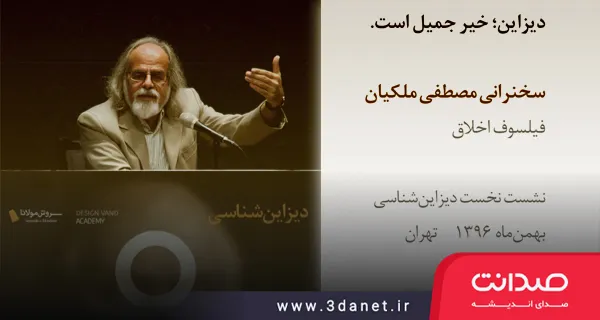
I offer greetings and salutations to all the ladies and gentlemen present; I am pleased to be in the company of friends and esteemed colleagues for a few hours, speaking about something that, although it has a relatively recent and new term, has, in terms of its concept and the phenomenon itself, long been the focus of human attention generally, and of thinkers particularly. Of course, as all friends know and it hardly needs saying, I have no knowledge whatsoever about design and matters pertaining to design, but the perspective I am putting forward is a theoretical and philosophical perspective on design, without entering into any of the details of discussions related to design. But how this concept, which is expressed today by the term design, found its way into human understanding, and what led humanity to gradually feel the need to become familiar and intimate with this phenomenon; well, in my opinion, this is an important point.
If friends pay full attention to the point that lies at the very foundation of the concept of design, it seems to me that they can see many things in a new light and with a new perspective, and essentially, they can think in a design-like manner about many matters that are not even technically categorized under the umbrella of design. Now, the explanations I will give will, to some extent, clarify this initial claim for friends.
I will actually begin the discussion from the Western world, but from the ancient Western world; that is, from ancient Greece. Plato, who is perhaps the greatest philosopher of the ancient Greek and Roman era (the Hellenistic period), developed a theory about the human interior, a theory which, although new modifications have been made to it, no thinker has yet fundamentally and from the ground up opposed it. That theory is that our interior, we humans, in contrast to our exterior, which is our body and, in Plato's view, is our exterior. Our interior, which you can refer to as the 'soul' or 'psyche' or whatever other term you wish; that which is inside me versus that which is outside me, which begins with my body and then extends and expands to the entire external world. In Plato's view, my interior is composed of three realms. If you reflect on this statement of Plato's, you will see that it does not even require much philosophical argument. We find through intuition that Plato was speaking correctly. He said: There is a realm within us that is the realm of our beliefs, the realm of our cognitions, our doxastic-cognitive realm. This is one of our inner realms, and many of the verbs you use in language refer to that realm of yours. When you say, 'I know that such-and-such,' or 'I doubt that such-and-such,' or 'I suppose that such-and-such,' or 'I guess that such-and-such,' 'I have an argument that such-and-such,' 'I estimate that such-and-such,' 'I reckon that such-and-such,' and all verbs of this category refer back to the first realm of your interior. All verbs of this category, the number of which is considerable in every language, point to the first realm of my and your interior. This realm is called the 'doxastic or cognitive realm' (Doxastic or Cognitive); this is the first realm.
According to Plato, there is also a second domain within us, which is the "domain of our feelings, emotions, and passions (Emotional or Affective)." In that domain, we do not know anything, nor do we hold any beliefs about anything. No. We either like something or dislike it. We take pleasure in something or suffer from it. We are inclined toward something, averse to something, or antagonistic toward a third thing. This inclination, aversion, or antagonism of ours toward matters constitutes our second domain. This domain is referred to as the "emotional domain or the sentimental domain of our existence," sometimes as the "affective domain of our existence," or sometimes as the emotional domain or the emotive domain of our existence. Well! Many of the verbs we use at any given time also refer to that very domain; such as when I say, "I love," "I hate," "I like such and such," "I am an enemy of so and so," "I am angry about something," "I am pleased with something," "I like it that...," "I dislike it that...," "I wish that...," and "God forbid that...." Pay attention! Wherever there is talk of love, hatred, friendship, enmity, malice, contentment, anger, tranquility, anxiety and agitation, fear, hope, despair, and all our feelings and emotions, it falls within this second domain. The number of these feelings and emotions, contrary to what an ordinary person like me imagines, is very large. By my count, psychologists have distinguished nearly 85 feelings, emotions, and passions within us, although if we are asked to count our feelings and emotions, an ordinary person usually does not recognize more than 18, 19, or 20 emotions, feelings, and passions. In any case, this is the second domain of our being. We can call this domain the "domain of likes and dislikes," the "domain of pleasures and displeasures," the "domain of pleasure and pain," all of which find a kind of centrality and focus in this second domain. This is also the second domain.
Of course, the psychologists of our time have made these refinements, noting that the collection which Plato considered a single domain in his time—and it truly is one domain—nevertheless, within this domain, a distinction must also be made between feelings, emotions, and passions. These all relate to that same second domain, but they have subtle and delicate differences among them. This is also the second domain.
There is a third domain within us, and that is the domain of our desires, which he referred to as the "volitional domain of our existence (Volitive or sometimes conative dimension of our existence)." That domain where we want certain things. Do you see? This domain relates to action, and if you pay attention, we have many verbs in language for this domain as well: "I want to...," "I have decided to...," "My goal is to...," "My ideal is to...," and "My motivation for this speech or this action was to...." Expressions like goal, intention, purpose, desire, will, ideal, and all such expressions pertain to the third domain; a domain where, in fact, we deal with doing, whether that doing is of the category of speech or of the category of action. In fact, according to the same order Plato believed in, when we combine our doxastic-epistemic state and our emotional-affective state, then desires emerge; that is, the third part (the third domain) is the result of the intermingling and marriage of our first and second inner domains. Suppose that "I know that this is water." This relates to my doxastic domain. On the other hand, "I take pleasure in drinking water," which relates to my emotional, affective, and passionate domain. Then this causes me to "decide to drink water." In fact, if a transformation occurs in the first and second domains, a transformation will necessarily occur in the third domain, although the degree of transformation in the first and second domains is very different, and naturally, the result of that transformation in the third domain will also manifest in various ways. These are our three inner domains.
Afterward, Plato would add a second theory to this first one, and that second theory was that now, since "the inside of you and me," "the soul of you and me," "the psyche of you and me," "the spirit of you and me," and whatever else we want to call it—even say "the ghost of you and me"; for our discussion, the term you choose is not very important, rather what is important is that you speak of your inside, not your outside... He said the inside of you and me had three domains. Now, I say each of these three domains is hungry and thirsty for something, and in order to quench this hunger and thirst, you must give each of these three a kind of food and drink. The food and drink of each of these three domains differ from one another.
The first domain, which is the doctrinal-epistemic domain of our existence, he said is satisfied only with truth and nothing else. Our doctrinal-epistemic domain is hungry and thirsty for truth and seeks and desires only rightness (in the sense of truth), and this means that in your first domain, until you are certain you have attained the truth, you are still striving, you have no peace and quiet. Again, this first domain of yours continues its striving and still feels it has not reached its destination or what it wanted. Until I feed the food and drink called truth to the first part of my interior, this first part will have no peace and quiet and will remain in striving and remain restless. Therefore, I intensely need truth to satisfy the thirst or hunger of the first domain, and I intensely require it.
The second domain, that is, the emotional, affective, and excitational domain; he said its only food and drink is beauty and loveliness. Our feelings and emotions find no rest except with beauty and loveliness, and until they encounter something beautiful, they have no tranquility; but of course, beauty from Plato's perspective was very broad. When we usually speak of beauty, we first think of visual beauties, for example, we say "a beautiful face," "a beautiful person," "a beautiful flower," and "a beautiful waterfall." Of course, according to Plato, these beauties are very important. Then, for instance, we also mention auditory beauties, for example, we say "the beautiful voice of such-and-such singer." It seems we also attribute the quality of beauty to auditory beauties obtained through hearing; but when we get to the sense of smell, it is somewhat less common, yet we still say this cologne and this perfume have a beautiful scent. But we use it less. However, Plato said this, too, has beauty to the same degree. When we get to tastes, we almost no longer use the term beautiful and do not say "a beautiful taste," but rather say "a pleasant taste." We say it is tasty. But he said beauty relates just as much to our faculty of taste as it does to our faculty of hearing and our sense of hearing, and to our faculty of sight and our vision. In the same way, our faculty of touch and our sense of touch also have their own specific beauties. Plato did not even limit beauty to these 5 senses of ours, or in the ancients' terms, our five senses, and he took the scope of beauty wider and wider and wider still, which, if I wanted to explain those beauties, would take me far from my discussion. But if you pay attention, all these fivefold beauties we mentioned are merely beauties we perceive with our five senses, but Plato believed we also have a beautiful mind. Some minds are beautiful, some minds are more beautiful, and some minds are less beautiful, and the components of a beautiful mind, in his view, are specific components, such that if you possess those components mentally, you have a beautiful mind, and he went even further than this and did not even limit it to the mind. The discussion is very complex and at the same time fascinating, although some of the points Plato made about beauty are, in the view of some aestheticians, indefensible; for example, some aestheticians of our time believe that beauty pertains only to material things and one can no longer speak of a beautiful mind if you do not consider the mind material. One cannot speak of a beautiful psyche, but in any case, I am conveying the gist of Plato's words without entering into its details, which might provoke objections. Well! So beauty is also the food and drink of our second inner domain; that is, the domain of our feelings, emotions, and excitations.
And as for the third realm of our existence, namely the volitional realm of our being; he said it finds rest only through the good and virtue. That is, my will and your will attain peace when you are certain that through your will you have attained some good, some virtue. Well! Please note, this was a theory concerning our three inner realms, which were the "cognitive-epistemic realm," the "realm of feelings, emotions, and sentiments," and our "volitional realm." This is one theory. It was a theory about the ideals within us, and it said that our inner being has three ideals: one is the ideal of truth, that is, veracity; one is the ideal of beauty, that is, aesthetics; and one is the ideal of the good, that is, virtue. It has these three ideals, and since these three are the ideals within us, within the psyche of us humans, a flourishing soul is one that possesses all three together, in parallel, in balance, and with equilibrium. Whichever of these three I possess less, my soul is somewhat more ruined than your soul, which possesses it. But in Plato's view, what was important was that these three must be in parallel, and none of the three should dominate the other two ideals, nor should two of these three ideals dominate the third. The human being who has a flourishing soul is one who advances these three in parallel, and naturally, since they wish to advance them in parallel, they must advance them in a kind of balance, harmony, and equilibrium; otherwise, if this balance, equilibrium, and harmony are disrupted, that initial parallelism is also disrupted. Well! Naturally, the flourishing soul is this soul. Therefore, in Plato's view, you and I are seekers of these three things. Now, if you were to ask, well, in life we are seekers of thousands upon thousands of other things as well. I am a seeker of wealth, a seeker of power, a seeker of social status, a seeker of fame, a seeker of popularity, a seeker of knowledge. I have a series of other desires; I have desires called "bodily and physical desires," I have desires that are "mental desires." It seems we do not only want knowledge; in the area of knowledge, we do not only want truth, and in the area of our feelings, emotions, and sentiments, we do not only want beauty, and in the area of our will, we do not only want the good. It seems we want many other things. At that point, Plato and later Aristotle (Plato's student), following him, would say that anything else you want besides these three, if you analyze it, you will see that with one intermediary, two intermediaries, three intermediaries, and N intermediaries, they lead back to these very three. Come, write down the list of all the desires you have in life, and then begin to analyze them and say, for example, I want wealth. Very well! Then you say, what do I want wealth for? Do I want it for its own sake? You see, no, we want wealth to acquire a car, to acquire a house, and so on. Well, now let us go to the car and the house. What do you want the car for, what do you want the house for?! He said when you perform this analysis, you will see that all those thousands of desires you had begin to converge, and converge, and converge, and at the apex of the pyramid of these convergences, you see those very three. You see that you wanted truth, you wanted beauty, and you wanted goodness. In reality, you wanted these three. From this perspective, he called these three "intrinsic objects of desire" and called the rest of our desires "extrinsic objects of desire," meaning we want those objects other than these three so that they become a means to lead us to these three, a ladder to take us to the rooftop of these three, steps so that through these steps our hands might reach these three. Therefore, in Plato's view, all our other desires are desires by virtue of another, extrinsic desires; that is, desires we have but in order to lead us to something other than themselves. But these three are intrinsic objects of desire, objects of desire in themselves. These we want for their own sake; that is, if someone said to you, you love the beauty of this flower so much, for what? What do you want to attain through loving the beauty of this flower?! You can say nothing else. You say, I love the beautiful flower because it is beautiful. That is all. Beauty has no further side to it, such that I saw something as beautiful and loved it because that thing, through beauty and using beauty as a bridge, leads me to something else! No. Beauty is the final destination in the realm of feelings, emotions, and sentiments, and in the same way, goodness is in the realm of the will, and in the same way, truth is in the realm of our beliefs and knowledge. These three, he said.
So, you see, up to this point we have an anthropological theory that considers the human interior to have three domains; we also have an ideal-oriented and axiological theory that says there are three first-order values, and to the extent that you are deprived of these three, you are restless, striving, uneasy, and dissatisfied. Pay attention! According to Plato, whenever you see that you have a kind of self-dissatisfaction, dissatisfaction with your life, and unease, or in its very acute cases, self-loathing and self-hatred, understand that you have gone astray in one of these three directions. This, so far, is Plato's theory.
Aristotle, Plato's student, based on these two theories, put forward a new opinion that was entirely grounded in these two theories of his teacher, namely: if this is the case, we must learn three things in life, and if we fail to learn any of these three things, our life will limp somewhere. He came and said that all human knowledge that we need, I, Aristotle, call "wisdom," and then I say wisdom is of three kinds: theoretical wisdom, practical wisdom, and productive wisdom. In Muslim culture, this productive wisdom of Aristotle was not much welcomed, and later you will understand how devastating its effect was in the Islamic world, in my opinion. But Aristotle said if it is the case that my interior has three domains, and each domain thirsts for something and hungers for something, then I must learn three things. With the first thing I learn, I satisfy the hunger of the first part of my interior; with the second, the second part; and with the third, the third part. He called these the "threefold wisdoms." If you learn these threefold wisdoms, then you will have a wise life (according to Aristotle), meaning a life in which those strivings, those uneases, those restlessnesses, and those self-dissatisfactions no longer exist. One is theoretical wisdom. He called the first part "theoretical wisdom," the second part "practical wisdom," and the third part "productive wisdom."
He defined it this way: theoretical wisdom is whenever you want to know something solely for the sake of knowing it, not for any other purpose (I want to know such-and-such a thing just to have known it). I want to know the specific gravity of water just to have known it; I want to know the length and width of this room just to have known it; I want knowledge for the sake of knowledge. I know in order to have known. Does such a desire exist within us? Yes. Knowledge and truth are valuable to us. Yes, truth means knowing that A is B or A is not B. Knowing that A has relation R with B or does not have relation R with B. The very knowing of this is the thirst of my soul, because one part of our soul thirsts and hungers for truth. He said if you gain knowledge of existence and the various phenomena of existence, but only for the sake of having gained knowledge, you are dealing with theoretical wisdom. Theoretical wisdom means knowing solely for the sake of knowing. Do you see!? Today, this state, where a person wants to know solely for the sake of knowing, is usually expressed with this phrase: they say one of our needs is scientific curiosity. Scientific curiosity means I want to know just to have known. I do not want to obtain anything else through this knowing beyond this. Well, if this is the case, we have theoretical wisdom.
A second part he called "productive wisdom," and a third part he called "practical wisdom." Practical wisdom is knowing for the sake of transforming. Productive wisdom is also knowing for the sake of transforming. So practical wisdom and productive wisdom share a common fate in that neither of them seeks knowledge for the sake of knowledge, but rather knowledge for the sake of transformation. They do not want to know something just to have known it, but rather to know something in order to transform it. Do you see!?
Let us set aside knowledge for its own sake, which is theoretical wisdom, and turn to these two. Both of these—whether "practical wisdom" or "productive wisdom"—are knowledge for transformation, or more precisely, knowledge for the sake of transforming. I want to know something in order to transform it. Well, if that is the case, why then did these two become two? Why was practical wisdom separated from productive wisdom? Because transforming that thing can be of two kinds. Sometimes I want to know something in order to transform it, but transforming it is in the direction of providing benefit. At other times, I want to know something in order to transform it, and transforming it is not in the direction of providing benefit but in the direction of beautifying that thing. Transforming something so that it reaches a state that benefits human beings is different from transforming something to make it beautiful. He would say, if you want to know something in order to transform it so that advantage, benefit, and profit from that thing accrue to human beings, then you are dealing with practical wisdom. And if you want to transform something in order to make that thing, through your transformation, more beautiful than it is, then he would say we are dealing here with productive wisdom. This productive wisdom; when we engaged with the philosophy of ancient Greece and Rome from the late second century AH through translations of Greek and Syriac works and similar languages, our philosophers and sages paid very little attention to this third part, that is, productive wisdom, and then gradually abandoned it altogether, which I will explain later. So from this perspective, you see in the works of our philosophers, in the works of our theologians, and in the works of our sages, when they are expounding that intellectual heritage of Aristotle for us, they say he divided wisdom into two parts: "theoretical wisdom" and "practical wisdom." They no longer mention "productive wisdom." This productive wisdom is, in fact, related to art. However, as my esteemed friend pointed out, art in the view of Plato and Aristotle dealt only with beauty. It is today that you have works which, while considered works of art, our intuition may not allow us to regard them as works of beauty; but in any case, in the theory of Aristotle and Plato, art dealt with beauty.
Well, now I want to say this. Today, instead of saying "theoretical wisdom," "practical wisdom," and "productive wisdom," we have transformed these three into three other concepts. What Aristotle called theoretical wisdom, we call "science" in its broad sense. What Aristotle called practical wisdom, we call "technique" in its broad sense. Productive wisdom we call "art." This is why, in our universities, whatever field you are engaged in is either a scientific discipline, a technical discipline, or an artistic discipline. In fact, science, in the very broad sense I will now explain, is the same thing we call "theoretical wisdom"; knowledge for its own sake. Technique is knowledge for transformation, but transformation in the direction of bringing benefit, advantage, and profit to human beings. Art is knowledge for transformation, but transformation in the direction of making things more beautiful. Therefore, we are now dealing with science, technique, and art.
Now, let me offer an explanation about these three, and then, with these explanations, the discussion that needs to be presented about design as the first session will, it seems, become clear.
In science, as we said, knowledge is for the sake of knowledge. That is theoretical wisdom; knowledge for the sake of knowledge. But science in the sense we are discussing includes these divisions: first, the logical-mathematical sciences. I have linked the logical and mathematical sciences together and do not wish to enter into that debate, because philosophers of science believe and have a consensus that logic and mathematics are in fact no more than one science. Now, some say logic is a branch of mathematics, and some say mathematics is a branch of logic. Russell had a theory on this matter, and others had different theories. Reducing logic to mathematics or reducing mathematics to logic are two different things, but in any case, both share one thing in common, which is that these two are so closely related that ultimately one must be reducible to the other. Therefore, when I said science is knowledge for the sake of knowledge, one of its branches is the logical-mathematical sciences. One branch is the philosophical sciences. The philosophical sciences are the second branch. All branches of philosophy are also science; that is, they are knowledge for the sake of knowledge. All the various branches of philosophy.
The third branch is the empirical sciences. Whether the natural empirical sciences, which are three important sciences—namely physics, chemistry, and biology—or the human empirical sciences, such as psychology, sociology, and economics. These too are truly knowledge for the sake of knowledge. Therefore, the empirical sciences, encompassing both the natural empirical sciences and the human empirical sciences, are again science; they are knowledge for the sake of knowledge.
The fourth category of science is the historical sciences. The historical sciences are also knowledge for the sake of knowledge. History itself is one of the historical sciences, philology is one of the historical sciences, grammar is a historical science. These too are, in fact, knowledge for the sake of knowledge. There is another science that is knowledge for the sake of knowledge, and that is the mystical sciences. The mystical sciences are also knowledge for the sake of knowledge. I want to know the world so that I may have known the world.
Now, if besides these we also posit another science called "religious and theological sciences," we must also be able to find its place, but I personally believe that the religious and theological sciences are not a separate, independent branch. Let us now state what is agreed upon. So, knowledge for the sake of knowledge—science—consists of the logical-mathematical sciences, the philosophical sciences, the empirical sciences (both natural and human), the historical sciences, and the mystical sciences. In fact, these acquaint us with the world only to satisfy our curiosity and, in the Platonic sense, to have satisfied our truth-seeking nature. We want to know that the world possesses three aspects and modes.
اما در فن؛ غیر از علم گفتم «فن». فن یعنی شناخت نه برای شناخت بلکه شناخت برای اینکه آن چیزی را که میشناسم دگرگونش کنم. دگرگونسازی. این علومی که اسم بردم فقط میشناساندند فقط برای اینکه شناسانده باشند اما فن نه. میشناساند برای اینکه دگرگون کند. من چند تا فن نام ببرم؛ پزشکی فن است. چرا؟ چون یک پزشک تو را میشناسد برای اینکه دگرگونت کند. تو بیمار هستی و پزشک میخواهد این بیماری را تبدیل به سلامت بکند؛ بنابراین پزشکی یک فن است. چرا؟ چون پزشک دگرگونی برایش مهم است. پزشک نمیآید تو را بشناسد برای اینکه فقط تو را شناخته باشد. میخواهد بشناسد برای اینکه دگرگونت کند؛ بنابراین پزشکی یک فن است. همین مثال پزشکی را اول استفادهی برای یک مقصود دیگر ازش بکنم و بعد به چند فن دیگر بپردازم و مثال بزنم. پزشکی فن است ولی برای اینکه تو دارای این فن بشوی باید چند تا علم را یاد بگیری. درست است!؟ مثلا باید زیستشناسی که علم است را بدانی (زیستشناسی فن نیستها؛ علم است. شناخت برای شناخت است)، فیزیولوژی که علم است را بدانی، کالبدشکافی را بدانی همان چیزی که به آن «آناتومی» میگوییم. باید خونشناسی بدانی، عصبشناسی را باید بدانی. اینها چند تا علم هستندها! ولی اگر یک پزشکی بخواهد پزشک باشد باید آن علوم را بداند. و از همین میخواهم استفاده کنم که هیچ فنی نیست الا اینکه نیازمند چند تا علم است. توجه میکنید!؟ پس فرق یک پزشک با یک فیزیولوژیست در این است که فیزیولوژیست بدن را میشناسد برای اینکه کارکرد بدن را شناخته باشد. همین. اما بعد اگر این دانشاش را در اختیار پزشک گذاشت، آن وقت پزشک از این برای دگرگون کردن بدن استفاده میکند. به همین ترتیب آناتومی و کالبدشناسی یک علم برای علم است؛ یعنی شناخت برای شناخت است ولی وقتی که کالبدشناسی بهخوبی انجام گرفت دستاوردهای کالبدشناسان و کالبدشکافان در اختیار پزشک قرار میگیرد. بنابراین وقتی یک آناتومیست و یک کالبدشناس و کالبدشکاف ساختار بدن را تشخیص داد و بعد یک فیزیولوژیست هم آمد کارکرد بدن را تشخیص داد، خب شکی نیست که وقتی من کارکرد بدن شما را بشناسم و ساختار بدن شما را هم بشناسم بعد اگر شما بیمار باشید میتوانم شما را دگرگون کنم حالا یا دگرگونی ساختاری به شما بدهم و یا دگرگونی کارکردی بهتان بدهم. توجه میکنید! وقتی جراحیتان میکنم دگرگونی ساختاری بهتان میدهم چون یک تکه از رودهتان را میبُرم؛ اما وقتی بهتان دارو (شرب بهتان میدهم، آپول برایتان تزریق میکنم، قرص بهتان میدهم و کپسول بهتان میدهم) میدهم دگرگونی کارکردی بهتان میدهم. ولی بالاخره دگرگون کردم یا ساختار بدنتان را و یا کارکرد بدنتان را. ولی هر دویش بهخاطر اینکه از دستاوردهای آناتومیستها و فیزیولوژیستها توانستم استفاده کنم. به همین ترتیب یک پزشک از دستاوردهای عصبشناسان و خونشناسان هم استفاده میکند.
این مثال را فقط برای این زدم که بهطور کلی یک حکمی را از اینجا بیرون بیاورم و آن اینکه هیچ فنی نیست که آدم برای اینکه در آن فن بتواند کارآمدی پیدا بکند باید به چند تا علم توجه بکند. خب! پس پزشکی یک فن است.
یک فن دوم هم مثال بزنیم؛ همهی مهندسیها فن هستند. مهندس میشناسد برای اینکه دگرگون بکند. منتها فرق مهندس با پزشک این است که پزشک بدن انسان را میشناسد تا بدن انسان را دگرگون کند ولی مهندس طبیعت را میشناسد برای اینکه طبیعت را دگرگون کند. چرا دگرگون کند؟ برای اینکه به انسانها نفع برساند. من باید اینجا بتوانم یک جاده در طبیعت احداث کنم که یک نفعی به انسانها برسانم. آن وقت من میشوم مهندس عمران. الان من باید طبیعت را بشناسم تا بفهمم این طبیعت را چگونه دگرگون کنم یعنی مثلا یک بخشی از این جنگل را از میان ببرم و بهعوض بتوانم یک جاده بکشم یا یک پلی روی رود بزنم. همهی انواع مهندسیها هم فن هستند. همهشان طبیعت را میشناسند برای اینکه طبیعت را دگرگون کنند. منتها در هر مهندسیای ما در دگرگونی طبیعت به یک راهی میرویم. اما همانطور که پزشکها نیاز به علومی داشتند مهندسان هم به این نیاز دارند که فیزیک بدانند و گاهی شیمی بدانند و مکانیک بدانند و هیدرولیک بدانند. اینها همه شناخت برای شناخت هستندها، ولی من اگر بتوانم طبیعت را دگرگون کنم باید بتوانم از آن دانشها استفاده کنم. پس مهندسی هم باز یک فن است.
Let us name a third technique, and that is management. Management is the knowledge of an organization in order to transform it. Whether it is political management, economic management, or cultural management. Any kind of management, whether the organization is on the scale of a global organization, or on the scale of a nation or a country, or on the scale of a province or county, or an economic organization, or any type of organization... managers want to transform this organization. Well! A manager, as an individual, needs several kinds of knowledge, meaning they need several sciences. That is, for managers to be able to transform an organization—whether I am a factory owner, or you are the manager of a commercial enterprise, or someone is the head of a ministry, or anything else—if I want to transform it, I must use sciences. Managerial transformations usually require psychology, and even require sociology, which are sciences. They require economics, which are also sciences. They require statistics, which are again sciences. They require, to a certain extent (a certain extent, and not very much), something that is referred to as 'anthropology.' Managers use those sciences to transform their organization. This is, in fact, a kind of transformation.
So, I have now given examples of three great techniques: 1) Medicine, which transforms your body. It knows in order to transform it. 2) Engineering. 3) Management.
Ethics is also a technique. In ethics, too, I want to transform myself. I want to know myself in order to transform myself. This is why ethics is also a technique. What is the difference between ethics and psychology? The psychologist says, 'This is what the human being is'; but ethics says, 'This is how it ought to be.' 'Ought to be' means that something, a transformation, must emerge within the human being. Ethics is a transformation. Therefore, in ethics, we need to ask psychologists what kind of being this human is, so that we can then transform it.
Just as every technique requires several sciences, ethics, as a technique, also requires several sciences, and among the sciences that ethics is intensely in need of, four sciences are of the first rank. The first and most important of all is psychology. In the second rank is sociology. In the third rank is anthropology, and in the fourth rank is axiology. These are four sciences that have been given to us as knowledge for the sake of knowledge. Now, I use this knowledge for transformation. However, in ethics, I want to transform myself.
Now, do we also want to transform others in ethics? This is a matter of debate. I myself believe not; in ethics, we want to transform ourselves. But some have said no, in ethics, we want to transform others as well, not just ourselves. (That is another discussion, which I will not address now.) So, ethics is also a technique. Thus, these other techniques were not knowledge for the sake of knowledge, but knowledge for transformation, yet transformation aimed at benefiting humanity and human beings.
But we also have a third thing, and that is something which is neither science nor technique. That is 'art.' In art, too, it is knowledge for transformation, but transformation is no longer aimed at providing benefit, but rather at beauty. Anyone who engages in art, if they hold a pessimistic view of the world, believes that the world is ugly and that they have come to reduce this ugliness of the world. And if they hold an optimistic view, they believe that the world is beautiful and that they have come to add to the beauty of this world. But whether I have come to reduce the ugliness of the world or to add to the beauty of the world, my work is art. So, art also wants to transform the world, but not for providing benefit; rather, only so that the ugliness of this world is diminished or its beauty is increased.
These arts have, since ancient times and since the time of Aristotle himself, been divided into two major categories: written arts and non-written arts. Written arts are the collection of things we call literature. In fact, literature is the written art, whether it be the genre of poetry, the genre of the novel, the genre of the short story, the genre of screenwriting, playwriting, memoir writing, and so on—these are all different literary genres, and all of them are subcategories of the written art. On the other hand, we have 8 non-written arts. Of course, I say 8 non-written arts because global art scholars currently recognize 8 arts as global; it is possible that tomorrow or a century from now, another art might be recognized among the global arts. But these 8 global arts (in a particular order) are: dance, music, painting, sculpture, architecture, photography, theater, and cinema. These are all non-written arts.
Now, let me return to our main point; if this is the case, it seems that if Plato's words were to be translated today, their meaning would be that if you want your soul to be quenched in life, science, technology, and art must all three advance in parallel in our lives. Do you see? Because its science satisfied the truth-seeking arising from our doctrinal-epistemic dimension; its art satisfied that emotional, affective dimension of ours that sought beauty and splendor; and its technology, one branch of which was ethics, satisfied that third dimension of us humans (our volitional and desiderative dimension, which sought goodness).
Now, friends discuss this; once it is established that these three, in Plato's terms, must advance together, then its meaning is that I must conduct my life in such a way that truth, goodness, and beauty do not harm one another and do not crowd each other out. This not crowding each other out has various types, one of which is that goodness does not crowd out beauty. Goodness and beauty should coexist. What does that mean? It means that in my actions, while I am benefiting you, I can accompany this benefaction with beauty. If I only benefit you, what have I done for you? I have only brought you goodness. But if I can accompany this with beauty; let me give you an example.... What is the difference between cold soup and hot soup? If I eat either, I will be full, so both bring me goodness. But when I eat cold soup, I become full but do not enjoy it, meaning I am deprived of beauty. When I eat hot soup, I both become full and enjoy it. The difference between cold soup and hot soup is that both fill you up and thus bring you a benefit; but one brings you a beautiful benefit and the other an unbeautiful one. Because, as I said, in beauty, we also speak of beauty in the sense of taste. Beauty also pertains to the sense of smell.
What is the difference between a good cook and an inept, unskilled cook? The food both of them cook fills a person up, and therefore, if someone's only problem is hunger, there is absolutely no difference for them between a good cook and a bad cook. They say, we wanted to be full, and we became full. Right? But if your problem is not only hunger, meaning you are not dying of starvation, then in those states, you want both your hunger to be alleviated and for this alleviation and removal of hunger to be accompanied by beauty as well. Beauty, if you recall, I said is pleasure and knowledge. You want it to be beautiful too, then; so therefore, you say the difference between a good cook and a bad cook becomes this: both filled me up, but one brought goodness accompanied by beauty; the other brought goodness but lacked beauty. There was no beauty in it anymore.
As a teacher, I am writing on the board and through the board, I am teaching my student mathematics. But one time I work with a piece of chalk that makes a jarring sound on the board. Another time, I work with a piece of chalk that makes no sound. In both cases, I am bringing goodness to my student, but the second goodness is not a goodness accompanied by beauty, because I am inflicting an ear-piercing annoyance on the person. I am bringing them goodness, but it is not accompanied by beauty. How good it is that, since truth, goodness, and beauty are meant to be together, our truths should be accompanied by beauty. Our beauties should be accompanied by goodness, and our goodnesses should be accompanied by truth. Design is this accompaniment of goodness with beauty. This is design.
So design can have two other companions. Sometimes truth and goodness want to embrace each other. Right? Sometimes truth wants to embrace beauty. That is something else. Sometimes goodness wants to embrace beauty. Design is this. That is, with design, I want to both solve your problem—that is, bring you a benefit, which is goodness—and I want to deliver this benefit to you as beautifully as possible. That is, I want to marry these two together. To make them spouses. I want to bring them into balance with each other. In fact, this is the work of design. This is design doing two things at once. Of course, I can solve your problem. I can offer you water in a very ugly glass. I can offer you water in a very beautiful glass. What do both do? Both are glasses, and through both glasses I have conveyed a good to you, but when I give you water in a beautiful glass, then I have, in fact, performed this beneficence accompanied by the conveyance of beauty. Let me give another example with water; you are thirsty. You know that a person is quenched by cold water and is also quenched by lukewarm water. Well! Sometimes I offer you cold water and sometimes lukewarm water. In both cases, you are quenched; so I have conveyed the good to you. But with the cool water, I also conveyed the beauty of taste to you, whereas with lukewarm water, your sense of taste does not derive pleasure.
How good it is, firstly, for a person to be a person of truth, a person of goodness, and a person of beauty, and how good it is that whenever they want to convey goodness, they convey it in the most beautiful form. Do you see?! I remember they used to say that in the life of Imam Hussein, it is written that when Imam Hussein helped a poor person, he would first kiss their hand and then help them. This means I am presenting the truth beautifully. I can give you the money, my goodness is complete; but when I kiss your hand, I have accompanied this goodness of mine with beauty. Beautiful goodness. Beautiful goodness is the concept of design. Therefore, in the sense that he mentioned, I can have design even for street line markings. To have design means I do something so that the street line marking is carried out, and also that it is carried out in the most beautiful way. Now, what must be done for this? Unfortunately, I have lingered so long on the introduction that I have not reached the main point; but I will allude to these main points because, in order for our beneficence to be accompanied by beauty, what must be done? I will just point to a series of points; that is, I actually noted down 8 points, but I can only allude to them and tell you these points.
The first point that exists is that today, art has found a liberation and found a captivity. You know that until recently in human history, art was at the disposal of courts and at the disposal of the very wealthy. Only they enjoyed art, and only they could employ the artist to create works of art. All works of art, whether written art or non-written art, until recently, that is, before the modern era, were only at the disposal of the holders of political power and the holders of wealth (and relatively enormous wealth at that). Artists were in their employ.
In the modern era, art gradually emerged from under the yoke of the holders of political power or the yoke of the holders of enormous wealth and, in a phrase I sometimes use, art became street-market art; that is, art became available to me as well, who am neither a holder of power nor a holder of wealth. I, too, can now use art. It is enough for me to buy a CD and use it. But do you know how difficult it was in the past to hear that sound which I now hear by buying a CD for a few thousand tomans!
I have always emphasized this point so that we might appreciate our time. The King of France asked Voltaire, the foremost French philosopher and thinker, for a set of instructions for a good life. He wrote a treatise addressed to the King of France, saying that if you wish to lead a good life, you must do these things. This treatise was published. It is a truly excellent treatise. Voltaire is, in fact, proposing an ideal yet realistic life to the King of France. The King of France wrote a letter to Voltaire, which was also published. In that letter, in his own words, he expresses great gratitude to the great philosopher of his land, saying that the guidance you provided was very beneficial to me; however, some of the points in your guidance are not practically possible for me. One of them is this; he says you stated that every human being should listen to music for half an hour each day. He says, well, this is beyond my ability. I can summon an orchestra to my presence every day to play music. That is, even the King of France cannot do this, because at that time music had to be live, non-live music was meaningless, and a King of France cannot have an orchestra play for him every day. Now, pay attention! Beyond the imagination of the King of France, you and I now enjoy this, because we need no wealth for this task and we do the same thing with a CD. Something that was not even possible for the King of France.
Now, consider this; when this art became accessible to you and me, who possess neither political power nor immense wealth, well, it was liberated from the imposition of the views of the powerful and the wealthy. It came into the possession of you and me, and in this respect, it was freed. But it acquired a new captivity, which is this: now, I, the artist, the work of art I want to present, its customer is no longer the courts and the wealthy, but its customer is everyone. Because its customer is everyone, I must attract the customer. What does attracting the customer mean? It means, in fact, I must produce the work of art in a way that has a buyer. Whether my work of art is dance, I must dance in a way that pleases you, whether it is music, painting, sculpture and statuary, architecture, photography, theater, or cinema. I seek a customer. The artist of the past no longer sought a customer! And therefore, they paid him, and he produced what his heart desired. But now, I seek a customer for my work of art. When I seek a customer, I must caress and pamper your tastes so that my artistic production sells. This is why the phenomenon we today call kitsch in art—meaning shoddy work, vulgar art, low art—this phenomenon did not exist before. Previously, we did not have kitsch in the world of art, but now, because the majority of people in a society (of course, societies differ, but generally in all societies) have low-level desires. Well, I want to find a customer among this majority of people; therefore, my art becomes a kitsch commodity and a shoddy commodity. I just have to cobble it together in a way that you buy it from me. Exactly! This is the first point.
So, in fact, we have something in modern art and our era that we did not have in art before. If you turn on the television and see a dance or hear a piece of music being broadcast that disgusts you, and then if you say to your spouse or your child, "What on earth is this music?" they say, "It has customers." And they are right, it does have customers. That music which seems very sublime to you, and perhaps is sublime in reality, well, it has no customers. If you broadcast that, you will see that most viewers turn off their televisions. Therefore, I am an artist who seeks a customer, and naturally, I present low, vulgar, and shoddy phenomena, just something that caresses and pampers you. My dance is the same. We have sublime dance, and we also have vulgar dance. But if my customers want vulgar dance, well, I, the dancer, also direct my dance towards vulgarity and banality; but if there were a select group of people who wanted a sublime dance, well, naturally, the artist would gravitate towards them. But because the majority usually have low desires, we encounter this. Keep this in mind. This is the first premise of my talk: that art now suffers from this problem, that it can become sublime art or low art. This is truly a new phenomenon in the modern era.
In fact, we must say that our artists were liberated from the captivity of courts and the wealthy, only to fall into the captivity of average and mediocre human beings; and most human beings are mediocre, and most of us human beings are mediocre. When I am mediocre, well, they buy goods from mediocre artists, whatever goods they have. That is the first point.
Now the second point. But on the other hand; if I am in love with you... Suppose I am in love with you, whether you are my child, or my spouse, or my father or my mother, or another human being, anyone. Ultimately, I am in love with you. If I am in love with you and one day I see that you, my beloved, are caught in a contradiction and conflict between your desires and your best interests, what should I do? As long as what you desire is also in your best interest, and what is in your best interest you also desire, I have no problem. I will fulfill both your desire and your best interest. But if one day you desire something that is contrary to your best interest, or you do not desire something that is in accordance with your best interest, and thus an incompatibility arises between your desires and your best interest, if I truly love you, what should I do? Apparently, I must prioritize your best interests over your desires. Is that correct? When you are a father or a mother who cares deeply for your child, and your child wants to go play football or watch football on the night before an exam, their pleasure, of course, is watching or playing football, but it is not in their best interest; rather, it is in their best interest to have a good sleep the night before the exam. Is that correct? Well, if you truly love your child, which you do, you will certainly take away their desire and replace it with their best interest. You say, even though I know you want to go play or watch football, no. You must go to sleep. That is how it is. It is only demagogues who prefer people's pleasures over people's best interests. The one who is truly benevolent towards the people and loves the people, if the people's desires and their best interests are moving in two incompatible directions, will certainly sacrifice the desire of their beloved for the best interest of their beloved. The beloved means the one I love (whoever it is). Apparently, this is the case.
That which in today's political literature is called "populism," and which we constantly hurl at each other as an insult; do you know its precise definition? Populism means preferring the people's pleasure over the people's best interests. Whatever the people find pleasing, I will give it to you, even if it is contrary to your best interests. Do you see? Populism is a political method in which the politician (statesman or stateswoman) sees that the people's best interests lie in this direction, but the people's pleasure lies in that direction; in order to preserve their power and maintain their popularity with the people, they say, whatever your pleasure is, I will give it to you. Even though your best interests are being destroyed. But a person who is an honorable politician says, yes, I know that the people's pleasure is on this side, but their best interests are on that side; however, if experts and scholars have proven that the people's best interests lie in that direction, I will prefer the people's best interests over the people's pleasure, even if the people will not vote for me next time. Is that correct!
I want to draw a conclusion from these two points. Firstly, why might people's best interests and their pleasures move in two different directions? For the very reasons I mentioned; because we are mediocre. When a person is mediocre, they cannot understand that their best interest should correspond with their pleasure, and this means that whatever is in my best interest, I must desire, and whatever I desire must be in my best interest. But when a politician deals with these very mediocre human beings, well, they may want to exploit this mediocrity of the people and say, I will give you your pleasure so that you will vote for me next time, and the time after that, and the Nth time. But if they prioritize the people's best interests over the people's pleasure, then the people will feel that their pleasure has not been given to them, and they will not understand that, my friend, this person has actually served the people.
Now, the same point I made about the politician, I want to repeat about the artist. I, the artist, am looking for customers. Right? Most of my customers are also mediocre. So if I want to give them an art that fulfills their deep psychological needs, they will turn away. But if I give them a vulgar art that they simply and solely enjoy, I will gain customers. Now, what should I, the artist, do? The argument is that if I love people, I must blend artistic beauty with the good of the people. Right? Combining the good and the beautiful. If I want to combine the good and the beautiful, I lose my customer. Why? Because your good lies in hearing that sound, not this sound that you want. But you want this sound, and I, as a musician, give you the sound you like, not the sound whose hearing would fulfill your deep psychological and emotional needs. Now, to address this point, I must turn to the third matter.
And that is: our nourishment is not only what we eat. The things we see are also our nourishment. The things we hear are also our nourishment. The things we smell are also our nourishment. Smell is also one of human beings' nourishments. The things we touch are also our nourishment. Because what does nourishment mean? Any intake by a human being from their surrounding environment is nourishment. What does nourishment mean? The nourishing quality of nourishment is that I take something from the surrounding environment into myself. Well, we don't just put food and drink into our bodies. We also take in sights, we take in sounds, we take in smells, we take in things we touch, tastes, and everything. Right? Well, if we take them in, and all these five channels are doing the work of our throat and gullet, then we must pay attention to this point: if your child has a cold and won't take the medicine they need to take, but will eat the ice cream they shouldn't eat, which of these nourishments do you give them? (If you love them). You say, even though my child wants to eat ice cream—meaning it is pleasing to them—and doesn't want to take the medicine—meaning it is not pleasing to them—I know that their best interest lies in taking the medicine, not the ice cream. Therefore, I never give them the ice cream and I give them the medicine. Well! Now, if an artist wants to hear a sound from me, the musician, that they like, but there is another sound that benefits their psyche, refreshes them emotionally, arouses hope in them, and increases their tranquility; then which of these two sounds should I give them? The premise was that design is the combination of the good and the beautiful. Right? I want beauty to also be accompanied by the good, and if it is to be accompanied by the good, I must give my customer the sound that gives them peace of mind, makes them hopeful, reduces their existential anxieties, keeps them content with themselves, lessens their self-loathing, and reduces their conflict with themselves; I must give them this sound. But, well, if I give them this sound, I lose this customer, because my customers often want what is pleasing to them. In fact, what I have been interpreting until now as the conflict between the pleasing and the best interest, I now want to express precisely in its psychological formulation as 'the conflict between wants and needs.' We want some things and we need some things. For most of us, our wants are not the same as our needs, and our needs are not the same as our wants. We want one thing but need another. We need one thing but do not want it. We want something and not only do we not need it, but it is completely counter to fulfilling our needs. Well, here, since my premise was to be an artist who wants truth and beauty together, side by side, I then want to align my artistic beauty and aesthetics (my music, my dance, my song, or anything else) with your needs, not with your wants. Naturally, I lose my customer. If design is to be applied in the world of art, one must forgo merely attracting customers and say, I want your good (the customer's good), whether you become my customer or not. I cannot, for the sake of you becoming my customer, abandon your good and give you something that is your want but does not fulfill your need. So far, this is clear!
Therefore, if I wish to draw upon the subject of design in art, I must first be able to disregard the value judgments of others and not seek to attract customers. In Hafez's words, the market for self-selling lies elsewhere; I must have nothing to do with self-selling, with trying to sell myself to you. I must say, I have discerned that this music, this dance, this painting, this theater, and this cinema fulfill your human needs. Whether you like it or not, I will produce just that, and of course, I will lose you. So, first, in order to be an artist who has embraced truth and goodness together, I must not value or heed your value judgments. That is one.
Second, I must not fear isolation among my colleagues. Going one's own way and isolation bring fear. In Arabic, the fear arising from isolation is called 'wahshat.' Not every fear is called 'wahshat' in Arabic; it is the fear stemming from being left alone. This is called wahshat. I must be free of wahshat; that is, I must not fear becoming a stranger and isolated among my colleagues.
And third, I must grow accustomed to a simple life, because if I have no customers, I will no longer have a luxurious and aristocratic life. Since my customers will be few, and few customers mean little income, and little income can only sustain a simple life.
These are the three difficulties that prevent artists from intertwining beauty with goodness. They say, we give people what seems beautiful to them, even if it does not contain their good. Because they cannot disregard the value judgments of others. Everyone is cheering for that colleague and rival artist of mine, and they might boo me, and because I do not want to remain alone among my colleagues, and because I cannot live simply. When Spinoza said that no honor has ever been attained without a simple life, it is because if I wish to attain honor, I must live simply. This, in fact, is the third point I wanted to make.
Therefore, what I want to say up to this point is that I must distinguish the audience's need from the audience's want and respond to my audience's need; just as I would do with my child, for whom I wish well. If my child's needs conflict with their wants, I will certainly fulfill their need and pay no heed to their wants.
But the fourth point: whenever I disregard what pleases you and offer something contrary to your pleasure, you feel violence, you feel that I have committed violence against you. Violence, in its precise definition, means offering someone something contrary to their pleasure. This ranges from that starting point all the way to the tortures inflicted in prisons. The essence of violence is that I did not give you what pleases you. That is it. Well! If that is the case, then it is as if I am committing violence against you, because you liked this song and you liked this dance, and I am offering a different dance and a different song. So, in fact, I have not fulfilled what pleases you, and you feel I have committed violence against you. But this violence is a violence I have termed 'loving violence' or the 'violence of love.' I committed violence against you, but the difference between this violence and that committed by Saddam, Stalin, and Hitler is that their violence stemmed from hatred for human beings, whereas I commit violence because I am in love with you. When a child is denied ice cream, they say, my father and mother committed violence against me. I wanted ice cream, but not only did they not give me ice cream, they also forced the medicine down my throat. They feel violence, but this violence is a violence of love.
One of the five spiritual paradoxes of the world, which the world's spiritual figures have enumerated—that the spiritual person faces five paradoxes—one of them is "the violence of love." The violence of love seems paradoxical. A lover committing violence?! Yes. The spiritual person can live with the violence of love and cannot satisfy your pleasures. If I now say in an Iranian gathering that Iranians are the best nation in the world, Iranians are the bravest nation in the world, Iranians are the most self-sacrificing, the most valiant, the most noble, and the most honorable nation in the world; all these 70 million will applaud for me. There is no doubt, because it pleases them. But it is possible that, despite the fact that I love the patriotism of my compatriots and am myself a patriot, I might say we are neither the most honorable, nor the bravest, nor the most self-sacrificing, nor the most altruistic, nor the most noble, nor anything else; well, here I am doing something that ends in the good of my audience but is not pleasant. My audience feels a violence from me. This violence of love must be accepted. In design, if I want to be a real designer and want beauty in the service of the good and the good in the service of beauty, I must become accustomed to the violence of love.
The next point is: Sir, isn't customer satisfaction a condition? The customer pays money to have their satisfaction fulfilled. Isn't that a condition? Well, what's wrong with them wanting to pay for what pleases them? You take their money and give them what pleases them. They are satisfied, after all. Mutual consent suffices, doesn't it? They consent to this dance, to this music, and to this painting. You give them that same dance, that same music, and that same painting, and in return, you take your money. Isn't mutual consent a condition? I say yes. Mutual consent is when the party has been told that this will fulfill your pleasure, but it will harm you. If they have been told. Most of those who love this music, which fulfills their pleasure but is not for their good, are unaware of what music does to the human psyche and nerves. What a scene in a painting or watching a particular film does to the human psyche?! They are unaware. This is like you being unaware that your car is worth 40 million. You haven't been in the car market for a while and have no idea that the price of your car has reached 40 million. You think your car's price is 30 million. I say, Sir! I'll buy your car for 32 million. Not only are you satisfied, but you are over-satisfied because you were willing to sell your car for 30 million, and now I'm giving you 32 million. Now, if I said I bought his car with his consent, do you think I did a benevolent act or not?! No! Because he doesn't know his car is worth 40 million and thinks the maximum price of his car is 30 million. I give him 32 million and even gave him over-satisfaction; but because he is unaware, he is satisfied. But if I tell him, 'Sir, your car is worth 40 million, but I'll buy it for 32 million.' Then if he consents... that is called consent. Consent born of ignorance is not consent. When someone doesn't know what theater or cinema is doing to our psyche and nerves, what positive things it can do, and possibly what negative things it can do, consenting to this theater does not exempt me, the theater artist, or me, the theater director, or me, the playwright, from that thing, which was that I must seek the good of my audience. To say that the people themselves want it. The people themselves want it because they are unaware. Therefore, from this point, I want to digress that the fact that the customer themselves paid money willingly and eagerly does not exempt you from your moral responsibility, because the customer is unaware of what harm they will suffer from your product. This is like me selling you poisoned and spoiled food, even if the spoilage is not such that it has changed the taste of the food, and because it hasn't changed the taste, you pay for it and are even satisfied. But I know that I am delivering unhealthy food to you. Your satisfaction here does not eliminate my moral duty. But more importantly than this; the customer, besides needing to know what harm it has for them, I might say no! Incidentally, what you want is not harmful to you; in fact, it's good for you, but there is an even more beneficial product than this. They must also be aware of that. They must be aware that if this music they are giving me is incidentally useful music, but there is more useful music, then naturally they would not consent to this useful music. If I tell you, this orange of mine is not a bad orange at all and is very good; but there is an even better orange. If after I said there is a better orange, you still consent to this one, that's fine; but if you don't know that this orange is healthy, but you don't know that there is an even better orange.
Therefore, two things: one, my customer, the artist, must know what the positive and negative psychological effects of this artwork are and still consent; another is that even if there are no negative psychological effects in my artwork, they must know that there is an even better artwork than this, and then if they consent... But when they don't know these things; most people, due to their mediocrity and their low cultural level, are unaware, I cannot comfort myself and say they consented themselves.
From here I also want to critique the next point; and that is, if an artist's work is unproblematic from a legal and juridical standpoint, it does not mean it is unproblematic from an ethical standpoint. Do you see! If someone says that the law (I am giving an example now) has itself determined that this work is pornographic, and the law itself has prohibited it, so anything below that threshold is not prohibited by law and therefore has no problem, this means that the work I am presenting has no legal-juridical problem in its presentation, but there are many things that have no legal-juridical problem yet have an ethical problem. Therefore, one cannot cite legal statutes and say, 'Sir! The musical work I presented, the law has permitted its presentation.'
But the next point; the next point is that if I want to blend the good with the beautiful, it means I must take your needs into consideration. But there is an even subtler point. (Step outside the artistic realm for a moment) Can I fulfill the real need of someone who truly has that need, but by fulfilling their need, harm the needs of five others; can I do this? Let me give an example; I take the hand of an elderly woman or man and cross from this side of the street to the other side, and I also assume I truly desire their good. But this does not give me license, while I am taking them from this side of the street to the other, to also step on your foot. Is that right?! To say, 'Sir! Can't you see? I am helping an elderly woman across.' He says, 'My friend, bringing good to this elderly woman can only be realized on the condition that, in bringing this good, you do not inflict several evils upon others.' Now, why am I saying this?! Many of those who work in architecture or design face this situation where they say, 'Our client has told us, make my interior decoration beautiful, I don't care about the exterior facade!' Do you know what this means? It means, bring good to me, but don't concern yourself with those outside; we are three people living in this house, always dealing with a beautiful design, but roughly 50,000 people pass by the front of my house every day. That ugly design and that anxiety-inducing design my house has is not important! This means, bring good to me, even if in the process of bringing good you inflict evil upon others. Do you notice how much we Iranians value the interior decoration of our homes, yet pay no attention whatsoever to the exterior decoration of our homes, to those who walk through our alleys and streets, because we think only we ourselves are important. A true artist says, 'I will not do this. I must do something so that this architecture or this design brings good to you and your family members, and also does not harm society.' Many of the large buildings that my dear friend said have made this city ugly and are constantly, moment by moment, putting the nerves of this city's residents under pressure (and this is also an important point); do you know how beautiful the inside of many of these houses is?! The building's interior is beautiful. Those 4 or 5 people living in the building are, quite coincidentally, deriving neuro-psychological benefits from the beauty inside their home, but the exterior of their home is such that it constantly creates anxiety in every passerby. Pay attention! You should not necessarily consider anxiety...
Psychologists, in an experiment they use for a different purpose, say that if you throw a frog into a pot of boiling water that is bubbling, it will, by any means possible, throw itself out. But they say, if you put a frog into a pot of cold water, place the cold water on the stove, and turn on the heat. Because with each second, the temperature rises only a thousandth of a degree more than the previous degree, the frog acclimates to this next temperature. The next second, the water temperature rises another thousandth of a degree, and it acclimates to that, and it acclimates, and acclimates, and acclimates, until eventually the water comes to a boil and it does not throw itself out; it has become so thoroughly acclimated.
Don't think that a psychologist looking at Tehran's architecture will say,
.
.


Discussion0 comments
No comments yet; let yours be the first voice.