Philosophy
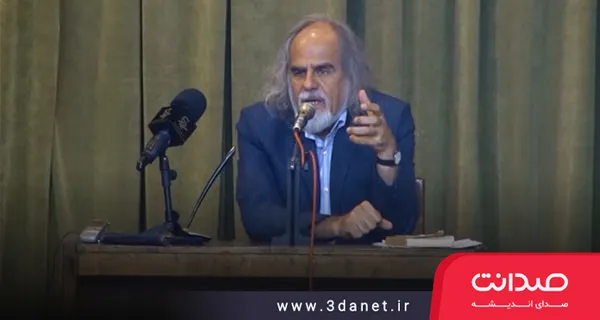
Touraj Saberivand's Lecture at the First 'Designology' Conference: Ugliness, Beauty, and Ethics
Design is humanity's rebellion against nature and the creation of a new environment called the city—a process that began three million years ago with tool-making to solve problems. Touraj Saberivand examines the relationship between ugliness, beauty, and ethics within this design process.
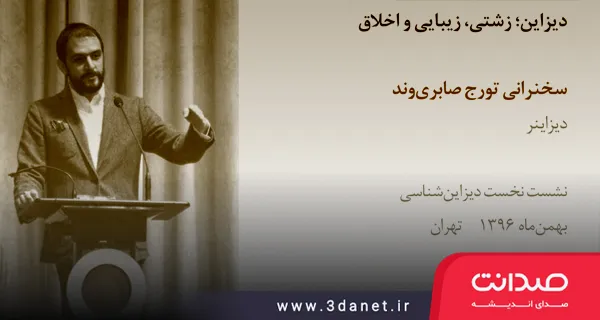
The story of design is the story of humanity's rebellion against nature; the story of design is the story of humanity's revolt against what nature had ordained for it; the story of design is the story of humanity's defiance against the conditions of its own life.
From the moment humans began refusing to accept that they must be weak creatures in the face of animals larger and stronger than themselves, and saw this not as something nature had destined for them, but as a problem (a problem they had to solve), they began this rebellion. Thinking that this is a problem and I, the human, must solve this problem. Once they identified and defined the problem, they began finding solutions for it and started creating things that had not existed in nature before. They struck large stones against smaller ones and made new tools from them. These were humanity's first artifacts, as things that did not exist in nature and that humans made for themselves to overcome their problems. This process is the process of design, and if we want to say when design began, in this sense we can say it began 3 million years ago, and humans created things to solve their problems, created them by themselves based on what was around them and based on the possibilities available in those days, and they continued this making and this solving of problems, and continued, and multiplied these tools so much that they stepped out of nature. Now, the environment that humans have created around themselves is a new nature. A nature that bears no relation whatsoever to the nature that existed on Earth before human thought and before human making, and humans created their own nature themselves.
In this sense, the design that humans did three million years ago is not essentially different from the design that humans are doing today in the 21st century. Design is a process: humans encounter their problems, identify them, assume they are solvable, and begin solving them, finding solutions for them. When they find the solutions, we can assess whether the problem has been solved or not! What happens in the 21st century is the same thing.
Shamloo has a poem that perfectly describes this process.
So he planted his feet more firmly on the ground
Straightened his dark back
Raised his neck in pride
And let out a cry
Behold, I am Man, the king of the earth
So the mounds and the soil submitted to Man's obedience
And the mountain submitted to Man's obedience
And the seas and the river submitted to Man's obedience
As did the groves and the wind
And fire became Man's servant
And of all living things, whatever there was became Man's servant, in water and on earth, in the sky, whatever they were and wherever they were
And the kingdom of the world became his
And the sovereignty of water and earth was assured to him
And the world came entirely under his signet ring
And time was placed in the grip of his power
Later, man became so insolent that he even made his own god and, as Shamloo says, prostrated before it because he himself had made it.
Three million years ago, when humans made stone tools to solve their problems, mastered them, and improved them, they were confronting their problems and solving them. The 21st-century human is doing more or less the same thing. In later years or centuries, in order to carry water around, humans created something called a cup, and they are doing exactly the same thing—in fact, they solve the problem of carrying water with the simplest tool they can make. Or, wanting to cross from one side of a river to the other, they build a bridge. None of these existed in nature; humans created them, and these creations and makings were the beginning of humanity's departure from nature into its own self-made nature. Into a self-made nature that we today call the "city," and this city is completely alien, its logic entirely alien to nature.
In this sense, we can say that the city, or design, is the antithesis of nature; meaning, if we were to posit an antithesis to nature, it would be "design," and if we were to posit an antithesis to design, it would be "nature."
Today, we live in a nature where every particle, every component, and all its parts have been designed, and a human thought about that object and built it before it came into existence. Cities today are museums of design, and to me, it is truly astonishing that we have built a city, grown accustomed to it, pay little attention to anything in it, and are unaware of the space in which we are living. When we are in nature, nature itself is constructed based on its own laws and a thousand and one incidents and events that have occurred. Before an event happened and a waterfall was formed, nature had not thought, "I want to create a landscape and an attraction here at this point, so I will give the land a sharp difference in elevation and direct water from one side so that when the water reaches this point, it falls and creates a waterfall." It happened for a thousand and one reasons. Or when we encounter and see a tree in nature, no one had decided that this tree should be planted or come into existence exactly at this spot. But when we see a tree in the city, although it appears to be a natural element, a person decided, "I want to plant this tree, for this reason, and this type of tree, exactly at this spot." This is the difference between nature and design.
Here, a question can be raised: Is everything that humans have made (all human artifacts) design? That is, is everything we see in the city, or human-made things, designed? To answer this question, we must review what exactly we are talking about when we talk about design. Design is a process. A process where we can accept that, in our time, designers generally agree that design has three main stages; the first step of design, or the first step of the design process, is empathy. You empathize with a person, understand their problems, see their life, see and understand the context in which this person lives, both culturally and in terms of lifestyles, and you identify with them. Once you understand their problems, you start thinking and finding solutions. This ideation or thinking is the second step of design. After this stage, you, as a designer, begin to build and implement one of those ideas you thought could solve that problem. Once you have built it, you create a prototype, go and test it, and ask the same person with whom you initially empathized and whose problem you identified to use it, to see if it can solve their problem. And then you improve this process.
Therefore, when we talk about design, we are talking about a process. A chair is not design; it is the result of the chair's process. A logo itself is not design; it is the result of the design process, and we can assess whether this design is a successful design or not. How can we assess whether this table or this chair is successful? By seeing whether it solved the initial problem or not. If it arrived at something interesting and creative but did not solve the problem, then it is not a successful design, although it can be a creative, new, and interesting thing. In any case, it is not design.
When we design something in this sense, we are doing an ethical act. The design process begins with recognizing the problems of another, with recognizing their pains and their sufferings. In design, we never, from the first step, intend to create something creative, not at all. In design, we strive to create something that solves another person's problem. And this becomes design. Whether it is creative or not; whether it is beautiful or not.
There is a saying by Mr. Malekian that is completely well-known and familiar to those who have sat in on his talks and classes. I am neither concerned about tradition nor about modernity; neither concerned about civilization, nor about culture, nor about any other abstract matter of this sort. I am only concerned about the flesh-and-blood human beings who come, suffer, and go. Design deals only with this part: "suffer." In fact, the second proposal that Mr. Malekian made after these statements... He has three proposals; one is to know the truth correctly, the second is to reduce those pains and sufferings, and the third is to do as much good as possible and to increase goodness. In fact, design is carrying out this second step. It tries to reduce people's pains and sufferings. Design came into being for this very reason and is still doing the same thing. It may be changing form, different people may think about design in another way and with different aesthetics, but ultimately it is supposed to do this. In this sense, we can say that design is an ethical matter in its very nature.
But design actually has an approach that makes it even more ethical. When a designer wants to make a glass or wants to create a pedestrian crossing; what is a pedestrian crossing? It provides a solution to the problem of safely crossing the street for people. Precisely when the number of cars in cities increased, a Mr. William A. defined a series of rules to increase people's safety on the streets. Now, whether the idea of cars entering the streets in this volume and at this level was fundamentally a good one is another issue; but what Mr. William defined is that now cars exist, and now cities exist, and people are crossing these streets. So how can I increase safety? He established a series of rules, including the pedestrian crossing, which both cars and pedestrians are obliged to observe there.
When design seeks to solve a problem, it never asks about a person's faith, it never asks about their beliefs. I have seen this neither in design theories nor in the work of various designers around the world—that, for instance, when they want to design a cup or a chair, their problem and their problem statement is: what is the religion of the person who will sit on that chair? Are they religious or irreligious? Are they a corrupt person or a virtuous one? Are they white or black? It is not that they decided not to think about it; the truth is, it was never fundamentally their concern. They wanted to make a chair for people to sit on at a certain height. And if they asked a question about those people, it was about how tall they are, how old they are, whether this chair is for a child who will sit in a classroom, or for an elderly person who will sit at home and watch television, or for people who will sit and work in an office environment, or who will sit and negotiate. But they never asked whether this chair is for atheists, or for secular people, or for religious people. This was never, in any way, their concern. Therefore, when it defines that 'other,' it encounters a flesh-and-blood, flesh-and-bone human being whose suffering it seeks to alleviate.
Another Question for Design;
Are all human-made things design? And can we also assume that works of art are design? After all, they are made by human hands, and before they come into existence, works of art are generally not based on accident. A human being has made a decision to create a work of art. If we review this definition—that design is a process for solving the problems of other human beings—in this sense, we can say that art is not design. For a while, I tried to explain why design is not art, but I think the correct question is: why is art not design? Therefore, art fundamentally does not seek to solve the problems of other human beings. I know that art cannot be defined so easily, and no one has been able to define it. No philosopher has been able to offer a definition that encompasses all works of art, and I have absolutely no such intention whatsoever. But to simplify the discussion for myself, I can enumerate three types of art and explain them one by one.
We are faced with an art that has content or a message (perhaps "message" is the more accurate word) or a statement, and the task of art and the artist in this type of art is to come and explain that, in fact, they encode that message with forms and expect the audience to decode these in order to access that message. Now, that message is either truly the artist's own message to society, to existence, or to their audience, or someone has paid them to convey this message. In terms of the nature and this message, nothing particularly special happens in this process; that is, both have a message that the artist encodes and waits for someone else to decode. Therefore, what happens here is simply that a message is issued; if we assume that a message is issued. Because when art becomes a little more complex, this process of encoding and decoding sometimes becomes almost impossible for those codes to be correctly encoded and decoded. Well, afterwards we also have discussions that there is no need at all to be exactly sure that the encoding and decoding has been done correctly. Whatever anyone understands from the artwork is correct. But in any case, the process is such a process, and when that art and that encoding and decoding become difficult and complex, there is almost no access to that original message anymore. So much so that I do not understand at all why we should do such a thing; when a message can be said more simply, why should we encode it in order to decode it! There may be a time when we want to send a letter whose encoding and decoding rules no one else should know about, so that no one gains access. But if we are doing this so that kings do not understand, well, they are not stupid either; they also happen to understand, and they understand these signs quite easily and quickly censor them, and you probably cannot carry out this process correctly. Or you make it so complex that no one understands it anymore, and if no one understands anything, then surely that message was not conveyed at all. In any case, this is one type of art.
Another type of art we encounter is the art of self-expression. The artist feels constricted by the emotions, excitements, pains, and passions they feel within themselves and wants to find an outlet for that affection, that feeling, and that excitement. They start writing poetry, or start painting a picture, or creating a musical work in its classical forms and in its modern forms, and the infinite strange and new forms that we see, and in any case, the artist is doing their own work. What happens here is that no message is necessarily conveyed. It is exactly like, in the words of Shamloo, "I scream and I am relieved." This art of self-expression is precisely that scream; meaning, they have neither encoded anything nor do they want to issue a specific message to their audience, and it is a scream, and its nature at 23:43 is also entirely a scream, it is a form, and when it happens, that artist feels better. They are relieved of that excitement, that love, that pain, or that inhumane scene and whatever they had seen. And here the process of art takes place. This is the artwork, whether there is an audience or not. Whether an audience sees it or not; understands it or not. They have done their work and let out their scream.
We also encounter another conventional art, which I truly do not know why they called art, because it is more like technique and more like craft. That I write Nastaliq exactly as my master has set it as a model for me, writing it precisely the same, and the criterion for judging these arts is that you write exactly the same 'ن' that the master wrote. Here, you neither cry out and find relief, nor have you necessarily encoded a message that the audience must decode. Or in music, we have the same situation: if you are a tar player, you do neither of those first two things. You do exactly what the master did years ago, or what he has asked you to do today. Of course, there are various other arts. But when we look at each of these, its nature and process have absolutely nothing whatsoever to do with the nature and process we defined for design. The process of design begins with you identifying a problem and then going through the process to solve it. Whose problem is it? It is the problem of another person, whom you may know closely or not. But you are supposed to go and get to know them and solve their problems. However, the issue of art is never that other people have a problem and I want to go and solve that problem. An artwork may start from a problem, meaning the artist sees a problem in a society and their heart aches, or they become happy and excited, and they begin creating an artwork; that is, its starting point can be the social problems of a specific group of people. But it is in no way seeking to solve that problem; that is, we can never measure that before this artwork, this problem existed in people's lives, and after this artwork, it no longer exists. Therefore, art is not design; rather, it is one of humanity's creations, but it is not design.
Another example can be given, and that is me, a human being who wants to carry water with me to a place. Another designer can come and solve this problem of mine, but if I am overcome by romantic feelings, another painter cannot paint a picture so that I feel better and so that I have a pleasant feeling. I must necessarily paint for myself. That is, an artist can do almost nothing for another, and if a designer solves their own problem, they themselves act as another, having identified the problems of that other, which is themselves, and gone and solved them.
This explanation must also be given that art has fundamentally never claimed that it wants to solve human problems. Design claims that it wants to solve human problems, and perhaps we can measure and say that it has been successful in one place and unsuccessful in another, or less successful somewhere else; but in general, it claims that it wants to do this. And what kind of human problems does it want to solve? Incidentally, it wants to solve the problems of everyday life. Design, unlike art, does not seek a fundamental change in the world. That which Camus claims in his Nobel lecture, saying that art, in my opinion, is the fundamental change of the world. We can, of course, measure whether art has been able to bring about a fundamental change in the world or not. And indeed, we do not see a fundamental change in the world to then investigate whether art led to this fundamental change or it was something else. But in any case, art's claim has never been that it wants to solve the ordinary, everyday problems of flesh, skin, and bone people, or to bring about fundamental changes in the world.
Another question that can be raised, answered, or at least pondered is: what, then, is the relationship between beauty and design? If we claim that design has nothing to do with art, what are we to do with this beauty? Can works of art inspire beauty in design, or not? Beauty, too, is among those topics that cannot be addressed or answered so easily. But something that can be dealt with and answered in this domain is whether art’s fundamental concern is beauty, and whether the artist is always seeking to create beauty. I think we cannot say, as a general proposition, that every work of art seeks to create beauty. Certainly, throughout history we have arts whose aim was the creation of beauty, but we cannot extend this as a general implication to all works of art across all of history and say that all of them sought to create beauty. Especially in the 21st century, such art practically no longer has any external existence. That is, was Picasso seeking to create beauty? Was Marcel Duchamp seeking to create beauty? Does the urinal that Marcel Duchamp presented as a work of beauty have anything to do with beauty? Or does it make any claim to being beautiful? Marcel Duchamp never said, ‘In my view this is beautiful, therefore it is a work of art.’ He had nothing to do with beauty at all. Ai Weiwei, one of today’s dissident Chinese artists, stands in front of the camera and drops ancient Chinese vases from his hands, and they fall and shatter! Is he seeking to create beauty? Or is Abramović, the Bulgarian-American performance artist, fundamentally seeking to create beauty in her works? In fact, we see the opposite more often; that is, there are works of art today whose aim is fundamentally to create and produce ugliness, whereas we very rarely encounter works of art that seek to create beauty.
Even if we suppose that we have works of art available to us today that are also beautiful works, and people can agree that these are beautiful works, can we use this beauty in design? As a designer, I do not know what the method would be, or whether it can even be done at all. And to be honest, my prejudice is that it cannot be done at all. Suppose the Mona Lisa is beautiful. When we want to make an iPhone, or a mobile phone, or a chair, what idea or form can we derive from the beauty in that painting and use in designing the chair, in the chair’s appearance? Or must we resort to cut-and-paste—something we do a great deal in Iran, by the way. For instance, we take pictures of the tilework of mosques from centuries ago and paste them onto the back of mobile phones, onto clothes, and so on. Well! That is not being inspired by it; it is merely cutting and pasting that beauty. That is, we cannot say we took an idea from it or that it helped make the design more beautiful.
The next issue is whether we need beauty in design or not! Should the things we want to design be beautiful, or does it not matter at all if they are beautiful!? Of course, beauty is one of the considerations of design. I also think it should be. What happens if it isn't? The result of the small and large designs of us Iranians creates a city like Tehran or like the rest of our cities. The result of not paying attention to beauty while still designing is this; that is, we see a building that functions as a building, we see a staircase that functions as a staircase, we see a glass that functions to hold water; but are they beautiful? Not at all. Well, naturally there are trees in the city, and in all other cities of the world they plant trees and do lighting too; but we cannot find any beautiful city where at one moment it is blue (the trees from Parkway to Tajrish) and immediately turns green, and immediately turns pink, and then turns phosphorescent. Well, it is obvious that I get stress and anxiety in this city and feel sick of this city. It is natural that when I see all these billboards across the city—advertising/non-advertising or cultural, as they call it, which is mostly no longer cultural but rather admonitory—the very organization responsible for this, the Beautification Organization, precisely what it does is put up ugly billboards in the city. Well, it is natural that when we do not pay attention to beauty in design, we face a city that is catastrophic in terms of beauty, and it is natural that my driving is like this because, subconsciously, it is as if I am fleeing from this city, from this street, and from all this ugliness to another enclosed space just so I don't see them. Of course, when we live in such cities for decades, our taste also becomes similar to them because we are exposed to them, after all. Therefore, when we see the homes of Iranians, they are truly ugly. The bizarre furniture without a trace of beauty, and the objects in homes (these very homes we live in) without any connection whatsoever; they are truly ugly. That is, no order, no thought, no formal calculation, no color... Go look at the furniture on these sites where people put their second-hand items and see what things they have made! Truly, some of them are laughable from sheer ugliness. And the result of such design and taste becomes our life, and naturally, it also affects our behavior, psyche, interactions, and the customs of our lives.
So, what becomes our judgment here? We say that the city is ugly and think that the city is ugly in its essence, and we see pictures of nature, and because the effect of our bad taste on nature is very minimal, we think that nature is beautiful. In my opinion, nature is not necessarily beautiful, and the city is not necessarily ugly; that is, the city in its conceptual sense is not an ugly thing, but rather it is we who have made it ugly. And based on a hasty sentimentalism, we declare that nature is beautiful. If it is beautiful, how can we explain that the plain is beautiful, the mountain is beautiful, the sea is beautiful, and the desert is beautiful!
I think the reason we essentially assume cities are ugly things and nature is a beautiful thing is because we see it from afar. We see nature from a distance and only see a picture. Or we go into nature for a few hours, walk in nature for a few days at most, our visual taste changes, we distance ourselves from the ugliness of the city, and we return. We have, in fact, created ugly things in cities, and when we go into nature, we distance ourselves from this ugliness, and because that stress, that pollution, and that immense volume of ugliness does not exist in nature; therefore, we say, look how beautiful it is! A sound comes, and we feel that this sound is a very beautiful sound. We have been systematically trained to see nature as beautiful. We think that nature... because, look! The poets we had looked at their surrounding environment, observed carefully, contemplated, and saw its beauties, and we have many sentences and poems and such that say nature is beautiful. But essentially, we never have the contemplation, the reflection, and the careful observation that people of the fifth century had now, and we do not see the beauties in our own surrounding environment and our cities. I don't want to say the city is always beautiful, mind you! I think I have explained that fully. But in these very cities of ours, our homes, and our surrounding environment, there are things that are completely beautiful by our contemporary taste. I think the vertical form of a staircase, repeating one after another, is an infinitely beautiful form. Why do we think a ladder is not beautiful, a stair is not beautiful; but the slope of a mountain is very beautiful!? I simply do not understand the reason for this and cannot explain it at all. When I experience it, it holds nothing but hardship for me. But when I climb a stair, I completely sense the person who thought about it and, so that a person could easily ascend that 45-degree slope, created a form so one could go up comfortably, and so they wouldn't get tired, also placed a landing. In my opinion, both its form is beautiful in terms of aesthetics, and the event that occurs and the process that actually led to this point is beautiful.
Why do we think a river is beautiful, but highways whose forms resemble those rivers are not beautiful? We have things in our urban nature that we do not have in nature. The black and white contrast of street surfaces; such a thing absolutely does not exist in nature, and for me, a 21st-century human, when I pay attention to it, it is infinitely beautiful. We never have straight lines in nature, and straight lines are infinitely beautiful, and such a thing does not even exist in nature. Why do we think a pond is beautiful but a water tap is not beautiful!
Therefore, from these words, I want to conclude that we are not accustomed to nature, and it is a different thing in our eyes, and we think it is beautiful because we see something new. It conveys a good feeling to us, and we see something new, pay attention to it, and it seems beautiful to us. But we have become accustomed to the city and all the things that exist in the city, and we do not look at them at all, and even because of this, we do not look in this way to see whether this is beautiful or not. I think we, in Iran or in countries where ugly cities have been built, essentially have not looked; otherwise, the city is not ugly. Go to other places and other cities and see how beautiful a city can be, how calming it is, and how much you enjoy it. Your driving style probably changes too.
In nature, because we have more rivers than waterfalls, a waterfall seems more beautiful and interesting to us. And among all the waterfalls that exist in nature, those that are more different from the rest seem more beautiful to us. In our view, a waterfall is more beautiful than a river, or there are fewer of them, and again, in our view, Niagara Falls is more beautiful than the waterfalls in Lavasan. Because we have seen something like Niagara Falls less often, and it seems more interesting to us. This, in my opinion, is our hastiness in seeing everything in nature as beautiful; we hear the drumbeat of nature from afar and have become afflicted with a kind of myopia in the city, where we do not necessarily see our surroundings with the attention we should.
If I were to summarize my remarks, it would be this: I have tried to argue that design is an entirely human phenomenon, having nothing whatsoever to do with nature or art, and is a completely ethical matter. I have tried to explain that beauty must necessarily be considered in design, and if we consider beauty in design as one of its considerations—not only its consideration, because beauty is by no means the sole consideration of design; it is not even its primary consideration at all—but naturally it must be among its considerations, and this beauty can be found neither necessarily in nature nor necessarily in art. However, the question of what kind of beauty we should pursue, how we should define beauty, what kinds of beauty fundamentally exist from our perspective, and how these beauties can be an ethical matter, is a discussion that Mr. Malekian has honored us by agreeing to address today at this Designology conference (a conference whose very title, Designology, was also coined by Mr. Malekian).
.
.
The First 'Designology' Conference: Ugliness, Beauty, and Ethics
Bahman 1396; Bagh-e Ketab Tehran
Organized by Soroush-e Mowlana Institute and designology
.
.
Touraj Saberivand's Lecture at the First 'Designology' Conference: Ugliness, Beauty, and Ethics
.
.
Related Content:
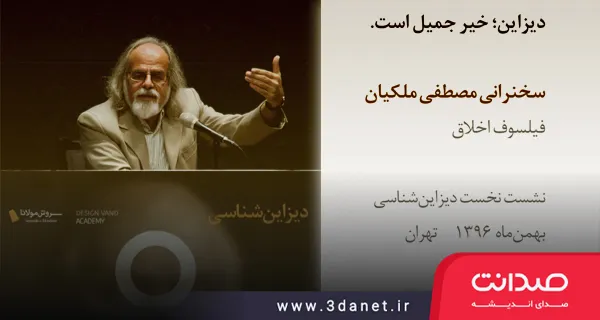
Mostafa Malekian's Lecture at the First 'Designology' Conference: Ugliness, Beauty, and Ethics
Touraj Saberivand's Lecture at the First 'Designology' Conference: Ugliness, Beauty, and Ethics
.
.

Discussion0 comments
No comments yet; let yours be the first voice.