Philosophy
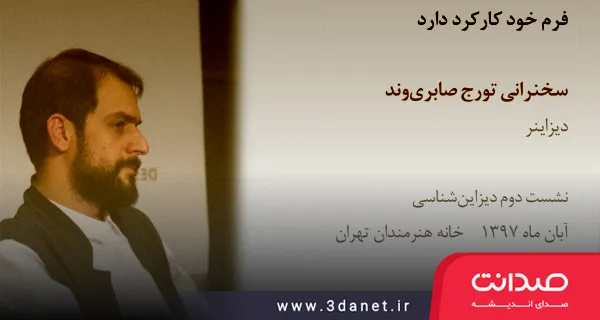
Touraj Saberivand’s Lecture at the Second “Design Studies” Conference: Philosophy and the Nature of Design
Touraj Saberivand critiques the definition of design as 'problem-solving'—a definition that blurs the boundary between the designer and other professions. What distinguishes design from engineering is its simultaneous attention to function and form; a form whose function is experiential.
The Definition of Design These Days
In response to the question “What is the definition of design?”, the answer we often hear these days is this: “Design means problem solving; in fact, a designer is solving a problem, and when we ask them, ‘What problem are you solving?’ they say, ‘Any problem at all.’”
These days, designers explain that “when someone brings something or a situation from state A to state B, they are designing.” We see the same idea in the thoughts of Herbert Simon, the sociologist, psychologist, and science researcher: “If you bring something from state A to state B, you are in fact designing.”
When we ask today’s designers, “Does anyone who brings anything from any state A to any state B design?” the explanation we hear is: “No, state B must be the desirable state; that is, they determine the current state to be brought to the desirable state.” We ask again, “Does anyone who brings state A to the desirable state B design?” and they generally say, “Yes.”
The third question could be, “So, is everyone a designer?” They explicitly say, “Yes, everyone is a designer.” Of course, not all designers in the world necessarily hold this view, but it is the dominant thinking. Is this answer correct? Does this answer help us understand design? In my opinion, no! This answer is so broad and vast that it says “everything is design” and “everyone is a designer.” According to this, the engineer, the doctor, the politician, and the legislator are also designers, and I think they are not. Someone might even claim that animals are designers too, since they also sometimes solve one of their problems. This answer that “design is problem solving” does not help at all in understanding what design is.
This definition is comprehensive but not exclusive. We must conceive of characteristics for design that allow us to understand it more precisely. If we are designers, we must understand what we design for, what is design and what is not, what it does to us and what we do with it! That “design is problem solving” can still be an acceptable definition for the first step, but the question “What is not design?” brings with it several questions. When design claims that “I solve problems,” one can ask, “What kind of problems do you solve?”
Friends active in the field of Design Thinking answer “any kind of problem,” but when we pay closer attention to their words, we see that in reality, not every kind of problem pertains to design; rather, design only solves questions related to practical wisdom. However, Design and Design Thinking never address theoretical questions and do not even claim to solve mathematical or philosophical problems. Design encompasses all things that relate only to technical problems, in the general sense of the word. Technique means engineering, medicine, and so on. Design does not provide answers to scientific problems, does not even come close to them, and makes no such claim. If design says, “I solve all problems,” I hear it as solving all technical problems.
Form and Function
What is design’s tool for solving technical problems? Look at the various design disciplines: architecture, industrial design, fashion design, ... When we look at the design disciplines, we accept that they are all solving problems, but is there a common characteristic among them that distinguishes those fields from other disciplines? Let us look at mechanical engineering, electronic engineering, road engineering, medicine, and surgery. They also solve problems, and design also solves problems. But the fields and disciplines of design pay attention to something that the rest of those who solve problems do not: form!
In design, form is of serious importance. A civil engineer never pays attention to the form of the column they build; they only pay attention to the function and performance of what they build. If we ask a civil engineer to build a structure, they will ask us, “What function does the structure serve for you?” They only calculate the gravitational forces, lateral forces, etc., acting on the structure, and then begin calculating and building, solving the problem—that is, creating a structure that fulfills the desired function.
They might ask, “How many people are doing what in this structure?” but they do not ask, “What feelings, emotions, and sentiments do they have?” They only want to know the amount of load and forces acting on the structure. From a civil engineer’s perspective, the column of a dance hall is no different from the column of a religious structure. They simply calculate all the forces acting on the structure and, based on that, provide a solution; but if we ask an architectural designer to design a structure for religious rituals, they will certainly inquire about the mood and feelings of the people in the building; not to understand the resistance and characteristics of the structure and columns, but because they want to create a space where people can realize the expected function.
From the civil engineer’s perspective, the structure only has a structural function, without thinking about formal aspects, but an architectural designer thinks about the form of the structure and what kind of space to create. “Does this space function for a religious ritual or a dance hall?” Attention to form separates design from other technical disciplines. Both engage in problem-solving, but technical engineers are indifferent to form, whereas the designer relies on it. A surgeon performing an operation does not pay attention to the form of the heart surgery or the nature of the incision and only considers the function, because it is not seen at all, but for a doctor whose work results are visible, form also matters. I am not saying that design is solely focused on form. In the first step, design means problem-solving and creating function; but form is equally important alongside it.
Form Follows?
A classic question arises here: “Does form follow function, or does function follow form?” I consider posing this question to be fundamentally erroneous because it seems to carry a kind of prejudice that considers form and function as separate and independent from one another. I have doubts about this. Are form and function truly so independent of each other that we can say one follows or should follow the other?
Let us think about this: “What is form, anyway?” The implication of the question “Does form follow function?” is that form has no function, whereas I believe that form, in fact, does have a function, but we must define its function. In my view as a designer, form is something that the audience sees, understands, remembers, and experiences! Some characteristics serve as functions. A matrix of these characteristics can define the functions of form. I see some forms and remember them. When we talk about form, it is as if we have a matrix of arrays whose values can be zero or another number, but a matrix of functions that come together defines the function of form.
Politics and Religion
We sometimes fall into a misunderstanding: that form is only present in art. In my opinion, many artistic, technical, social, political, and religious institutions use form. Art also utilizes form, and design does the same; but they have differences. Art has defined various applications for form! What we mean by “art” is not one specific type of art. “Narrative art” uses form to narrate something; “committed art” uses form to convey a message to the audience; “abstract art” employs form in the service of the artist’s self-expression. “Committed cinema” uses form to create expressiveness and depict its own ideals and aspirations.
Religion also uses form and signs to distinguish itself from other denominations or other religions. Each religious symbol comprises a form. One can even guess people's religion from their clothing and distinguish them from others. Believers use forms to be ambassadors of that religion. In my view as a designer, coverings are also forms. You can even guess a believer's religion from their grooming. These are entirely formalistic aspects. So when religion uses visual forms to solve a problem, it is using design.
Politics also uses form; very seriously so! Politics employs form to display its presence and power. Politics harnesses visual forms like the flag to make a colored piece of fabric known as a symbol of power, and demonstrates its power by producing and distributing it. In politics, the flag becomes something that gathers a group of people together, unites them, sets a goal for them, and engages their feelings and emotions so they feel they belong to this shape. They also put the map of the country on money. Sometimes it asks the population of that city or country to become emotional about their flag, to kiss it, and to fight for it. Sometimes form becomes something sacred that is respected by the military and is even respected more than people. When individuals are killed in war over a form, it means there is something behind the form that is intangible and unseen. "Homeland" has no shape, but politics uses forms to give objectivity to the homeland. The function of form is to give objectivity to things that are not seen. "ISIS" makes the most intelligent use of form in the political arena. They have given themselves such a consolidated integrity and identity that all the people of the world agree on the shape of ISIS. They use this very shape and form to frighten people. America presents and showcases its military equipment in such a way as to claim that "these military tools bring democracy." They employ well-dressed, fit soldiers and dress them in attractive uniforms to appeal to Iraqi children. Iraqi children like to look through the scope of a gun. Politics is precisely this use of form for political goals and ideals! ISIS uses form in another way. ISIS kills far fewer people than America's advanced military forces, but it kills in a way that creates fear and terror. All of this is done with form. Form is not only used in art. Politics' use of form is highly intelligent. These examples are endless. So when politics uses visual forms to solve a problem, it is using design.
The Difference Between Form in Art and Politics
In politics, forms are produced and appropriated. Where this color and that shape came from and what secrets and mysteries they hold is unimportant. In politics, it does not matter what the colors of a certain country's flag mean. It is of no importance what a triangle and a single eye mean; the fact that {a specific political group} has appropriated this form is sufficient. A plus sign with one arm longer than the other means "Christianity"! The lengthening of that sign would signify the increase of Christianity's power. For me as a designer, it is not important why ISIS chose black for its flag; what matters is that it has appropriated and produced this form, and it has become a tool of power to amplify its voice! This use of form is not art in the conventional, historical sense, but it is functional.
Form in Everyday Life
Ordinary people, too, use forms in the “praxis” of their everyday lives, and these forms have a function for them. Ordinary people in their daily lives use form to display their social and cultural class. The designer’s use of forms is more conscious than that of ordinary people in everyday life, yet, as it happens, ordinary people define remarkably coherent and integrated applications for form. People’s clothing is defined by their social class. Although we might say that capitalists and economic systems are trying to steer forms, people also have a degree of agency and choose one from among various alternatives. People of a particular class dress alike. The colors and objects they choose also resemble one another and form a kind of coherent system. Sometimes people use functional objects merely as tools, and sometimes as ornament, decor, a consumer item, and so on.
When you put all of this together, you see that it forms a kind of integrated formal system. You can expect that a person from a specific class, when placed in a formal setting, will wear clothing that displays their class and personality. Someone who chooses informal clothing has specific characteristics. Seeing someone in their workplace, you can probably guess what form of clothing they wear at home. If you saw their home, you likely wouldn’t be very surprised. If you know a person’s character, you can guess what car they drive; after all, how much technical difference is there really between cars? Why do you expect certain people from specific cultural and social classes to drive one car, and expect another class to drive a different one, and feel surprised if they were to swap?
People in their ordinary lives use form to represent their social and cultural class. They probably do this unconsciously, but they do it. “Bourdieu” emphasizes the subject of “taste.” People’s social class reveals their taste. Bourdieu has a brilliant sentence: “Taste is the basis of everything that people possess, and people construct their identity and classify themselves culturally based on their taste. People are socially classified based on their choices and taste.” If they were to choose an art form as well, you could understand a person’s cultural class from the art form they select. Commercial systems also exploit this {taste}. I don’t want to absolve commercial systems, but they see that people choose things based on their tastes. Commercial systems, in a self-interested manner, produce and make the same goods or services appealing based on the audience’s taste and cultural class, so that through the choice of consumer or non-consumer goods, they help individuals better and more fully represent their social and cultural class. This happens in an intelligent way.
Specialized groups and guilds also enlist form. Physicians use form; not for the medical profession, but to classify themselves in relation to others! Physicians wear clothing that makes it completely clear: this one is the doctor, that one is the nurse, and the other is the patient! The clergy of any religion uses form to distinguish between themselves and other believers. Even within their own group, they display forms and colors to show their distinctions.
Political activists and artists also create this same distinction among themselves with form. If two artists, one a calligrapher and the other a minimalist painter, are both seen, you can easily tell which is the calligrapher and which is the minimalist painter. They use form for social aspects.
So, whenever any institution or person uses visual forms to solve a problem, they are using design.
What Use Do Designers Make of Form?
The main issue is that designers use form not only in social class but also in their work. The use of form in the designer’s profession differs from its use by other groups. Designers employ form for two functions. One is the functional-instrumental-consumptive function; for example, they make a chair and use form so that the chair is sittable, or they make a ladder so that you can climb it. These are instrumental functions. The second function is the creation of social functions. Many of the examples I gave are carried out by designers. In fact, designers can easily propose a suitable and appropriate solution to each of these groups. Designers use form to create a tool for the user that displays their individual taste and social class. Designers also create forms that give the user a new experience.
Baudrillard gives an example regarding the system of objects: the lighter! He says, “A lighter is a lighter; all lighters do the same thing and are roughly the same size, but a designer makes a lighter shaped like a stone found on the beach! They want to say that the sea shaped the form of this lighter by rubbing coastal stones together! In this way, they create an experience for the user so that the lighter is not merely an instrumental and consumptive object but a new experience.” In my view, “experience” is one of the functions of form. Perhaps we need to think more about the functional matrix that forms possess and refine its items. I do not know whether these are limited or unlimited; but I understand that they have a visual aspect and an objectifying aspect. Form creates social classification and has social functions.
The Proximity of Design and Art
The final point concerns the proximity of design and art. In my view, the difference between design and art can be seen in that design is definitively functional and art is non-functional; but we also see a similarity between them: form is important in both art and design! One might say that form is the most important aspect of art. “Form” is the shared wall between art and design, but the use that art makes of form is completely different from design’s use of form, and although form is the shared wall, it simultaneously separates art and design.
The distinction between design and art is based on the type of use they make of form and the encounter that the audience of form and design has with form! A clear example is the difference between a red siren and a symphony. Both utilize musical instruments and sound, and in both, form is important, but the use that art makes of sound to create an artwork is different from the use we make in sound design for another purpose, and this separates art and design. These two uses are so far apart that I cannot imagine any relationship between art and design, whereas I can easily imagine the relationship between design and politics, design and religion, design and business, and design and many other fields. I see the least connection and similarity in the use of form between design and art.
.
.
The Second “Design Studies” Conference: Philosophy and the Nature of Design
Form Has Function
Aban month 1397; Tehran Artists' House
Panel Director; Ali Varamin; Journalist and Writer
Organized by Soroush Mowlana Institute and designology
.
.
Touraj Saberivand’s Lecture at the Second “Design Studies” Conference: Philosophy and the Nature of Design
Download the PDF of the lecture
.
.
Related Content:
Mostafa Malekian’s Lecture at the First “Design Studies” Conference: Ugliness, Beauty, and Ethics
Touraj Saberivand’s Lecture at the First “Design Studies” Conference: Ugliness, Beauty, and Ethics
.
.

Discussion1 comments
سلام عرض می کنم بازهم باعث حیرت من شدید. بسیار سپاسگذارم ( صوت آقای ملکیان را گوش دادم. از حیرت و شگفتی ام بخاطر مطالب و نحوه ارائه آنها که بگذریم، با نهایت صمیمیت و ادب عرض می کنم که کیفیت صدا خوب نیست. _ آنهم در این عصر که کاملن و به آسانی در دسترس قرار دارد.) قربانام امین بلندی