Economic Sciences
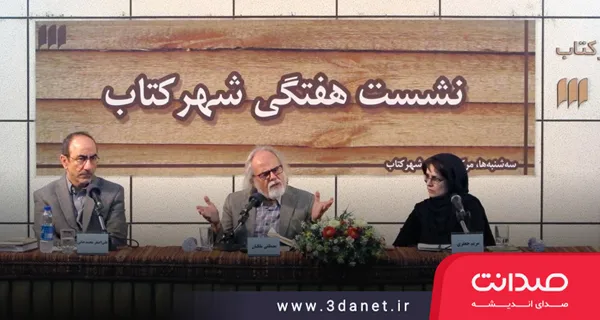
Mostafa Malekian, Abbas Abdi, and Ali Sarzaeem at the Book Launch for “Economic Insight for Everyone”
At a book event for Economic Insight for Everyone, with Mostafa Malekian and Abbas Abdi in attendance, Ali Sarzaeem stressed the necessity of explaining economic concepts in plain language. He argued that failing to convey economic complexities fuels populism, and that understanding the market requires a non-mathematical vocabulary.

Iranian analysts and intellectuals have very little familiarity with economics. Most Iranian theorists have studied either philosophy, political science, or social sciences. Generally, our reading public does not engage much with economic topics, and various reasons can be cited for this gap. One is certainly that economic books are mostly written in mathematical language, and this has meant that, unlike other works in the humanities, fewer people turn to economic works. Writing economic works that, while adhering to scientific and research principles, are also usable for the general reading public is important in this regard. Ali Sarzaeem, an economic analyst and graduate of this field, wrote two books last year, one titled Economic Analysis for Everyone and the other Economic Insight for Everyone. In these works, he has tried to explain the main and general concepts of the major branches of economics, namely macroeconomics and microeconomics, in simple language with numerous understandable examples. The reception of these works by Mostafa Malekian, professor of philosophy and psychology, and Abbas Abdi, social researcher and political analyst, indicates that these works have succeeded in achieving their goal. On the afternoon of Sunday, the ninth of Khordad, the Bank Keshavarzi brokerage hosted a meeting with the presence of Mostafa Malekian, Abbas Abdi, and Ali Sarzaeem about the book Economic Insight for Everyone, an account of which follows:
.
The Necessity of Economics in Simple Language Ali Sarzaeem
Economic Researcher
I will mention six points about my book. First, the book Economic Insight in Line with the Economics for Everyone Project has been compiled in five volumes, the first of which has been published under the title Economic Analysis. The third volume is Finance for Everyone, which has been partially written. The reason for working on this project is that I felt it was necessary for economic concepts to be explained to the general public. Moreover, due to extensive experience in writing journalistic content, I felt I had the ability to speak to the masses. Of course, in the field of economics, many have greater ability than I do, but due to my journalistic experience, I have the ability to connect with a general audience. But what is the necessity of writing simply in economics? Paul Krugman says: If those who understand the complexities of social and economic issues do not express them in simple language, then those who do not understand those complexities and see issues simplistically will speak to the people, and the name of these individuals is populists, and as a result, populism will dominate society. Therefore, it is essential that those familiar with specialized topics speak to and connect with society. We have paid the cost of populism dominating society over the past 10 years, and I feel this issue is not over, and other populists with different faces and different brands are on the way. Thus, the necessity of acquainting society with the complexities of economic and social issues is undeniable.
Why is economics important for everyone?
The second point is that in economics we are compelled to use mathematics, because in economics the question of “how much” is important. It matters how much we help our neighbor; helping too much and helping too little are not good, and one must recognize the optimal point. The use of mathematics and mathematical parameters to find this optimal point is unavoidable. However, with the opening of the door to mathematics in economics, its use became so widespread that today university economics textbooks are no different from electrical engineering textbooks, and this has expanded to such an extent that economic concepts are sometimes lost behind the formulas. This problem is not unique to Iran and the technical fields in which economics is taught; rather, the same thing happens in other countries within the field of economics itself. For example, Robert Frank, a professor at Cornell University, one of the most prestigious universities in the world, conducted a study on students taking microeconomics in America. He posed an economic problem to those who had passed university-level microeconomics and those who had not taken the course. Interestingly, no significant difference is seen between those who had taken this course and those who had not in solving this problem! It is quite possible that those who had taken the course gave worse answers! This has led economists to raise the question of what problem causes the core economic concept not to be learned despite all this studying and to be lost behind the formulas. Therefore, the feeling arose worldwide that something must be done to make these concepts more visible. Unfortunately, even in English, there are few books that have managed to convey economic concepts free of formulas. One is Economics Is Everywhere by Daniel Hamermesh, and another is a blog by Gary Becker titled ECONOMIC INSIGHTS, FROM MARRIAGE TO TERRORISM, from which the title of the book (Economic Insight) is also derived. I think we need this kind of work in Iran.
Economics considers humans to be rational beings
The third point is that what distinguishes economics from other sciences is its strong emphasis on rationality. Perhaps other human sciences do not have this emphasis. I feel this is alien to our culture. That is, I think our intellectuals and analysts like to consider humans as irrational beings or say their rationality is of a different kind. Economics is different in this respect. I do not know why such a notion is common in our society, but I sensed that if we do not consider humans as rational beings, then their repression also has a rational justification. In my opinion, part of the problems we have in the political arena are rooted in this type of view of the human being. Therefore, if we consider the economic view, which sees humans as rational beings, the way is opened for other fields of analysis regarding social and political issues.
We have not understood the market mechanism
The fourth point is that in society, although there is emphasis that privatization is good and the market is good, etc., these discussions have remained at the surface, and the market mechanism has not been understood as it should be. We see this point at critical junctures, such as whether the university should be private or not. It is here that we realize from the talk of intellectuals how deeply that state-oriented mentality has penetrated. Incidentally, the prevailing atmosphere among our intellectuals is strongly opposed to the market mechanism. This book attempts to unpack the market mechanism and show what the strengths and weaknesses of this mechanism are.
Big government, small public economy
The fifth point is that we are in a country where the public sector is very large and the state is a significant phenomenon in Iran. This point has been acknowledged in various disciplines. Therefore, it is fitting that we have a proper understanding of the state's existential philosophy. When should the state intervene in the economy, and how should this intervention be? Thus, we need a precise understanding of the state, its mechanisms, the necessity or lack thereof of its intervention in the economy, and the manner of this intervention. Unfortunately, despite this need, one of the weakest areas in Iran's economic science is public sector economics, whose entire subject is the state. It is strange to me why we have a large state but a very weak science of public sector economics, and no one works on this area. We see the effect of this deficiency in a state that cannot properly perform its functions, such as regulation, and where it intends to fix things, it botches the job due to ignorance.
An Economic Lens for Seeing Affairs
The final point is that in this book, numerous examples from family, marriage, divorce, politics, religion, society, etc., have been deliberately used. The goal was to convey the message that economics as a whole is a lens. If it sits on our eyes, we can see all issues in this way. If we take the concept of cost and benefit seriously, then whenever we see any phenomenon, we say people are calculating costs and benefits. Another important claim of economists is that the microeconomic framework is very strong and helps, alongside other scientific frameworks and disciplines, to have a good analysis of issues and topics, from social problems to politics and beyond. Of course, I am aware that society is strongly opposed to an economic view of social issues; apparently, there was similar initial resistance in the West as well. But gradually, economists have shown that this approach can be effective.
The new parliament has begun. If I were in the position of someone in the parliament, I would take them to a one-week class and tell them to read these two books, especially the second one, thoroughly, for the reason that they are going to make decisions about the country's fate, but what we need is precisely this economic insight that we lack. If someone looked at Iran from the sky and observed the details of our behavior, they would probably be very surprised by our actions.
Economics; An Inferior Good
I myself, despite having paid much attention to this insight, when I read the book, I see that beyond the economic sphere, it can also be greatly helpful in the social sphere regarding subsidiary issues. The problem we have in Iranian society is not the science of economics but rather economic insight, just as in sociology we also have this problem with sociological insight—and not its knowledge. You can find people who have a PhD in sociology and are also good at authoring books, but when you look at their behavior and analysis of society, you see it is not based on their knowledge. The reason is that knowledge in the West was not abstract. Their social and economic knowledge was also based on external realities. But when it came to Iran, we have nothing to do with insight and its external referents, and economics has turned into a series of formulas, lines, and graphs for us. But in practice, economic insight does not work for us because we do not have it. Economic knowledge does not work for us because we lack its insight.
The Priority of Reading the Book for Members of Parliament
Over various terms, this issue has been raised: why does the Iranian parliament easily collude with the government and approve all sorts of useless projects in cities and villages? The question is, does it really not occur to anyone that doing these things is futile? In my opinion, when the book explains it, a person can read well and understand why this happens. Why a non-partisan representative, when there is no party, represents separate individuals, each seeking to maximize their own interests; perhaps the best solution for them is to secure projects in their own region, even if their economic productivity is zero or even negative. This is why I say that studying this book is a priority for members of parliament.
Seeking to Present a Clear Idea of Economic Insight
The importance—and perhaps the weakness—of the book lies in the fact that it cites the most significant issues we grapple with as examples. Some of these issues are managerial, some political, some economic, and some social. For instance, marriage and divorce, fertility, polygamy, the issue of subsidies, political topics like ISIS, the crucial issue of interest rates, pricing, democracy, the execution of drug offenders, the important matter of highway construction, coupon sales, rationing, the implementation of futile projects in various cities, even discussions in the realm of philosophy such as justice, politics, election candidacy, and so on... All of this shows that the book does not seek to solve these problems but rather to present a clear idea of an economic insight, which I believe is the insight of our lives. In practice, we live based on that insight, but we do not articulate it. For example, when we marry, we might say something about the mahr or dowry, but when a scholar analyzes it, they perform that very economic analysis. Yet, this is also the book's weakness; perhaps it would have been better if some examples had not been given—examples where the economic insight and the cost-benefit insight can, at most, interpret 30 percent of the variance. Another correct example in the book concerns the income effect and the substitution effect. It explains what happens with the income effect and the substitution effect, but it does not specify that when he and I encounter such a thing, we ultimately do not exhibit a fixed reaction. This goes back to our culture; culture plays its role here, but it cannot change the fundamental rule.
Revising the Rules of the Game
To increase the impact of this book and to ensure no ambiguity remains for the reader, it would have been better to avoid examples that could be a source of ambiguity or to handle them with caution. For example, it is very good that the example of the family was given, but since we are all involved with it, anyone might think, based on the details, that the example provided is not so, and that other factors might be at play. Or, to understand why ISIS kills its captives, good ideas are presented here, but there might be other reasons and factors, which someone unwilling to accept this could cite and dismiss it. Or, some parts of the book require further explanation; for instance, regarding pricing, we understand why a problem arises when something is priced or rationed in the way described, but someone might defend milk pricing with a completely different logic. It seems that such examples, which contradict the book's logic or are exceptions to it, must certainly be corrected, because these examples do not refute the book's logic, but those who ignore the main point can very easily cite these exceptions. But overall, it is a very good book. Dr. [Author], in his notes and other matters, truly lives with this; the book of economics is not a textbook for him that a group of students pick up and read; he uses it in his daily encounters and analysis of issues, and this is what matters. And if we can promote this economic insight—which is, in fact, a kind of life insight for us—in society and gain a correct understanding of it, perhaps we can hope to have at least some common understanding in our future decisions. But my impression is that the book's importance lies in showing the reader that you, as an individual, cannot overcome many issues; that is, when a structure exists, you must play within that structure. The collective of individuals makes decisions based on a structure. Therefore, I think a fundamental revision must be made regarding structural reforms, that is, the rules of the game.
It will probably be astonishing to everyone that I should speak about economics; it is not particularly agreeable for me either, because I am not a specialist in economics. But what made me accept the invitation to attend this gathering was, first, that I was asked to speak about the book from the perspective of philosophical analysis and analytic philosophy. Second, reading these two volumes was deeply gratifying for me and not only made me interested in the field of economics, but through studying these two books I observed that writing works of this kind is pioneering not only in economics but in other fields as well. The book Economic Insight for Everyone has precisely this characteristic, and without technical jargon that is only useful to pundits and economics experts, it can convey economic material to the audience simply; that is, even if the audience does not acquire economic knowledge, they at least gain economic insight. So these two points made me willing to talk about this book. However, throughout the book I encountered certain philosophical points, and I will direct my discussion to those, and several questions have arisen for me in this regard.
The Difference Between the Psychology of Motivation and Microeconomics
At one point, the author defines one of the definitions of microeconomics, as opposed to macroeconomics as one of the two main branches of economics, as the science of studying incentives. In my opinion, this definition is incorrect both conceptually and referentially, and the study of incentives is not the task of economics; rather, it is a part of psychology as an empirical human science, namely the psychology of motivation, that studies incentives—that is, it both conceptually clarifies incentives and identifies their referents. Meaning, first, psychology says that one must draw precise distinctions among concepts such as incentive, intention, will, goal, ideal, plan, and so on. Of course, these concepts have affinities with one another, but from a precise standpoint they differ, and their definitions, status, effects, and consequences are different. Second, this same branch of psychology distinguishes among the different incentives of human beings referentially and enumerates the various types of incentives existing in the psychological and physical structure of humans that lead to specific or general behavior. Microeconomics is the study of human incentives solely in the economy. In other words, the science of microeconomics is a kind of magnifying of economic incentives alongside non-economic incentives.
Moral Judgment Does Not Entail Rationality
A correct claim is made in the book that a rationality governs human behavior, whether in the institution of the economy or other institutions such as the family, education, law, ethics, religion, and so on. Then the author addresses the possible objection of a reader who finds this claim (that humans act rationally) strange, and enumerates instances where humans act irrationally, such as someone who is lazy and becomes wretched, or someone who commits a crime and later expresses remorse for their behavior, or criminals like Saddam and Hitler who destroyed their own lives and countless other human lives. In response to this question, the author says: none of these counterexamples refute the claim of human practical rationality. But in my view, three important matters must be considered in this response. First, moral value judgment and behavioral rationality do not entail one another and must be separated. The rationality of a behavior does not necessarily mean the behavior is moral. This statement does not mean that living morally is contrary to living rationally. Rather, it means that the two ideals of rationality and morality must be separated, and one should not think that whoever possesses one also possesses the other. The second important distinction in the philosophy of action, which is significant, is the distinction between goal and outcome. What is meant by rationality is rationality in the goal. My behavior may be rational in terms of its goal, but it does not achieve the desired outcome because other factors are also involved in reaching the desired outcome. Therefore, the rationality of behavior is considered in the realm of the goal, not the outcome. The third important point is that the rationality of human behavior is compatible with calculation error; that is, it is not the case that if someone makes a calculation error, their action is, by virtue of this error alone, devoid of rationality. On the contrary, precisely because they wanted their action to be rational, they engaged in calculation, but made an error in the calculation due to the limitations of the mind. The author has mentioned these three points in brief, but it would have been better if these three matters had been separated and an independent discussion devoted to them.
Practical rationality is broader than economic rationality
Dr. Sarzaeem has offered four definitions of rationality, all of which are correct. However, he has considered all four definitions to be definitions of economic rationality. Since Aristotle’s time, when the discussion of rationality was first raised, it has been said that rationality has two parts: theoretical rationality and practical rationality. Theoretical rationality comes into play when a person wants to adopt a belief or abandon a belief they previously held. The discussion then is that in cases of accepting or rejecting, strengthening or weakening, denying or affirming, discrediting or adjusting, erasing or correcting, negating or proving a belief, theoretical rationality demands a specific discipline. If this specific discipline is observed in these seven cases, the individual has exercised theoretical rationality. Practical rationality, however, concerns the decision to perform an action. Practical rationality states that if you want an action to fall under practical rationality, a series of criteria must be observed. Simply put, when we want to understand the world, we need theoretical rationality, and when we want to change the world, we need practical rationality, because every action is a kind of transformation of the world, whether external or internal, present or future. The book deals mostly with practical rationality, and the definitions provided are among the best definitions of practical rationality, but they are not definitions of economic rationality. That is, practical rationality must first be defined, and then it must be specified in which domain this practical rationality is applied, such as practical rationality in the domain of politics, or practical rationality in the domain of economics, or practical rationality in the domain of religion, and so on. In the book, the discussion is about practical rationality in its general sense, because it is emphasized that it does not only discuss cost and benefit, whereas economic practical rationality deals only with cost and benefit. The fact that a person also thinks about honor, popularity, status, rank, fame, and social prestige and calculates them indicates that their calculation is not purely economic. The requirement of practical rationality is to calculate all these matters, whereas the requirement of economic practical rationality is only the calculation of cost and benefit. From this perspective, I believe the definitions provided are among the best definitions of practical rationality, but they are not economic rationality.
Intuitive propositions are not logical rules
He has written that rationality in economics means that humans observe the basic rules of logic in their choices, and he has enumerated several of these rules as follows: one, that when faced with any n number of options, a person either prefers one or remains indifferent; another, that preference is transitive; third, that humans prefer more to less; fourth, that when humans lose something they had, they are overcome by negative feelings, emotions, and excitements, meaning they at least become sad; fifth, that humans prefer variety to lack of variety. All of these are correct, but these are not the basic rules of logic, neither formal logic, which deals with the structure of arguments, nor material logic, which deals with the content of propositions. These are, in fact, psychological intuitions. That is, in psychology, some truths about humans are understood through experience and some through intuition, and these five items are five psychological truths obtained through a non-inferential method, meaning that any person who refers to themselves will affirm these propositions. In other words, what is today called intuitive propositions in epistemology and "aha" experiences in psychology, he has called the rules of logic. Incidentally, intuitions are stronger than inferential matters.
The mutual need of the humanities and philosophy
All branches of the humanities in Iran, including economics, need philosophy for a series of issues, just as philosophy, in certain parts, needs other human sciences, whether empirical, historical, or mystical. One of the areas where the humanities seriously need philosophy is the discussion of metaphysics, that is, the part of philosophy that looks at matters from an ontological perspective. For example, the book states that when a person loses something they have, they become upset. Counterexamples can be listed for this proposition. For instance, a debt is also one of a person's possessions! But when we lose this possession, we do not become upset. Therefore, someone who says that people become upset when they lose their possessions certainly does not mean debt or illness. This is why, to clarify this general proposition (people become upset when they lose their possessions), we must clarify the ontology of concepts; that is, as an economist, we must know that the concepts we use belong to one of these categories: substance, desire, event, process, number, set, and so on... and each of these categories has its own specific rules. We must know to which of these categories the subject of our discussion belongs. In this specific case, when we say people become upset when they lose 'something,' this 'thing' belongs to the category of substance, like a house or a car... But if this thing belongs to the category of desire, the matter is different. If a person loses most of their desires, they become happy. The same applies to an event or a process, and so on. Therefore, we must specify the key concepts of science ontologically so that it is clear exactly what we are talking about. The entities that exist in the world are ontologically different and, in this respect, have different modes. For example, no substance is destructible, but desires and events are destructible. Each of the philosophical categories has rules that carry a specific judgment, and we must recognize their differences. For instance, psychologists constantly speak of intelligence, but it must be specified whether this intelligence is a desire, an event, a relation, a process, or something else. In this book, it is also written that people prefer more to less. It must be specified what is meant by more or less of what. Therefore, the point is that it would be better if the key concepts in this book were specified in terms of philosophical metaphysics. Of course, someone might say that this ambiguity is soon resolved in an economics book, and when it says 'thing,' it means a commodity. But this statement is also not precise.
The Difference Between Need and Desire
The book states that human needs are unlimited and that human needs are insatiable. It is also sometimes said that humans like to consume more. It seems to me that several matters have been conflated here. First, need is different from want, and the rule governing each is different. To clarify the discussion, I must return to philosophical ontology. Need belongs to those entities whose being perceived (with a fatḥah on the rāʾ) is not their existence, and whose existence is not their being perceived (with a fatḥah on the rāʾ). But want belongs to that category of entities whose existence is their being perceived, and whose being perceived (both with a fatḥah on the rāʾ) is their existence. That is, philosophically speaking, a human can have a need but be unaware of it, but a human cannot have a want and be unaware of it. For example, a human's hunger (a type of want) is different from their lack of money (a need). It is impossible for a human to be hungry and be unaware of it, but it is possible for a human to be without money and be unaware of it. Therefore, lack of money is among those existents whose existence and being perceived are not one, whereas hunger is among those existents whose existence and being perceived are one. Another example is pain. Pain is among those existents whose feeling and perception are one with its existence. If pain is not felt, it does not exist at all. Whereas illness is among those existents whose existence is not one with its perception. A human can be ill but not perceive it. Therefore, the existents of the world must be divided into two major categories: those whose existence and being perceived are one, and those whose existence and being perceived are not one. One of the important concepts in economics is the concepts of need and want. But they must not be conflated. For instance, medicine is not among the wants of a sick child, but it is among their needs. Whereas in an adult, medicine can be both a need and a want. Or, for a sick child, ice cream, although a want, is not among their needs. Therefore, need and want must be separated. Of course, the error is not Mr. Sarzaeem's. He says that economists equate need and want, classify them under the category of taste, preference, and likes and dislikes, and call them preferences. Whereas this is an error, and a distinction must be made between states of which we ourselves are necessarily unaware and for whose existence or non-existence we ourselves are the best judge, and those of which we ourselves are unaware and the economist discerns whether we have that need or not. Therefore, the separation of need from want, which has been carefully carried out in psychology since William James, must be heeded. The ancients, instead of these terms, spoke of expediency (need) and pleasantness (want). That is, something is in the child's best interest but is not pleasant to them, or something is unpleasant for the child but is in their best interest, and so on.
.
.
Video of Mostafa Malekian's speech at this event
.Download the PDF of the Etemad newspaper report on the Economic Insight for Everyone event
.
.
Mostafa Malekian, Abbas Abdi, and Ali Sarzaeem at the unveiling ceremony for the book “Economic Insight for Everyone” on May 29, 2016
Statism dominates the mentality of our intellectuals
Mohsen Azmoudeh-Atefeh Shams
Etemad Newspaper | Issue 3540 | Tuesday, May 31, 2016
.
.




Discussion3 comments
در بجث این دو بزرگوار جای خالی پرداختن به منطق رفتار انسانی (پراکسیولوژی ) بسیار دیده میشد چرا که ایرادات ملکیان وارده اما جوابش هم وجود داره. در این زمینه روتبارد مقاله ای داره که بطورخلاصه به این موارد پرداخته و قسمتهایی از آن به شرح ذیل تقدیم می گردد: ? "کنش (action) به طور خلاصه حکایت از آن می کند که رفتار افراد، هدفمند است و اهدافی خاص را دنبال می کند. افزون بر آن، کنش انسان به این نکته دلالت دارد که او ابزار های خاصی را به شکلی آگاهانه برای دستیابی به اهداف خود برگزیده است. اهداف برگزیده شده از سوی فرد باید برای او ارزشمند باشند، چرا که می خواهد آنها را برآورده کند و بر همین اساس، باید ارزش هایی داشته باشد که بر انتخاب هایش اثر بگذارند. اینکه فرد ابزار هایی را به کار می گیرد، بدان معنا است که به باور خود از این دانش تکنولوژیکی برخوردار است که ابزار هایی مشخص، اهداف مطلوب او را برآورده می کنند. باید متذکر شد که منطق رفتار انسانی (پراکسیولوژی) ، انتخاب ارزش ها یا اهداف توسط فرد را عاقلانه یا صحیح فرض نمی کند یا مسلم نمی گیرد که او روشی را برای دستیابی به آنها انتخاب کرده که از نظر تکنولوژیکی صحیح است. تمام آنچه پراکسیولوژی مورد تاکید قرار می دهد، این است که فرد کنشگر، به درست یا غلط، اهداف و باور هایی را اتخاذ می کند که می تواند با استفاده از ابزار هایی معین به آنها دست یابد... بنابراین کنش دلیلی است بر اینکه انسان، دانشی فراگیر درباره آینده ندارد، زیرا اگر به شکلی فراگیر از آینده آگاه بود، هیچ یک از اقداماتش اهمیتی نداشت و تفاوتی را به وجود نمی آورد. بنابراین کنش به این معنا است که ما در دنیایی با آینده ای نامشخص یا آینده ای که به طور کامل معین نیست، زندگی می کنیم. بر همین مبنا می توانیم تحلیل خود از کنش را بدین شکل اصلاح کنیم که دلیل اینکه افراد تصمیم می گیرند در حال حاضر ابزار هایی را بر اساس یک برنامه تکنولوژیکی مورد استفاده قرار دهند، این است که انتظار دارند در آینده به اهداف خود دست یابند....اجازه دهید به مداقه در باب ارتباط آن با دیگر شاخه هایی که کنش انسان را مطالعه می کنند، بپردازیم و مخصوصا بررسی کنیم که چه تفاوت هایی میان رفتار شناسی و تکنولوژی، روان شناسی، تاریخ و اخلاق - که همگی به نوعی به کنش انسان می پردازند - وجود دارد. رفتار شناسی به طور خلاصه ترکیبی است از دلالت های منطقی این حقیقت صوری جهان شمول که افراد دست به عمل می زنند و ابزار ها را در تلاش برای دستیابی به اهداف انتخاب شده به کار می گیرند. تکنولوژی به این مساله محتوایی می پردازد که چگونه باید با استفاده از ابزار ها به اهداف دست پیدا کرد. روانشناسی، این مساله را که چرا افراد، اهدافی متفاوت را برای خود برمی گزینند و چگونه دست به انتخاب اهداف می زنند، مورد بررسی قرار می دهد. اخلاق به این موضوع می پردازد که افراد باید چه هدف ها یا ارزش هایی را اختیار کنند و تاریخ در این باره مداقه می کند که چه اهدافی در گذشته انتخاب شده اند، چه ابزار هایی برای دستیابی به آنها مورد استفاده قرار گرفته اند و این اقدامات، چه پیامد هایی را به دنبال داشته است...." مورای روتبارد متن کامل مقاله
به نظر میرسد که امروزه ودر سطح جهانی قبل پیش نیاز بحث پیرامون مسائل وموضوعات اقتصادی سیاسی اجتماعی حقوقی و....بحث ونظر بنیادی وبامبناورویکردفلسفی وحقوقی وشرعی درماهیت پدیده ی اسکناس (پول کاغذی!)، یک ضرورت نظری وعملی میباشد.
صرف جهت اطلاع : Ali Ghaderi, [۱۶.۰۵.۱۶ ۱۵:۲۹] [In reply to Ali Ghaderi] اسلام از شهر کوچکی در عربستان به نام مکه حیات خود را آغاز کرد و از آنجا بود که به سرتاسر جهان گسترش یافت، اما همان شهر کوچک موطن الگوی کسبوکاری بود که بر تجارت در مسافتهای طولانی و نقاط دوردست تکیه داشت و از طبقه بازرگانان همان شهر فرزندی پدید آمد، که محمد ابن عبدالله (ص) نام داشت و کیشی نو، یعنی اسلام، را رواج داد و همراهش طریقهای نو برای زندگی را گستراند. یکی از جنبههای رویکرد او به نظم بخشدن جامعه، تعهدی بود که او نسبت به رواج تجارت داشت. در مدینه او بازاری تازه برساخت و با این کلمات افتتاحش کرد که «باشد که این بازار شما باشد و مالیاتی از آن قبض نگردد». اما محمد (ص) کار را به همینجا ختم نکرد. بسیاری از جنبههای اداره ثروت را نظم بخشید -برای مثال: احکام ارث- و کارهای دیگر بسیار کرد. در لحظهای که بعدها مسیر تاریخ مدیریت اقتصادی را عوض میکرد، محمد(ص) قیمتگذاری دستوری را برانداخت. یک قحطی در مدینه حادث شده و قیمت مواد خوراکی به شدت بالا رفته بود. طبق عرف حاکم باید در آن شرایط سقف قیمت تعیین میکرد. مومنان مطابق عرف از پیامبر درخواست کردند که سقف بر قیمتها تعیین کند. پیامبر به شدت با آن درخواست مخالفت کرد با این استدلال که «قیمتها دست خداست». این رایی است که تاثیر عمیق بر بسیاری از محققان و دانشمندان اسلامی گذاشته است، برای این که بگوییم بصیرت محمد (ص) تا چه اندازه از زمانه خود پیش بود: او بدینسان مفهوم «دست نامرئی» آدام اسمیت را که بعدها راهنمای بازارها میشد، پیشبینی کرده بود. بندیکت کلر/نویسنده مجله فارین افرز ####### با توجه به اینکه به نظر میرسد اسکناس (پول کاغذی =پول اعتباری ) از موضوعات مستحدثه میبا شد سوالات زیر مطرح میباشد: 1 با توجه به اینکه اسکناس با برات وچک وسفته و قبض و..... (که در احکام حقوقی و فقه معاملاتی هرکدامشان تعریف خاص خودشان رادارند) تفاوت و فرق اساسی دارد جایگاه وتوجیه حقوقی و فقهی اسکناس چیست؟ 2هرکالایی ارزش ذاتی دارد وسکه های سیم وزر ودراهم و.. هم همینطور . حال جای سوال است که پول کاغذی اعتبار وارزش خود را از کجا دارد آیا صرف مهر امضای دولت بر روی آن ؛ به آن ارزش میدهد . درهرصورت معامله با آن چه چه حکمی دارد؟ 3اسکناس اگر باپشتوانه هم که چاپ شود ازارزش ذاتی وپایدار بر خودار نیست چه برسد به اینکه بدون پشتوانه چاپ شود . حال به لحاظ حقوقی وفقه اسلامی چاپ اسکناس بدون پشتوانه چه کمی دارد؟ 4 چرا فقهاوحقوقدانها وروشنفکران ودیگر صاحبنظران تاکنون نسبت به پدیده اسکناس وشناخت ماهیت ولوازم آن بی توجه از کنارش رد شده اند وسلبا وایجابا حکم ونظری نداده اند. ####### برخی براین باورند که: چاپ کاغذ و به همراهش تورم لجام گسیخته تمام مصداق بردگی سیستماتیک رو داره برای همین کسی که موافق چاپ اسکناس کذایی هست نمی تونه بگه من عدالت طلب وشیعه هستم . در مورد چاپ پول کاغذی ،سیستم آموزشی ایران کلا ساکت وصامت تشریف دارند و مطلبی ارائه نمیشه بجاش تا دلت بخواد کتب اقتصاد کلان یک و دو و پیشرفته ی رییس بانک مرکزی اسراییل تدریس میشه( دکتر فیشر) برای کسی که اصول سومش عدل هست مطالعه ی عمیق اقتصاد و اخلاق اقتصادی از الزامات دینشه نه یک کار فانتزی و سهل و تفننی . کتاب "اخلاق تولید پول" نوشته "یورگ گوئیدو هولسمن"پیشنهاددهید خونده شودتاببینید اون عجنبی ها عدل اسلامی شیعی رو بهتر فهمیده اند