Sociology
“Dialogue in the Public Sphere”: Logic, Ethics, Psychology
Ardeshir Mansouri, Hossein Bayat, and Hossein Dabbagh examined 'Dialogue in the Public Sphere' from the perspectives of logic, ethics, and psychology; from the spectrum of linguistic exchange and principles of rational discussion to the boundaries of ethical criticism and the permissibility of satire in criticizing rulers.
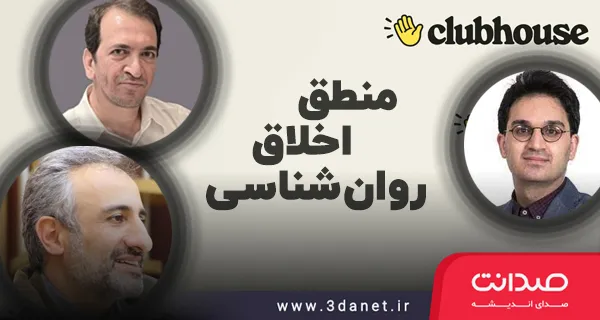
The session “Dialogue in the Public Sphere”: Logic, Ethics, Psychology was held through the efforts of the Deep Thinking Club on Clubhouse on Thursday, 1402/2/21, with the presence of Messrs. Ardeshir Mansouri, Hossein Bayat, and Hossein Dabbagh.
.
.
Points of interest to Ardeshir Mansouri in this session:
- Highlighting considerations in dialogues and linguistic culture within Iranian society, particularly dialogue in the public sphere, including addressing contentious issues in social and political exchanges, merits greater attention.
- Noting that “dialogue” is a general term for various types of linguistic interactions, and adherence to the criteria for healthy and effective dialogue is a spectrum, not a so-called “zero and one” binary. There was a theoretical difference among the participants in this roundtable on this matter. In my (Mansouri’s) view, if an ideal “dialogue” (according to David Bohm’s famous model) scores 100, and hostile quarreling and insulting expression score zero, various forms of linguistic exchange such as negotiation, discussion, and debate lie in the middle of this spectrum. In Bohmian dialogue, the sole aim is to create a shared space for broadening perspective (gaining new viewpoints in thinking) and refining one’s own perspective, not even reaching final understanding or making the best decision! Accordingly, other forms of linguistic exchange like negotiation, discussion, and debate fall in the middle of this spectrum. It is fitting for the ethical citizen and actors in the public sphere to apply the considerations of ideal dialogue, as much as possible, in public conversations according to the situation.
- The considerations of dialogue (ideal conversation) include, in addition to logic, ethical and psychological considerations as well. If the lesson learned from logic is attention to the strength of reasoning and avoidance of fallacy, from the perspective of ethics and psychology, it is necessary to observe respect for the other party in conversation, avoid insulting and belittling intellectual opponents, and attend to the other party’s readiness to correctly understand the claim; bearing in mind that categories such as “respect/insult” are culture-dependent matters. For further elaboration on these points, refer to the audio file of the conversation.
.
.
Points of interest to Hossein Bayat in this session:
If we wish to use the two key terms “dialogue” and “public sphere” in their precise, modern senses, we must refer to the relevant scientific fields. Regarding dialogue, detailed discussions have taken place and a specific discourse has formed in at least three different fields. These three fields are: 1_ Dialogue theory or dialogism, i.e., the views of figures such as David Bohm, Martin Buber, William Isaacs. In this field, the term dialogue is usually used in a sense distinct and different from other forms of verbal communication, such as types of monologue, discussion, debate, chat, and diatribe. In Persian, we conventionally use “goftogu” for dialogue in this sense.
2_ Discourse analysis, i.e., the views of figures such as Harvey Sacks, Emanuel Schegloff, and Gail Jefferson. In this field, the more general term conversation or talking is usually used, and the pragmatic aspect of language is important.
3_ Theory of discussion and argumentation, i.e., the views of figures such as Frans H. van Eemeren, Rob Grootendorst, and Paul Graham. In this field, the terms discussion and argument are used.
In this third domain, when we speak of rational discussion, it is comparable to dialogue in the first domain, and I try to explain the principles of rational discussion or critical dialogue in the physical and cyber public sphere from this perspective, particularly based on the scrutinies of Paul Graham and Kanali Chuni. They first introduce 7 principles or rules of discussion and then divide discussions into six levels of rationality depending on how many of these principles and rules are observed. Level zero is a completely irrational discussion, and level four is the most rational level.
.
.
Points of note by Hossein Dabbagh in this session:
Dialogue in the public sphere, if not always, at least in most cases, is accompanied by "disagreement." Disagreement in the content of beliefs, in the method of reasoning, and...
Disagreement, however, is intensified especially if the individuals engaged in dialogue are not "epistemic peers" and have significant epistemic, cultural, social, political, etc., differences.
In this dialogue, I have addressed the question of what should be done, epistemically and ethically, in the face of disagreement. How can one seriously critique rival views while maintaining respect? At the end of the dialogue, the question was raised whether it is ethically permissible to use humor and ridicule to critique an opponent. My argument is that in some cases, particularly in criticizing despotic rulers, the use of humor and ridicule is ethically permissible.
.
.
Ardeshir Mansouri's Telegram Channel
Hossein Bayat's Telegram Channel
Hossein Dabbagh's Telegram Channel
Jarfandishi Club Telegram Channel
Direct download of the audio for the Club "Dialogue in the Public Sphere": Logic, Ethics, Psychology
Listen to the club audio on Anchor | Spotify | Castbox
.
.

Discussion0 comments
No comments yet; let yours be the first voice.