Religion
Dr. Seyed Ali Azin and Seyed Mohammad Khademolhosseini: A Debate on Islamic Medicine and Modern Medical Discourse, Titled “Prevention and Treatment of Corona”
In a debate on Covid-19, Khadem al-Hosseini argued that the remedy of Imam Musa al-Kadhim (AS) requires no trial and error. Azin maintained that integrating Islamic medicine into the treatment cycle must be contingent on scientific proof and adherence to medical ethics.
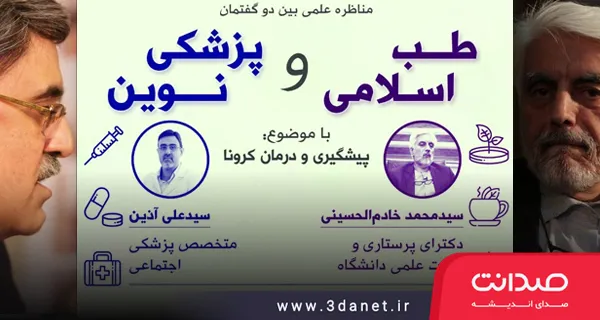
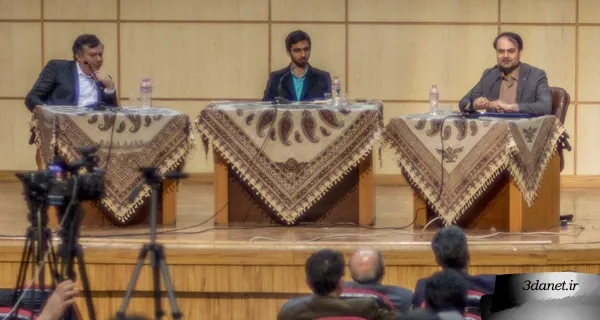
A scientific debate between two medical discourses, classical and traditional, on the subject of the prevention and treatment of Corona was held on the morning of Monday, April 27, 2020, with the presence of Seyed Mohammad Khademolhosseini, PhD in Nursing and university faculty member, and Seyed Ali Azin, PhD in Medical Sociology, at the Imam Sajjad (AS) Research Institute.
At the beginning of the session, Khademolhosseini, referring to the effectiveness of the medicine of Imam Kazem (AS) on the Corona disease, said: "I, along with a research team, have been working on this medicine for several years, and prior to the Corona disease, this medicine had been responsive for pulmonary patients. Currently, we have also unofficially tested this medicine on a number of Corona patients, and fortunately, it has led to a cure, but unfortunately, we have not yet been able to obtain a permit to conduct formal scientific and research studies and introduce it into the treatment cycle for Corona patients."
Subsequently, in response to the question of why, despite a medicine's effectiveness on Corona patients, a research permit has not yet been granted for it, Azin said: "Humanity has, to date, gained experience regarding various diseases, which constitutes knowledge and is a matter separate from science and the scientific method. In the challenge of complementary and alternative medical methods, the history of medicine receives little attention, and based on the historical process, the speed of medical science's growth was not high, but in the last three to four centuries, this process has gained exponential speed, and gradually, research has also entered the cycle of medical science."
He continued: "But due to the existence of certain errors and research, evidence-based medicine entered this arena, and the scientific experiences of recent years have manifested in the daily lives of patients, because many people in the past lost their lives due to basic diseases, but today, these cases are easily treatable by science."
Khademolhosseini, in response to this question, stated: "Alongside the research errors that were mentioned, there are also medical recommendations in religion, the accuracy of which we are certain of because they were put forth by the Infallibles. When these guidances exist, why should we move towards trial and error and research, and simply because a research company is not registered, there should be no permission for investigative study on that company's pharmaceutical achievement, especially in the country's critical conditions? For example, there are separate scientific articles for the medicines of Imam Kazem (AS), but it is natural that we do not have a scientific article for their combination and effect on patients. Regarding the changes and transformations of science that were raised, it must be said that what changes are theories, and science must be constant. This very medicine of Imam Kazem (AS) has numerous narrations, and in practical experience, it truly works, just as I, along with my research team, have witnessed its results on some individuals to date, but we have not succeeded in proving it practically."
Medical Sociologist: We Have Few Narrations to Rely on for Traditional Medicine
Azin, continuing and in response to Khademolhosseini, stated: "Religious hadiths and the hadiths of Imam Kazem (AS) are provable for Shia and Muslims, but the path to their scientific proof on a global level has not yet been found, and the only possibility for their use is to test them and introduce the hadiths of Islamic medicine into the laboratory and scientific cycle. In general, to prove Islamic medicine, we need two references, one of which is the Quran, but by referring to the Quran, such instances are not found. Furthermore, there is evidence to the detriment of Islamic medicine in this source. The other discussion is the reference for the narration of Islamic medicine, and in treatment methods, apart from widely transmitted (mutawatir) narrations, we cannot rely on other narrations. This is while the number of these narrations is also very few and scarce."
This medical sociologist added: "It is for this reason that Ayatollah Javadi Amoli has also stated that one cannot completely rely on Islamic medicine. I have a problem with the separation of old and new medicine, and a medical matter can be tested and examined regardless of its age, whether this matter was put forth by the Imams or by scientists in previous centuries. Rather, the only way for the scientific proof of issues related to Islamic medicine is to introduce them into the cycle of testing, research, and global verification."
Khademolhosseini further stated: One cannot undermine the sciences of Islamic medicine by claiming that the number of mutawatir hadiths is small, for in that case, all Islamic sciences and texts would be undermined. Examining various proposals takes a long time, and this constitutes an exception in the country's critical conditions, when many people are dying due to the outbreak of a disease. I have personally informed a number of officials that they must all be held accountable, despite being aware of the effects of Islamic medicine drugs and failing to take action for their official use.
Regarding the claims made in cyberspace about the use of violet oil and its therapeutic effect on the coronavirus disease, Azin reminded: The members of the group that had raised the issue did not have approval from the health committee, and for this reason, the committee secretary has completely rejected the matter.
University Faculty Member: Urine is sometimes used in medical science
In response to the question of how acceptable the claims made in cyberspace are regarding the use of camel urine or the presence of an individual without any sanitary covering in a hospital for coronavirus patients, Khademolhosseini asserted: The individual who had entered among coronavirus patients without observing health protocols introduced himself to the judicial authorities as a rioter. Regarding the consumption of camel urine, urine is used in medical science, and in this usage, urine is a pure product, such that experiments have been conducted on some individuals so far and have yielded good results. In general, the use of urine in treating certain diseases is not wrong from a medical and religious standpoint, but expressing it in this manner in cyberspace is problematic, and the person who raised this issue was not from the field of Islamic medicine.
Continuing the session, Azin spoke about the reason for not granting permission for the scientific use of Islamic medicine drugs regarding the coronavirus disease: In medical science, we strive for a better life for people, and over the past years, the topic of medical ethics has been raised to prevent the exploitation of individuals seeking to introduce pseudo-sciences into medical science. Based on medical ethics, not every experiment can be permitted, and this issue has been greatly emphasized over the past 20 years.
We must gradually introduce Islamic medicine into the research arena
He added: Now, we are faced with a number of hypotheses on one hand, and medical ethics on the other, and the issue of conflict of interest also exists. In general, to introduce Islamic medicine into practical human knowledge, we must act gradually and step by step.
Regarding coronavirus patients, Azin also stated: For these patients, a drug from Islamic medicine cannot be suddenly introduced into the therapeutic arena, because these drugs should have been tested and examined several years ago. The path for examining these hypotheses is open in the country's research institutes, including the Academic Center for Education, Culture and Research (ACECR), and currently, three drugs approved by the Ministry of Health are being produced at this institute.
Research on Islamic medicine narrations differs from other hypotheses
Khademolhosseini then stated: The narrations we have today in Islamic medicine are from the Infallibles and not from ordinary people; consequently, the matter of testing and trials for these narrations differs from testing and trials for ordinary drugs and hypotheses. My final recommendation is that people can, at least personally, test the drug of Imam Kazim (AS) on themselves and see the result.
In response to the question of what should be done to counter the ethics committee's opposition to Islamic medicine, he remarked: The least possible thing is to provide a research context for these hypotheses and narrations, and to converse or interview with patients who have been treated so that the results become clear to everyone. We have also submitted our scientific studies to the ethics committee.
In response to the question of why, given the claim that traditional medicine drugs for the coronavirus would not be harmful even if they lack therapeutic benefits, they have not been used, Azin noted: There is no drug that is free from harm and damage, and one cannot use drugs based on this claim, for even potable water can cause poisoning in some cases. In general, we must advance the issues related to Islamic medicine and modern medicine through dialogue and without taking sides.
Khademolhosseini also concluded by saying: Any drug, if not tested, may have harmful effects, but our discussion concerns the drugs of Islamic medicine which have been narrated from the Ahl al-Bayt, and if they were to have any harm or detriment, it would also be mentioned in the narrations.
.
.
A Debate on Islamic Medicine and Modern Medical Discourse, Titled “Prevention and Treatment of Corona”
Dr. Seyed Ali Azin and Seyed Mohammad Khademolhosseini
Organized by the Paya Think Tank, affiliated with Imam Hossein University
At the Imam Sajjad Research Institute
Report text from Mehr News Agency
Watch the debate video on YouTube
.
.

Discussion3 comments
اینکه فرموده اند «نمیتوان با بیان اینکه احادیث متواتر تعداد اندکی هستند، علوم طب اسلامی را زیر سوال برد، چرا که در این صورت تمامی علوم و متون اسلام زیر سوال میرود.» نشان می دهد که چقدر با دانش دینی بیگانه اند. اگر یک حکم فقهی بر اساس روایتی واحده عمل شود هیچ اشکالی ندارد چون هدف فقها اصابت به واقع نیست. و اگر خطا کنند خداوند میبخشد. ولی اگر در پزشکی خطا کنی خداوند اثر خطا را که محو نمی کند. ضمن اینکه بخش بزرگی از علوم دینی مبتنی بر روایات نیست بلکه اصول عقاید مبتنی بر استدلال و قرآن است. واقعا متاسف شدم از بی سوادی مدعیان سواد دینی.
در مورد علمی بودن حرف خادم الحسینی همین بس که چون که میگه این حرف منصوب به کسانی هست که معصوم هستن پس حتماً ادعایشان صحت دارد واقعاً تاسف برانگیزه
سلام برای علاقمندان به مباحث فلسفه علم مدرکی است مناسب برای طرح در سر کلاس و نیز درک موقعیت خودمان که کجای کار هستیم و از قافله چقدر پرتیم یا فاصله داریم.