Philosophy
Dying with Eyes Open, Sam Mahmoudi Sarabi
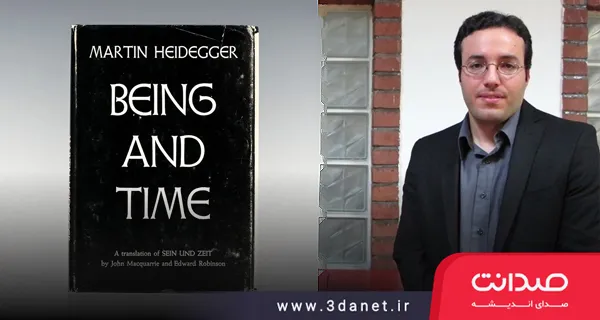
Heidegger's Being and Time in Iran, especially during the 1980s, became a subject of baseless polemics; many attacked it without ever having read it. A re-examination of the concept of death in Heidegger's thought shows that it is through the anticipation of death that human beings arrive at authentic decisions.

Perhaps if we set aside Aristotle's Metaphysics and a few other prominent and important works of Western philosophy in terms of historical priority, Being and Time is one of the most significant and influential books in the history of Western philosophy, and naturally, the translation of this epoch-making work into more than 17 languages attests to its importance. But perhaps more interesting than this point is the discussion of this work's arrival in Iran. After the name of Heidegger was introduced by Henry Corbin and his conversations with Dr. Seyyed Ahmad Fardid, later everyone clashed over a book they had never even read, and one might say that the discussion of Heidegger as a Western philosopher in Iran is one of the most fascinating and, at the same time, astonishing issues that has occurred in this geography over the past years.
Everything we experience is neither more than an interpretation nor less than it; the things of the world are always interpreted within the framework of our own subjective values, and thus the only world that can be known is the world of differences, that is, the world of interpretations. Gianni Vattimo
Perhaps if we set aside Aristotle's Metaphysics and a few other prominent and important works of Western philosophy in terms of historical priority, Being and Time is one of the most significant and influential books in the history of Western philosophy, and naturally, the translation of this epoch-making work into more than 17 languages attests to its importance. But perhaps more interesting than this point is the discussion of this work's arrival in Iran. After the name of Heidegger was introduced by Henry Corbin and his conversations with Dr. Seyyed Ahmad Fardid, later everyone clashed over a book they had never even read, and one might say that the discussion of Heidegger as a Western philosopher in Iran is one of the most fascinating and, at the same time, astonishing issues that has occurred in this geography over the past years.
Fascinating because all the battles and quarrels that took place in the 1980s between the claimants of Iranian thought, with their particular attachment to two Western philosophers, were over a book that neither side had read. Or if someone claims to have read this work, they are usually someone who remains silent and is naturally not inclined to quarrel. One can hardly find an enthusiast of intellectual discussions who does not remember the Popperian-Heideggerian (Soroushian-Fardidian) quarrel of the 1980s, where two important and influential bases (on one side, Keyhan-e Farhangi as the base and tribune for enthusiasts and interlocutors of Martin Heidegger, who were considered students of Dr. Seyyed Ahmad Fardid, and Kiyan as the official organ of devotees of analytic philosophy and Karl Popper, with Dr. Abdolkarim Soroush as its spokesperson) attacked each other as much as they could, all without reading or at least understanding Heidegger's important book, Being and Time.
Today, perhaps the question arises: what essentially is this book, and why has the fight over Mulla Nasreddin's blanket dragged on so long that, despite a temporal distance of 15 to 20 years from that great dust-up, occasional comments from one of the claimants on either side once again cast a heavy atmosphere over the world of thought?
At any rate, this writing seeks a fragmentary (and perhaps uncomprehending) rereading by a philosophy student of Being and Time, based on the translation by Siavash Jamadi and other available translations (which, at times, due to their extreme difficulty, appear very ignorant and incomprehensible), and perhaps the monographs of native thinkers and scholars of philosophy (and not philosophers), and seeks to re-understand the concept of death in the thought of this philosopher, however far-fetched this leap may seem…
Heidegger is the thinker of Being. All the ups and downs of his thought, all his turns and revisions, all his strange and newly coined words, and all the multiplicity of themes in his works, like forest paths or the branches of a great river, flow toward a single, unifying center of gravity: "Being as Being; existence qua existence." Being; this is the point of departure for his intellectual journey, and the answer to the question "What is Being?" is his destination, and the hundred-volume collection of his works (which, with three volumes of unpublished material per year, we must await the completion of their publication in 2020) are his paths, not his works, toward the aforementioned destination.
Being is a mystery: all-encompassing, the unifying source and ground of all multiplicities. Yet the question remains unanswered: what is Being itself? As far as we know, Heidegger does not answer! He remains on the way and dies midway between origin and destination!
Has no one ever posed such a terrifying question before? Did Aristotle not make being qua being the principal subject of his philosophy? Or does Plato not cast us into wonder in the Sophist in the face of what Being is? The answer is yes, and Heidegger himself is well aware of this fact. But the answers do not satisfy him—they have all posed the question of Being and, in their response, have spoken of beings: all the first principles, whether water, fire, atoms, immutable essences, or categories, are beings, not Being. The three substances, the single substance, Absolute Spirit, representation, and eternal recurrence are beings, not Being. Even being as the common element of all entities does not open a path to the realm of Being—the Being of beings is not itself a being. So what is Being or existence? It cannot be defined, does not fit into a concept, and naturally, by these interpretations, is not of the order of categories. But why? Is it because it is evident and self-evident? The answer must logically be negative, and one must admit that this subject has remained hidden due to its very obviousness.
Being is a mystery: all-encompassing, the unifying source and ground of all multiplicities. Yet the question remains unanswered: what is Being itself? As far as we know, Heidegger does not answer! He remains on the way and dies midway between origin and destination! The question is: as a philosopher or thinker, in theory or in practice, where does he lead us? One might even ask why this "question of the meaning of Being" must be so vital and serious that the human being, insofar as he is its passageway, appears worthy of consideration? And the truth is that in Heidegger's thought, the human being does not have validity merely for his own sake. Even in Heidegger's early thought, where the book Being and Time is entirely occupied with explicating the being of the human, the human is posited only as an ontological (or ontologic) subject and solely by virtue of the fundamental constituents of his existence: thrownness into the world or facticity, the limit of possibilities and the future (i.e., death), and states such as eventuality, existence, understanding, discourse, care, and existentiales that are preceded by the limit of birth and driven toward the limit of death. The teachings of Epicurus and the Stoics regarding death have no place in Heidegger's thought: as long as we are, death is not, and when death is, we are not.
In Heidegger's thought, the most authentic resolutions and decisions sometimes emerge when death has already appeared as a possibility: freedom, historicity, transcendence of the present situation, and projecting oneself out there and beyond. All these reveal their authentic meaning on the horizons of death and the end in nothingness. The human being in Heidegger's thought is posited as such a being: as Dasein, that being whose existence is not foreclosed and sealed in advance like that of wood, stone, angel, God, or devil. Like an open clearing in the dense forest, like the light of Being and a guiding lantern.
Perhaps Dostoevsky said: "The ant knows its way, but man does not know his way." And Heidegger turns this short, simple saying into a sevenfold labyrinth, whichever way we go through it, it only increases our wonder. By identifying the human being with Dasein, he enumerates the most important components of the human (or Dasein) as follows:
1. The human being is not a thing, meaning he is not definable or predictable; rather, his being is the foundation of meanings.
2. Dasein is not a static substance but is in constant, everyday transformation.
3. The human being is free to choose the form and content of his being from among all existential possibilities. In the realm of beingness, he is not chosen; rather, he chooses how to be.
Given these characteristics, one must claim that the human being Heidegger speaks of in Being and Time and Pathmarks is an exceedingly complex and mysterious entity. The truth of the human is not merely what is outwardly observed. Precisely because of this complexity and mysteriousness, no universal criterion can be offered for measuring and evaluating it. Sciences such as sociology, psychology, biology, and other human sciences can none of them comprehend the human being as a whole. The human is an exceptional, “finite,” and “incomplete” being. It is not as though death completes this unfinished existence; for even imperfection does not turn us into perfection. The perfection that the human seeks beyond itself; the yearnings, strivings, and struggles that testify that we are both here and there! And our openness to the world, which drives us as an ever-potential force toward the actuality of the being of our potentiality—all of this never, even with death, reaches the perfection of ants.
Until now, few have spoken of Heidegger’s interest in Dostoevsky. Otto Pöggeler and Karl Löwith, however, are among the rare individuals who point to this affinity. According to Pöggeler, among the first critics of the European tradition, Heidegger “accorded the greatest importance to Dostoevsky,” and Karl Löwith recalls two portraits on Heidegger’s desk, one of which belonged to the creator of “the Underground Man.” Just as walls, for the Underground Man, are a head that stops human advancement like the collision of a bull’s horn against an obstacle, death too is the cessation of perfection and transcendence. Even death does not close the file of human existence entirely, as it does in the case of the termite. In another sense, existential death, in its very frustration and incompleteness, turns into the existentiell.
Is it a coincidence that Heidegger’s being continues after his death in his still-unpublished works? The eyes of the termite, from beginning to end, are not open to the forthcoming, to time, and to the possibility of death and the rejection of the whole upon the world. Death suddenly blinds the human being in the midst of openness to the world, and thus it is that the human always dies unfinished and frustrated. Every being except the human is, in a sense, born blind, lives blind, and dies blind; but the human, with eyes open, is present in the world and dies with eyes open. In Heidegger’s terms, a stone is inside the world, but it is not in the world. The tree, the horse, and even the angel and God are, but in themselves and not in the world! “Time” both nurtures and wears us down. Every breath, just as it gives us life, brings us closer to death, and the open-eyed confrontation with this matter demands courage and provokes reflection. In Heidegger’s expression, the human is a being that stands outside itself. It faces toward the “there.” Dasein (human existence) can place itself upon itself. For instance, a glass of water can never pose itself to itself and think about itself. The animal is likewise. Only we can stand outside ourselves, look at ourselves, and challenge and question ourselves.
For Heidegger (and all existential thinkers), being absorbed in everyday life means being inauthentic. One who is immersed in everyday life has no project, is alienated from truth, has lost their authentic possibilities, does not go outside themselves, and is not open to the world. That is, in principle, they are deprived of genuine freedom and choice. When the human has not manifested their presence in the world through their decisions and attitudes, they have an inauthentic existence. Being absorbed in everyday life, for Heidegger, is a kind of shrugging off and fleeing from responsibility; because whenever we grasp our situation, we must then cast projects into the world and, with the choice and freedom we possess, transcend the existing state of affairs and become responsible and committed toward ourselves and our projects. But by being absorbed in “everydayness,” we shrug off these responsibilities.
Accordingly, everything, every entity except the human being, is, but is not present in the world, nor is the world present for it. The human being is in the world, is present in the world, and only the human being has existence (Ek-sistenz), stepping outside and standing outside itself; likewise, other entities are, but they do not have Ek-sistenz (presential standing-forth). They are enclosed within themselves. In Heidegger's view, we possess "authentic existence" when we recognize our possibilities and become aware that "death" is the ultimate possibility of the human being. To be authentic means to know Dasein in its totality. In this respect, if we wish to know "Dasein" in its totality, we must arrive at death-awareness. Heidegger posits authenticity as a way of life that stands at a higher stage than "everydayness."
.
.
Dying with Eyes Open, Sam Mahmoudi Sarabi
Author: Sam Mahmoudi Sarabi
.
.
Source: Zeitoon Cultural Site
.
.





Discussion0 comments
No comments yet; let yours be the first voice.