Religion
Faramarz Motamed Dezfouli in Conversation with Hassan Mohaddesi: The Quality of Speaking of God in the Modern World
Hassan Mohaddesi considers the proof of metaphysical beliefs impossible and religious convictions a secondary matter; religiosity rests not on rational demonstration but on the direct experience of God and righteous action, having passed through the refinement of inherited beliefs.
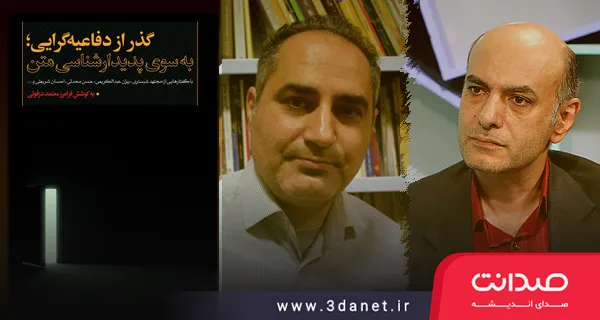
The following conversation is selected from the book “Moving Beyond Apologetics: Toward a Phenomenology of the Text,” compiled by Faramarz Motamed Dezfouli. This book is a collection of questions and answers with some of the most prominent contemporary religious intellectuals of Iran concerning the nature and essence of categories such as “speaking of God,” “revelation,” and “sacred texts.” (Explanations about this book are provided at the end.)
The Quality of Speaking of God in the Modern World
A Conversation between Faramarz Motamed Dezfouli and Hassan Mohaddesi
How can one prove Allah to an individual and a human being who lives in this modern world and thinks in a modern way?
For me, at this stage of my life and intellectual development, proving my religious beliefs to others is meaningless; that is, the value of beliefs, whether religious or non-religious, has significantly diminished in my eyes. Therefore, I am at a stage in my religiosity where establishing a religious belief for others has lost its importance for me. In my youth, I was not like this at all. I remember during my military service, I met a Sunni friend for the first time, and we had long discussions. At that time, I wanted to show him that Shi’ism is the true Islamic denomination and Sunnism is not. I tried to prove this to him by giving him books by some Shiite authors, such as some works of Ali Shariati. He also tried to do the same by giving me books on Sunni theology and jurisprudence. I still have the gifts from this Sunni friend. Today, however, I have reached a point in my religiosity where religious beliefs are a secondary matter. I am now devoted to peace in the world, accompanied by rational growth, moral commitment, the improvement of the quality of human life on earth, and spiritual transcendence. I have now realized that beliefs and rigidity and bigotry toward them have been the cause of many wars and conflicts at various levels and dimensions. Belief-worship now appears to me as one of the great afflictions of religions and denominations. For someone who believes in religious pluralism and also believes that ultimately (whether in this world or the hereafter), deeds are decisive, not beliefs and acts of worship, the affirmation and consolidation of religious beliefs is considered a secondary matter. For me now, the Islamization of the world has taken on a general meaning: Islamization now means inviting the people of the world to righteous action through our behavior and speech (action takes precedence in Islamization), not merely propagating Islamic beliefs.
But if we move beyond personal discussion and consider a hypothetical individual who wants to affirm one of the important Islamic beliefs, namely belief in Allah, for others, what can they do? I think metaphysical beliefs can no longer be affirmed in a convincing manner; “proof” is even further out of the question. It seems to me that we can only reason for others, based on critical intellect, that belief in Allah, or belief in the Resurrection, or beliefs of this kind, are justified beliefs; meaning that holding these beliefs does not contradict rationality. So, for someone who does not believe in Allah or any god (like the approximately one billion atheists living in the world today), one cannot speak in a way that makes them believe in this conviction. It seems that regarding such beliefs, there is no argument that can serve as a decisive word.
But let us suppose we want to explain our belief in God to another person; not to convince them, but merely to satisfy their curiosity about our belief. In my view, reasoning and proof have no place here either. I must inevitably say that I was born into a Muslim family, and within this family, I accepted certain beliefs without any reasoning, through the process of religious upbringing or (as sociologists would say) religious socialization. It was only years later, after reaching a degree of intellectual maturity, that I realized I had accepted these beliefs without valid proofs or arguments. This is something that happens in all religions and to all religious people in the world. All religious people in the world, in the manner I have described, accept certain metaphysical beliefs, and at the time of acceptance, it is impressed upon them that these beliefs are the firmest and most credible of beliefs.
What have I personally done in this regard? At some point, I began to refine the beliefs derived from religious upbringing, and this long process of refinement still continues. I believe in the refinement and pruning of belief, and generally in an economy of belief (being frugal with beliefs). By economy of belief, I mean reducing the multitude of beliefs to a few that are rationally defensible and humanly universalist and ethical. It was during this very process that I undertook various searches and diverse investigations. One of my motivations for choosing the field of sociology of religion was precisely this intense interest in pursuing my religious questions. Therefore, my religiosity is no longer reliant on collective religiosity or the religiosity present in society and family. After becoming acquainted with the ideas of Ali Shariati, I gradually (and of course through a long and fascinating process, at times sweet and at times anxiety-inducing) abandoned the religion of my forefathers, and this was the first major transformation in my religiosity. From this point onward, my religiosity (including my religious beliefs) has passed through a long, critically reflective current of personalization, and will continue to do so. What remains of this religiosity may, in some respects, share commonalities with the religiosity of other people, and in other respects, may have fundamental or minor differences and divergences. Arriving at the belief that religious convictions and acts of worship are not ultimately decisive, but rather that it is action that is ultimately decisive, has been the latest major transformation in the course of my religiosity up to this moment in my life.
My belief in Allah is of the same kind and has passed through this process of transformation. Allah is a God with whom I have a relationship. I took the general image and conception of this God from my family and then from certain religious texts, especially the Quran, but gradually my understanding and comprehension of Him changed and became more and more personal. The important point for me in speaking of Allah is not that I want to provide reasons and proofs about Him, but rather that I experience His existence and presence in my life and my world. Long ago, that is, from adolescence, I realized that God is not something one can believe in through proof. God must be experienced from within and also from without. How can I experience Him? For experiencing God (or in Islamic language, Allah), I know two ways. One is the path of self-cultivation and preparing oneself to see Him and to read and hear His messages, and the other is God's self-manifestation to me and the imposition of His presence upon me. Religiously, I have always thought that His signs and traces are everywhere, and His messages are audible, and His symbols are readable and comprehensible, but if I do not see, hear, read, and comprehend Him, it is because I am not sufficiently worthy and good. In the words of Hafez, I have always said to myself, "As long as you are not an intimate, you will not hear a secret from behind this veil." I have always consoled myself that I am not "God-forsaken." I have always given myself this reassurance that God is too kind to forget anyone. I have always whispered to myself that the prerequisite of "God-forsakenness" is "self-forgetfulness." If you have become God-forsaken, it is not because God has forgotten you, but because you have forgotten yourself and, as a result, have become God-forsaken. But many times in conversation with God, I have reminded Him that if He wants to be present in my life, He must, from time to time, show Himself to me in whatever way He knows and can! Do not rely too much on my efforts! I am too weak and incapable to find You, understand You, and experience You through my endeavors, efforts, and self-cultivations. From time to time, You must reveal Yourself to me so that I may still remain a believer in You and live relying on You. There are many places and moments where I fall short or simply cannot see Your presence and experience Your being. So You too must be committed to the relationship with me! Be mindful that I might forget You. O God, You too must take a step for this relationship! For what reason should I believe in Your existence? You must show Yourself to a servant who is skeptical or forgetful and immersed in his daily struggles. Sometimes my speaking to You turns into empty rhetoric. Please become present in my experience so that my words may be filled with You and my prayer may not turn into a hollow performance and a habitual act. How often my words, in addressing You, become devoid of You. How often I sit before You and intend to converse with You, but You are not present on any horizon. When I circled around Your house, I was looking for You, saying, "O Master of the house, where are You?" When I fall short in the difficult passages of life, I call out to You, "Why do You not sweeten my bitter palate with Your presence?" The pretext of Your presence placed so much burden on my existence, so why do You not lighten my burden by revealing Yourself? Truly, God, when Jesus said, "Eli, Eli, lama sabachthani?" ("My God, my God, why have You forsaken me?"), where were You? For him who had believed in Your existence and presence in that way and, for the sake of this belief, carried his cross for a relatively long time and was finally crucified upon it, what did You do? In that moment, how much did You share in his suffering?
Thus, from the perspective of the poverty that a servant suffers, I question Him and sometimes reproach Him; just as I sometimes blame myself for not experiencing God in my moments. Therefore, I do not accept a one-sided relationship with God. If He does not reveal Himself to me, I might forget Him entirely, and in this God-forsakenness, in my view, it is God who is worthy of blame and reproach; for I am poor and in need of assistance. Yes, my relationship with God is audacious, and in my view, within this audacity lies the existential plea of a modern religious human being.
So far I have mostly described my inner state in connection with what I have received from religious upbringing and heritage and the transformations I have undergone. In explaining these states, as a piece of knowledge accompanying them for a hypothetical curious audience, I say that I believe in the spirituality of the world and of life. For me, the world and life are something more than the realm of the sensible and sensible events. I believe, in the Quranic sense of the word, in a ghayb—an unseen world beyond the witnessed and the sensible. Certainly, I know nothing of the geometry of the unseen world, its elements, compositions, and entities, and I consider what has come down from the heritage to be filled with mythical imaginings and thoughts, and I deem the demythologization of religion a necessity for religious life and thought in the modern world. Yet in my view (according to my belief up to this moment), within that which is unseen, there is a longing to become manifest, and within me, a poor human being, there is also an inherent longing toward that which is unseen: from that side, a longing to become manifest, and from this side, a longing to make manifest. I believe that these two longings sometimes coincide in a particular moment and act synergistically. It is in these particular moments that the poor human being succeeds in perceiving an unseen matter and hunts down rich meanings. From this perspective, God is both the hunter and the hunted. He both hunts and is hunted. In my religious life, I, a poor human being, am enamored of these moments of two-way hunting. Sometimes it is being hunted and being enamored, and sometimes it is hunting and being the hunter. In both states, states of self-sufficiency are experienced. Nevertheless, sometimes within these very moments and sometimes shortly thereafter, there is always a doubt and skepticism that prevents a raw and false devotion, dispels the opiate-like quality of these experiences and states, brings alertness and wakefulness, and restrains this poor servant from the soporific intoxication and ignorant pride of one who claims union with the Truth. And this skepticism and doubt, although not in itself a product of the critical thinking of the modern era (for in the pre-modern age and even in the experience of the founders of religion, forms of it can be found), is nonetheless strengthened and energized by the critical thinking inherent in modern life and thought. Therefore, in my dialogue with God, I remind Him that although I have believed in His self-manifestation in the experience of the founders of religious traditions and, in the idiom of each of them, am enamored of their experience, yet despite this, I too am in need of Your self-manifestation; for, O God, You Yourself know that any attachment, if not renewed, is bound to fade, especially in the modern world. O God, O Merciful One! Please do not expect of me more than I can bear!
What I have said was all about my personal God[1] and my relationship with Him. If you ask me about Allah in the Quran and early Islam, then I must tell another story and depict the image of Allah in the Quran and early Islam (as I understand it). I have spoken about this in detail in articles I have written about the liberating God, and in writings critiquing the views of contemporary intellectuals Mr. Akbar Ganji and Mr. Mohammad Reza Nikfar, as well as in reconstructing the image of God in the views of Engineer Mehdi Bazargan and Ayatollah Mohammad Taqi Mesbah Yazdi, most of which have been published and a few of which have not yet been published (which I hope will all be published in a single book about God).
Most of what I have said has been speaking of God in subjective (nafsi) experience and in a subjective manner. How can one speak of God (not just Allah) in an objective manner? If we only speak of God subjectively, the solidity and influence of speaking of God is largely lost. In such speech, the discussion of God becomes contingent upon and deferred to the subjective experience of individuals. Are there also objective indications to be found beyond the subjective experience of individuals? In my view, there is an objectively accessible truth about God, attention to which is very important, and I will try to explain it in what follows and to propose a logic by which the discussion of God (and not His proof) can be defensible in an objective manner as well. Let us note that I say defensible and do not say provable.
Since I am interested in religious studies, I have tried to collect copies of the sacred scriptures of various religions and study them as much as time permits. Some I have read repeatedly, and others to a very limited extent. Studying the verses of the sacred books of five different religions, which emerged at different periods and in different lands, and whose books were written in different languages, reveals an important truth. These five religions, five prophets, and five sacred books are: the religion of Zoroaster, the prophet Zoroaster, and the Avesta (especially the Gathas, which are said to be, without doubt, the verses revealed to Zoroaster); Judaism, Moses, and the Torah; the Sabian religion, the prophet John, and the Ginza Rabba; Christianity, Jesus Christ, and the Gospel; and finally, the religion of Islam, Muhammad ibn Abdullah (PBUH), and the Quran. These five prophets appeared in different centuries. Their lands were also distant from one another, and their languages were, if not entirely, at least to a great extent, alien to each other. The Avesta was recited and then compiled in Avestan (close to Old Persian), the Torah in Hebrew, the Ginza Rabba in Aramaic, the Gospel in Aramaic (Jesus spoke Aramaic), and the Quran in Arabic. While some of them may have had affinities in terms of historical and linguistic heritage, others were completely alien to one another. Due to the difference in the time of emergence, the difference in the context of emergence, and the difference in language (in short, the difference in the three 'T's), they could not have borrowed and transmitted each other's words. Moreover, all these five religions and five sacred texts emerged in an era when the dominant culture was still oral, and humanity had not yet entered the age of written culture. Throughout this period, literacy was an exclusive affair among a few nobles and clerics, and the majority of people were illiterate. In other words, all these religions and books emerged in an era when there were minimal means for cultural transmission, exchange, and translation. Therefore, for these reasons (differences in time, context, and language, as well as their shared emergence in the oral era of human history), we cannot say their message is a copy of one another's words. Hence, we can claim that we are faced with five revelatory experiences and five authentic messages from five founders of religion. I must also add that the life stories and conduct of these five founders show that they were, in their claims, very sincere and devoted individuals, passionately attached to their message to the point of death. Thus, they can in no way be considered deceitful charlatans who, lacking an authentic experience and an existential, all-encompassing engagement, borrowed words from here and there and then claimed knowledge and power. Everything indicates that they employed all their strength and resources sincerely in the path of realizing the implications of their message.
Now, if the above claims are defensible and valid, and partake of some truth, then a significant claim can be made based on them: by studying these five sacred scriptures, we find that numerous verses are shared among them. When we look more closely, we discover that they all present a common and unified worldview and share a common discursive structure. For instance, they all speak of monotheism, resurrection, revelation and prophethood from God to humanity, righteous deeds as the criterion of judgment, human free will and choice, and other common matters; in many cases, only the names and terminology differ, but the core message is one. One reaches the conclusion that a single message has been given to humanity by God in different times, contexts, and languages. Although the names of God differ in each (for example, Ahura Mazda, Yahweh, Allah), the message is one, and the audience is one. From this, one concludes that the source of the message is also one, which has addressed humanity each time in a specific era and context with a particular language, giving them glad tidings and warning with a single message. From this perspective, Allah is one of the names of this God who has repeatedly addressed humanity in different languages. Thus, in my view, one can speak of God in an objective manner, beyond a personal inner experience, and such speech is, in my opinion, both valid and deeply moving. For example, when we, as Muslims with an Islamic spiritual heritage, open and read each of these books (especially for the first time), we are profoundly affected and astonished by all these affinities with our own spiritual heritage. It is there that one deeply discovers that they are the same, proclaiming a single message from a single source. You suddenly feel that Muslim, Christian, Jew, Zoroastrian, and Sabian all reside within a great realm of faith and share a common heritage. Then you are struck by the thought that the founders of religions from other lands might also have a relation and affinity with these five great religious traditions of the Middle East, and that we need to explore further. Now, when you study the following Quranic verse once more, you think you understand the matter better:
"Say: 'We believe in God and what has been sent down to us, and what was sent down to Abraham, Ishmael, Isaac, Jacob, and the Tribes, and what was given to Moses and Jesus and the [other] prophets from their Lord; we make no distinction between any of them, and to Him we are submitters'" (Verse 84 of Surah Al-e-Imran, The Holy Quran, translated by Mohammad Mahdi Fouladvand).
Then we see that Allah in the Quran affirms all five religions in question and simultaneously introduces the followers of all five as subject to His judgment: Indeed, those who have believed [i.e., Muslims] and those who became Jews and the Sabians and the Christians and the Zoroastrians and those who associated others with God—indeed, God will judge between them on the Day of Resurrection. Indeed, God is witness over all things. "Indeed, those who have believed and those who were Jews, and the Sabians, and the Christians, and the Magians, and those who associate others with God—God will surely judge between them on the Day of Resurrection. Indeed, God is witness over all things" (Verse 17 of Surah Al-Hajj, ibid.; brackets are mine). The word 'those' (alladhīna) is repeated three times in this verse to separate the three groups of Muslims, People of the Book, and polytheists. It is only in this verse that Zoroastrians are mentioned as People of the Book and the Zoroastrian religion as a monotheistic faith. This is despite the fact that some Iranian Muslim scholars still introduce Zoroastrians as fire-worshippers, and many Arabs, after all these developments, still out of hostility call Iranians not God-worshippers and Muslims, but Magians and fire-worshippers.
Thus, my religiological and extra-religious view that Allah is one of the names of the one God who speaks to humanity in these five religions finds intra-religious confirmation in the text of the last holy book (the book that appeared after the others and in which Allah is the speaker). In any case, one can also speak of Allah in an objective manner, beyond subjective experience. This means that I am engaged with this message, its history, and its destiny, and I am attached to it. In my view, human history is, to a great extent, influenced by this message. Therefore, remaining distant from its effects and not being influenced by it requires great indifference and very heavy ears; or ears that have become attached to and engaged with other messages.
Mr. Mohaddesi, based on what you have said, my understanding is that you have moved past the provability of Allah, but in the course of your conversation, we do not grasp how you make this concept reasonable and rationally acceptable to your audience. Do you use argumentation to consider this concept rationally acceptable, or do you take another path?
As is evident from my answer, when I ask God to occasionally reach out from behind the veil of the unseen and reveal Himself, how can I speak of "proving" God to others? In such cases, I believe one must speak much more humbly. The only thing I can defend as somewhat rationally acceptable is that beliefs such as belief in God or the Resurrection are, from the standpoint of critical rationalism (and not maximal rationalism), reasonable beliefs, but as Peterson and his colleagues state in their book Reason and Religious Belief (Peterson et al., 1379), their "conclusive proof" is not possible. Likewise, someone who wishes to speak of the absence of God or the non-experience of resurrection will be in a similar situation. This is why I believe that in the modern world, religious people are compelled to speak humbly. Speaking boldly on these matters stems from the fact that the religious thinker or the religious person has not yet properly grasped critical rationalism. Some of our religious scholars, on the one hand, speak of the rationality of religion, and on the other, declare critics and deniers of fundamental religious beliefs to be apostates. This is one of the intellectual contradictions that exists in our traditional religious thought. But in discussing beliefs and defending or refuting them, we are, in any case, in need of arguments; unless we abandon rationalism and turn, for example, to fideism. Critical rationalism, in such cases, while paying attention to existential experiences and referring to them, tries to formulate an understanding of these experiences in a rationally acceptable way. I also adhere to this method of thought. It was for this reason that years ago, in Kiyan magazine (Mohaddesi, 1379), I spoke of "religion as a possibility." In that discussion, I said that religious experience and religious life are one possibility among the various possibilities that humans can have in the modern world. It is in this sense that I speak of religiosity and religious life as a possibility. I consider a specific type of religiosity (green religion) to be a highly desirable possibility for human beings in the new era. Therefore, for me, an aggressive defense of fundamental religious beliefs (speaking of religious beliefs to call into question any non-religious and anti-religious beliefs) is no longer relevant; rather, today I speak of religious thought and religious life in its totality as a possible, desirable way of life, and I place this way of thinking and living in contrast to other ways of thinking and living, such as the mystical, mythological, or secularist ways. Moreover, given the negligible importance that beliefs (whether religious or non-religious) hold for me compared to action, the propagation and promotion of religious beliefs become entirely insignificant to me. Conversely, the promotion and propagation of a desirable religious life (and not just any religious life) or non-religious ways of life that are closest to the religious way of life become most important to me.
Now, if we return to the end of your answer regarding the phenomenology of Allah and the religion of Islam at that time and at the moment of the Prophet's mission and his audience, what can be said? Can we now, from the horizon of modern man, find a way to the horizon of the text and traditional man?
Certainly, to understand how the Prophet's audience perceived Allah and what relationship they established with Him, we must gain an understanding of the world in which the Arabs lived. We cannot speak of their understanding of Him without comprehending the world of the pre-Islamic Arabs. First, we must see how the pre-Islamic Arab viewed the world and, more importantly, how he experienced the world. Otherwise, by referring to religious texts such as the Quran and other Islamic texts, we will obtain a biased understanding of them, their world, and their comprehension of worldly affairs; just as many Muslim scholars, by saying that the Arabs who were the Prophet's audience lived in jahiliyyah (ignorance) and were ignorant, present a biased understanding of them and absolve themselves of the responsibility to understand the Prophet's Arab audience and their world. For this reason, Muslim scholars become largely incapable of understanding the Quran itself. Until we understand in what world the Quran emerged and took shape, we cannot properly understand this text itself, because this text took shape in harmony with a specific culture and social context and was a response to the conditions, issues, and questions that were prevalent in that era, opening a new path for those people. Therefore, it is not enough to refer to the Quran and, because the Quran called its opposing force ignorant, we too characterize them with jahiliyyah. First, we must understand what jahiliyyah means here. Hence, we are compelled, as far as possible, to know the culture and social world of the Arabs, as it was (I say this relatively, of course), according to the resources available to us. What I mean is that we must first have a scientific theory about the social and cultural world of the pre-Islamic Arabs so that we can later speak of Allah regarding these matters (such as the pre-Islamic Arab people's understanding). However, Muslim scholars, including theologians, exegetes, and hadith scholars, lack a scientific theory in this regard. Of course, our religious intellectuals have seriously understood the need for such a theory, but due to other preoccupations, they have practically not addressed it. The theory I advocate is the theory of the non-literate society[2]. According to a sociological analysis, a non-literate society is a type of society[3] which, besides not yet having attained script, writing, and the book, possesses the following social and cultural characteristics:
1) Cultural isolation;
2) Lack of mental mobility;
3) Social infertility and intense opposition to change;
4) Social sanctification and traditionalism;
5) Gerontocracy;
6) The determining nature of kinship-based groups such as the tribe;
7) Absence of individual identity;
8) The dominance of taboos and simple laws;
9) Xenophobia;
10) Ethnocentrism;
11) Division of labor based on age and sex;
12) Infanticide for population control;
13) Personal ownership instead of private property and an economic ethic oriented toward generosity;
14) Belief in cultural heroes with a divine-human character;
15) Language oriented toward particular and concrete matters;
16) Sorcery and worship of gods in the practical aspect of religion;
17) Animism and ancestor worship in the emotional aspect of religion;
18) Belief in gods, but a diminished theology in the cognitive aspect of religion;
Therefore, we can speak of an ideal type of society called the non-scribal society, which possesses the above characteristics. When we research the history of the Arabs before Islam, we see almost all of these characteristics in pre-Islamic Arab society in a significant and pronounced way. In other words, I can extract numerous pieces of evidence for each of these characteristics from the various available historical sources. There is no opportunity here to explain each of these characteristics individually. One chapter of a book I was interested in writing, titled Islam and Myth—a considerable part of which has indeed been written, but was left unfinished due to life's preoccupations—is dedicated to explaining the non-scribal society. According to these characteristics, in such a society, the dominant culture is a mythical culture, and rational thought plays little role in explaining the affairs of the world—whether the natural world or the human and social world. All explanations have roots and foundations in mythical thought, and there is no such thing as law (meaning rational rules) in such societies; rather, taboos are determinative in such a society and culture and constitute rights and customs.
As characteristic 18 shows, in such a culture, people believe in various gods, but the realm of divinity is not separated from the realm of nature and humanity. There is a comprehensive intermingling between the divine realm (the world of gods) and the earthly realm (the mundane world), and the gods are often deities embodied in natural objects and phenomena such as stones, rocks, trees, wood, springs, the sea, and so on. In such a culture and society, the majority of people believe in a creator god who once created the world but now resides in the heavens and has little involvement in the world or the religion of humans. This god is a distant god with whom people have nothing to do under normal circumstances. In their daily lives, they constantly deal with and take refuge in the handy, accessible gods, seeking help from them. These are the very gods whom the Quran calls "arbāb mutafarriqūn" (lords diverse/dispersed) and contrasts with "Allāh al-Wāḥid" (Allah, the One). Therefore, Allah, in the view of pre-Islamic Arabs, is a distant god to whom they turn only when the handy gods are of no avail. Otherwise, Allah is forgotten. Hence, from this perspective, the conflict between the Prophet and the Muslims on one side and the polytheists on the other is a conflict between the agents of two total cultural systems, namely myth and religion. By a total cultural system, I mean a cultural system that simultaneously responds to three human domains and seeks to fulfill human needs in these three domains: the cognitive domain[4], the expressive domain[5], and the normative domain[6]. Therefore, I consider the conflict between Islam and polytheism to be a conflict between myth and religion. In fact, polytheism, in the sense with which early Islam is in conflict, is a product of mythical thought at one stage in the history of this type of thinking.
When, for example, we read Surah Al-An'am in the Quran, we understand precisely that the conflict between the two sides is a conflict between two different types of epistemic systems, based on which each group wants to engage in world-making[7]: a polytheistic social construction versus a Muslim social construction. They tell the Prophet that what you say are "asāṭīr al-awwalīn" (legends of the ancients), and the Prophet tells them that you are followers of "ābā' al-awwalīn" (the ways of the forefathers). Do you not have your own intellect? In Surah Al-An'am, we see mutual denial and negation. Each wants to have their own specific social world: the Arabs want to preserve the social world they have built, and the Prophet and his followers also want to build their own specific social world, and to build it, they inevitably had to destroy the existing social world and its relations. Thus, the Quran says: "Are the blind and the seeing equal? Will you not then think?" (part of verse 50 of Surah Al-An'am, The Holy Quran, translated by Mohammad Mahdi Fouladvand).
This is the understanding that the Arab people, the Prophet's audience, had of Allah: Allah as a distant God. It is for this reason that the Quran says: "Say, 'Who rescues you from the darknesses of the land and the sea? [While] you call upon Him imploringly and in secret, "If He rescues us from this [peril], we will surely be among the thankful."' Say, 'It is God who rescues you from it [those darknesses] and from every distress, yet you associate partners [with Him]'" (verses 63 and 64 of Surah al-An'am, ibid.).
This is only one dimension of the pre-Islamic Arab people's understanding of Allah. They also believed that the divine matter was immanent in things; that is, it indwells in rocks, springs, trees, and other bodies such as idols. Now, Islam portrays a divinity that is separate from nature and humanity, transcendent beyond every object and being, and all the beings of the universe are signs that guide us toward Him and glorify Him. Therefore, now, in place of the constantly indwelling and proliferating divine force, a personal, transcendent God is established who no longer dwells in objects but must be perceived and experienced inwardly and outwardly; through and by means of the signs within the self (anfusi) and the signs on the horizons (afaqi). The most important attribute of Allah in the Quran, in my view, is jealous. He tolerates no human attention to any other. Hence, I believe that despite all the commonalities in vocabulary between the two monotheistic and polytheistic worldviews, each possesses a completely different intellectual and normative structure from the other.
The discussion of knowing the character of Allah is, of course, not limited to the cases mentioned, but discussing other aspects of Allah's character in the Quran, such as Allah's liberating nature, Allah's partisanship, and Allah's intervention in history, or discussing Allah's promises and punishments, as well as tracing the lineage of Allah as a Semitic god and its relation to Yahweh, the God of the Torah, would become a very lengthy discussion. Therefore, I will suffice with this and hope to be able to independently publish my view on the character and most important features of Allah in the Quran.
When you portray pre-Islamic Arab society in this way and in this form, what will your understanding of the Quran be like?
First of all, I must say that, in my view, we must conceive of two stages for the Quran: 1) the Quran in its pre-book stage; 2) the Quran in its post-book stage. In my opinion, the Quran is initially a text that is not a book in the sense we understand it today. That is, it is not and was not a text with a beginning and an end, divided into chapters, and written in a particular way by an author with a specific, predetermined purpose. The Quran is initially a collection of separate, discrete fragments that appeared and emerged in accordance with the Prophet's inner events as well as the external, social events occurring in the Arab society of the Prophet's era. Hence, in my view, every Quranic fragment is linked to one or more inner or outer events. These fragments, in my opinion, are utterances within events that cannot be understood without understanding those events. Therefore, the most important characteristic of these Quranic fragments is their particularity and contextuality. However, with the division into chapters and the transformation of the Quran into a book, and its arrangement in the form we now possess, the particularity and contextuality of the Quran were sacrificed for the universalization of the text. This is one of the most significant veils obstructing our understanding of the Quran, and this is a veil for everyone. Of course, we non-Arabic speakers have two major veils for understanding the Quran that prevent its correct comprehension: language and time (the era and living horizon). Naturally, Arabic speakers also have difficulties with the veil of language, but their problem is less than that of non-Arabic speakers. In this regard, they must become familiar with the changes and transformations of the Arabic language and with the usage of Arabic vocabulary and concepts at the dawn of Islam to overcome this obstacle. We must also overcome the obstacle of translation. Translations often lead to the distortion of the Quran. For example, the Quran says: "yatawaffā" and its meaning is that He takes life in full or receives it entirely. For instance, the Quran says: "Allah yatawaffā al-anfus ḥīna mawtihā..." (verse 42 of Surah Az-Zumar). Allah takes the souls in full at the time of their death (receives them entirely). The Persian-speaking translator renders it as: He seizes the spirit. But in this verse, nothing called a spirit is mentioned at all. In any case, in the post-book stage, these Quranic fragments have lost their characteristic of particularity, and the particularity of the Quranic fragments has been sacrificed for the universality of the book. Universalizing the Quranic text may have been useful for the early Islamic civilization-building, but now it confronts us with a "disordered[8]" book, many of whose contents are seemingly unrelated to each other. The reason for this unrelatedness and this so-called "disorder" is that these fragments were never unified and connected from the beginning; rather, each fragment emerged within a specific context, condition, and event. For example, the first Quranic fragment was the first five verses of Surah Al-Alaq. But now this Surah contains 19 verses; that is, another fragment that emerged at a different time and in a different context has been added to this first fragment. Consequently, the audience of the Quran is now forced to connect these two parts. When we look at these two fragments, we see that the first fragment has a positive charge and speaks of God teaching humanity, but the fragment added to it speaks of human transgression, denial, and punishment, and has a completely negative charge. These two fragments have no semantic connection with each other, except that both speak in some way about humanity. When we, as the audience of the Quran, encounter the text of this Surah, we try to somehow establish a connection between the two parts, and perhaps we find no connection. This causes us either to distance ourselves from the text or to blame ourselves. In any case, an unpleasant feeling will overcome the audience. Why should the text be rendered and arranged in such a distressing way? Therefore, I believe that deconstructing the text anew into its original, separate, discrete fragments would be a liberating experience. Now the situation is such that we must, with great effort, discover the particularity of each fragment to grasp the correct meaning of each piece and to be able to understand the text properly. The universality derived from each fragment perhaps leads to mind-numbing inferences from the Quranic text, at least some of which incorrect inferences are resolved by discovering the particularity of each fragment and understanding the related event and context.
Therefore, the authoritative interpretation of the Quran is one that is carried out based on the time and context of revelation; otherwise, interpreting the Quran based on Greek philosophical ideas and earlier or later mystical ideas is an eclecticism of the Quran with other bodies of knowledge, and unfortunately, many new and old commentaries suffer from such eclecticism. The majority of such commentaries suffer from the problem of decontextualization. Therefore, I personally prefer a compilation of the Quran that reflects the uniqueness of each fragment and is arranged based on the time of revelation over the existing compilation and arrangement, because what is now available to us under the title of the Quran is a type of arrangement and compilation of the Quran that was carried out one or two decades after the death of the Prophet of Islam, and other compilations and arrangements are also possible, and the initial arrangement is not sacred. Moreover, we know that Quranic scholars disagree about the order and arrangement of the surahs. In the initial compilation, they connected these fragments together, divided them into chapters, and gave each chapter the name of a surah. Thus, the Quran of the movement (the Quran before the book) was transformed, during the process of the institutionalization of Islam, into the post-movement Quran (the Quran after the book). The compilation of the book in all religions is part of the process of the institutionalization of religion, and in all religions, the compilation and arrangement of the religion's sacred scripture occurred after passing through the movement phase and during the phase of institution-building and the institutionalization of religion[9] . Therefore, many existing Quranic interpretations and esoteric interpretations are in fact reliant on the post-movement Quran, not on the Quran of the movement.
For example, the jurisprudential understanding of the Quran is linked to the post-renaissance Quran. Islamic jurisprudence emerged in the post-renaissance phase to address the religious affairs of the time and relies on the post-renaissance Quran. By knowing the initial audience and the culture and society in which they lived, our understanding of the Quran will certainly be completely transformed, and we can return to that renaissance era. For instance, all the emphasis in the Quran on invoking the name of Allah in every action is to combat the polytheistic worldview. When we understand that there were people who, for example, invoked the names of idols when slaughtering animals, we understand the Quran's emphasis on mentioning the name of Allah at the time of slaughter. Now imagine we want to slaughter animals industrially in the modern world, and a religious problem arises; because the machine or the "slaughterer's blade" cannot mention the name of God! Now, pay attention and see how, among us Muslims, an issue that was originally part of a practical struggle between the monotheistic worldview and the polytheistic worldview is now understood as anti-modern, and eating chicken, beef, or lamb that has been industrially slaughtered is declared forbidden on this pretext.
In other words, verses that were concerned with the intellectual and practical struggle between the two worldviews of polytheism and monotheism and their bearers and agents are generalized to all times or understood in a ritualistic and superficial manner. I can mention dozens of examples of this kind of incorrect understanding of the Quranic verses.
Let us return once more to the concept of Allah. If you were to describe Allah in the Quran, how would you describe Him?
In my view, the character of Allah in the Quran can be better understood by considering several of His attributes. At least at first glance, one can emphasize four attributes of Allah in the Quran. In my opinion, one of the most important attributes with which Allah in the Quran can be described and defined is the attribute of jealousy. Allah is very jealous, and no power in the world can or should appear more important than Him in the eyes of a servant. His intense jealousy is evident both against the gods of polytheism and against earthly gods (tyrants). It is in this sense that the affirmative aspect of monotheism (relying solely on Allah and placing complete trust in Him) and the negative aspect of monotheism (detaching the heart from all but Allah) become apparent. In this sense, Allah's jealousy is a universalistic jealousy. It encompasses all of humanity, and people are the family of Allah. Therefore, His divine jealousy and exclusivity are universalistic. He does not tolerate injustice to His family. Hence, He is a serious and unforgiving enemy of the arrogant and the earthly and social tyrants.
For this very reason, the second important attribute of Allah is that He is interventionist. He intervenes "on earth." Allah intervenes in human society and history and is not neutral. Allah strives to direct human attention toward His intervention and presence. He is a partisan God who intervenes in history on behalf of the righteous and the oppressed, and promises to intervene. Therefore, Allah is a God of promise, and through the fulfillment of His promise, He acts, and through His action, He constructs His identity. In the Quran, Allah fundamentally defines Himself by His actions. He constantly says that Allah is the one who has done such and such. In this sense, He is a concrete God. He can be sought everywhere; not just in the heavens or in the solitude of hearts. I must also add here that God's intervention is not the capricious intervention of a tyrannical God but is dependent on the actions of human beings within human society. On the other hand, because God intervenes on behalf of the righteous and the oppressed, His intervention is emancipatory. Therefore, the God of the Quran is very different from the Deist God, the God of universal peace of the mystics, and the self-absorbed, self-thinking God of the Muslim philosophers.
The third important attribute of Allah in the Quran, in my opinion, is the attribute of Judge. Allah is the ultimate judge of the deeds and conduct of all human beings on the Day of Resurrection: a strict, precise, and exacting judgment that one must fear; such fear that from this fear, one must seek refuge in His forgiveness so as not to despair of one's ultimate end. A large portion of the Quranic verses concerns the occurrence of the Day of Resurrection, the description of the scene of Allah's judgment, and the description of the state and condition of human beings and their receipt of the results of their deeds on that day.
Another important attribute of Allah in the Quran, which is compatible with all His other attributes and closely intertwined with them, is the personal nature of Allah. Except in very rare instances, Allah is depicted in a personal manner in the Quran. When He speaks to human beings, a person-to-person relationship is established; a transcendent, self-sufficient, and magnificent person in relation to an earthly, dependent, poor, and insignificant person. Thus, Allah enters into a communicative action with humanity and does not remain a cosmic, unknown, and impersonal being. In this way, human beings can speak with Him and establish an intimate relationship with Him. Only in rare moments in the Quran is an impersonal conception of God highlighted; such as where Allah is likened to light and a niche. Allah is the Light of the heavens and the earth. These impersonal glimpses of Allah help the Muslim person not to attribute human characteristics to God and to take the path of transcendence (tanzih). The key and crucial point is that the personality of Allah in the Quran is significantly transformed within Islamic theology, so-called Islamic philosophy, and Islamic mysticism. Examining the process of this transformation itself requires separate research and a thorough discussion.
Mr. Mohaddesi, now looking from the perspective of the sociology of religion, what can be said about the concept of revelation for the contemporary audience?
Revelation is a type of inner experience. We have various kinds of inner experiences; such as mystical experience, poetic experience, romantic experience, religious experience, introspective experiences concerning personal states, and experiences resulting from the consumption of narcotics. Revelation is the inner experience of the founder of a religion. We hear accounts of these experiences in the descriptions of the states of Moses, Zoroaster, John the Baptist, Jesus, Muhammad (PBUH), and some other prophets. Sociology cannot speak of the quality and quiddity of these experiences, but it can tell us what social effects the interpretation these individuals had of their experiences, and the activity they undertook based on them, have produced. What epistemic system has emerged based on these experiences, what historical and social transformation it has created, and what movements it has launched. These are matters the sociologist can speak about. The sociologist can also tell us what type of social type or character those who had these experiences possessed, and how they differ from other social types. But we can also look at revelation from a phenomenological perspective. The phenomenology of revelation is not about cultivating a priori theory, such as the theory of "revelation as a dream." The phenomenologist never possesses an a priori theory; unless another meaning of phenomenology is intended. For us to cultivate an a priori theory and then try to use every related and unrelated thing as evidence supporting our theory (as the saying goes, clutching at every straw), that is not phenomenology. The phenomenologist of revelation is someone who collects all the descriptions that experiencers of revelation have presented anywhere in the world and at any point in history, and tries to extract all the common characteristics of these experiences from these descriptions, and thereby gain an "eidetic insight" into revelation (essence in the phenomenological sense, not the Aristotelian). Phenomenological sociology can look at the experience of revelation and its social effects from this perspective.
You believe in a transition from the age of myth to religion regarding Islam and the text, and you understand the text and discourse of the Quran in this way; what do you mean?
My point is that religions, especially monotheistic religions, have played an important role in history in transmitting culture from the mythological age to the non-mythological age. Religions have played an important role in the demythologization of culture. Therefore, I think the prophets have played a very significant role in the moralization and rationalization of human history. In mythological thought, humanity was captive to objects and unknown forces. But religions have provided a rule-governed conception of the world and have placed extraordinary emphasis on the historical role of human beings and their moral responsibility. For example, in the Quran, a world is depicted over which divine traditions (sunan) rule. Gone from Quranic thought is that world full of chaos where capricious gods disrupted the order of affairs in various forms, a kind of irregularity governed the universe, and every phenomenon had its own god with its own realm and particular characteristics. For the first time, with monotheistic religions, the human being was posited as an individual. Before that, a person did not possess an individual identity; rather, their identity was the identity of the tribe. For this reason, when someone committed murder, the tribe of the victim had to kill someone from the tribe of the murderer, and not necessarily the murderer themselves. Thus, the principle of qisas (retaliation) is a legal rule based on the principle of moral individuality. Consequently, the principle of qisas was a legal revolution in these societies and, indeed, in history. With monotheistic religions, this moral rule was introduced that every person must stand alone before God and answer for their own deeds and conduct. Now, in religious culture, taboos are set aside and fade, and in their place, religious rules and sharia are established. In this way, contrary to mythological culture, which negates individuality and in which heavenly destiny is determinative, in religious culture, the human being is responsible for their own deeds and conduct. With the formation of moral individuality, innovation was also recognized and found the possibility to emerge and manifest. Contrary to mythological culture, which is oriented toward the eternal past, religious culture pays attention to the future and directs the human being toward eternity and the future: the Day of Resurrection will be the ultimate criterion of judgment. In mythological culture, the archetypal model or primordial pattern (archetype) is determinative, and everyone must behave according to the primordial pattern, otherwise they have committed heresy. But in religious thought, the ways of the forefathers are negated, and the human being can engage in innovation. Indeed, God is engaged in new creation every day, and the human being must also strive towards the realization of the divine promise; the realization of a tomorrow that is now beyond the human being's horizon of vision but may at any moment come into view and be realized sometime later. Therefore, what has been and what is, is not the end of affairs. Even divine punishment is the ultimate product of the behaviors of human beings and human society. God's punishment descends when people forget the divine promise and ignore the divine traditions. So, in a sense, it is they who bring down the punishment. Punishment is nothing but the result of their actions. In religious thought, God is no longer immanent in things but is transcendent, and things declare His glory and are nothing more than a sign (ayah) among the signs of God. Thus, the human being is freed from the clutches of enslavement to objects. With monotheistic religions, in a particular way, the human being steps out of the mythological worldview and into the religious worldview. With this transformation, the human world is completely altered. The story of Abraham in religious texts, including the Quran, is the religious expression of this transformation. Even the ritual of sacrifice is transformed and takes on a symbolic meaning, and human sacrifice is replaced by animal sacrifice. Instead of Ishmael or Isaac, a ram or sheep is sacrificed, and this sacrifice is no longer to appease the wrath of the gods but is a symbol of severing the heart from human attachments and sincerity in the path of God. It is a kind of moral and existential reminder, a form of self-cultivation and remembrance. This has been the case in all religions. For example, in the Zoroastrian religion, we see a transformation in the two categories of Ahuric and Ahrimanic forces: at one time, these forces were conceived as having an external existence and possessed cosmological dimensions, and then, with the religious movement of Zoroaster, a revolution occurs in mythological thought, and these two categories of forces become two categories of forces within the human being. In fact, the cosmological matter in Zoroastrian thought becomes an anthropological matter, and this is, of course, a very great intellectual revolution that all monotheistic religions brought about in the world of culture and in human history. This intellectual revolution certainly entailed a social revolution and led to new world-makings.
در این مورد، اسلام فرق چندانی با دین زردشت، مسیحیت، و یهودیت، دین صابئی ندارد. متون دینی نیز جزئی از این فرآینداَند و در این تحوّل نقشآفرینی میکنند.I must state here that I distinguish between three types of mythical texts and three types of mythical narratives: full myth, broken myth, and pseudo-myth. Full myth is based on and relies upon a mythical worldview. Broken myth is a mythical narrative and text situated within a non-mythical context and worldview; such as the story of Adam within the Quran. These texts and narratives have the potential to be understood and interpreted symbolically. Finally, a pseudo-mythical narrative and text is a narrative and text belonging to the modern era, but which, in an inverted and transformed manner[10], reflects a shadow of the characteristics of mythical thought.
In your discussion, you spoke of the demythologization of concepts. Can these categories be adopted as an approach of liberal theology and figures like Bultmann within the context of Islam?
Apparently, in some respects, my discussion resembles Bultmann's, but the demythologization discussed by Bultmann has serious differences from my discussion. Firstly, there is a difference in the point of departure: the point of departure in liberal theology is the modernization of theology and religious thought, making it compatible with modern thought. This is a respectable concern, but if it is not methodical, it can lead to a foregone conclusion. Bultmann carried out this modernization of religious thought based on the philosophy of existentialism, and therefore undertook the interpretation of the religious text based on such thought. As a result, Bultmann, in my opinion, has not demythologized but rather de-religionized. Methodologically, we cannot ignore the characteristics of the religious worldview and interpret religion in a way that conforms to our own intellectual system. Such a religion is then a personal religion, not Christianity or Islam as possessors of historical and recognized characteristics with specific texts and distinct productions. The religious worldview has characteristics; if you take these characteristics away from it, you have stripped it of its religious nature. Previously, in the article
"Demythologization of Religion in the Modern World" (Iran Farda bimonthly, Tir and Mordad 1394, Issue 92, pp. 102-107), I have explained in detail the difference between my approach and Bultmann's approach, and elaborated my critique of his views.
The point of departure for my discussion is not the concern for religious modernization and making religious thought conform to modern thought, but rather the precise understanding of historical religion based on the context in which it emerged. Bultmann's view concerns "the rejection of the biblical worldview." However, my view on demythologization concerns understanding the biblical worldview, not rejecting it. Rejecting that worldview is a secondary matter and depends on the personal choice of individuals. Bultmann considers the worldview of the Bible (the Gospel) to be mythical, whereas I believe the worldview of the Holy Book (the Quran) was formed in opposition to the mythical worldview of the Arab society of the Prophet's era, and this worldview is anti-mythical and, in fact, a religious worldview; although its opposition to the mythical worldview is incomplete, and the faithful of later centuries within the religious tradition can continue and complete this demythologization present in the sacred text.
Secondly, Bultmann's approach is existentialist and consequently his theology is personalistic and, in a sense, ahistorical, but my approach to the demythologization of religion is a historical one and concerns the great transformation that has occurred in human culture: the movement from within one total cultural system into another total cultural system; the movement from myth to religion, the movement from religion to mysticism, and the movement from these three—as the constituents of tradition—to ideology, within the context provided by science. In such a transformation, each new total cultural system is indebted to the previous total cultural system. Without myth, religion could not have been realized, and without religion, mysticism either would not have been realized or at least would not have been so fruitful and developed. In this regard, ideology is, of course, an exception. Although ideologies are in some way indebted to myth, religion, and mysticism and have borrowed elements from them, they are more indebted to science. It was science that provided the favorable ground for the formation of ideologies; although they are not scientific. In principle, liberal theology is a theology indifferent to history. But critical theology (in the Abrahamic sense of the word and in the Marxist-Hegelian sense of the word) pays full and complete attention to history.
If demythologization occurs entirely within the text, in your view, what will remain of the text for the contemporary audience and their religious concerns?
The main issue, in my view, goes back to our type of attitude toward the text. First, do we consider the sacred text a collection of supra-contextual and eternal truths, or do we consider the text a contextual matter whose propositions could not have emerged detached from context at all? In my opinion, the very idea that a text could exist that is completely detached from context is a mythological view and stands in opposition to the achievements of linguistics; because linguistics has taught us that the use of language is a contextual matter. However, we have also learned that concepts can sometimes have supra-contextual significations as well. The second point is whether we look at the sacred text with a doctrinal approach and consider the sacred text a collection of doctrines expressing truths, or do we consider the sacred text as presenting a way of life? Those who reduce the sacred text to a collection of doctrines are worried about demythologization and criticism of the sacred text; because their only link to the sacred text is that they consider it to express a collection of truths. When you show that there are contradictions in this text, or, as some critics say, some of its propositions are irrational, they feel that the text's credibility has been completely lost. But in an approach where the sacred text is not as a collection of propositions but more than that and as the presenter of a way of life and the promoter of a specific praxis in a specific social context, such a text, despite all the criticisms leveled against it, remains inspiring for the religious person. Several thousand years have now passed since the words of Jeremiah, Isaiah, Ezekiel, and other prophets of the Children of Israel. But why is their message still inspiring for us religious people? Because their message promotes and presents a way of life. Therefore, such a text, despite all the criticisms leveled against the Torah, remains inspiring and motivates us to perform righteous deeds. In the approach of liberal theology and the scholastic theology of the seminaries as an intellectual paradigm, the sacred text has a more cognitive relevance, but in critical theology, the sacred text, in addition to cognitive relevance, also has a psycho-existential relevance and a normative relevance, and as it happens, these two types of relevance of the sacred text prevail over its cognitive relevance. Therefore, if the cognitive relevance of the text becomes ineffective for our age (for example, the natural science of the sacred text is incompatible with the achievements of modern sciences about nature, and we can no longer accept the natural history of the sacred text), we will not be very worried, because in this approach, the natural history and cosmology of the sacred text is a secondary matter and is subordinate to the way of life. In this view, if the sacred text has spoken of mountains, camels, plains, deserts, seas, and the sky, this kind of speech was a kind of setting the stage for presenting the desired way of life. Hence, the cosmology and anthropology of the sacred text (propositions concerning the existential structure of the human being and his bodily and psychological processes and mechanisms) are not considered the principle and foundation of the book, but rather the way of life that the sacred text proposes for building the desired society is considered the principle and foundation of the book. According to this conception in critical theology, this book is more a book of building and acting than a book of knowledge; building the human being and society based on a religious worldview and anthropology. As Charles Davis, the critical theologian, says, "The theoretical thought that revelation inspires must remain experimental and to a large extent a function of the secular intellectual context in which revelation is effective. The reference center that gives identity and continuity to a revelatory tradition is the praxis in which revelation is embodied. Revelation is fundamentally a way of life. The Word of God is not just a set of sentences that have expressed truths in the form of propositions. The Word of God is the language of promise, forgiveness, wrath, and persuasion." Therefore, when we consider the sacred text a contextual text and consider it not as a collection of propositions and truths but as the presenter of a way of life, what cause for worry will there be from demythologization or even criticism of the sacred text? Thus, when the Quran says: 'O you who have believed, why do you say what you do not do?', this speech is, for me, a speech of the kind that presents a way of life, and as a Muslim, I consider myself obliged to pay attention to it, and otherwise, I will consider myself sinful or at least at fault.
Now if someone were to say that Quranic orology is incompatible with the findings of geology (as some Iranian and non-Iranian Muslim critics have said), I would ask them: Did you expect Quranic orology to correspond with orology in modern geological science? Is such an expectation, from a text-critical perspective as well as from the standpoint of the history of the evolution of knowledge (that is, epistemologically speaking), a justified expectation? I will approach the historical stories and other narratives of the sacred text in the same way.In your view, what possibilities and obstacles does the approach of religious modernism and its century-long legacy of textual scholarship place before us for understanding the text?
In my opinion, the greatest achievement of religious modernism in this field has been that it has provided the ground for modern critique and perspective on the text, and has furnished a new paradigm in textual scholarship, as you put it, and has marginalized the doctrinal and mythological attitude toward the text, or at least discredited them, and has opened important chapters regarding textual scholarship. It has also raised important prerequisites for textual scholarship. In this respect, these achievements are very significant. However, in my view, the most important weakness that exists is methodological weakness. Each of the text-research approaches must present its own specific methodology. I think that in the Arab world, religious modernism has been more successful in this regard, and Iranian modernists have unfortunately not presented their own specific methods for textual scholarship. Although I have seen very valuable insights in the work of Iranian thinkers and have learned many points from their works, methodologically, I often see personal and arbitrary encounters rather than a disciplined approach based on a specific method. For example, when you study the Quranic scholarship of Abed al-Jabri or Nasr Hamid Abu Zayd, you realize that they strive to develop their own specific research method and remain faithful to its methodological rules. Method is very important in work, especially in textual scholarship, and is a fundamental and basic matter. The objection I have to most existing interpretations of the Quran, from Taleghani's Partovi az Quran to Allameh Tabatabai's Al-Mizan, is precisely this lack of a specific method. That I open the Quran and write down whatever I understand from it is not a valid undertaking. I must necessarily state based on what method I have understood and interpreted it in such a way. This is why I see that a commentator, in the first year of interpretation, encounters a verse and interprets it in a particular way, and in, say, the twentieth year of interpretation and near the end of the text, encounters the same verse again and has understood and interpreted it in a new way. They call this an evolution in understanding! I call this a lack of discipline and the absence of a defined method in understanding and interpreting the text. Now, the more you interpret the sacred text in a modern and contemporary way, the more invalid it is in my view! Because appropriating the text to suit one's purpose is the easiest thing possible and has a long history in Quranic interpretation. For this reason, I consider Izutsu's book God and Man in the Quran to be the best text of Quranic scholarship; because from beginning to end, Izutsu has explained and interpreted the verses of the Quran with a specific, valid method (the semantic method).
Finally, I would like to ask your opinion about Ali Shariati's particular view of the Quran and the text, considering that you have been contemplating his works and thought for years and, despite your great fondness for him, also possess a critical perspective on his works. Now, what does Shariati have to offer in this regard?
For me, Shariati's Quranic discussions have always carried a dual implication. On the one hand, there are valuable flashes of brilliance in his view and approach to the Quran and his interpretations of its verses, which are innovative and pioneering because he did not remain confined within the traditional religious discourse and freed himself from its imposed limitations. This certainly gives the audience the audacity to look toward new interpretive horizons and not remain bound by the scholastic religious apparatus, which is heavily indebted to Greek philosophy. This is the horizon-opening aspect of Shariati's perspective and writings on the Quranic verses, which has always been fascinating and instructive for me. Alongside this positive aspect, there is the negative aspect of his view and approach, which is that Shariati, in confronting the Quranic verses, does not have much serious methodological concern, and this, in my opinion, is a major shortcoming and deficiency that exists not only in Shariati's work but also in the work of many religious intellectuals and even clerics in their encounter with the Quranic verses. For this reason, I believe both Shariati and many other Muslim thinkers, due to the lack of reliance on credible methods, engage in a kind of interpretation and understanding of the verses that, to me, a large part of these interpretations and Quranic discussions seem arbitrary and consequently lack credibility. Let me give an example. In one of his discussions about the names of the surahs, by examining the names of the Quranic surahs, which are often the names of natural phenomena (such as The Cow, The Spider, The Ant), he concludes that the Quran's perspective is an empirical one. Thus, Shariati establishes an epistemological link between an ancient text and the empiricist thought of the modern age and concludes that the Quran possesses an empiricist outlook. His great error here is that he has considered the language referring to the particular and concrete matters of non-literate societies, which has also manifested in the religious text, as a sign of this text's empiricism. If this were the case, we would have to conclude that the Mu'allaqat (a surviving work of ancient Arab poetry) which is full of concrete and particular concepts, is a sign of the empiricism of the Arab mind of that era! Such errors are very gross errors that are unfortunately seen in abundance in the work of some religious intellectuals and clerics, and primarily indicate a lack of methodology in interpreting and confronting the sacred text. An examination of the capacities, possibilities, and products of the "Arab reason" at the dawn of Islam or in the pre-Islamic era, which figures like Ahmad Amin (in the first volume of the book Fajr al-Islam, translated by Abbas Khalili) have addressed in detail, clarifies what the level of the Arab mind and language was in the era in question, and how mistaken it is to imagine that they had intellectual products similar to the intellectual products of modern man.
.
.
[1] . private God
[2] . illiterate society
[3] . type of society
[4] . cognitive
[5] . expressive
[6] . normative
[7] . world-making
[8] . Some Iranian Quranic scholars have spoken of the disordered order of the Quran.
[9] . institutionalization of religion
[10] . transposition
.
.
Bibliography: Moving Beyond Apologetics; Toward a Phenomenology of the Text
Author: Compiled by Faramarz Motamed Dezfouli
Publisher: Naqd-e Farhang
Publication Date: 1397
ISBN: 978-600-8405-52-8
Number of pages: 367
.
How to obtain the book:
66967007 | 66460099
Available from online bookstores (30Book, Qoqnoos Distribution, Ketab Farhang, and others)
.
Table of Contents:
Foreword
Introduction and Acknowledgments
God, a Matter of Faith, Not Proof (Abdolali Bazargan)
God, a Human Inquiry (Habibollah Peyman)
Phenomenology of Revelation (Taqi Rahmani)
The Place of God in Modern Epistemology (Ali Zahed)
From the Phenomenology of the Name Allah Towards the Meaning of Being (Ehsan Shariati)
A New Sociological Approach to Religion (Sara Shariati)
A New Inquiry into the Name of God (Ali Tahmasebi)
Moving Beyond Theology (Bijan Abdolkarimi)
On the Explanation of Revelation and the Meaning of Being (Reza Alijani)
The Search for God as the Search for Meaning in Being (Maghsoud Farasatkhah)
How Do You Understand the Quran? (Mohammad Mojtahed Shabestari)
The Quality of Speaking of God in the Modern World (Hassan Mohaddesi Gilvaei)
God, Neither Provable nor Deniable (Lotfollah Meisami)
Authority, Revelation, and the Inimitability of the Text (Hassan Yousefi Eshkevari)
.
.

Discussion1 comments
چه گفتگوی پیراسته و روشنگری