Philosophy
Hadi Samadi: Corona, from an old novel to garlic and conspiracy theory
Hadi Samadi applies critical thinking to coronavirus hypotheses, from claims of the virus being prophesied in a novel and created in a lab to superstitious beliefs about garlic cures. Scientific skepticism stands against bizarre explanations and the evasion of responsibility.

Perhaps you too have come across statements and material such as the prophecy of Corona in a novel, treating Corona with garlic, the creation of the coronavirus in a laboratory, and various other hypotheses. Hadi Samadi, in several notes—on his Telegram channel—has attempted to demonstrate, through critical thinking, how to engage with these hypotheses.
.
.
Act One: The Prophecy of Corona in a Novel
You have probably seen two pages from the novel The Eyes of Darkness by Dean Koontz on social media in recent days; a book written in 1981. According to what is circulating on social media, the book mentions a microbial weapon called Wuhan-400, made by the Chinese, which infects the world in 2020. (You can see the two pages in question in the images below.)
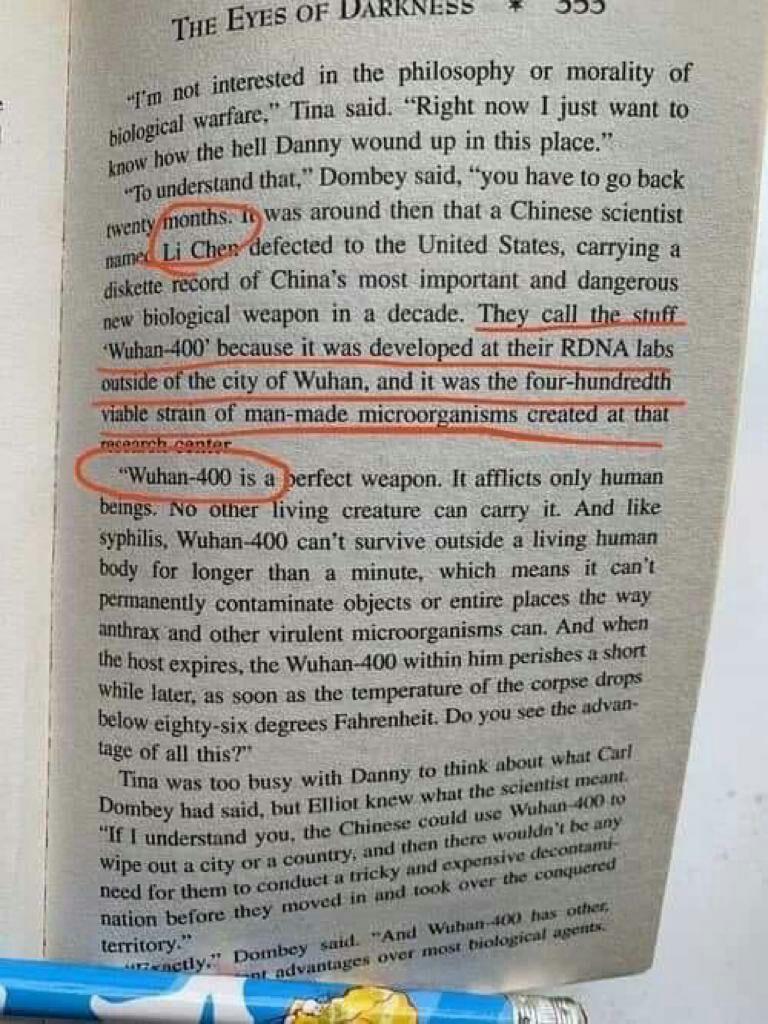
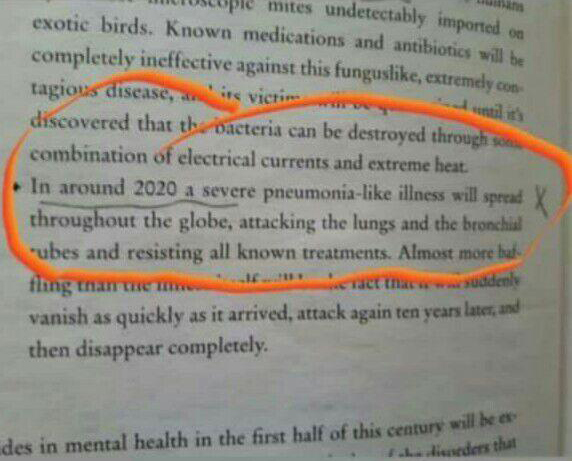
How is such a thing possible? How did an author make such a strange prediction about 40 years ago?
What is your answer?
In such cases, one must doubt the substance of the matter and not simply surrender to superstitions. Doubt is the most fundamental component of the scientific approach. The sociologist of science, Robert Merton, considers "organized skepticism" one of the four main characteristics of science. This is the most important step toward approaching the truth. After that, we must proceed to falsify the claim. How? First, see whether such a book really exists? And if it does, does it contain such information? The book really does exist. But is the claimed information also in the book? Yes and no. The page on the right is page number 181 (of the software version) of the book, but the page on the left is fake. (Do not trust this claim either. Open the book yourself and search.)
Book download link from: External Server | Sedanet Server
The claim is refuted! As simple as that! A charlatan, to promote a superstitious spirit in society, has forged the left-hand page and has had two messages for us. The secondary message: There are humans with supernatural powers who have predetermined our destiny. The primary message: We are forced to surrender before such powerful individuals.
But consider a scenario where the claim was not refuted and both pages were in the book. In that case, adopting a scientific approach, what should we do?
We must provide an explanation for a strange phenomenon.
First explanation: 40 years ago, an author, with supernatural abilities, predicted today with astonishing precision. If no other explanation is available, it is reasonable to accept this explanation. But let us, with a little effort, provide an alternative explanation ourselves.
Alternative explanation: A virologist working on the coronavirus family is a fan of the mentioned book, to the extent that, several years ago, they decide to deliberately release COVID-19 from the laboratory environment into society to fulfill the book's prophecy. They do this in late 2019 so that in 2020 we witness a global Corona pandemic and the book's prediction comes true.
Which is more probable: the alternative explanation or the initial explanation that resorted to the supernatural powers of an author?!
So far, the second explanation seems more acceptable. But you might provide a better explanation and also refute the alternative explanation.
This is how science progresses: encountering a strange phenomenon, offering natural explanations for it, and then eliminating the weaker explanations.
Many phenomena have much simpler causes. The coronavirus has become widespread due to destructive human actions in the environment. When we fueled global warming through population growth and excessive energy consumption, the natural habitats of bats were destroyed, bringing them into closer proximity with humans and increasing the likelihood of their viruses being transmitted to humans. But accepting such a simple explanation places the responsibility for pandemics of this kind squarely on ourselves. So, we find it easier to shift the blame onto others, even if it means accepting very strange superstitious explanations. (SARS, MERS, and Ebola have also been linked to bats.)
It is we who have caused trouble for bats, not the other way around!
.
.
Act Two: Corona and Garlic
"Garlic prevents infection with the coronavirus."

These days, statements of this kind are being circulated with great frequency on social media. Sometimes "garlic" and "lemon" are mentioned, and other times "violet oil" and "Amber Nisa." You probably also know people who believe that the number 13 is unlucky. According to statistics, 25 percent of Americans hold such superstitious beliefs. (I do not know the statistics for Iran.)
Question: Why, during human evolution, did belief in superstitions take shape?
Reflecting on the answer reveals why superstition has been on the rise in society these days.
The simple answer is: the primary function of superstition is to reduce anxiety in high-tension situations that we are unable to control.
Our ancestors experienced very high-tension situations during hunting. Believing that, for example, pinching their foot three times before the final attack would help them succeed reduced their anxiety. Success in hunting, in turn, reinforced this false belief.
Professional athletes know well that success is tied to managing intense anxiety. For this simple reason, superstitious behaviors, like those performed by hunters, are observed with greater frequency among professional athletes.
But there is a very big difference between this false belief of superstitious athletes and the false belief that consuming garlic prevents infection with the coronavirus.
The former does not directly harm others (although it indirectly fuels the promotion of superstition in society), but the latter directly threatens public health. The superstitious individual who has consumed some garlic or violet oil, believing they have become invulnerable, steps into social gatherings and not only increases their own chances of infection but also creates trouble for others. Such anxiety reduction is not only unhelpful but is clearly a threat to public health.
It has been only a few days since the coronavirus entered Iran. Who, in this short period, has matched two groups of people, given garlic to one group and not the other, and then discovered that consuming garlic is effective in preventing infection with this virus?
If Razi and Ibn Sina were alive today, they would not turn to garlic and violet oil to prevent the coronavirus; instead, they would stand alongside the virologists who are seeking to find a vaccine for it.
Of course, society today needs anxiety reduction. But let us judge fairly: which reduces society's anxiety in a reasonable way: burning Amber Nisa or the dancing of hospital medical staff? Not to mention that the former is tied to the profiteering of charlatans who exploit people's desperation, while the latter is done solely with the intention of boosting the morale of patients and the community.
.
.
The question is: What caused the outbreak of the 2020 coronavirus?
1) COVID-19 was a virus manipulated and created by Chinese scientists and deliberately released.
2) It was not a widespread and dangerous virus but a very common cold virus that American media portrayed as catastrophic.
3) It was a virus resulting from a natural genetic mutation that occurred within the coronavirus family, enabling the mutated virus to transmit from the bodies of bats and intermediaries like pangolins to the human body.
All three answers are logically possible, but that does not mean they are all equally probable. From possibility to probability is a long road ahead. When engaged in discussions about everyday matters, we must not confuse possibility with probability. All three options above are possible, but only the third is more probable.
When we choose the third option, it does not mean we are certain the other two are incorrect.
Unfortunately, in many analyses we see on social media these days, something possible is presented not only as probable but as the very reality; that is, they declare their certainty about something that is merely possible.
.
.
Act Three: Corona and Conspiracy Theory
Around 6 million people worldwide die annually from infectious diseases, some of which are contagious and some not. About one percent of the world's population is Iranian. That means roughly about 200 Iranians lose their lives daily due to defeat against microbes. According to this statistic, it seems the new coronavirus should not be taken so seriously. So why is this virus taken so seriously in the world's media? This is where some appear in the role of theorists and propose hypotheses. For example, consider the following three hypotheses.

First hypothesis: America reaps enormous profit from this story. The most important profit is striking a blow against China. Question: But if that is the case, why have the Chinese themselves taken the matter so seriously? Answer: You have underestimated the power of the media. The media forced China to take the matter seriously.
Second hypothesis: It is the Chinese themselves who designed this virus. Question: Why did they do that? Answer: To buy shares of Western companies in China at a cheap price. Question: If that is the case, why are Western media cooperating with China? Answer: The West tried to prevent their one-sided profit by damaging China's credibility.
Third hypothesis: Certain insurance companies are behind the matter. America and China have collaborated to design a virus that kills the elderly in society. Question: Why did they do that? Answer: Because these individuals are nothing but a cost to governments. They use insurance and receive pensions. Furthermore, they waste energy and cause more global warming. Question: But aren't the major decision-makers themselves mostly elderly? Answer: They have the relevant vaccines themselves, and only the poor die.
And dozens of other hypotheses we hear a lot these days.
How should we judge in these cases? The reality is that we do not have behind-the-scenes information. All these types of hypotheses are possible. If there are decision-makers at the level of economic giants who truly make inhumane decisions, which is entirely probable that they do, they would be very happy to hear any false hypothesis that gains public favor and would even promote it to divert minds.
What should we do?
The statistics cited above are those of predictable and conventional situations. For this very reason, they do not instill much fear in hearts. But sometimes contagious diseases can spiral out of control. The 1918 pandemic is the closest historical example. 25 percent of the world's population contracted influenza, and some estimates attest that 50 to 100 million people died. This is while the population density at that time was about one-fifth of what it is now. Is it not possible that COVID-19 could do the same?
The answer depends on our behavior. The more we allow the virus to spread by participating in gatherings, the greater the likelihood of a pandemic. Such viruses only love dense populations, and it does not matter to them whether these people are engaged in worship, studying, or gathered for recreation. But we generally prefer to consider such obvious facts as fiction and instead occupy ourselves with self-made hypotheses and argue in their favor. Hypotheses that, of course, could be true, but to address them, one must first stay alive!
.
.
Corona, from an old novel to garlic and conspiracy theory
Author: Hadi Samadi
.
.

Discussion3 comments
کاملا ساده لوحانه بود دوست من. فقط یه سوال؛ جمعیت ایران ۱٪ جمعیت جهانه?
دوست عزیزی که با عبارات تک کلمه ای مانند " ساده لوحانه" تمام زحمات نویسنده و این سایت وزین رو زیر سوال می بری آیا بهتر نیست شما هم نقدتون رو در مورد این نوشته بگید؟ در مورد سوالتون هم باید بگم بله جمعیت ایران در حدود یک درصد جمعیت جهان است.
مطلب بسیار آموزنده و محققانهای بود. بسیار ممنون از نویسندهٔ محترم و سایت صدانت