Literature
Hafez Lectures: A Commentary on Three Ghazals by Hafez, by Dr. Hassan Bolkhari
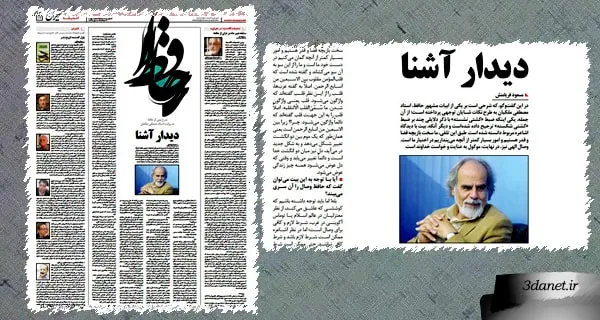
Hafez's relationship with the Quran and Sharia has always been a point of contention among Hafez scholars. Drawing on historical evidence, Dr. Hassan Bolkhari challenges the image of Hafez as a libertine who shunned religious law, instead portraying him as a Sharia-oriented mystic.

Sessions of the Hafez Lectures: "A Commentary on Three Ghazals by Hafez," with a speech by Dr. Hassan Bolkhari
.
.
First and Second Sessions of the Hafez Lectures: "A Commentary on Three Ghazals by Hafez"
Hafez: A Carefree Libertine Who Shuns the Sharia, or an Adherent to the Sharia!?
According to Hafez's famous verse, the love that governs his soul and his world cries out, better than reciting the Quran from memory. Now the question is: what is the relationship between the Quran and love, and more importantly, the cry and loud clamor of love, and is there a verse or verses in the Quran indicating this meaning? Hafez Studies: Two Opposing Views, Each Negating the Other Bolkhari initially addressed the subject of the relationship between Hafez and the Quran, stating: There is much talk and speculation regarding the relationship between Hafez and the Quran. On one hand, we have very illuminating points that Hafez himself has expressed: "Whatever I have done, I have done all through the good fortune of the Quran"; and on the other hand, there is the speech of those who, by citing Hafez's verses and ghazals absolutely, tend to consider Hafez a libertine (rend), a gazer at beauty, and a lover who shuns the Sharia. Throughout the history of Hafez studies, these two views have always existed in opposition to each other and in a state of negating each other. I repeat that some are strongly inclined to consider Hafez a carefree libertine whose identity as a libertine lies in shunning the Sharia, and some are inclined to consider him strongly Sharia-oriented and usually cite these verses: Of the memorizers of the Quran in the world, none has gathered like this servant / Subtleties of wisdom with Quranic points I have seen nothing sweeter than your poetry, Hafez / By the Quran that you hold in your breast Rising early and seeking well-being, like Hafez / Whatever I have done, I have done all through the good fortune of the Quran All of Hafez's poetry is the quintessence of mystical knowledge / Praise be to his captivating soul and the grace of his speech None like Hafez unveiled the face of thought / Until they combed the tresses of speech's secret with the pen Or that famous poem which is the focus of my speech and critique today: "You recite the Quran from memory in [with] fourteen narrations." Humans Are Not All Objects of Time and Space Usually, in explaining contradictory and opposing concepts, reason dictates that we seek evidence that, without bias, relying on proofs and arguments, and at the same time on precise historical documents and evidence, recounts the truths to us. I accept, of course, that in Hafez's ghazals, there is sometimes such depth of meaning in the matter of libertinism (rendi), gazing at beauty, physical love, and even wine, kissing, and embracing that reason itself, which was the ruler in this field, does not accept that such a speaker could describe these attributes so openly and nakedly without having touched wine to his lips. But the reality is that there are some artists who, by virtue of their immense art, impose the color of their own quest upon reality, without having experienced that reality. Hafez has a famous poem: "I am the one renowned in the city for love-making / I am the one whose eye has not been tainted by seeing evil." This is a very important discussion. Hafez, based on this verse, is a possessor of insight; he is a possessor of vision. Some human beings, in the realm of the spiritual path (tariqat) and mysticism, reach such a station that the light emanating from their vision shapes reality. These are the rulers of existence and possess the power of creative (takvini) agency. I said this quickly and moved on so that you know that humans are not all objects of time and space; they are not objects of external entities. Sometimes they are the active agents over external entities. That revered master and saint who walks on water by the hand of miraculous grace possesses creative agency. He is not bound by reality. He is the master of reality. For this reason, to describe the attribute of wine, one need not necessarily be a wine-drinker. It is true that reason's judgment is that Hafez sometimes speaks of kissing, embracing, and wine in such a way as if he has carelessly experienced them repeatedly. But according to other evidence, this power of his in describing wine and kissing can be interpreted as arising from his power as a spiritual master, not from the ordinary experiential power of common people. To What Extent Is Hafez Truthful in What He Has Said About the Quran There is a verse by Hafez that is very exceptional: "If the beloved's shadow fell upon the lover, what of it? / We were in need of him, he was longing for us." As someone who is a scholar of Ibn Arabi, I say that this single verse is worth at least 500 pages of the writings of the esteemed Ibn Arabi. Where he speaks of our need for the Truth and the Truth's longing and love for us. This is a completely two-way relationship. I distinguish between "Allah," which is the Name of the Essence, and "Rabb" (Lord), which is the Name of the Attributes. Not I, who am a child in the field of knowledge, but the great ones in this realm have made this distinction. Rabb means the Nurturing Lord; and the Nurturing Lord, in the human realm, sometimes adopts the language and exigencies of human life for Himself. Or that very famous verse of his: "Seek desire from what comes contrary to habit, for I / Gathered composure from those disheveled tresses." Those who are possessors of theoretical mysticism, and especially those who have worn out pens and blackened pages, have sought to explain the meaning of this "contrary to habit" and have sometimes been unable to, and Hafez says it in a single verse. Unless one is a cavalier and champion of meaning, language does not serve him in this way. These meanings require us, outside the common dispute among these warriors, to look, based on historical evidence, at the extent to which Hafez is truthful in what he has said about the Quran. First, we must clarify this great man's relationship with the Quran according to historical documents. Can any illiterate person be considered a scholar in today's media world?! One of my historical documents in proving this point is a work by Muhammad ibn Qays called "Al-Mu'jam fi Ma'ayir Ash'ar al-'Ajam" (The Compendium on the Standards of Persian Poetry), written in 781 AH; that is, a few years before Hafez's passing. The well-known account dates Hafez's death to 792 AH. If we take this famous account as the basis, the sentence Muhammad ibn Qays writes was composed during Hafez's lifetime. He writes: "Mawlana Shams al-Din Muhammad Hafez says: 'The reflection of your face fell into the mirror of the cup / The lover fell into raw greed from the wine's smile.'" Of course, in today's media world, citing the caprices governing the media, any illiterate person can be considered a scholar, but in that era, for someone to receive the title "Mawlana" and for no one to doubt it upon hearing this title, one truly had to be a Mawlana. One cannot, based on the definitive historical account that Hafez was called Mawlana during his lifetime, consider him a libertine and carefree. Of course, anything is possible in youth. However, people are not judged by their transient errors. People are judged by the outcome of their deeds. We are human; that is, from the root "nisyan" (forgetfulness). That is, forgetting the primordial decree. Forgetfulness is in our essence and at times governs us, and when it governs, there is no escape from the fulfillment of desire, the defeat of reason, and the dominance of passion. And because we are bashar (human), that is, from "basharah" (outer skin), we are disciples of the outward and attached to appearances. Being appearance-oriented, humans are inevitably prone to error. But in the lives of individuals like Hafez, one must take the final outcome as the basis. For the reason that God makes the final outcome the axis and foundation.
Hafez Abru, in one of his works, called Hafez “Mawlana.” On this basis, Muhammad ibn Qays referred to Hafez as “Mawlana.” What does Mawlana mean? For Jalal al-Din Muhammad, it is a proper name; for others, it is a common noun. We know Jalal al-Din Muhammad as Mawlana because Shams considered him his Mawlana. Was Shams the Mawlana of Jalal al-Din Muhammad, or was Jalal al-Din Muhammad the Mawlana of Shams? In common parlance, Shams was the Mawlana of Mawlana. But in the language of Shams’s Discourses, Mawlana was the Mawlana of Shams. In the realm of lover and beloved, there is no superior and inferior. The lover, in the very act of loving, is the beloved, and the beloved, in the very act of being beloved, is the lover. If, in the realm of lover and beloved, there were superiority and inferiority, causality and effect, that would not be love. Among the attributes of love is that lover and beloved are equal. In our culture, Mawlana describes someone who has not only reached the spring but has drunk from it, and not only sipped from that spring but has quenched the thirst of the thirsty. Such a person is Mawlana. Mawlana is not a word or term merely bandied about by disciples. It is not a general social attribute by which some might boast and act with arrogance. Mawlana is an attribute that society itself does not permit to be used except for those who are truly possessors of spiritual authority. Muhammad ibn Qays, during Hafez’s lifetime, called him “Mawlana Shams al-Din Muhammad.” Hafez Abru, too, in one of his works, called Hafez Mawlana. This is one piece of evidence.
Hafez had no intention of collecting his ghazals The second reason is this: As you know, Hafez, as history tells us, had no intention whatsoever of collecting his ghazals. These ghazals were collected by one of his classmates, whose name may have been Muhammad Golandam. That classmate wrote a preface to Hafez’s Divan, and in that preface, he said: “Mawlana the Greatest, the felicitous, the deceased, the martyr, the pride of scholars and the mine of spiritual subtleties, the treasury of divine knowledge, Shams al-Milla wa al-Din Muhammad Hafez of Shiraz.” Do you think such titles could be applied to a libertine who constantly has his mind on the tavern, pawns his cloak, and is ever in pursuit of kisses and embraces? He continues: “Because of his diligent study of the Quran, his constant adherence to piety and charity, his investigation of the Kashshaf and the Miftah, his study of the Matali‘ and the Misbah, his acquisition of the rules of literature, and his research into the collections of Arab poetry, he did not attend to collecting his ghazals, nor did he occupy himself with compiling and recording his verses.” Perhaps this is because the lover is given the tongue to express, not the tongue to collect. If the lover sets out to collect his own produce, he ceases to generate meaning. God, in every age, has possessors of meaning who become manifest, and He appoints others to record and register these meanings.
In the Tazkirat al-Shu‘ara of Dawlatshah Samarqandi, written a hundred years after Hafez’s death in 892 AH, it is stated: “The mention of the confidant of the secrets of the Self-Sufficient Lord, Khwaja Hafez of Shiraz, the rarity of the age and the wonder of the world. His speech possesses a quality that lies beyond the realm of human capacity; it is indeed a matter of divine inspiration and has a flavor from the fountain of spiritual poverty. The great ones have called him ‘the Tongue of the Unseen.’ His speech is without affectation and simple, yet in truths and gnostic knowledge, it conveys the essence of meaning. His virtue and perfection are boundless, and being a poet is beneath his station. In the knowledge of the Quran, he was without peer.” There are many such instances. These are historical proofs that demonstrate the connection between Hafez and the Quran. Thus, the first point of my discussion is concluded.
Shah Shoja’s Critique of Hafez: Why Are the Pearls of Your Ghazals’ Necklace Scattered? After this introduction, we must see where in his Divan Hafez speaks of his relationship with the Quran. The famous ghazal I am reading, based on the Qazvini-Ghani edition, is ghazal number 94. This ghazal is, in fact, the basis for the commentary in “Fourteen Recitations.” And does love come to one’s aid, in Hafez’s view, if one can recite the Quran by heart in fourteen recitations? Or is it love that cries out? In one place, love is the rescuer of man; in another, love clamors. Is it the cry of love or the act of rescuing? We must discuss this. The entire ghazal, until we reach the final verse, is as follows: That heart-comforting beloved brings a complaint mingled with gratitude / If you are a connoisseur of love, listen to this tale. Without reward or obligation was every service I rendered / Lord, let no one have a patron devoid of grace. No one gives water to the thirsty-lipped rogues / It is as if the knowers of sainthood have departed from this realm. O heart, do not coil into her noose-like tresses, for there / You will see heads severed without crime or offense. Your eyes, with a glance, drank our blood and you approve / Beloved, it is not lawful to protect a shedder of blood. In this dark night of mine, the path to the goal is lost / Come out from a corner, O star of guidance. From every direction I went, nothing but my terror increased / Beware of this desert and this endless road. O sun of beauties, my heart is boiling within me / Shelter me for an hour in the shade of your grace. Though you have ruined my reputation, I will not turn my face from your door / The cruelty of the beloved is sweeter than the consideration of a pretender. Your love will come to your aid if, like Hafez, / You recite the Quran by heart in fourteen recitations.
Our discussion concerns the final verse. But before entering into the final verse, I must mention a point that is part of the preliminaries. If you have read Hafez’s history well, you know that Shah Shoja has a critique of Hafez. He rebukes Hafez in one place, asking why his poetry is scattered. Jumping from one branch to another is the characteristic of your ghazals. Why are the pearls of your ghazals’ necklace scattered? In one verse of a ghazal, you speak of the sky, and in another verse of the same ghazal, of the marsh? What connection is there between the marsh and the sky? Hafez seemingly confirmed this statement. But the reality is that there are now two theories. One theory says that each of Hafez’s ghazals has an intrinsic semantic unity. That is, there may be dispersion in the form of words. But if you are a connoisseur, you will see a Hafez ghazal as continuous. We have a continuity-oriented proposition and a discontinuity-oriented proposition. One view says that each of Hafez’s ghazals has a semantic sphere. Like the ghazal I read, whose semantic sphere is love. Some, based on the continuity proposition, say each ghazal contains one meaning and a semantic unity governs the entire ghazal. I reconcile these two views. Because all of existence is unity in multiplicity and multiplicity in unity. The Relationship Between Love and the Quran: The Quran is the Sultan and Love is the Vizier The verse “Your love will come to your aid if, like Hafez, / You recite the Quran by heart in fourteen recitations” has been read in several ways. Regarding “Your love will come to your aid,” there is no verbal disagreement. But there is a thematic disagreement. Everyone has read it as “Your love will come to your aid.” But there is disagreement on whether love comes to one’s aid or love cries out and makes an uproar. The next word has been read in three ways: “ar khod,” “gar khod,” and “var khod.” This version is “var khod.” If it is read as “gar,” it must be interpreted as a conditional: “Hafez, if you can recite the Quran in fourteen recitations, love will be your rescuer.” I do not understand this. The Quran is nobler than love. In the relationship between love and the Quran, the Quran is the sultan and love is the vizier. Is it not better for a person to be supported by the protection of the sultan than to be supported by the protection of the vizier? In other words, in the comparison between love and the Quran, the Quran is nobler than love. So it is better for a person to have a rescuer like the Quran than love. For this reason, I do not favor interpreting “Your love will come to your aid” as meaning the rescuing act of love. As long as the Quran exists, the Quran is more worthy for rescuing. But the Quran can make you clamorous in the realm of love. In any case, we will conclude the discussion at this point, and in the next session, we will delve into the commentary on the fourteen recitations.
.
.
Third and Fourth Sessions of the Hafez Lectures “A Commentary on Three Ghazals by Hafez”
Is Hafez’s Approach to the Quran Philosophical?
Dr. Hassan Bolkhari, referring to the previous session's discussion, said: In the previous session we discussed a ghazal that demonstrated Hafez is both a mystic and a scholar. Having studied fourteen recitations of the Quran, he not only possesses mystical insight but has memorized all fourteen recitations. Numerous verses from Hafez's Divan show his intrinsic devotion to the Quran. Of course, one can draw upon the Quran and act according to the exigencies of various life situations. It is true that we love Hafez dearly and he is beloved to us, but Hafez is measured by the realities of his life, not necessarily by the image we wish to have of him. We can certainly hold that image. But since the discussion has reached the point of critique and examination, we must consider that, according to multiple accounts, he was devoted to the Quran while also having human exigencies. If you view Hafez in this way, the roguish and carefree Hafez can be reconciled with the Quran-oriented and Sharia-oriented Hafez. Otherwise, it is the war of the seventy-two nations, which has no end. Historical evidence says Hafez was devoted to the Quran.
The frequency of Quranic expression in Hafez's Divan indicates that he did not speak of the Quran out of poetic necessity or, God forbid, hypocrisy. Historical evidence shows that Hafez was committed in his expression and his devotion to the Quran. This commitment is sometimes evident in the form of his verses and sometimes in the accounts of historians and chroniclers. Therefore, the fundamental connection between Hafez and the Quran is certain. To what extent he drew upon the Quran and how much the truth of the Quran influenced his soul is another discussion. But the connection itself is undeniable. There is a point here, and this point is new, and I wish to address it today. The question is: what was Hafez's image of the Quran? In the many different commentaries and extensive research on Hafez, I have rarely seen this issue discussed. Is the Quran that exists in the mind of Avicenna, through which he expounds the divisions of the intellect, the same Quran that Hafez had in mind? Or is Hafez's approach and view of the Quran philosophical? As Avicenna, and to a lesser extent Farabi and Qutb al-Din al-Shirazi, had? This is an important discussion. Do not imagine that the Quran, as an eternal truth, has a single color in every mind. The Quran manifests within the mental vessel of individuals. If the mind is expansive, the Quran is expansive, and if the mind is narrow, it becomes a book for wedding ceremonies and the bridal chambers of the dead. But in the view of Sheikh al-Ishraq, the Quran is an elevated Quran. It is his saying: "When you recite the Quran, recite it as though it were revealed for you." Do you know who can speak in this way? One who has repeatedly seen himself, absolutely, within the clear realm of the heart, as the direct addressee of the Quran.
The Quran governing Hafez's mind and language is the Quran of Ayn al-Quzat
Is the Quran of Hafez's soul the Quran of Illuminationist wisdom? Is it the Quran of the author of "Majma' al-Bayan," who interprets the Quran purely through narration? Or is it the Quran of Khwaja Nasir? Or none of these, but the Quran of Ibn Arabi? My new discussion is that the Quran governing Hafez's mind and language is the Quran of Ayn al-Quzat. It is the Quran of Hallaj and the Quran of Ahmad Ghazali in "Sawanih al-Ushshaq." I have evidence for this perhaps novel claim. This difference is not in the essence of the Quran. To say so would be polytheism and blasphemy. Rather, the Quran differs according to the perceptive capacity of the readers' minds. The Quran of the fourth and fifth centuries is a narrative-based Quran. I suspect that the "lesson of the Quran" Hafez speaks of is the Quran spoken of by the mystics. Among them Hallaj, Ayn al-Quzat, and Ahmad Ghazali. I will not enter the domain of Ibn Arabi. Although, as a student of Ibn Arabi studies, I know that the intensity of Ibn Arabi's esoteric interpretations of the Quran is no less than that of the mystics. Yet, despite this, I believe Hafez did not turn to Ibn Arabi. But he did turn to Hallaj. Many commentators have not dissected the semantic anatomy of the Quran that exists in Hafez's mind. My claim is that this Quran is the Quran discussed within the realm of mysticism. To prove this, I must explain two points. One is Hafez's relationship with Hallaj. We must clarify whether Hallaj influenced Hafez. If this influence is proven, then certainly the Quran governing the heart, soul, and spirit of Hallaj also influenced Hafez's spirit, and Hafez views the Quran in the same way Hallaj viewed it. Such a Quran unlocks the language of human love. In any case, each person, according to the strength of their diving ability, discovers one of the inner dimensions of the Quran. Some remain at the outward letter, while others pass beyond even the fiftieth inner dimension. We have only heard Hallaj's "I am the Truth" from him.
The second point we must establish is the Qur’anic exposition that existed in Hallaj’s mind and tongue, the very thing that caused Hafez’s love for Qur’anic recitation to cry out. First, allow me to prove the second point. Look at these statements by Hallaj. These are my proofs. I am depicting the Qur’an inscribed upon Hallaj’s soul. Ibn Fatik, in his book Akhbar al-Hallaj, says: “I myself heard Hallaj say that the knowledge of all things exists in the Qur’an. The knowledge of the Qur’an is not in its sequential words, but rather in the mysteries of the opening Fatihah and the initial letters of certain surahs.”
We have only heard Hallaj’s “Ana al-Haqq” (I am the Truth). You cannot enter the school of love and the tribe of lovers without seeking the tent of Husayn Mansur al-Hallaj. For those who have sought the truth of mysticism, Hallaj and Ayn al-Qudat are the ones who were executed. Not Bayazid, Shams, or Abu’l-Khayr, who chose a corner of safety, spoke lofty words, uttered ecstatic sayings, and no one put them on the gallows. Those who are students of mysticism, among the chieftains of this tribe, whom do they seek out first? Of course, Shams is lofty in the Maqalat. Bayazid and Abu’l-Khayr are lofty in their ecstatic utterances. But for the student of mysticism, Hallaj and Ayn al-Qudat hold an unattainable station. Therefore, do not accept that Hafez, from his youth, was preoccupied with mysticism and did not seek out Hallaj. The Qur’an that governed Hallaj’s mind and tongue is a very particular Qur’an. My conjecture is that Hafez’s Qur’an has the same hue and fragrance. The mystics look to the inner meaning and the truth of the Qur’an My second proof is Ayn al-Qudat Hamadani. In the eighth chapter, first section of his Tamhidat, he says: “O dear one, when the Qur’an lifts the veil of glory from its face and removes the mask of majesty, it will heal all those sick with separation from and meeting with God, and all will be saved from their pain. Hear from Mustafa, who said the Qur’an is a remedy. The Qur’an is a rope that pulls the seeker until he reaches the sought. And the Qur’an was sent down to this world in the garb of letters. In every letter, a thousand thousand soul-stealing glances have been embedded.” This is Ayn al-Qudat’s very sweet narration of God’s intimate whisper in the soul of the Messenger: “You set the snare of the prophetic mission and invitation; the one who is Our prey will know Our snare himself. And in strangers, I have no desire whatsoever.” All that is, was, and will be is entirely in the Qur’an. Ayn al-Qudat says: “The Qur’an is the pre-eternal address to His friends, and strangers have no share in it except the letters and words they hear outwardly, for they lack the inner hearing. And God forbid that a human being be dismissed from the faculty of hearing. If I knew that they should be given hearing, it would have been given. But they will never find deliverance from estrangement.”
The mystics look to the inner meaning and the truth of the Qur’an, and Hafez is a mystic of high rank. His verses attest to this. Ayn al-Qudat continues: “The unbelievers who were distant from the Qur’an knew the Qur’an by its words and were dead to the truth of the Qur’an.” This is said by Ayn al-Qudat, who lived chronologically almost 300 years before Hafez. Muhammad Ghazali is verbose, but Ahmad Ghazali speaks the kernel and the essence
Sanāʾī has some lines about the Qurʾān: “The bride of the Sublime Qurʾān will lift her veil / when she finds the realm of faith emptied of tumult. / No wonder if your share of the Qurʾān is nothing but a form, / for the blind eye receives nothing from the sun but heat.” This is precisely what ʿAyn al-Quḍāt means when he says: “Alas, we see nothing of the Qurʾān but black letters on white paper. As long as you are in [the realm of] existence, you can see nothing but blackness and whiteness, but when you depart from existence, the Word of God effaces you within your own existence. Then it brings you from effacement to affirmation. When you reach affirmation, you see no blackness; you see all whiteness, you see light, you read. Blessed be the one who expounded all this and said: Every letter of the Qurʾān on the Preserved Tablet is greater than Mount Qāf. Do you know what this Tablet is? The Preserved Tablet is the heart. O dear one, you will behold the beauty of the Qurʾān when you abandon the worship of habit, so that you may become one of the people of the Qurʾān. These people are the folk who have truly attained the Word of God.” ʿAyn al-Quḍāt’s Tamhīdāt presents a very particular image of the Qurʾān, one not unrelated to the Qurʾān of al-Ḥallāj. They are mystics who seek the Qurʾān in the reality of its inner meaning, not in the outward form of its words. I will cite another reason from Aḥmad Ghazālī. You know that there is a difference between Aḥmad Ghazālī and Muḥammad Ghazālī. From the perspective of figures like Shams, Muḥammad is verbose. Aḥmad, however, speaks the kernel, speaks the essence. The difference between the two can be found in this historical account: It is said that Aḥmad used to follow his brother Muḥammad in congregational prayer. Once, in the middle of the prayer, he broke away and performed his prayer individually, withdrawing from the congregation. After the prayer, they asked him why he had done so. He said: I was praying with Muḥammad as long as he was praying. From the moment he drowned in a sea of blood, I performed my prayer individually. They asked Muḥammad Ghazālī the secret of this story. He said: I wish my brother had preserved my honor. He spoke the truth. When I raised my hands for the qunūt [supplication in prayer—assuming he was Shīʿa], I remembered a question a woman had asked me before I came to the mosque. Aḥmad possesses the eye that sees the inner reality.
Mysticism begins with love, and love has its roots in the Qurʾān
Aḥmad Ghazālī, in his book Savāniḥ al-ʿUshshāq, says the following about the Qurʾān: “It is sufficient for the special status of the human being that his being beloved exceeds his being a lover. This is no small measure of acceptance.” What does this mean? The human being imagines he is the lover. The lover imagines that the intensity of his love is greater than the intensity of the beloved’s love. This is a raw and childish notion. It is true that, in outward terms, the human being is the lover of the Divine. But inwardly, he is the beloved of the Divine.
In al-Lumaʿ fī al-Taṣawwuf by Abū Naṣr al-Sarrāj al-Ṭūsī, who lived in 350 AH, 500 years before Ḥāfiẓ, it is stated: “God has mentioned love in several places in the Qurʾān. As He said: God will bring a people whom He loves and who love Him.” Our mysticism begins with love, and love has its roots in the Qurʾān.
The influence of al-Ḥallāj on Ḥāfiẓ and a comparison of their poetry
The second point to be discussed is Hallaj's influence on Hafez. What I read here is from the Divan of Mansur al-Hallaj. Like Moses, I am effaced in the light of theophany / And then with every breath I bring forth a white hand. The gardens of paradise become a sign of hell / If I utter a sigh in the garden of the houris. I break the ship of reason in the ocean of love / And from the depths of the sea I bring forth gleaming pearls. When I found the dagger of Lahut from La and Hu / I set out to plunder the realm of reason. I do not clamor like a wine vessel, yet constantly / With lips sealed, I bubble forth like a vat of red wine... Like Husayn in the pavilion of the imaginal world / Every moment I bring forth a thousand beautiful witnesses. Did you think Hallaj could compose poetry this fluently? Compare Hallaj's first couplet with this couplet by Hafez: In pre-eternity, the ray of your beauty breathed of theophany / Love appeared and set fire to all the world. Your face made a manifestation, love saw it had no angel / The lightning of jealousy flashed and threw the world into confusion. The pretender wanted to come to the spectacle of the secret / The unseen hand came and struck the uninitiated on the chest. Look at these other couplets by Hallaj: Until a cry and lament: where is that beloved? / All horizons became full of the beloved; where is the other? The fire of love's jealousy came and burned the others / The eye that sees nothing but the beloved; where is the other? Do you discover the connections? I did not think Hallaj was such a master of the Persian language. Because usually, mystics who pursue objective and practical ecstasy do not have beautiful language. Although if you become a lover, love itself gives you the language. But Hafez has taken speech to such heights that we usually accept the poetry of others less. Hallaj's poetry, in terms of meaning, is such that it is as if you are listening to Hafez. But in terms of meter, beauty, and elegance, it certainly does not reach Hafez's poetry. Nevertheless, I consider Hallaj to have influenced Hafez. The couplets I read clearly demonstrate this influence.
.
.
Hafez Lectures: "A Commentary on Three Ghazals by Hafez"
Speaker: Dr. Hassan Bolkhari
Audio of Sessions One and Two | 11 & 18 Tir 1393
Audio of Sessions Three and Four | 25 Tir & 1 Mordad 1393
.
.
Source: Book City
.
.

Discussion0 comments
No comments yet; let yours be the first voice.