Philosophy
Hafez, Our Poet, and Rumi, Our Contradictor
Why does Hafez feel so close to our everyday lives, while Rumi so often occupies the place of a poet to be praised and drawn upon for inspiration? Through a philosophical comparison of the two poets, this article reads Hafez as the poet who recognizes the unfinished human being, and Rumi as the poet of the possibility of transformation and self-transcendence. In this reading, doubt and certainty, companionship with human contradictions, and the passing beyond oneself become the axes for understanding the difference between the two poets' worlds.
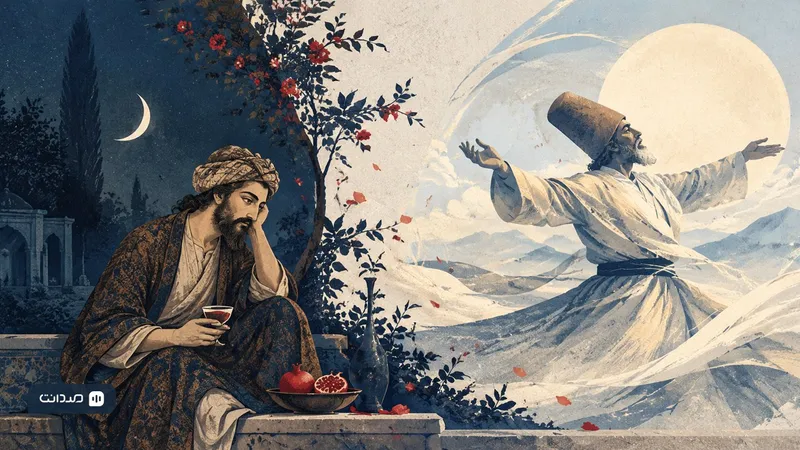


A reflection on how Hafez and Rumi relate to doubt, certainty and the possibility of human transformation
Why is Hafez's Divan present in our homes, while Rumi lives more in our praise? This article proposes an interpretation: Hafez, above all through his problematic relation to certainty, is the poet of recognition and of companionship with the unfinished human being, while Rumi, within his mystical horizon, is the poet of the possibility of transforming the human being's relation to the self and to truth. To clarify this distinction, the reading of Hafez and Rumi is placed in conversation with Montaigne and the Pyrrhonian skeptics[1], Kierkegaard, Nietzsche and Gadamer, without any of these comparisons leading to an equation of the two poets with them.
1. Introduction: Why Is Hafez in Our Homes and Rumi in Our Praise?
In Iranian culture, two names more than most are bound up with the inner and spiritual experience of the human being: Hafez and Rumi. We love them both and consider both part of our spiritual heritage. Yet there is a thought-provoking difference between the places they occupy in our everyday lives. Hafez's Divan is present in many homes. We turn to it, we take omens from it, we take refuge in it in moments of doubt and sorrow, and at times we feel that the poet knows something about our situation that we ourselves have not yet managed to put into words. Rumi is beloved too, but our relation to him often has a different colour: we praise him, we speak of his spiritual greatness and we draw inspiration from his teachings, without necessarily being able to dwell in his world to the same degree.
This difference should not be turned into an unproven statistic about the two poets' popularity: a historical and sociological claim about popularity would require separate research. What is put forward here is a cultural observation and an interpretive hypothesis: Hafez is a poet with whom we can converse in the ordinary moments of life, while Rumi often summons us to a horizon beyond ordinary life.
The central question is this: why is Hafez close to our lived experience, while Rumi at times keeps his distance? Should the difference be sought in language and style, or in the kind of relation that each poet's verse establishes between the human being and the world? The hypothesis of this article has two foundations: first, the place of doubt and certainty in Hafez's world; second, the difference between Hafez's way of accompanying the human being and Rumi's way of transforming him. Hafez enables us to recognize ourselves in another human being, whereas Rumi summons us toward a human being we have not yet become.
2. Hafez and Dwelling in the Region Between Doubt and Certainty
One of the most striking features of Hafez's world is the instability of the human being's relation to certainty. In his poetry certainty is not easily attained, and any claim about truth is, as a rule, not immune from doubt, irony and rethinking [1]. Hafez confronts the preacher who regards truth as his own possession, the ascetic who is confident of his own purity, and the pretender who believes he has discovered the path to salvation, yet the poet constantly opens a gap between the claim of these figures and the truth they lay claim to. A familiar example is the verse that accuses the preachers who put on a show in the pulpit and at the prayer niche of doing something quite different in private [1]. In a world of ascetic and hypocrite, love and pretension, outward and inward, there is no simple and trustworthy boundary: what appears outwardly as a sign of virtue may be a cover for self-interest, and what is condemned from the standpoint of the official order may possess an honesty not found in the conduct of those who profess virtue.
This doubt must be understood precisely. Hafez is not necessarily someone who believes in no truth at all. He distinguishes between truth and the claim to possess truth. This kind of doubt might be placed within the philosophical tradition of "suspicion" toward the self-sufficient claims of knowledge and morality [10]. The issue is not merely that the human being does not know the truth. Those who consider themselves owners of truth may also be mistaken in knowing themselves. Hafez not only doubts the certainty of others; he also makes problematic the very possibility of leaning untroubled on certainty.
In such a world the human being is neither wholly deprived of truth nor able to take hold of it with final assurance. He lives in the gap between seeking and attaining, hope and despair, faith and doubt. This gap can be called Hafez's "grey zone," not in the sense of indifference between truth and falsehood, but in the sense of a condition in which certainty always remains open to question. Here one may, with caution, set Hafez beside Montaigne. In the Essays, instead of relying on grand assurances about human nature, Montaigne stresses the limits of knowledge, the instability of judgments and the need for constant rethinking of one's beliefs [4]. He himself is indebted to the tradition of the Pyrrhonian skeptics, who regarded the "suspension of judgment" as a path to tranquillity [5]. This comparison does not mean treating them as identical: the historical and intellectual context of Hafez differs from that of Montaigne and Sextus[2], and Hafez cannot be called a skeptic in the philosophical sense of the term. But all three are wary of simple, self-sufficient certainties and separate the claim to know from the truth of knowing. For this reason, Hafez's closeness to us lies in the fact that, to enter the world of his poetry, we are not asked first to resolve all our doubts; we can enter with those very unanswered questions.
Such a condition is familiar to the reader. We too move between our beliefs and our doubts: we believe in a truth but cannot live according to it. We place our hope in salvation but are unsure of our own worthiness; we loathe the hypocrisy of others and find traces of the same contradiction in ourselves. In this situation Hafez is neither a judge who condemns us from the outside nor a teacher who lays a fully defined path before us. He is a companion who is himself acquainted with the contradictions of the world. He can speak of faith while calling the pretenders of faith into question, speak of wine and the tavern while setting a moral and spiritual meaning against official asceticism, and keep hope alive without turning it into a definitive promise. He does not necessarily dispel our doubts; at times he gives them a voice, and perhaps that very giving of voice is itself a kind of consolation.
The calm that Hafez provides is not necessarily the calm of a problem resolved: it may be the calm of not being alone in the problem.
3. Empathy Instead of Liberation: The Consolation of Recognition in Hafez
We do not always expect literature to turn us into a better or more perfect being. Sometimes we ask poetry for a way of understanding an experience that we cannot articulate in everyday life. Much human suffering intensifies because the individual takes his experience to be exceptional, unjustifiable or the sign of a personal defect: failure in love, jealousy, grief, disillusionment with the world, the gap between ideal and reality, even the inability to act on one's own beliefs. The individual suffers not only from a difficult experience but also from the thought that he may be the only one living such a contradiction. Hafez's poetry can ease this loneliness: it turns the scattered and at times shameful experiences of the human being into a language in which one can recognize oneself.
To understand this relation, we must distinguish between two kinds of calm. The first is the calm that comes from the resolution of contradictions and the arrival at a new condition. The second is the calm that comes from being accepted in the midst of those very contradictions: the human being discovers that his condition, with all its flaws, is neither unique nor shameful. Hafez, at least in an important part of his poetry, is closer to the second kind. He shows that there is a gap between what we long for and what we are, but that this gap does not deprive us of living: with awareness of our weaknesses we can still love, enjoy, hope and seek meaning. Pleasure, love, friendship and presence in the moment are not necessarily the reward of attaining certainty; they can be experienced in the midst of doubt as well.
This feature should not be mistaken for surrender to the status quo. Hafez's irony is cutting, and his critique of hypocrisy, performative asceticism and unfounded moral claims has critical force. His closeness to the ordinary human being does not mean endorsing all of that person's habits and weaknesses; at times Hafez draws near to the human being by exposing contradictions, not by justifying them. Yet the outcome of this exposure is not always a command for fundamental transformation. He reveals the complexity of the human condition without necessarily drawing a complete map for leaving it. In his poetry the reader finds both a critique of the self and a permission to go on living: he comes to see that flaw and contradiction are not merely obstacles that must be removed before life can begin; life itself at times flows within these very tensions.
Hafez does not say that all human beings are exactly alike; he shows that the gap between ideal and reality, faith and doubt, wanting and being able is part of shared human experience. In this way he lessens the feeling of loneliness. The substance of this relation might be summed up thus: Hafez shows us that other human beings too live in this same unfinished world, with the same questions and contradictions; and this recognition can itself be a source of calm.
4. Rumi and the Necessity of Human Transformation
In Rumi's poetry too, the human being confronts contradiction, weakness, fear and incompleteness. So one cannot regard him as a poet who speaks merely from a position of certainty, and Hafez as one who only remains in doubt. Rumi also begins from crisis: from a human being caught in habit, selfishness, attachment and his own limited views of the world. The opening verse of the Masnavi, which laments the reed's separation from the reed bed, puts this very crisis in the language of allegory [2]. But in many parts of the Masnavi and the Divan of Shams, this condition is not the end point; crisis can be the threshold of transformation [2][3]. In Rumi's world the human being is a creature who must not only know himself and come to terms with his limitations but also has the possibility of passing beyond his present form. The famous verse "Yesterday the sheikh went about the city with a lantern, saying: 'I am weary of beasts and demons; it is a human being I long for'" [3] shows this quest for becoming human: what we now are, we do not yet count as "human."
Here love is not simply one feeling among human feelings; it is a force that transforms the human being's relation to the self, the world and truth [12]. What once seemed the whole of reality may be only part of it, and what was taken to be the human being's definitive identity may perhaps be a passing form of his existence. For this reason, Rumi's summons is not merely a summons to become better within the framework of the same earlier self. At times it concerns changing the very standards by which the human being measures himself and the world. In such a horizon, moral transformation and epistemic transformation are not separate: to see something different, one must to some degree be changed oneself.
This feature can be called "existential transformation": a condition in which knowing is not merely adding new information to the mind, and the individual's way of being and living changes as well. It is here that comparing Rumi with Kierkegaard is illuminating. In the Concluding Unscientific Postscript, Kierkegaard says that existential truth cannot be reduced to a set of correct propositions. What matters is the individual's relation to what he accepts and the way in which he lives by it, and hence "truth is subjectivity" [6]. A person may speak about truth without truth having left any mark on his way of being. Between Kierkegaard and Rumi there are fundamental differences in theology, faith and the standing of the individual, and this comparison is not an equation. Nevertheless, it reminds us that in some intellectual and spiritual traditions, truth is not something that can be merely viewed from the outside.
Pierre Hadot[3] likewise, in reading ancient philosophy as a "way of life," has shown that in many ancient schools philosophy was an exercise in transforming the self, not merely a system of theories [9]. This framework is useful for understanding the transformative role of Rumi's poetry, though Rumi speaks within the horizon of divine love and not of philosophical reasoning.
For this reason, Rumi is sometimes harder for the reader than Hafez. His difficulty lies not only in language, allegories or mystical concepts; it lies in the kind of expectation he has of the human being. In Hafez's poetry we may see our present condition and feel that we have been understood, but in Rumi's poetry we may feel that our present condition is being challenged and that we are being called to pass beyond it. Poetry here is not merely a mirror for recognition. It can be a force for transformation. This does not mean that Rumi lacks empathy for human sufferings and weaknesses; on the contrary, his works are brimming with a deep knowledge of human desire, fear, pride and bewilderment. The difference is that this knowledge is often placed within a horizon that invites the human being to go beyond his present state. In other words, Rumi too sees the human being where he is, but usually does not wish to leave him only there.
5. Nietzsche and the Problem of Passing Beyond the Self
To clarify this aspect of Rumi's thought further, one may point to the concept of "self-overcoming" in Nietzsche's philosophy. Nietzsche's Zarathustra says that the human being is a rope stretched between animal and Overman; he is a "bridge" and not a "goal" [4][7]. The human being should not consider himself a perfect and finished being, and should take seriously the possibility of passing beyond his present form. Yet Nietzsche's self-transcendence is not the same as Rumi's mystical transformation: Nietzsche starts from a critique of the dominant morality, a rethinking of values and the creation of new ways of life, whereas Rumi understands transformation within the horizon of divine love and the human being's relation to a transcendent truth. The difference in destination and foundation must not be overlooked.
What this comparison clarifies is a question that both, in their own ways, pose: can the human being go beyond the present form of his life? This question, compared with the question of how to live within the present condition, makes a different demand. The first asks us to discover the possibilities of living within this very world; the second confronts us with the possibility of changing the very standards, habits and forms of our being. It is here that the proposed distinction between the two poets becomes more precise: Hafez mostly helps us recognize our human condition, whereas Rumi mostly calls us to the possibility of transforming it. The word "mostly" matters: the point is not that Hafez never calls for change or that Rumi never offers empathy and consolation. The matter concerns a difference of emphasis and direction of movement, not the marking out of two separate territories.
6. The Difference Between the Two Poets in Their Relation to Certainty, and Why Recognition Is Easier Than Transformation
Now the two axes of the discussion can be joined. In Hafez's poetry certainty is often problematic. The claim to have attained truth can become an object of irony and critique, and the human being can remain in the search for truth without suspending life until he reaches final certainty. In Rumi's horizon, at least in many of his mystical works, doubt and bewilderment are more a stage on a path that can lead to another kind of knowing and experience. Here again one must avoid the simplistic opposition between a "skeptical Hafez" and a "certitude-minded Rumi": Hafez too speaks of love and faith, and Rumi too is aware of bewilderment and of language's inability to express truth [2][12]. Nevertheless, the direction of movement in these two poetic worlds differs: for Hafez, incompleteness may be one of the enduring conditions of life, but for Rumi it is a sign of the necessity of movement and transformation.
If we accept this difference, we can pose the opening question anew: why is Hafez more familiar and closer at hand, while Rumi is more often praised as a great and inspiring poet? One possible answer is that recognition is cheaper than transformation. When we meet our own doubt, love, failure and mistrust in Hafez's poetry, we do not need to have become a different person before reading. We can be the person we are now. But the call to transformation confronts us with another problem: are we prepared to pass beyond certain habits, attachments and certainties of our own? Can we yield to another possibility of being, even if we do not know where this transformation will take us? Transformation may confront the individual with the question: if what I have known about myself until now was not the whole truth, then who am I? Admiring a new horizon is not the same as moving toward it; we can accept the greatness of an idea without being ready for its consequences in our own lives. This is the difference between spectator and participant, and Rumi's poetry often calls the reader to participate, while Hafez's poetry opens a space for reflection and recognition in which there is not necessarily an immediate obligation to be transformed.
For this reason one can say: in facing Hafez we feel that the poet shares our situation, but in facing Rumi we feel that we are facing someone who wants to change our situation. The matter is not only the difference between doubt and certainty but the difference between two relations to the human being: accompanying the unfinished human being and summoning him to transformation. Of course, this is a difference of dominant tendency, not an exceptionless law: Hafez's poetry too can shake the reader's moral and intellectual foundations, and Rumi's poetry too can produce a deep calm.
7. Hafez as Mirror, but a Mirror That Changes Us Too
To understand our relation to Hafez, another point must be noted: his poetry is not merely a mirror that reflects our ready-made image without any change; it can also transform the way we look at ourselves. Here Gadamer's hermeneutics is helpful. According to Gadamer, understanding a text is not the recovery of a meaning independent of the reader. Understanding takes shape in the fusion of the text's horizon and the reader's horizon. The reader approaches the text with his own prejudgments and experiences, but in this encounter some of those prejudgments may change [8]. From this perspective, our closeness to Hafez is not merely because he says things we already know. At times he reveals in us an experience that we previously could not express clearly, and at times a poem that had one meaning in one period of life takes on another in a different period.
This flexibility must not be mistaken for an absence of meaning. From the fact that Hafez's poetry takes on multiple meanings in the experience of different readers, it does not follow that every interpretation is equally valid. The words, images, contradictions and structure of the poem play a role in the formation of meaning. The reader participates in understanding but does not construct meaning entirely at will. The same caution is needed regarding Hafez's relation to Iranian culture: the presence of his Divan in homes cannot be attributed to a single philosophical feature alone. The tradition of the Hafez omen, cultural memory, the language of the poetry, family occasions and the modes by which literature is transmitted all play a part [11]. One must distinguish between two questions: why do we turn to him culturally? And why do we feel an existential closeness in his poetry? The two are related but do not have the same answer. This article, rather than making claims about the historical causes of Hafez's popularity, is a reflection on the second possibility.
Within this framework, the title of the article takes on its meaning. Hafez is not merely a poet who speaks about us; he can become part of our inner language. In moments when we are unable to express what we feel, his poetry speaks in our place. When we are caught between hope and despair, a verse of his lays bare the precise shape of that state. The verse "Love seemed easy at first, but difficulties came" [1] is an example of how the gap between expectation and experience is put into words. For this reason, in many homes Hafez's Divan is a book to be consulted, not merely read: we return to it not necessarily for a definitive answer but to find a language that makes our situation intelligible. Rumi, by contrast, more often has the form of a horizon: something one can fix one's eyes on, draw inspiration from and feel small before, without always being able to turn it into everyday experience. Being cherished is not the same as sharing our condition.
8. Does Hafez Keep Us in the Status Quo?
A serious objection can be raised: if Hafez enables us to recognize ourselves in our present condition and to come to terms with our contradictions, is this closeness at times an excuse for not changing? Can his poetry be used to justify weakness and inaction? This objection must not be ignored. Any literary work may be put to use in different ways. But the way we use a poet should not be confused with the capacity of the poetry itself. Accepting human complexity does not mean endorsing it. Recognizing one's own hypocrisy and contradiction can be the first step of change. Philosophers such as Ricoeur have spoken of a "hermeneutics of suspicion," an approach that seeks more hidden layers behind the human being's consciousness and manifest claims [10], and Hafez, with his suspicious gaze at the garb of asceticism and the claim of faith, provides in his own way such an opening for self-awareness. At times the human being cannot transform his real condition until he is able to see it.
From this perspective, Hafez and Rumi can also be seen as two complementary possibilities: sometimes one must first know oneself, step back from the illusion of perfection and discover that one is not alone in one's experiences, and only then ask what must change. And sometimes a call to change, if it comes before a genuine knowledge of the self, leads to the denial or suppression of the human being's real condition. Even so, these two poets should not be turned into two fixed stages on a single path. Such an interpretation also erases their differences. Comparing them merely distinguishes two human needs: the need to be understood and the need to be transformed. Perhaps we need both, but at different moments of life one becomes more urgent.
9. Conclusion: Hafez Is Near to Us, Rumi Calls Us to the Distance
The thesis of this essay can be stated as a compact contrast:
Hafez shows us that we are not alone in our unfinished human condition; Rumi reminds us that this condition is not necessarily the last possibility of our being.
Hafez, in this reading, is the poet who keeps company with the human being in the region between doubt and certainty. He knows the distance between ideal and reality, and he makes it possible for us to live inside that distance. His calm arises less from a final resolution of contradictions than from recognizing them within a shared experience. Rumi is the poet of the possibility of transformation: he knows the human being as he is, but does not take that knowledge to be the end, and calls him to move beyond his mental habits, his settled self-understandings and the boundaries of his present experience. For this reason Hafez is the more familiar to us and Rumi the more difficult: we read Hafez in the ordinary moments of life and find his language to be our own; Rumi we must sometimes read as an invitation to another experience that we have not yet reached.
If this thesis is right, Hafez's wide presence in our homes is not merely a sign of one poet's popularity; it signals our need for a poet who will keep company with us in the unfinished human condition, and our attachment to Rumi signals a longing for a horizon that goes beyond this condition, however hard the road to it may be. We no longer need to choose between the two: we need Hafez in order to recognize ourselves in the complexities of life, and Rumi in order not to take that recognition as the end of the road.
Hafez is "our Hafez," not necessarily because he spares us from change, but perhaps because, before any change, he allows us to see ourselves as we are.
References
Persian Works
1- Hafez of Shiraz. Divan. Edited by Mohammad Qazvini and Qasem Ghani. (See also the edition of Parviz Natel-Khanlari.)
2- Mawlana Jalal al-Din Muhammad Balkhi. Masnavi-ye Ma'navi. Edited by Reynold Nicholson. Book One, opening verses (the Song of the Reed).
3- Mawlana Jalal al-Din Muhammad Balkhi. Kolliyat-e Shams-e Tabrizi (Divan-e Kabir). Edited by Badi' al-Zaman Foruzanfar.
Philosophical and Theoretical Works
4- Montaigne, Michel de. Essais (1580–1592), esp. «Apologie de Raimond Sebond» (II.12), «Du repentir» (III.2), «De l'expérience» (III.13).
5- Sextus Empiricus. Outlines of Pyrrhonism
6- Kierkegaard, Søren. Concluding Unscientific Postscript to Philosophical Fragments (1846).
7- Thus Spoke Zarathustra, by Nietzsche, translated by Dariush Ashouri, Agah Publications
8- Gadamer, Hans-Georg. Wahrheit und Methode (1960)
9- Hadot, Pierre. Philosophy as a Way of Life (1995)
10- Ricoeur, Paul. De l'interprétation: Essai sur Freud (1965)
11- Zarrinkub, Abdolhossein. Az Kucheh-ye Rendan (From the Alley of the Libertines). Tehran: Sokhan
12- Chittick, William C. The Sufi Path of Love: The Spiritual Teachings of Rumi
[1] Pyrrho of Elis (c. 365–275 BCE), one of the major figures of skepticism in ancient Greek philosophy
[2] Sextus Empiricus, a Greek philosopher and physician of late antiquity
[3] Pierre Hadot, a French philosopher, scholar and historian of ancient philosophy
[4] Thus Spoke Zarathustra, translated by Dariush Ashouri, p. 24





Discussion0 comments
No comments yet; let yours be the first voice.