Sociology
Introducing and Reviewing The Autobiography of Martin Luther King, Jr. in the Speech and Thought Series
The Autobiography of Martin Luther King, Jr., a compilation of King's writings on nonviolence, was reviewed in a session; the translator began the work in Evin Prison, bringing his life into Persian.
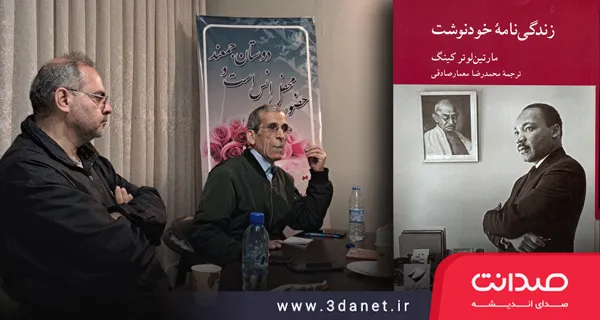
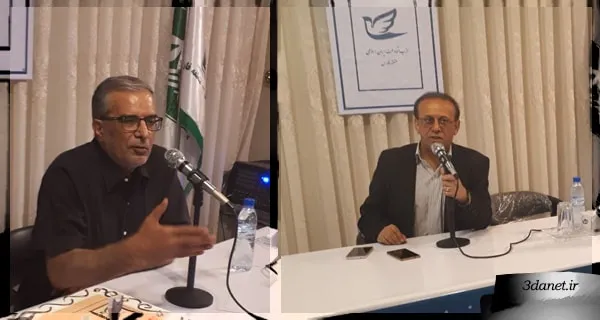
Saeed Dehghani (Etemad Newspaper | No. 5456 | Saturday, 19 Farvardin 1402 | Page 11): Individuals who have held political power and social influence yet chose the most effective path of non-violence to maintain their position have been rare in contemporary world history. "Nelson Mandela," "Mahatma Gandhi," and "Martin Luther King" are the most recognized figures for whom tolerance towards others, even serious opponents and enemies, was the fundamental principle of their conduct and decisions. These individuals all lived in the twentieth century; consequently, it has been many years since such role models have emerged in societies. Given that contemporary Iranian society needs a culture of non-violence more than ever, studying the lives of these individuals gains importance. The book "The Autobiography of Martin Luther King," as its title suggests, is one of the works that offers a precise, first-hand account of the life and thoughts of one of the foremost anti-violence figures. This book, published by Kargadan Publishing, was reviewed and discussed on Saturday, the twelfth of Farvardin, in a session attended by Mohammad Reza Memar Sadeghi, the book's translator. The Ettehad-e Mellat Party (Fars Branch) organized this session. The other guest at the session was Gholamali Keshani, who has translated several works on non-violence into Persian. What follows is a report on the speech by Mohammad Reza Memar Sadeghi, the translator of this book.
Mohammad Reza Memar Sadeghi, Translator of the Book | Martin Luther King never wrote a book titled an autobiography. So the question arises: how did this book come into being? A history professor at Stanford University, whose expertise is in the field of Black civil rights movements in the twentieth century, decided, at the suggestion of Martin Luther King's family, to collect and categorize King's writings. He began the work in 1998, and it took years to gather all of King's works into a collection of more than fifteen volumes. This collection of books was highly specialized and intended for individuals who aimed to study Martin Luther King's life. During the compilation of these works, this history professor defined several projects for himself that would also be of use to the general public; one of them was a play based on King's life. Another was this very book; what we read in this work is a collection of writings that King wrote about himself in various places, compiled into this book by this Stanford University professor. A biography of King in the Persian language has been absent from the Iranian book market. Although several biographies of this figure have been written in English, none have been translated into Persian.
As a child, King had a white playmate. After some time, the boy's father forbade him from associating with the black King. This very matter caused anger and resentment toward white people to arise in King's heart, but his father, who was a pastor, called him to turn away from anger. He told him that a true Christian does not nurture hatred within himself and even loves his enemy. Consequently, the background of Martin Luther King's tolerance took shape in his thought from childhood. He even came under the influence of Mahatma Gandhi, the spiritual leader of India, during a period of his life. Although later, in a speech, he had said that we Christians have Jesus, who is the model of forbearance. He became the civil leader of the Black movement by chance. In the city where he lived, he was among the few Black people who had pursued academic education to advanced levels. He had a doctorate in theology, and when Mrs. "Rosa Parks" refused to give up her seat to a white person, Martin Luther King was proposed to take on the leadership of the anti-discrimination movement. He himself had said that he was catapulted into the leadership of the anti-discrimination movement. They boycotted riding the bus for more than a year. Their nonviolent struggle continued until the U.S. Supreme Court ruled in their favor. This ruling brought worldwide success to the young King, to the extent that he received the Nobel Peace Prize at the age of twenty-eight. He later fought against poverty. For example, he rented a house in one of the poor neighborhoods of Chicago to grapple directly with the people's conditions of destitution. His lived experience in confronting poverty gave him strategies for combating this social ill. Or, during the period when America was embroiled in the war with Vietnam, he continued his activities in opposition to the war.
But what led me to translate this book? A few years ago, when activity on the Couchsurfing website was banned, I stood against this decision. For this reason, I ended up in Evin Prison, and it was in the ward where I was imprisoned that I became acquainted with this book. I began studying it at that very time and proposed its translation to the director of Kargadan Publishing, who also agreed with my proposal, and as a result, I translated the book.
.
.
Speech and Thought Sessions | Session 61
Introducing and Reviewing The Autobiography of Martin Luther King, Jr.
Mohammad Reza Memar Sadeghi (translator of the book)
Saturday, April 1, 2023
Islamic Iran Nation Union Party | Fars Branch
With the presence of Mohammad Reza Memar Sadeghi and Gholamali Keshani
Download the audio file of this session via direct link
Listen on Anchor | Spotify | Castbox
.
.


Discussion0 comments
No comments yet; let yours be the first voice.