Sociology
Introducing the Book “What Happened? The Story of Social Decline in Iran” by Mohsen Goudarzi
The book What Happened? identifies politics as the force that swallowed the economy and society, and charts the decline of social capital. At the launch event, sociologists critiqued its findings on the erosion of public trust and offered differing interpretations.
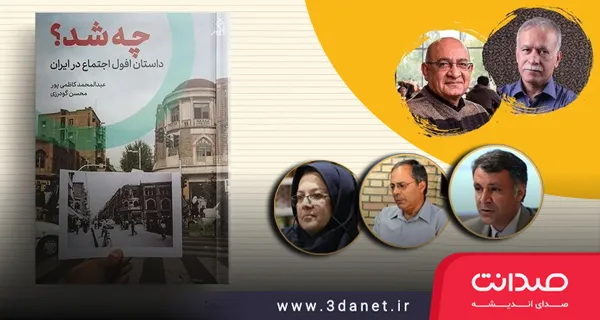
Introducing the Book “What Happened? The Story of Social Decline in Iran” by Mohsen Goudarzi
Mohsen Azmoudeh (Etemad newspaper): If we imagine society as a triangle composed of three sides—politics (the state), economics (the market), and the social (the people)—the authors of “What Happened?” believe that the story of the “decline of the social in Iran” is that the first side, politics, has swallowed and severely weakened the other two. In this book, Mohsen Goudarzi and Abdolmohammad Kazemipour have recently attempted, relying on existing statistics, figures, and surveys, to show why and how this situation has come about and, subsequently, what paths lie ahead for Iranian society depending on whether or not attention is paid to these conditions. This book has recently been published by Agar Publishing, and Shahr-e Ketab Tandis, in the first session of its series of discussion meetings about Iran, unveiled it with the presence of Dr. Mohsen Goudarzi, one of the authors, and several Iranian sociologists. What follows is a report on the speeches by Shirin Ahmadnia, Hossein Serajzadeh, Mohammad Fazeli, Abdolmohammad Kazemipour, and Mohsen Goudarzi at this meeting.
Watch the video of the discussion meeting on the book “What Happened? The Story of Social Decline in Iran” on YouTube | Aparat
Listen to the audio of the discussion meeting on the book “What Happened? The Story of Social Decline in Iran” on Castbox | Spotify
The youth are progressive and seek change
Shirin Ahmadnia, Sociologist| The authors, through a three-dimensional approach, demonstrate that building or destroying social capital is everyone's responsibility. In this book, drawing mainly on national studies and surveys conducted before and after the revolution, they present a picture of the current state of Iranian society, identify a trend, and show that indicators of social solidarity in Iran have been declining. In sociology, we have both quantitative and qualitative approaches. Therefore, one can use the data from this very book and show that other conclusions can also be drawn. In this book, the authors define social capital as the resources and possibilities embedded within the fabric of social relations that are utilized by individuals; in other words, social capital is a kind of asset derived from interpersonal relations in society. As individualism increases, this capital diminishes or is weakened and destroyed. Individual-centeredness is on the rise in many societies, and consequently, social capital in these societies is decreasing. Sociology, unlike psychology or medicine, which consider human beings as universal entities, is context-oriented and pays attention to social fields. Accordingly, when we consider the cultural, political, social, and religious context of Iranian society, we find that individualism in Iran, despite many similarities, differs from other societies. Therefore, the results of national surveys in Iran must be analyzed and interpreted in different societies according to their specific coordinates, and the logic of interpretation and the mechanism of analysis differ in various societies. When we take these differences into account, we then look differently at the statistical results concerning the decline of trust, the increase in lying, tax evasion, the rise in emigration, and so on, and we find that, in fact, we are facing a cohesive society with strong social capital, where individuals find each other very well, support one another, and form common fronts. Therefore, as an Iranian sociologist, one must consider Iran's events with different theoretical frameworks and models specific to Iran, and while gathering information and data, also pay attention to complementary and deeper research so that our investigations are more aligned with reality and the moral condition of society becomes clearer. For example, before today's events, it was said that the generation born in the 2000s is indifferent and unconcerned with society, but now we see that these very youths are pioneering and seeking change; or in interpreting the use of social networks, one must pay attention to different standards and the differences in the level, depth, and coordinates of society. Thus, we should not speak merely of the decline of social capital, and we can use the book's data in another way.
The Governance Model Must Change
Hossein Serajzadeh, Sociologist | Sociology is the science of civil society and the public sphere, alongside economics, which deals with the market and economic processes, and politics, which is focused on power and the state. The book discusses the decline of community in relation to the concept of social capital in sociology, considering how social capital is formed and the factors affecting it. The book has the structure of an academic work, but it lacks a section or chapter on methodology, and the authors do not provide an explanation of their method for analyzing data. Also, the book argues within a Durkheimian tradition, but a critical perspective on the concept of social capital is absent in this book. For instance, those who examine societal transformations from a conflict perspective are critics of the functionalist view. In the fourth chapter, the book attempts to present a picture of the decline of social capital in Iran and uses survey data for this picture. In one section, it addresses the level of associational activities, changes in the level of trust among people, and so on. These data show that from the first survey work on capital in Iran in 1974 until now, we are facing a downward curve. The authors conclude that we are facing a "widespread and deep crisis of public trust." I do not agree with the discussion of a social crisis of this intensity, and I believe that interpreting the data in another way is also possible, while especially in conditions of social movements or in conditions of natural disasters and major problems, different data are evident, and we are not facing a decline of capital and trust of this severity and intensity. We are facing a decline of trust, but not a widespread and deep crisis of public trust. In the discussion of participation and social bonds, it is interesting that from 2016, for which data exists, we do not see much of a decrease, because it seems that in the matter of participation, Iranian society has always had low participation. The authors do not make a definitive conclusion here that we are facing a crisis. Regarding religiosity, the book draws on Durkheim's theory, but in this model, it has not remained faithful to his theory. Durkheim, like other functionalists, considers three important components for religion: 1. beliefs, 2. rituals, 3. moral community. The discussion of the decline of community approaches the moral community. But Durkheim's emphasis is that rituals create, construct, and reproduce beliefs. In his view, the content of beliefs is not important; what is important are rituals, being together, having connections, being in a collective, and the moral community, which has a regulatory function. The theoretical model of this book emphasizes beliefs and places the focal point on them. Secondly, in the discussion of religion, Durkheim explicitly states that in modern society, religion loses its function for social solidarity, and alternatives and substitutes must be sought for it, and modern society creates these substitutes, so one should not be worried. But the book, while discussing modern society, still emphasizes the role of religion in social solidarity. The Durkheimian functionalist view neglects the negative role of religion in social solidarity in modern society. From Durkheim's perspective, in the pre-modern community, religion played a positive role in social solidarity and emphasized the similarity of all and a kind of mechanical solidarity, but in the new society, associations, unions, and guilds are the source of organic social solidarity, and religion no longer plays this role. Therefore, there is a need for a solidarity-building religion that does not have an identitarian, closed, and sectarian view. Such a religion can create social capital, strengthen connections between people, and recognize others beyond itself, and by this token, in Iranian society, a specific relationship is established between religion and the state, and the institution of religion has formed a state in the name of religion. This state has adopted a type and narrative of religiosity that corresponds to mechanical solidarity in Durkheim's account, that is, solidarity based on similarity and a kind of uniformity. While, of course, this is not all of religion, and narratives of religion can be solidarity-building in societal conditions, narratives that have a pluralistic view. Such narratives can be found in religious texts and sources. Whereas the approach of the established state in Iran is similarity and homogenization, which is suitable for the conditions of "community," while we are living in the conditions of "society." In my opinion, the decline of community in Iran began when the processes of modernization started in Iran and gradually expanded, that is, from around the 1950s, 1960s, and 1970s. In the new society, social capital must be formed in a way that is appropriate to societal conditions.
In Iranian society this capacity has emerged through the formation of NGOs, trade groups, and professional unions. But the main obstacle to the manifestation and emergence of these capacities is the approach of the state and the ruling establishment, which regards them as a threat to the “community” and a homogeneous society, and even considers them a security threat, as seen in the view toward scholarly associations, while unions are not allowed to form. Public trust, solidarities, and associational work in the political system take shape through the formation of parties, active political groups, and so on. The ground for social capital and associational activities must be laid under comprehensive conditions. In Iran, due to the special role of the state and the combination of a particular narrative of religion with the state, we witness the blockage of the growth of capacities that exist in society. Until this obstacle is removed, proposing other models is of no avail, because until a change occurs in the governance model, they will find no opportunity for effective emergence and manifestation.
The social capital between the state and the people is in decline
Mohammad Fazeli, Sociologist | In my opinion, the book’s title is conservatively chosen, and had it been me, I would have titled it “The Silent Revolution: The Process of the Decline of Reason.” The reason that governs societies is not a philosophical category necessarily found in books, but rather a balance, proportion, and relation among three facets: 1. Government, meaning political power, 2. The market, meaning the provider of material and resources for living, and 3. Society, the part that establishes emotional and human relationships. Politics and economics have a strong capacity for accumulation, but society has less capacity for accumulation. As a result, the first two spheres (politics and economics) can exploit and severely control the third sphere (society). Reason emerges at the moment when this third side (society) is able to somehow control and constrain the power that leads to violence from the other two sides, and those two sides cannot dominate the third side. Reason is the product of society’s control over power, and the decline of reason occurs when this control is not possible. The book is an account of how one side of this balance (society) has lost to the other two sides (politics and economics). In my view, however, the economic side in Iran has also lost to the political power side. The authors also explain how the economy in Iran has come under the domination of political power. In this respect, a silent revolution has occurred in Iran, comprising these elements: 1. The decline of the social capital of religion, in the sense that, firstly, its rituals have diminished, and secondly, the government has directly intervened in religion, causing a kind of devaluation of it. 2. The decay of morality, which, in a country with five decades of double-digit inflation, an increasing Gini coefficient, declining power of religious rituals, and a sense of humiliation, discrimination, and inequality, is a natural matter. Morality here, in the Durkheimian sense, is everything that regulates human relationships with one another. 3. Increasing inequality and economic poverty, especially after the sanctions of the late 1380s, which severely impoverished Iranian society, 4. Population displacement and migration. In sociology, there is a dispute between the Durkheimian-Putnamian school, which believes social capital is produced from the bottom up, and a group that believes social capital is produced from the top down and that efficient, fair governments create social capital. Bo Rothstein demonstrates this point about Swedish society in his book “Social Traps and the Problem of Trust.” In the book “What Happened,” it is said that “the building and destruction of social capital is not the result of only one part of society, namely governments alone, and the entire community plays a role in its construction and destruction,” but it then proceeds to argue in a way as if it is the government’s actions that have led to the decline of social capital, and economic poverty, inequality, population displacement, and migration are due to the low quality of governance. This book can also be read as a kind of elegy for Iran, because when we put its data together, we see that the decline of reason has occurred and the balance among economy, politics, and society has, in a long-term process, been disrupted in favor of politics, and society and the economy have been subjugated and defeated by politics, and that silent revolution has, in fact, now become illuminated since the fall of 1401. The best witness to the correctness of the book’s claims are the events of the past four months. When Durkheim, in the late nineteenth and early twentieth centuries, pathologized French society and showed that it had become anomic and abnormal, he proposed as a solution that this abnormality could be prevented by strengthening professional associations, unions, and occupational guilds. In “The Division of Labor,” he explicitly stated that morality is produced in the economic sphere. In Iran, from the Qajar era until now, politics has acted against any form of organization, including parties, unions, etc. The result of this situation is what this book narrates. We have two kinds of social capital: 1. Social capital in the people-government relationship, 2. Social capital in the people-people relationship. In the second type, we witness that in the face of natural disasters, people rush to help one another. But the social capital that heavily influences a country’s fate, especially in the short and medium term, is the degree of organization and the power of society to control the arbitrariness of the government, the power of society to manifest reason in relation to the state, the power of professional associations in the economic sector so that the government cannot destabilize the economy every day. The book should explicitly distinguish between these two types of social capital: people-people social capital and people-government social capital. Today we are witnessing that people-people social capital is being produced and reproduced in new forms, but what is declining is government-people social capital. That is, the social capital that determines Iran’s macro-destiny in the long run.
آن سرمایه اجتماعی که سرنوشت تمدنی و تاریخی ما را رقم میزند، نوع رابطه دولت و مردم است. نویسندگان در پایان مینویسند: «این انقلاب خاموش خبر خوبی برای جامعه ایران نیست، چراکه در نتیجه آن، این جامعه ظرفیت بزرگی را از دست داده است. ادامه این مسیر، ادامه حیات جامعه را به مثابه جامعه مختل کرده و امکان کارکرد آن به مثابه یک ملت-دولت را روز به روز بیشتر تحتالشعاع قرار میدهد.» کتاب روایت خوب و هشداردهندهای از ایران است. برای مثال مینویسد: «در جایی که فقط منفعت حاکم است، از آنجا که هیچ مهاری بر خودپرستیهای موجود در کار نیست، هر «من»ی در برابر «من» دیگر در حالت آمادهباش جنگی است.» در فقدان جامعه زور و پول بر همه چیز غلبه میکند. یا مینویسد: «نهادهای نظم و قانون زمانی میتوانند در تقویت سرمایه اجتماعی نقش مثبت داشته باشند، هم کارآمد باشند، هم مبتنی بر انصاف عمل کنند»، همچنین مینویسد: «پدیده انقلاب در ماهیت خود گسترش نفوذ و قدرت دولت را در پی دارد، هر انقلابی برای آنکه مقاومت نظم پیشین را از میان بردارد و مخالفان خود را سرکوب و پایههای خود را تقویت کند، به ناچار به دستگاه دولت و ابزارهای اعمال قدرت متوسل میشود، بینظمی حاصل از انقلاب هم به این نوع عملکرد وجاهت و مشروعیت میدهد.»What Kind of Society Is Iran?
Mohsen Goudarzi, Sociologist | In writing the book, we examined several models: 1. A report published in the 1980s in the Soviet Union to examine developments over seventy years in the spheres of industrial production, society, the family, and so on. This report appears in the introduction to the book World Armed and World Hungry by Willy Brandt, translated by Hormoz Homayounpour. Due to its alarming content, this report was published as an anonymous statement. The statement said that reforms were still possible based on the teachings of socialism and that this could change the fate of the Soviet Union. It was rumored that Gorbachev himself was among the report's authors. The group of writers had not mentioned their names for fear of the Communist Party. 2. Another model is a report published in the late 1960s and early 1970s by Messrs. Shapour Rasekh and Jamshid Behnam in a book titled An Introduction to the Sociology of Iran. In that book, they explain that monographs were prepared with the aim of understanding Iranian society at the Institute for Social Studies and Research of Iran, and in their book, they strive to narrate various sectors of Iranian society such as the family, the village and countryside, leisure activities, stratification and classes, and so on. Following this logic, we too have tried to present a synthesis based on empirical data on the transformations of Iranian society and to emphasize that these discussions are a collection of information produced within the country. These data are not only quantitative; we have cited survey and polling data, as well as information from the Statistical Center on censuses, the Gini coefficient, and so on, and in cases where we lack information, we have turned to fields such as cinema, literature, poetry, and books to gain an overall picture of the transformations in Iranian society. Consequently, we have endeavored to create a frame to grasp the main trends in Iranian society and to answer the question: what kind of society is Iranian society? We are all grappling with the issues raised in this book, asking ourselves and others what is happening in this society and where we are heading. Why does everyone feel that we are not well? This book can perhaps provide meaning for these questions. Thus, this book is an invitation to make sense of individuals' experiences. As Dr. Masoumi Hamedani writes in his recently published book, The Ethics of Writing, this book is written "for those who write," and these individuals are always faced with four questions: 1. What do they write about? 2. Why do they write? 3. For whom do they write? 4. How do they write? I will address the present book within this framework. Firstly, the book is about community and social capital. Of course, we have not considered community in opposition to society. We have considered community to mean a group of individuals who share common values, goals, and ideals. But why have we focused on the transformation over several decades? Many surveys now provide a general picture of Iran today. However, in this book, we have tried to show why the situation has become this way. Certainly, this situation has occurred gradually and, in Saadi's words, "over days," and it will be resolved "over days" as well. We also tried, for the coherence of the discussion, to view it within a three-dimensional model, that is, a triangle whose three sides are: politics, economy, and community. From our perspective, this triangle works when it is balanced, and when one side is weak, an empty space is created. That empty space is filled by the other two sides. Our argument is that the community side in Iran has weakened, and the politics and economy sides have filled its empty space. The politics side has even become so prominent that the economy side, in the sense of the market, has also weakened. We wrote the book for a general or public audience, meaning an educated audience that has not studied sociology professionally, and for this reason, we tried to choose a relatively simple, clear, and direct language and avoided entering theoretical discussions in the sociological sense so that it would be engaging for a non-sociologist audience as well. Of course, the book has a specific theoretical perspective, but we tried to express this theoretical perspective in the conventional forms of sociological texts. Finally, the form and the how of writing the book is a kind of response to the book's problem. During the COVID era, Dr. Kazemipour and I had online contact and held discussions, and the idea for the book was raised. We agreed to talk once a week, and these sessions sometimes lasted several hours. We would prepare texts and read and edit them together in the sessions. We wrote the book twice to finally arrive at the final version.
خود فرم نوشتن یعنی همکاری و مشارکت به این شکل پاسخ به مساله کتاب هم هست. یعنی این فرم همکاری و مشارکت هم به ما کمک میکند.
Discussion0 comments
No comments yet; let yours be the first voice.