Philosophy
Is Boredom a Good Thing?
Contrary to the belief that boredom spurs creativity, neuroscientific evidence shows that what occurs in idle moments—like in the shower—is mind-wandering, not boredom. Distinguishing between these two states and understanding the role of mind-wandering in creativity matters.

Is Boredom a Good Thing?
Peter Toohey
Translated by: Iman Motlagh Arani
In a New York Times piece titled “Let Children Get Bored Again” (2019), Pamela Paul suggests that allowing children to experience boredom is a good thing. It activates the creativity of novices:
“When you are truly engaged with the mind-numbing effects of boredom, you place yourself on the path of discovery.]…[ That is why so many useful ideas come to mind in the shower, when you are captive to a material activity. Allow your mind to wander for itself and go wherever it wants.”1
Pamela Paul also argues that boredom makes children tougher: “Certainly, teaching children to tolerate boredom, rather than escalating amusements, prepares them for a more realistic future, one who has no undue or mistaken expectations of work or life in its true sense.”2
This is an appealing argument on both counts, but especially regarding creativity. Boredom is often linked with creativity. The poet Joseph Brodsky sometimes said so, providing strong evidence for its fecund properties, and perhaps Pamela Paul had him in mind when writing her article. In his essay “In Praise of Boredom,” Brodsky claimed:
“When hit by boredom, let yourself be crushed by it; submerge, hit bottom. In general, with things unpleasant, the rule is: the sooner you hit bottom, the faster you surface. The idea here is to take a full look at the worst. The reason boredom deserves such scrutiny is that it represents the tedious splendor of the unnecessary repetition of pure, neutral time.”3
A defense of boredom’s capacity to foster creativity has also been made by WNYC podcaster Manoush Zomorodi in Bored and Brilliant: How Boredom Can Spark Your Productivity and Creativity (2017).4
But do boring activities foster creativity, as Brodsky, Paulo James, and Manoush Zomorodi say? There is news, and the devil is in the details beyond the general formulations; yes, it does, no, it doesn’t. So we must examine the details, even if the subject is, at first glance, as soothing as taking a shower.
Since when has taking a shower been boring? I mean this seriously. I love taking showers. The longer, the better. I cannot imagine thinking of showering as a boring affair. Surely I am not the only one who thinks this way. On the other hand, I agree that the shower can be an excellent place for activating creative ideas – it might even be accurate to say that the shower is a good place for solving problems, if solving problems is more or less the same as creativity. I had read that Gabriel García Márquez, the most famous Colombian novelist and Nobel Prize winner, said he took long showers and under the shower imagined and discovered his magical realist plots.5 David Streitfeld explains that “it is said that his (Gabriel García Márquez’s) showers were so long that he had to turn on the water heater twice.”6 Streitfeld continues: “The details (for his novels) come to him quickly, and he jumps out, slicks his hair down with shampoo, and rushes to his desk.”
Perhaps what inspired this novelist was a kind of advantage that Pamela Paul believed accrued to the child who is a victim of boredom, or at least when they are taking a bath. But before we jump to conclusions, I believe we really need to have a clearer understanding of the emotional state that might develop as a result of showering. What enabled Gabriel García Márquez to develop his ideas? Was it really boredom that caused him to be inspired while lathering up in the shower? Surely that was not the case. Could it stem from another feeling or emotional state? Was he daydreaming and fantasizing? I don’t know about you, but I daydream a great deal in the shower, provided the water is hot enough. Many people have told me they don’t daydream much, just as they don’t think about anything at all. Their minds gradually become inactive. Could it be that the great Colombian, like the rest of humanity, was daydreaming in the shower? Could it be that in the midst of those daydreams he was hoping a solution to the twists and turns of his plots would emerge? So daydreaming instead of boredom?
What really convinces me that daydreaming is the agent responsible for creativity in the shower is this: there appears to be known neurological evidence showing a link between daydreaming and creativity. This may help in understanding the finer point about showering and daydreaming. In 2009, Dr. Kalina Christoff of the University of British Columbia, according to UBC News, “found that our brains are much more active when we daydream… The brain areas thought to be involved in complex problem solving –previously thought to go dormant when we daydream– are in fact more active than when we focus on routine daily tasks” (see also Christoff et al. 2009). Before Christoff published her findings:
The only parts of the brain that seemed to be active when our minds were wandering were the medial prefrontal cortex (PFC), the posterior cingulate cortex, and the temporoparietal junction. However, these studies show that regions associated with complex problem solving, including the PFC and the dorsal anterior cingulate cortex (dACC), become active during daydreaming. (UBC News 2009)
Here a solution is offered for all sorts of creative questions that arise while bathing. The most valuable explanation for Gabriel García Márquez and Pamela Paul, who had such good ideas about showering, is that they were daydreaming while bathing. Daydreaming aids intractable creative problems, and the bath is the best place for some people to daydream. Intellectual success in the bath, if Christoff is right, may not be so much a matter of boredom as it is a matter of daydreaming. 6
Neuroscientists have carried out a greater number of such studies since 2009. The focus, however, was not on daydreaming and what happens in the brain when the body and mind are idle or in a state of “restlessness”—think again of those people who tell you not to daydream too much in the shower, just as you shouldn’t think about anything at all. Deniz Vatansever and the team at the University of Cambridge “focused their attention on the brain when it is not doing anything.” (James 2008; see also Vatansever et al. 2017) To achieve this, they turned their attention to regions of the brain known as the “Default Mode Network” (DMN). These areas, acting as coordinators, are highly active when people are in an inactive state. In such cases, “the brain is very active in the background, but it is not doing any specific task.” (James 2018) Vatansever and his colleagues, by considering these research questions and carrying out a new card game, reached certain conclusions. They observed that “when people move from learning the rules of the card game to applying the rules of the game, the DMN begins to activate.” (James 2018) Deniz Vatansever explains what happens in the DMN at such moments: “We may try to explain (make sense of) the world around us using what we already know.” (James 2018) The Cambridge team does not use the term boredom in their paper to describe these inactive states. Vatansever points to (2017, page 12825).
This active framework of brain function may provide an important scaffold for explaining not only the sustained activity of the DMN under stable “resting” conditions, but also its contribution to social interactions (such as theory of mind, intuition, and stereotyping), a conscious understanding of the self, creativity, and a variety of other cognitive domains, all of which rely on the sustained use of learned information to predict the world around us.
Creativity, therefore, may be linked to these inactive states just as it is linked to the daydreaming proposed by Kalina Christoff. In this case, there is no need at all to invoke the feeling of boredom. Daydreaming and idle or inactive states are not the same as boredom. However, daydreaming and inactivity can sometimes be associated with boredom. There is no particular reason to claim that daydreaming and inactivity are boring. Many people daydream while enjoying themselves in other circumstances, but unchangeable situations do not require much mental struggle: jogging, walking, playing with children and animals, waiting to fall asleep, or waiting for a friend you love dearly to share a coffee together. I have read that most people spend 46.9% of their working time daydreaming (BBC News; see also Killingsworth and Gilbert). If this is true—which I admit is hard to accept in its entirety—then for some of this time, many people may be bored and may use daydreaming as a remedy for boredom. But for much of this enormous amount of time, they may be daydreaming happily. They may also be relatively inactive (taking a shower, having a sauna, attending a routine meeting or work conversation). Do you daydream and become inactive when you are bored, or do you daydream because it is pleasing, useful, and even enjoyable? In my view, both answers are correct. When Pamela Paul praises the opportunities that arise from boredom, perhaps she really ought to praise the opportunities that arise from daydreaming and being inactive.
Let us take this discussion a step further and turn our attention to boredom. Many of the current concerns about the relationship between boredom and creativity stem from the use of smartphones.7 The argument seems to be that everyone devotes so much of their time to checking their phones that they have no chance to experience the kind of boredom that is useful and creative. This is the very subject Jason Farman has pondered. His thoughtful book, Delayed Response: The Art of Waiting from the Ancient to the Instant World (2018), is a study of waiting and modes of communication. Farman tells us of one of his experiences with his students, the conventional interpretation of the link between boredom and mobile phones. I asked [the undergraduate students]:
to diagram a week of their semester from the moment they wake up until they go to sleep, showing what they have done. What the students in this class of thirty-five had in common was that there was not a single minute when they did not keep themselves occupied with something… Even when standing in line, they are checking messages or email or playing with their phones. If boredom lurks around the corner, these students take another path by keeping themselves busy, and if they are not “entertained” by doing their tasks or reading the news on websites and social networks, they pass the time playing with their phones. (2019, p. 13)
We might conclude “let children be bored again” but – is that boredom – deprivation not an issue? Could it be that Jason Farman’s undergraduate students severely deprived themselves of the 46% of the day they were said to spend daydreaming? Now he realizes what this strange and even foolish claim that the smartphone prevents productive daydreaming might mean. But then linking smartphone use with boredom-deprivation and increased stupidity is also quite idle and meaningless. Surely many of Jason Farman’s students at New York University are A-grade candidates and are not at all stupid when it comes to creativity or problem-solving. My point has nothing to do with the human need for daydreaming, which may or may not be true, or with the human need for boredom, which may or may not be true. To put it more simply, the confusion between boredom, daydreaming, and inactivity shows that when people refer to boredom in their writings, they often do not have a clear definition in mind of what they mean by boredom, daydreaming, or even inactivity. Let me quickly add that I am not always sure what I mean by boredom either. But I do not intend to claim that it is one of the great virtues and unspoken properties of life. The devil is truly in the definition. If we knew how to define boredom and if we all agreed on that definition, then we might know whether it is a good thing to be bored or whether it is not, in fact, so. From the definitions, it is clear that boredom is not always seen as a great intellectual unifier. I will highlight just three of these definitions and then add my own explanations. In my view, John Eastwood and Tim W. offer a quite widely accepted definition: boredom is “an aversive state of being unable to engage in satisfying activity” (2012, p. 483). Perhaps understanding that this, as well as describing a feeling of impotence, is part of boredom, Eastwood refines his definition in this collection as follows: “Boredom… is a companion of the aversive feeling of ‘unused cognitive potential.’” John Eastwood believes that boredom is a “regulatory alert for the presence of a cognitive deficit and helps steer us toward meaningful engagement and the fulfillment of critical necessities.” You can quote that boredom is an unpleasant state that drives its victim toward productive activity to remedy this unpleasant sense of dysfunction and this cognitive deficit. Thus, Eastwood’s formula is the opposite of those who consider the experience of boredom valuable in itself.
For James Danckert, “boredom may provide a signal to switch between exploration (scanning one’s surroundings to discover resources) and exploitation (utilizing those resources once found)… boredom may function to minimize opportunity costs.” The element of “aversion” is still important. The unpleasantness of the boredom experience compels its victim to engage in productive action to pursue available utility. But it is worth noting that it is stressful; most organisms do not need to experience boredom in order to explore and exploit their circumstances.
The third definition is from Van Tilburg and Igou, who link boredom to “the search for meaningful engagement.” This search is activated by the aversive nature of the feeling of boredom. Van Tilburg has written another interesting article titled “Eat with Boredom: Consuming Food to Escape the Awareness of Boredom.” The connection of boredom with food and with disgust and satiety has a very long lexical and visual history. A 2,000-year-old Latin term for boredom is “satietas vitae,” satiety of life. (Seneca 1970, sections 24 to 26) I think the point is that boredom is recognized as a highly unpleasant state. This is not equivalent to saying we necessarily have aspirations for our children.
Perhaps I can dwell a little longer on the link between satiation, disgust, and boredom proposed by Van Tilburg, and in doing so, offer a fourth account of boredom. This will provide another example of the aversive nature of boredom and will also involve having a child, or having a child nearby, as part of the picture. I will take this description from the painting La tailleuse de soupe by the Swiss painter François Barraud (1899–1934). The features are those of his wife Marie, on the right, and his younger sister Louise on the left of the painting.9 The subject of the painting translates to "The Soup Cutter." The cutter is Marie, and she is cutting bread into her and her sister's soup.10 Marie appears to enjoy performing her task. Louise, dressed in the style of girls of that time—the 1920s—and with a bow in her hair, is not at all pleased. In my view, she is bored. Indeed, in my view, she is the epitome of what you might call the classic visual phenotype for boredom.
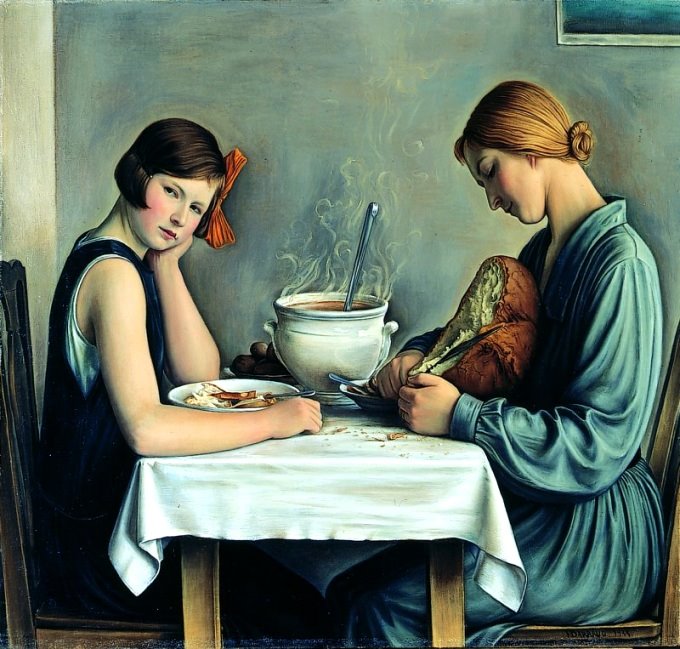
The six characteristics that follow can often be found in visual representations of boredom. You only need to see three of these characteristics. Disgust and satiation are also prominent in this landscape of aversion.
1- Food may be prominent (the bread in the soup, which seems to offer not even the slightest pleasure to the young girl) and often appears to provide little enjoyment for the bored individual.
2- The bored person's head is usually resting on the left palm, indicating the head is tired. (This gesture is as old as ancient Greece; if the person is right-handed, the head rests in the left palm, leaving the right hand free to do nothing of importance! If the head rests in the right hand, you are probably looking at a painting about depression!) Louise's right hand is free.
3- The manner of standing or sitting, a slouch when walking or sitting, leaning on an elbow, reacting to what has just happened. Boredom is about a specific, constraining situation in the present moment. Depression shares some of these gestures, but looks at something fixed, something not confined to a specific situation. Louise is reacting to what is happening now.
4- A temporary feeling of being trapped or under pressure is evident—this is common and shared in many of our experiences of boredom. You cannot escape it—at least not right now. Louise truly feels she wants to escape from her sister and the soup.
5- The bored individual is often painted alone, but if in company, they are staring at something beyond or past their company, which is colloquially referred to as staring into the (northern) horizon (Louise is staring at us—but we do not count ourselves as someone in the painting. She is not looking at her sister, la tailleuse (the cutter).
6- Yawning—this is not present in La tailleuse de soupe, but as one might expect, it is a common response to boredom. However, it is not something easily painted or photographed. People consider it a repulsive and ugly act.
As mentioned, to evoke the visual phenotype of boredom, you need several indicators such as surface, a staring gaze, and food. One indicator is not enough. Without several other clues, a sad face says nothing remarkable. Franz Xaver Messerschmidt sculpted many character heads of beautiful figures with various emotional states. But without a phenotypic context, they can be confusing. In Francis Berrard's painting of his wife and sister-in-law, he evokes boredom using five of the six pictorial clichés I mentioned above. If there were enough space, I could show you many comparable examples. What they all had in common was an embarrassing emphasis on the nature of boredom, relying on displeasure with an experience and its temporary limitation. However, there is no stillness in this evocation, and no daydreaming either. What exists instead is an emphasis on the unpleasantness of the experience—although what is evoked from Louise, we can never know for certain. It might be triggered by food. Perhaps she does not like the bread in her soup. The embodiment of these feelings offers a set of interpretations of the idea of "let children be bored." Louise is our own child. Leaving her to her own devices when she is bored is the last reaction you would want to give that adolescent in this image.
Boredom has little to do with daydreaming and creativity. Its link to creativity, bolstered more by enthusiasm than evidence, is exaggerated, and for what it's worth, boredom may not take as great a toll as excessive mobile phone use. That is probably daydreaming. Although there seems to be no cut-and-dried method for defining emotions, the concept of aversion is what emerges in various attempts regarding the task of vocabulary. Boredom is an unpleasant feeling to endure. Those who suffer it will do whatever they can to escape it. If any benefit is attributed to the experience of boredom, it is because its victims try their utmost to flee the experience and move toward something worthwhile (Mr. Danckert's point). The solution they find may or may not be creative; it only needs to be successful. I am sure this is what Louise would tell you. Perhaps I can offer another method and again use the image of Gabriel García Márquez. An unpleasant childhood is often associated with literary ability and literary creativity. I doubt anyone in childhood would choose literary excellence over being happy. Gabriel Márquez might be grateful for the hard times of his childhood that led him to climb the steps of the Nobel Prize in Stockholm in 1982 when he was 83 years old. Perhaps he was truly grateful for the opportunity presented by his mother, father, grandfather, and grandmother, who left him when he was just a little boy in Aracataca, Colombia. But it seems that for most of his life, he wished his parents had made a different decision than the one they did. Perhaps you can think about boredom in the same way. If it is true that it is linked to creativity (all the people I know who did not have a pleasant childhood were more prone to boredom), then they procured this grace at another's expense. Lars Svendsen's examination of animal emotions will review the possibility of boredom in animals (and other feelings). If animals also get bored, it tells us little about the connection between boredom and creativity. Like anything painful, boredom is a feeling that demands improvement and relief. In my experience, the most sublime boredoms are the very young and the very old. Their boredom, you could say, is a request for help, a relief that is not always as easily provided as it should be. I am not so sure that we should "let children be bored again." Whatever is truly boring is something whose purpose is to remove the person from the situation they find themselves in and guide them toward a more productive activity. It is not a feeling or an emotional state to be used as a vehicle for "Love in the Time of Cholera."
Final essay: Is the experience of boredom difficult for children? Who can say? I think someone who takes their job as a parent and teacher seriously, to teach children how to cope with boredom. I emphasize to teachers as well as parents, now that education is increasingly trending toward STEM (Science, Technology, Engineering, and Mathematics) instruction, children's ability to deal with boredom may be severely tested, especially if their instruction is general. After all, learning to cope with boredom is an important life skill; how else could you finish a doctorate? Perhaps the best way to prepare children to deal with the inevitability of boredom in working life is to teach them how to treat themselves using palliatives like daydreaming. This may improve creativity in problem-solving and give them something to do when they are bored. Who with a sound mind would want to be bored?
.
.
References:
1) BBC News. (2010, November 12). People spend ‘half their waking hours daydreamin’. BBC News. https://www.bbc.com/news/health-11741350. Accessed March 20, 2019. 2) Brodsky, J. (1995). In praise of boredom (adapted from Dartmouth College commencement address). Harper’s Magazine, 290(1738), 11. 3) Christoff, K., Gordon, A. M., Smallwood, J., Smith, R., & Schooler, J. W. (2009). Experience sampling during fMRI reveals default network and executive system contributions to mind wandering. PNAS, 106(21), 8719–8724. https://doi.org/10.1073/pnas.0900234106. 4) Eastwood, J. D., Frischen, A., Fenske, M. J., & Smilek, D. (2012). The unengaged mind. Perspectives on Psychological Science, 7(5), 482–495. https://doi.org/10.1177/1745691612456044. 5) Farman, J. (2018). Delayed response: The art of waiting from the ancient to the instant world. New Haven, CT: Yale University Press. 6) Godwin, C. A., Hunter, M. A., Bezdek, M. A., Lieberman, G., Elkin-Frankston, S., Romero, V. L., et al. (2017). Functional connectivity within and between intrinsic brain networks correlates with trait mind wandering. Neuropsychologia, 103, 140–153. https://doi.org/10.1016/j.neuropsychologia.2017.07.006. 7) Hoffman, E. (2016). Creative play. How to be bored (pp. 149–156). New York, NY: Picador. 8) James, V. (2018). On boredom. CAM (Cambridge Alumni Magazine), 84. https://www.cam.ac.uk/cammagazine/benefitsofboredom. Accessed March 20,2019. 9) Killingsworth, M. A., & Gilbert, D. T. (2010). A wandering mind is an unhappy mind. Science,330(6006), 932. https://doi.org/10.1126/science.1192439. 10) Lagan, B. (2019, March 4). Long showers banned as Australia’s dry spell worsens. The Times. https://www.thetimes.co.uk/article/long-showers-banned-as-australia-s-dry-spell-worsens-ntv8jzfd8. Accessed March 21, 2019. 11) Mann, M. (2017a). Yawn: Adventures in boredom. New York, NY: FSG Originals. 12) Mann, S. (2017b). The science of boredom: The upside (and downside) of downtime. London, UK: Hachette. 13) Maushart, S. (2011). The winter of our disconnect. London, UK: Profile Books. 14) McCall, R. (2017, October 25). A new study says daydreaming is a sign of creativity and intelligence. IFLScience. https://www.iflscience.com/brain/science-says-daydreaming-is-asign-of-creativity-and-intelligence/. Accessed March 21, 2019. 15) Moynihan, A. B., Van Tilburg, W. A. P., Igou, E. R., Wisman, A., Donnelly, A. E., & Mulcaire, J. B. (2015). Eaten up by boredom: Consuming food to escape awareness of the bored self. Frontiers in psychology, 6, 369. https://doi.org/10.3389/fpsyg.2015.00369. 16) Paul, P. (2019, February 2). Let children get bored again. New York Times, p. SR3. 17) Seneca. (1970). Epistles 1–65. Cambridge, MA: Harvard University Press. 18) Streitfeld, D. (1994, April 10). The intricate solitude of Gabriel Garcia Marquez. The Washington Post. https://www.washingtonpost.com/archive/lifestyle/1994/04/10/the-intricate-solitude-ofgabriel-garciamarquez/4b20cf31-5ac5-4726-89e5-de30f8c7c70a/?noredirect=on&utm_term=.ff60dd4f157b. Accessed March 21, 2019. 18) University of British Columbia. (2009, May 12). Brain’s problem-solving function at work when we daydream. UBC News. https://news.ubc.ca/2009/05/11/archive-media-releases-2009-mr-09-054/. Accessed March 20, 2019. 19) Vatansever, D., Menon, D. K., & Stamatakis, E. A. (2017). Default mode contributions to automated information processing. PNAS, 114(48), 12821–12826. https://doi.org/10.1073/ pnas.1710521114. 20) Zomorodi, M. (2017). Bored and brilliant: How spacing out can unlock your most productive and creative self. NewYork, NY: St. Martin’s Press.
.
.
Peter Toohey was born in Seymour, Victoria, and taught for many years in his native Australia, at the University of New England in Armidale, New South Wales. He is currently Professor of Classics in the Department of Classics and Religion at the University of Calgary, Canada. He studied at Monash University in Melbourne, Australia, and at the University of Toronto. He is particularly interested in the nature, representation, and history of difficult emotional and physical conditions, how people cope with them, and how individuals sometimes turn them to their advantage. His recent works include Jealousy (Yale University Press, 2014) and Boredom: A Lively History (Yale University Press, 2011). He is also the author of academic articles on boredom, such as “Some Ancient Ideas on Boredom” (Illinois Classical Studies, 1988) and “Acedia in Late Classical Antiquity” (ibid., 1990). His works have been translated into seven languages and he is cited worldwide. He is considered one of the leading figures in the field of boredom.
.
.



Discussion1 comments
pattern الگوی تکرار شونده فلاسفه ، روشنفکران و به طور کلی academics افراد دانشگاهی کشور شما: Some foreigner said something....then ...something is right. اگر از آغاز تا کنون صدانت را هم مطالعه بفرمایید متوجه می شوید که همه مطالب با گزاره ای از یک فرد extra terrestrial از عالم آسمانی شروع می شود. این انتحال به همنین جا ختم نمی شود بلکه هر پاراگرافی echo بازطنین speculation گمانه ها و حدسهای یک فرد است که باید خارجی باشد. هیچ وقت این speculation ها به محک تجربه (بخصوص غیر مؤید) و تحلیل انتقادی گذاشته نمی شود.