Philosophy
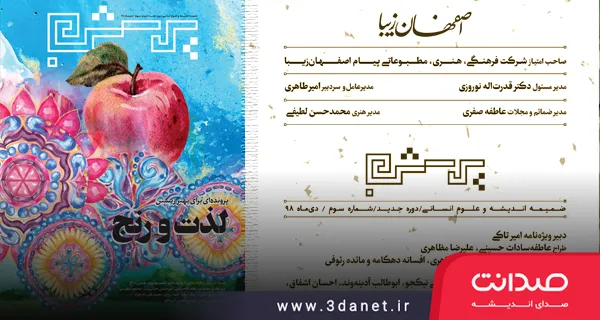
Isfahan-e Ziba Newspaper's Special Issue: A Dossier for Hopeful Living
Hope is not a political slogan, but a vital parameter in an idealistic, identity-forming human life. By examining this concept from multiple angles, the special issue of the Isfahan-e Ziba newspaper's Daily Question takes a step toward realizing a transcendent human existence.

The Movement of Hope, Amir Taki: The subject of this special issue is hope: hope not from the perspective of a political or electoral slogan, but as a crucial parameter in an idealistic human existence. Hope is not our slogan; hope is our very way of looking at life and constitutes our individual and collective insight and identity. Can one speak of humanity and humaneness while ignoring the concept of hope? The previous issue of this special dossier concerned the meaning-oriented life of human beings, which we examined in various dimensions, proposing that a person who sees life beyond materialities and the complex appearances of this world seeks a meaning to give significance to their movement through life. They find a goal and an ideal and chart a path toward it. Now, the crucial element in achieving the goals of this path is "hope." This hope is what makes us steadfast in our identity and empowers us to fulfill our historical and human responsibilities.
Some thinkers believe that faith is more a matter of hope than of certainty. In fact, a person who gives meaning to their life and sets a goal for it gradually develops faith in that goal and meaning. This faith is their inner safe harbor for walking beside the tumultuous sea of the times. Their faith in their ideals, their values, and their meaning-laden existence is, in reality, hope in the truth. They are hopeful that their path is correct and that its future and end will be as they have envisioned it; thus, from this perspective, the answer to some of the questions surrounding faith becomes attainable, and faith is not seen as something extraordinary.
The social manifestation of hope is another important aspect of this great concept. Regarding the great movements and uprisings that have formed throughout history and guided people toward determining their own social destiny, one can powerfully say that without the presence and role of hope, they would not have become destiny-shaping. If this vital factor had not flowed through the veins of history's transformations, especially in those upheavals arising from popular uprisings and emerging from the lower strata of human societies, the achievement of success and victory might never have been possible. For greater clarity, one of the best examples in the last century is the anti-colonial and anti-exploitation movement of India led by that great figure of history, Gandhi.
India has a strange history of occupation and exploitation. Despite centuries of occupation and foreign domination, as well as the abundance of diverse schools of thought and religions within it, this land, with the banner Gandhi raised, ended centuries of domination. Perhaps the people of India could not believe that they would one day be able to free themselves from these successive seizures by various tribes and nations; but Gandhi, besides being able to expand the meaning of freedom for them, made hope for a bright future centered on a free India flow and permeate among them. Gandhi is the epitome of humane living, human solidarity, hope, and the peace-seeking movement. What more does an ideal society need? Gandhi's ethical, peace-seeking, and ascetic movement was able, over several years, to free India from the yoke of centuries of captivity.
Studying Gandhi's movement and the hope he held for his path and goal for India is one of the best subjects of study for the topic of hope. His movement of hope encompassed various parameters: it promoted peace and non-violence while simultaneously insisting on freedom and liberation from materialities and the oppression of rulers; it advocated solidarity while recognizing the plurality of human cultures and beliefs in society; and it cultivated social responsibility in minds. Altruism, sacrifice, and patience were all components of Gandhi's movement of hope. With all these tools, he miraculously managed to make the potential capacities of the Indian people flourish and guide human society, with all its colors and differences, onto a transcendent and identity-oriented path. He succeeded, and the world was astonished by his success; even the English colonizers were left agape, amazed at the extent of human power, even with empty hands and bare feet, but with a backpack full of hope. May God have mercy on the great Gandhi.
Hope lays the groundwork for the realization of other important components in society. Justice, growth and flourishing, welfare, social capital and trust, life satisfaction, and so on are crucial matters that, if actualized, will make development attainable. In this issue of the special dossier, we will examine hope across various social, economic, cultural, philosophical, mystical, theological, environmental, and other domains, with the participation of renowned and brilliant professors and thinkers, in order to perhaps take a small step on the path toward the development of a transcendent human existence. God willing.
.
.
The Question Special Dossier of Isfahan-e Ziba Newspaper; A Dossier for Hopeful Living
Featuring writings and talks by:
Saeed Madani- Naser Mahdavi- Hossein Dabbagh- Abbas Abdi- Ali Sarzaeem- Mohammad Dehghani- Rahman Ghahremanpour- Javad Heydari- Saeed Edalatnejad- Mohammad Ali Dadkhah- Asgar Ghahremanpour- Ali Zamanian- Milad Nouri- Mohammad Darvish- Mohammad Reza Yousefi
.
.
Download the PDF file of the Question Special Dossier:
.
.





Discussion1 comments
سلام بسیار ارزشمند