Philosophy
A Dossier on Pleasure and Suffering: Supplement to Thought and the Humanities, Isfahan-e Ziba Newspaper
A good life and well-being depend on a sound interpretation of pleasure and suffering—from the tension between individual and public interest to the role of idealism in warding off meaninglessness. This dossier examines the rational boundaries of pleasure and its relationship to personal and social development.
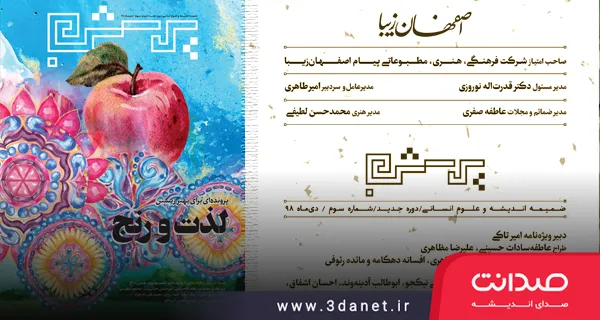
What we will address in this issue of the supplement is the concept of pleasure and suffering in life. This subject is important because human life throughout history has been indebted to the way we view and interpret the good and well‑ending life; in fact, the articulation of a way of life in which happiness finds meaning and the human being attains what they desire. The good life and well‑being, in the sense of living well, possess various components that numerous philosophers and thinkers have sought over the course of history. Since the ultimate end of life, together with the manner of living, has usually been a human preoccupation, the attainment of tranquility and the highest degree of improvement is also the source of its attachments.
Now, this pleasure and suffering encompass diverse varieties; from the material dimension to the spiritual and supramaterial dimension. Some have considered the meaning of pleasure to lie in obtaining the desirable blessings of the human being, and some regard the acquisition of spiritual degrees and inner tranquility as true pleasure. In the category of suffering as well, some deem any kind of suffering reprehensible, and some consider it necessary and essential for attaining higher degrees of gnosis and truth. In fact, human beings, in the goal they delineate for themselves, seek benefit, comfort, and satisfaction. These states are the other side of the coin of pleasure. Hence, a precise examination of this subject acquires great importance insofar as it is connected with the purpose of human living. The definition and interpretation of suffering and pleasure constitute the ground of the concepts and the principal foundations of human life. That the human being always seeks pleasure is undeniable. But one of the propositions under discussion is the type of this pleasure and the manner of obtaining it. Various ideologies and schools have set about delineating the ideal society. Naturally, these ideal societies are shaped in accordance with the highest human desires, and this means obtaining greater benefit and pleasure for the human being. By placing the semantic symmetry of benefit, profit, and advantage alongside pleasure, one can better grasp the depth of the analytical need for this proposition. One of the points that must be addressed is the definition of suffering and pleasure in the new century and an examination of the situation in which contemporary human societies find themselves with respect to it. Have they drawn closer to greater hedonism? Toward which kind of pleasure have they shown a greater inclination?
The conflict between individual utilitarianism and public and collective interests is another important topic subsumed under this subject; for in the public sphere, a society capable of moving along the path of transcendence and development is one in which public interests are preferred over individual interests. In fact, everyone should take steps for one another, and collective energy should be directed toward collective goals; not that each person, for their own profit, drags the interests of others and the accepted values of society to the slaughterhouse.
If this utilitarianism is laid on the tracks of idealism—whatever the ideal in question may be—a more principled structure will emerge for society. Regardless of any judgment about ideals, the pleasure that is tied to idealism may well be more compatible with the human being’s transcendence‑oriented approach. This point is important because living without ideals, without values, and without goals paints the color of nihilistic living on the walls of society.
Obtaining superficial and material pleasures without any fundamental goal is precisely taking steps on the path of futility and nihilism, which calls to mind a life without meaning. One must see and examine how far the limits of each pleasure extend and how these limits and boundaries can be delineated with rationality; delineated in such a way that they are both compatible with goals and do not conflict with the public interests of society. Finding these boundaries rationally is itself one of the most sensitive parts of social life.
From an evolutionist perspective, addressing the priorities of pleasure and suffering is another fundamental point; which pleasures are lasting and enduring, which sufferings are necessary for evolution, and the endurance of which suffering steers society toward obtaining greater public benefit. All of this requires a precise definition of the meaning and the path of individual and social human evolution—this article neither intends to confirm nor reject various definitions, and merely the theoretical framework of the discussion is of concern. The scope of familiarity with the concept of pleasure must be sought in the analysis of the concepts of altruism, humanity, chivalry, fairness, the emotional dimensions of the human being, and other related concepts, and the relationship between concepts such as steadfastness and intolerance of injustice, the struggle against injustice, the preservation of the dignity of the soul, the preservation of human dignity, etc., and the concept of suffering must be weighed so that we may arrive at the concepts of well‑being within a more reliable framework and mold.
In this issue of the Porsesh supplement, an attempt has been made, with the help of professors from the fields of philosophy, sociology, psychology, and others, to discuss and exchange views on some of the matters raised; in the hope that it may influence a better life for human beings.
.
.
Complete PDF file of "Porsesh"; Supplement to Thought and the Humanities, Isfahan-e Ziba Newspaper
.
.
Featuring talks and writings by:
Saeed Madani, Naser Mahdavi, Hossein Dabbagh, Seyed Hadi Motamedi, Lotfollah Meisami, Amirhossein Khodaparast, Mahmoud Moghaddasi, Mehdi Zamani, Shirzad Peik Herfeh, Naghmeh Parvan, Mohammad Ali Dadkhah, Hoda Khatibi Moghaddam, Seddiq Qotbi, Amir Taki
.
.
Pleasure and Suffering
"Porsesh"; Supplement to Thought and the Humanities, Isfahan-e Ziba Newspaper, has been published
Source: Isfahan-e Ziba Newspaper
Supplement Editor: Amir Taki
.
.






Discussion0 comments
No comments yet; let yours be the first voice.