Religion
Lecture Series on Shariati's Intellectual Legacy and Religious Intellectualism by Soroush Dabbagh
Soroush Dabbagh recounts his journey with Shariati's thought, from fascination to critique and synthesis. Rejecting the charge of fascism and the attribution of post-revolutionary failures, he calls for a fair re-reading of Shariati's legacy as a concept-building thinker.
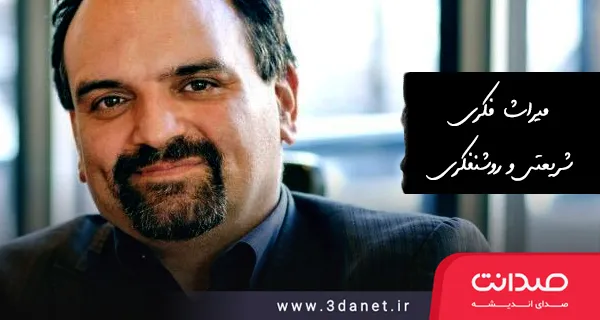
Personally, I did not experience living in Shariati's era. When the 1979 revolution occurred, I was four years old and not in Iran. At that time, I was with my family in London and naturally do not remember much. Therefore, what I have thought about Shariati is solely through reflections, readings, and hearsay; the works of his that I have read and the lectures of his that I have listened to.
My mother recounts that after Shariati's passing in 1977 in Southampton, London, some of his followers imagined that his body would be taken to Tehran in secret. But as you know, his burial ceremony ultimately took place in Damascus. Nevertheless, a magnificent funeral procession with an empty coffin was also held for him in London, which my sister and I, who were young children at the time, attended with our mother. This was my first encounter with Shariati; I myself do not remember anything of it, though I have seen photographs of it in the family album. My first intellectual encounter with Shariati was "knowing him in the mirror of his opponents." When I was a teenager, I studied at "Nikan" High School, which was a religious school, and our teachers and instructors were influenced by the teachings of the "Anti-Baha'i Society." There, we spent many hours studying the principles of doctrine; in that atmosphere, Shariati was heavily criticized.
On the other hand, at home and in my surrounding environment, I encountered another narrative of Shariati; a current that considered him a "religious revivalist" and a "religious reformist." Influenced by this view, I was fascinated by Shariati. I remember being a third-year high school student when I gave a presentation on Shariati's ideas in history class; it was a sympathetic lecture on the subject of "religious revival." This atmosphere and image stayed with me until the end of my studies in pharmacy at the University of Tehran, around the year 1997.
I also recall that during my time studying at the Faculty of Pharmacy, we published a special issue on the anniversary of Shariati's death in 1996; something that had no precedent in the Faculty of Pharmacy before. In that special issue, I published an article suited to the epistemic and emotional atmosphere I breathed in those days. After this, gradually, and to the extent that I read philosophy, I experienced a different kind of relationship with Shariati and realized the weakness of some of his arguments and citations.
Subsequently, in the last six or seven years, yet another type of encounter with Shariati has emerged in me, and if we wish to use Hegelian terms and consider the first and second encounters as "thesis" and "antithesis," through the dialectical relationship of these two stages with one another, I have arrived at a "synthesis."
At present, while being aware of some of his weaknesses in reasoning and acknowledging that his discourse is "rhetoric," I recognize his importance and greatness in the intellectual atmosphere of contemporary Iran and try to emphasize his positive points, considering and introducing him as a "concept-creating thinker" and an "enduring name" in the history of contemporary thought. I believe there are sparks and embers in Shariati's thought that can be pursued, although I do not sympathize with his project of ideologizing religion, nor do I agree with what is central to his intellectual project, namely the "geometric design of the school" and the "extraction and refinement of cultural resources" aimed at providing an ideological reading of Islam. At the same time, however, I am fond of Shariati's "Kaviriyat" (Desert Writings) and have so far written two extensive articles on this subject.
Why should we turn to Shariati today and re-examine his works and thoughts? And what relation does Shariati have to our "here" and "now"? What is his role in the process of the last 35 years of our society?
As the saying goes, "the past is a lamp for the future's path," we have no escape or alternative but to re-examine the legacy of contemporary intellectualism. We must draw upon that tradition and separate its weaknesses from its strengths; a re-examination in light of the developments before and after the revolution and the thirty-some-year record of the Islamic Republic. Some attribute certain failures of this 35-year path to Shariati, using harsh terms about him and seeking, in a way, to take revenge on him. Shariati, of course, has a close connection with the 1979 revolution and the emergence of an ideological and emancipatory discourse, but one must not stray from the path of fairness.
If we judge his legacy from today's perspective and with current values, both "epistemically" and "ethically," it seems we have committed the error of "anachronism." Just as Heidegger should not be blamed for writing Being and Time and linking it to the rise of fascism and Nazism. We cannot reproach Heidegger for the consequences and results of his philosophical thoughts, even though his actions, such as collaborating with the Nazis and denouncing Jewish students, are reprehensible in their own right.
Shariati initiated a discourse, but he was not there and did not live to see the revolution; he died of a heart attack a little over a year before the revolution—not, as some have claimed, as a martyr. For this reason, he cannot be held morally culpable for certain failures, as he had no part in them. However, the requisites and implications of his intellectual discourse, particularly "ideological Islam," can be subjected to epistemic critique. He is not responsible for the failures that some believe occurred after the revolution.
The notion held by some that Shariati was a herald of fascism is also unkind and an injustice to him. Perhaps the discourse he speaks of is not democratic, and the distinction between "democracy of votes" and "democracy of leaders" might lead us to guided democracy rather than the conventional democracy of today, but there is a long road from this to fascism and Stalinism. In his world, from Buddha to Avicenna, Hallaj, and Abu Dharr, all are gathered together; he has an open world and invites the faithful to various genres, from theater to the novel. To consider such a person a fascist and insist that his ideas lead to fascism is unfair.
He himself had tasted imprisonment several times, and when he was in Paris, his disputes with Tudeh Party students were over the necessity of distinguishing between socialism and what was underway in the Soviet Union of that era under the name of Stalinism. In encountering this important contemporary thinker, one must neither approach him with infatuation nor deviate from the path of fairness.
In Shariati, we encounter a vast collage of theories. On one hand, he places himself in the continuation of the tradition of religious intellectualism, and on the other, he draws upon concepts from Marxist philosophy. He takes humanism from the Western tradition and seeks to rediscover the same meaning within the Islamic tradition. And he engages with existentialism in a similar manner. Because of this multi-piece collage, when various thinkers approach him, they observe different strengths and weaknesses in him, and these very strengths and weaknesses are a matter of dispute. Among these disputes is whether Shariati is within modernity or against it. In the same way, his idea of a "return to the self" is subject to various readings. In your view, from this perspective, does Shariati belong to the "nativist discourse" or the "discourse of rupture"?
The idea of a "return to the self" is prominent in Shariati. In the duality of nativist discourse and the discourse of rupture, he belongs to the nativist discourse and follows in the footsteps of Jalal Al-e-Ahmad. He is influenced by the book Gharbzadegi (Westoxification), and his difference from Jalal is that Al-e-Ahmad seeks the reconstruction of the Iranian tradition and a return to the Iranian tradition, whereas for Shariati, the "return to the Islamic self" is prominent.
In the discourse of modernity, Shariati is closer to the discourse of critical theory, specifically the “Frankfurt School.” At the same time, traces and sparks of nativism can be seen in him, and he can undoubtedly be called a nativist thinker. One might suppose that he wants to see the experience of “liberation” in Ashura and to construct Shiite history, from Imam Ali (AS) to Imam Hussein (AS) and Lady Zainab (SA), along these same lines, and he seeks to synthesize it with critical theory. However, this synthesis, despite its vast influence and impact, is not justified; because Shariati knew neither Islamic philosophy well, nor Islamic mysticism, nor Islamic theology. He had a good familiarity with Islamic history, but in other disciplines, he lacked sufficient knowledge not only compared to the intellectuals of the generation after him but even compared to the generation before him. This is not meant to belittle Shariati, but the reality is that at least some of the concepts he constructed were not very justified; concepts he created, such as “Shiism as a Total Party,” despite its great social impact, do not correspond well with the history of Shiism. The reading Shariati offers of the Karbala event is not very consistent with historical evidence, and the rival reading has far more historical evidence. Also, the picture he presents of the idea of Occultation and Mahdism, and his introduction of “Waiting” as the “School of Protest,” differs from the orthodox theological reading of this category. Differing from the orthodox reading is, of course, not problematic in itself, provided there is sufficient evidence and convincing arguments, which, judging by what has been published, Shariati’s works have not much benefited from.
Regardless of the personal disputes between Shariati and Martyr Motahhari, it seems that Professor Motahhari’s judgment about his Islamic knowledge is somewhat correct, and the term “Islam-spinning” (Islam-sarai), though harsh, is not entirely off the mark if it means that he, as an Islamic researcher, did not have sufficient familiarity with mysticism, exegesis, jurisprudence, philosophy, and Islamic theology. For example, he uses the terminology of Islamic philosophy in his writings and lectures in a way that makes it clear he did not know the precise meanings of these concepts. This is where, in your words, these “intellectual collages” were formed.
In his use of critical thought, as with religious concepts, Shariati relied more on his power of genius and imagination than on a correct and deep understanding of concepts existing in the humanities. In particular, his uses of Sartre and especially Heidegger differ from what we know of them today. Of course, as I mentioned, we must not fall into the error of “anachronism.” It was only in the 2000s and 2010s that important texts of Heidegger were translated into Persian. I am mindful that at that time, there were very few texts about Heidegger in Persian; but in any case, “fundamental ontology” and “Dasein,” which are key concepts of Heidegger, are used in Shariati’s works in a way that shows he was not familiar with these concepts and used his own taste and creativity in this regard. From this perspective, this collage must be seen and considered with this observation in mind.
At the same time, it should be noted that at that time, there was no one else with Shariati’s strength and creativity to undertake such a synthesis. He had certainly outstripped others, for he possessed great abilities: he was an exceptional orator, a delightful spoken and written humor flowed within him, and he also had a charismatic personality, a creative mind, and a talent for conceptualization. The secret of Shariati’s gaining importance must be understood. Importance is not something anyone bestows upon another; rather, it is society that gives importance to an individual. This does not come down to our likes or dislikes. Shariati is important in the history of our contemporary thought; even though one can disagree with a multitude of his ideas. He perhaps did not know many things, but this does not diminish his importance, and if we understand this importance, we can learn from his legacy, follow in his footsteps, and better formulate the relationship between tradition and modernity.
It seems that in these very collages, Shariati completely transforms the image of “class” in Marxist literature, constructing a socio-political concept out of an economic one based on the contradictions of labor and capital. This is apparently the same thing that occurred during the Reform era, when intellectuals ceded the category of “economy” to the bureaucrats and focused more on “culture”—an approach that ultimately led to the Ahmadinejad movement. In fact, Shariati and the intellectuals who inherited his legacy, despite their fundamental differences, constantly turn to culture instead of solving society’s equation by thinking through economic and political matters. That is to say, when our intellectual contemplates social change, the “economic equation” is absent from their discourse.
This is a lengthy discussion and cannot be contained in this short space. But regarding the concept of “class,” I believe you are right. Shariati even tries to interpret the conflict between Abel and Cain in terms of feudalism and class. I should note in passing that one of Shariati’s sparks lies precisely here, though he himself did not pursue it: he does not necessarily consider the language of religion to be the language of “reporting reality,” and in the introduction to the book Salman the Pure, he points to the symbolic nature of religious language. Yet, as you said, the concept of “class” remains at the level of human concerns, and theorizing and seriously engaging with the category of “economy” is absent from his work. It can be said that this perspective is also absent among later religious neo-thinkers; neither in Shabestari, nor in Soroush, nor in others. The situation is the same in non-religious intellectualism. One of the few people who, by virtue of their expertise, has addressed this matter is Mousa Ghaninejad, who, of course, lacks the influence of others. This deficiency even exists among pre-revolution leftist intellectuals, where the “economic plan” remained at the level of general ideas of “fighting poverty.” An intellectual like Malekian does not really believe that the intellectual should engage with these matters. For him, inner, esoteric, and psychological transformations will lead to external transformations; hence, the “subjective dimensions” of his discussions are far more pronounced than the “objective” and external dimensions.
If “awareness” is not reproduced in society—an awareness that substantiates constructive and justified civic and social actions—“populism” will take center stage and win the field.
In one of the classes, you mentioned that after his time in prison, Shariati turned from “revolutionary activism” to “self-cultivation,” and you interpreted him quite sympathetically along this path. Your interpretation seems to presuppose that revolutionary discourse is necessarily accompanied by violence. This does not seem entirely correct, however.
As far as I understand and can be inferred from Shariati’s works, it seems that distancing himself from immediate and premature revolution was the product of Shariati’s personal reflections, which he arrived at especially during his prison period. We know that most revolutions have been intertwined with violence. In his post-prison period, unlike the “Ershad” era when he saw everything in black and white and said, “Those who left performed a Husseini act, and those who stayed must perform a Zainabi act, otherwise they are Yazidis,” I believe he entered a period of “gray-thinking.” The descriptions he gives of Abu Dharr in the pre-prison and post-prison periods are somewhat different. Attention to national interest and the “geography of speech” are points seen in his later works. Regardless of the extent to which revolution and violence are intertwined, I think Shariati concluded that premature revolution is of little use. His famous statement that “revolution before self-awareness is a catastrophe” belongs to this period. He uses such expressions less during the “Ershad” era. In that era, revolutionary concepts boil within Shariati, but afterward, he distances himself from this atmosphere, and the subjective, inner dimensions and “revolutionary self-cultivation” become prominent for him. I do not know whether he had completely abandoned his utopian vision in the post-prison period, but he had apparently realized some of the pitfalls of “utopia” and “no-place.”
In your commentary on the article “Mysticism, Equality, Freedom,” you explained that Shariati takes mysticism from the “Islamic tradition,” equality from “socialist thought,” and freedom from “Sartre.” How does he link these conflicting concepts together?
You should ask him that question yourself! Shariati wrote this essay in the period after his imprisonment; for him, "mysticism" and "politics" had a dialectical relationship. This essay is perhaps the final station of the long journey he undertook with these two categories throughout his turbulent life. Shariati seeks to blend the liberating aspect of the mystical path with the socialist concept of equality and the political concept of freedom. In those days, the liberating aspect of the mystical path had become prominent for Shariati. For him, a mysticism that is of no use for political engagement is worthless.
In the final years of his life, Shariati was preoccupied with reconciling "justice" and "freedom." Many leftist discourses of that era, as much as they were concerned with social justice, did not address freedom. Shariati, too, does not engage in theorizing to reconcile "justice" and "freedom," a theoretical explanation of which is very difficult. Here, he merely expresses his ideals; but at the very least, his importance lies in understanding that merely emphasizing equality does not cure our pain, and that alongside justice and equality, we must also be concerned with "freedom." In the triad of "mysticism, equality, freedom," mysticism possesses a liberating and existential dimension. Unlike someone like Sartre, Shariati does not consider "Being" to be absurd, blind, and deaf, and he attributes a "sacred realm" to Being. He speaks in the footsteps of the mystics, and his mysticism is formulated under the rubric of Islamic mysticism. In my articles "Descent into Nothingness: A Comparative Re-reading of Sepehri's 'Eight Books' and Shariati's Kaviriyat" and "Be Thus, Upside Down: A Reflection on Shariati's Kaviriyat," I have unveiled Shariati's existential concerns and attempted to provide a formulation of them. The concepts of "the realm of non-being," "annihilation," and "spiritual solitude" are prominent in Shariati's mystical outlook, as collected in the works "Descent in the Desert" and "Soliloquies." For this reason, I have considered him among the modern wayfarers. The "modern wayfarer" is concerned with undergoing dove-like, inner experiences in the current, surrounding disenchanted world.
Whether the synthesis between the mystical and socio-political strains of his concerns was successful or not is another matter. Shariati did not offer a groundbreaking solution in this regard but merely spoke of his lofty and precious ideals. However, reconciling "equality" and "freedom," as I mentioned, requires theoretical effort. I hope the Shariatists and neo-Shariatists will step into this arena so that they can thereby safeguard his legacy and continue his path.
Conversation with Soroush Dabbagh | A Concept-Building Thinker | Iran
.
.
Audio Recordings of the Sessions on Shariati's Intellectual Legacy and Intellectualism
Session 1 Download from Server 1 | Server 2
Session 2 Download from Server 1 | Server 2
Session 3 Download from Server 1 | Server 2
Session 4 — Download from Server 1 | Server 2
Session 5 — Download from Server 1 | Server 2
Session 6 — Download from Server 1 | Server 2
Session 7 — Download from Server 1 | Server 2
Session 8 — Download from Server 1 | Server 2
Session 9 — Download from Server 1 | Server 2
Session 10 — Download from Server 1 | Server 2
Session 11 — Download from Server 1 | Server 2
Session 12 — Download from Server 1 | Server 2
Session 13 Download from Server One | Server Two
Session 14 Download from Server One | Server Two
Session 15 Download from Server One | Server Two
Session 16 Download from Server One | Server Two
.
.
16 Lecture Sessions on Shariati's Intellectual Legacy and Religious Intellectualism
Speaker: Soroush Dabbagh
Sessions Start Date: January 12, 2013
Sessions End Date: May 24, 2013
.
.

Discussion4 comments
میراث فکری و روشنگری شریعتی را میشد صرفا در یک جلسه خلاصه کرد . افسوس وقت من که د ر 16 جلسه هدر رفت . ما را به سال به سال زندگی شریعتی چی؟
سلام عرض ادب خدمت آقای دکتر و سایر همکاران بنده تاحد امکان همه درس گفتار ها را دانلودنموده ام خیلی استفاده کردم اما میراث فکری مرحوم شریعتی را نتوانستم دانلود نمایم میشه در زمینه همکاری نمایید ممنون میشوم!
سلام و درود فایل ها دوباره آپلود شدند برقرار باشید
همانطور که فیخته و شلینگ زیر سایه کانت و هگل گم شدند, عبدالکریم سروش هم میشود زیرنویس تاریخ شریعتی... ولب بع جان خودم سوگند که او را به اسم بزرگترین محصول زندگیش, سروش دباغ تا ابد خواهند خواند.,,۲۵سال تمام درحال فلسفه خواندنم, هیچکس را مثل دباغ, مسلط به انچه میخواهد بگوید و متواضع به انکس که میگوید ندیدم... کاری کرد ازینکه یک عمر به شایگان فحش میدادم, به امامزاده شهرمان پناهنده شوم و توبه کنم. دباغ عزیز ممنون که کانت,ویتگنشتاین,سپهری,شایگان, ملکیان و شریعتی را درست نشانمان دادی... ترسیدم پدرت را از زبانت بشناسم... عقده ادیپ نداری... بزرگش هم نمیکردی بی شک, ولی....بگذریم....خدا سایه تو,بابک احمدی,فرهادپور,جهانبگلو, محمودخاتمی,اشوری و فلسفه را از سر منه بچه شهرستانیه مجنون فلسفه کم نکند