Religion
Komeil Bahrami's Article 'Shariati, the Imitator of Sorel'
Although Shariati never mentioned Georges Sorel or Gustave Le Bon by name, he appears to have drawn on their ideas in creating his own works. He ignited the engine of ideology with the fuel of 'myth' to stir passion in the people; an examination of this hidden influence.

Nezam Bahrami Komeil
AuthorShariati, the Imitator of Sorel
Dr. Nezam Bahrami Komeil
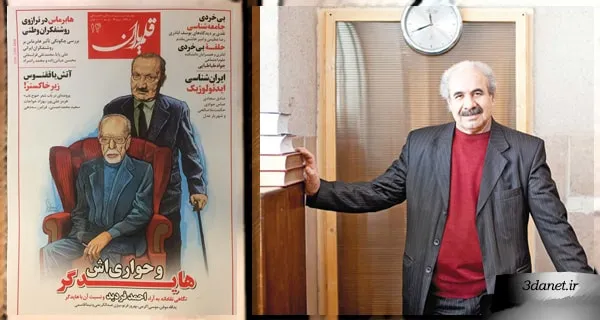
Ghalamyaran Monthly - Issue 18, Year 3, Tir 1398, Pages 60 to 67
Introduction
Writing something new about Ali Shariati is a very difficult task. Shariati was the ideologue of the revolution, and a revolution that is forty years old has given both proponents and opponents ample opportunity to critique and examine its greatest ideologue. Shariati has been praised enough, and continues to be; critics have also raised many objections. For example, some of these critiques are as follows: Shariati had an eclectic approach, patching together various schools and ideologies; Shariati turned religion into an ideology and, by promoting the idea of combining religion and socialism, ultimately reduced religion to a tool of struggle; by ideologizing history and tradition, Shariati created an obstacle to the evolutionary course of society; Shariati was selective in his approach to the totality of modernity, and in this selection, he discarded components such as "human-centeredness" and "self-founding reason," and so on. There are also numerous writings on the individuals and schools that influenced the master or were influenced by him, and on most of the key concepts and themes of Shariati's intellectual system, from "class" and "exploitation" and "Alavid Shi'ism" to "justice" and "return to the self." However, no one has yet addressed the issue of under whose influence or which school of thought Shariati concluded that the engine of ideology must be ignited with the fuel of "myth" to generate passion and motivation among the people. Of course, Dariush Ashouri, Yadollah Mowqen, and Mohammad San'ati have pointed to the presence of a mythical approach among Iranian intellectuals; but where Shariati derived this mythical approach from has not been examined until now. Shariati introduces his most important idols as Louis Massignon, Alexis Carrel, Frantz Fanon, Jacques Berque, Gurvitch, Jean Cocteau, Marxism, and Existentialism, and does not mention Georges Sorel or Gustave Le Bon; but it seems these thinkers had a great influence on Shariati. Shariati had access to the works of these individuals; because during the period Shariati was in France, the names and works of these thinkers were widely prevalent. The claim that Shariati was influenced by figures like Georges Sorel in creating his works is a subject that will be examined in this article.
The Passion-Oriented Thinkers
Gustave Le Bon (1841–1931), Georges Sorel (1847–1922), Vilfredo Pareto (1848–1923), Henri Bergson (1859–1941), Giovanni Gentile (1875–1944), José Ortega y Gasset (1883–1955), and Hendrik de Man (1885–1930) formed a generation of European thinkers who emphasized the power of emotions, instincts, and psychic excitations over the power of reason and argumentation. Vitalism, of which Bergson was a proponent, believed in a creative force called the “élan vital” that living beings possess, which definitively distinguishes them from non-living entities. Le Bon stressed the role of faith-based beliefs and convictions (not argumentative or rational ones) in generating human and social behavior. In his view, many of the most important human actions are the result of the influence of such convictions, and the holders of such convictions cannot be made to change or doubt them through reason, logic, and experience. Of course, faith-based convictions do undergo change and transformation, but faith itself never dies, nor can it die; because the human need for belief is a spiritual matter. (Le Bon; 1346: 1 to 10) Le Bon, in unison with Sigmund Freud (1856–1939), emphasizes the crucial role of emotions and feelings, and that the logic of feeling differs from the logic of reason. Le Bon considers the emotional and psychic unconscious to be the true ruler of individuals' behavior, speech, and thought, and believes the unconscious is far more important than the rational and logical conscious. “The mistake of many politicians was that they wanted to do with reason and logic things that could only be accomplished through emotions.” (ibid., 37) “It will still be a long time before we reach the time when the world becomes subject to rationalities and philosophical proofs; it has always been the opposite, and so far it has been the hand of convictions that has repeatedly created the upheavals and revolutions of the world. That is, the very convictions that are despised and scorned by rational logic, yet this rational logic cannot resist or equal them.” (ibid., 91) Le Bon says: “Presenting rational proof and argument to someone who holds a conviction stemming from emotion or religion has no effect other than to stir that person into greater passion and excitement regarding their conviction. For this reason, no one can overcome their own opinion and conviction by the power of their reason, unless that opinion and conviction become so old and decayed that they lose their force entirely.” (ibid., 94) By dividing logic into: 1. Biological (life) logic, 2. Emotional (psychic) logic, 3. Collective (mass) logic, 4. Religious logic, and 5. Rational logic, Le Bon emphasizes that individuals' behavior is carried out based on one or a combination of these logics. For example: “The rare leaders and chiefs who can sometimes change the opinion of a political assembly know well that one cannot exert influence on listeners through reason, but only by stimulating emotions, combined with recourse to certain religious formulas, can a reassuring influence be achieved.” (ibid., 143) While emphasizing the distinctness of the realm of conviction (faith) from the realm of knowledge (science), Le Bon points to a subtle point concerning the relationship between faith and religion. He writes: “People need faith, and religion does not create this need; on the contrary, people's need for faith is what causes the emergence of religions. So whenever someone abandons the religion of their forefathers, they immediately come to believe in other convictions, whether magic, sorcery, political illusions, or the like.” (ibid., 212) Unlike Kant and his followers, who do not involve spiritual, psychic, and emotional factors in determining the criteria of cognition, Le Bon is very interested in studying these factors. This difference arises because the world in Kant's philosophical approach is a world governed by reason and intellect, and for this reason his focus is on “epistemology.” But the world in Le Bon's philosophical approach is a world governed by will and power, and reason and logic are also in the service of human will and desire, and for this reason Le Bon's focus is on “behavioral science.”
At the same time, the Italian economist and sociologist Pareto emphasized the role of instincts and emotions over logic and reasoning. He believed that the behavior of most humans is based on instincts and emotions, even though they try to devise rational and logical justifications for them. For example, he said that humans rarely commit suicide even in the most difficult circumstances; but they deceptively consider this decision to be the result of a logical acceptance of moral and religious commands, while in reality they fear death, and the fear of death is, above all, an instinctive matter. From a mythological perspective, the emphasis on the power of instincts, passion, excitement, will, and faith, versus the emphasis on the power of reason, logic, and reasoning, goes back to the myth of Dionysus (god of passion, wine, and intuition) versus Apollo (god of wisdom, knowledge, and prophecy). The Dionysian approach in contemporary philosophy is linked to Schopenhauer and Nietzsche, in psychoanalysis to Freud, and in collective psychology to Carl Gustav Jung. An examination of the works of these thinkers shows that in this approach, in addition to the priority of inner intuition over outward thought, will and action take precedence over any kind of thought and theory. For this reason, theorists of Nazism and Fascism, such as Alfred Rosenberg and Giovanni Gentile, always repeated that it does not matter what you think; what matters is that you act and demonstrate the power of your will. It is important that you build a great dam or start a great war; the fact that, intellectually, that dam turns a lake into a salt marsh or increases the probability of an earthquake, and that war destroys the country and its people, is not very important.
Sorel and the Revolutionary Myth
Georges Sorel, the French thinker, with a Dionysian approach, had come to believe that to create a socialist revolution and, more importantly, to preserve such a system, human and moral motivations must be awakened by any means possible, and a new spirit must be breathed into soulless, rational socialism. Especially in an era when bourgeois morality had dragged society into the quagmire of the corruption of money and sex, a new moral system had to be established. Sorel believed that Marxism would only succeed if it transformed from an economic and rational doctrine into a moral and emotional doctrine. In his view, one must go beyond purely economic and materialist discussions and address the psychology of historical materialism. Revolutionary reason cannot be the basis for revolutionary action; revolutionary action requires a revolutionary spirit. Morality, myth, and social legend must be used to build a utopia; legend must be preferred to reality, and emotion to rationality. In this vein, instead of a proletarian revolution or the European Marxism proposed by Marxists and reformists like Bernstein, Sorel considered "general strikes" the best way to fight and overthrow the capitalist system. Such strikes, more than being rooted in a logical analysis of the economic base and relations of production or precise planning for step-by-step economic reforms, were rooted in a mass movement to destroy the existing capitalist system and reach a utopia. In his book Reflections on Violence, Sorel revisited the battle between the proletariat and the bourgeoisie from a moral and mythical perspective. By proposing the idea of syndicalism, he advocated for the formation of labor unions and the transfer of ownership and management of factories to the workers. For this reason, he praised Lenin, who had revived the myth of syndicalism. In Sorel's view, the only violence that is somewhat defensible is the violence carried out by workers in pursuit of their rights. Sorel considered the French religious system corrupt and all declarations of human rights to be a bunch of abstract, useless slogans. He saw science as something beyond a collection of mathematical and natural laws and formulas, and said that science, more than reproducing the structure of reality, should serve as a tool to provide the basis for achieving a creative conception. (Sorel; 1999)
Sorel was a fierce opponent of Cartesian philosophy and its principles such as skepticism, rationalism, and the distinction between mind and body. He was also opposed to Aristotelian realism and empirical, laboratory-based methods. Sorel wrote his first book, The Trial of Socrates, in 1889. In this book, he criticized Alfred Fouillée's interpretation of Socrates. Fouillée praised Socrates' character and conduct; but Sorel attacked Socrates and condemned him for undermining the moral foundations of society. (Jennings; 1985, 18) According to Jennings, the book The Trial of Socrates was nothing less than a retrial of Socrates. Sorel considered Socrates guilty because he had shaken the piety, religious fervor and sentiment, respect for marriage and family, and the purity and sincerity of rural life that bound the Greeks together. (Jennings; 1985, 23) Furthermore, Socratic philosophy was optimistic and caused individuals to fight against fate instead of being admirers of the gods' decrees. If people adopt an optimistic approach to the world, they see the world as a stage that beckons them like an attractive image, and they pursue their own love. In Sorel's view, such an approach destroys religious values and sentiments and corrupts the minds of the youth. (Jennings; 1985, 24)
Sorel believed that the masses are stirred by myths, and the political activist must turn to myth-making in order to justify violence and forceful action against the ruling power for the workers. Sorel writes in Reflections on Violence: "A myth is a body of interconnected images, not a discrete element considered apart from other things. Thus, a myth must reflect reality at numerous points and, moreover, be something outside the sphere of reason and logic... A myth was something upon which men acted, whereas general logical concepts could never impel anyone to action" (Hughes; 1369: 155). Sorel says: myths are not descriptions of things but expressions of a determination to act... contemporary myths prepare people for a struggle that will lead to the destruction of the existing order... (Boomer; 1385: 796 and 797). Sorel believes: "Socialists must cease trying to find a means to encourage the conscious middle classes; their sole duty is to make the proletariat aware of the immense revolutionary role that class must play... These results cannot be achieved in a definitive manner by using ordinary language; rather, one must utilize a body of images capable of evoking, solely through intuition and prior to any analysis, as an undivided whole, the entire range of sentiments corresponding to the various manifestations of socialism's war against modern society." (Ibid: 798)
Ernst Cassirer believes: "In myth, the ideal forms and the (logical and mathematical) relations and proportions that present the objective world as a world entirely under the rule of law do not exist; on the contrary, all reality is dissolved into concrete, unifying images. The opposition between myth and science, the result of which is so evident, ultimately leads to an opposition in principle. Every synthesis that myth presents of the particular or the specific possesses the same character that is fully evident only in the whole. Whereas scientific cognition, after having separated, distinguished, and determined elements through critical operation, can combine them with one another (according to certain logical relations); myth, it seems, throws everything together and unites and merges them without having separated and distinguished them from one another. The relations that myth establishes between elements are such that not only is an ideal, two-way relationship established between the elements, but they positively become identical with one another, and all of them become one thing. Objects that come into contact in a mythical sense—whether this contact is spatial contiguity or temporal succession, whether it is a distant resemblance or membership in a class or type—are no longer multiple and diverse objects but, from the mythical viewpoint, possess a substantial unity... The relations that myth establishes between objects are not logical relations which, once placed between objects, distinguish them from one another and also relate them to one another; on the contrary, mythical relations are like a kind of glue that can stick the most incongruous elements together." (Cassirer; 1378: 124-125)
According to Cassirer, in the alchemists' view, the world is a collection of simple properties, and bodies come into being through the accumulation of these properties. For example, it is assumed that all bodies that catch fire possess a common material cause (in this case, a substance called phlogiston). Likewise, all solids, liquids, or gases possess a common substance that renders them in these forms. For this reason, in alchemy, the first step toward attaining the "philosopher's stone" is to transform mercury, which is liquid, into a solid body by separating the agent or property that causes liquidity. "From the viewpoint of myth, every characteristic, even if accidental, is like every other characteristic; that is, there is no precise distinction between essential and accidental, fundamental and non-fundamental; because myth considers every perceptible similarity (between things or matters) as a direct expression of the identity of their essence... Moreover, in the mythical vision, whenever something resembles something else, the entire first object also exists in the similar object. For instance, mythical consciousness sees in the tobacco smoke rising from a pipe, not a mere symbol nor a simple tool for producing rain, but the tangible image of a cloud, and in this image, it observes the thing itself, namely the desired rain." (ibid: 131-132)
Sorel believed that Marxism is the myth of the proletariat. In Sorel's view, some characteristics of myth, which was an irrational yet history-making force, are as follows:
1_ Myth is a totality and cannot be decomposed into its constituent parts.
2_ Myth is a social and political matter in which the participants in a movement, who have practical goals, believe.
3_ Myth is active and pragmatic. Myth incites a destructive action whose aim is not to reflect reality but to act upon it and change it.
4_ Myth is a magical image in which its adherents see the fulfillment of their desires. Hence, myth cannot be critically analyzed and refuted.
5_ Myth is a creative and vital force that originates from the deepest human emotions. (ibid: 13 and 14)
Henri De Man, like Sorel, emphasized the emotional and moral dimensions of socialism. At the beginning of the first chapter of one of his books, he writes: "When you write with your blood, your writing penetrates the souls of individuals."; this sentence demonstrates the importance and superiority of the power of speech and language over reason and logic. In De Man's view, one must abandon the belief in economic determinism and its influence on individuals; just as many intellectuals and elites who supported socialism were, in terms of class, from the bourgeoisie and became interested in this theory only for moral and human reasons. Similarly, if we think that the working class will attain class consciousness through scientific and rational methods and then join the revolutionary movement, we are mistaken; the working class and other individuals must be persuaded emotionally and affectively. In other words, the action of workers in joining the revolution is an emotional and psychological action, and workers need practical reasons more than they need scientific reasons. The emotional dimensions and moral principles must be revived in Marxism to have a reliable source for revolutionary struggle; because class war results not from class consciousness but from a feeling of class resentment, and to revive this feeling of resentment, emotion and morality are needed more than consciousness. (De Man 1985) Shariati's conception of myth is more or less the same; Shariati considers myth to be the ideal and absolute model of every feeling and need that is beyond history; that is, it is not concrete and limited to place and time. Myth deals with "what ought to be" instead of "what is" and answers human beings' need regarding what they want to be, without any flaws or defects. (Shariati; 1382; vol. 26)
Shariati and Ideology
Shariati considers every individual's school of thought to consist of two parts: "worldview" and "ideology." Worldview is the intellectual framework and ontology, while ideology defines the responsibilities of individuals and the do's and don'ts. (Shariati; 1386; vol. 9: 116) In Shariati's view, ideology creates motivation and movement in individuals, gives direction to their lives, shows them how to be, and revives concepts such as love, sacrifice, selflessness, and martyrdom within them. (Shariati; 1379; vol. 23: 112) "Ideology is a faith founded upon the concepts of self-consciousness, guidance, salvation, perfection, value, ideal, and responsibility. Philosophy and science engage in phenomenology; ideology evaluates good and bad. Philosophy and science advance no further than the boundary of knowledge; ideology undertakes guidance. Philosophy and science are a mirror before nature, society, and humanity; ideology is a hand. Philosophy and science are awareness; true and complete ideology is realized through self-consciousness. Philosophy and science justify values; ideology uproots and creates values. Philosophy and science dissect you; ideology creates you. Philosophy and science produce philosophers and scientists; ideology produces the militant intellectual." (Shariati; 1381; vol. 7: 94) Shariati said: "I value those who are not scholars more than those who have stuffed and polluted their brains with information, because the former, with their sound and ordinary innate nature, can think and at least understand issues related to simple life, whereas those with stuffed brains have unnatural brains and unhealthy feelings and are even incapable of understanding simple issues." (Shariati; 1381; vol. 27: 4) It was this very approach to science and philosophers that led Shariati to consider five hundred Socrateses and Avicennas less valuable than a single Hallaj or Miqdad.
In this same context, Sorel had said: the socialists' conception of science is wrong; science is not a machine into which you pour problems on one side and receive answers on the other. The function of science is much simpler. Science seeks to know how to perfect the efforts of those engaged in experimental work. That is, Sorel defined science based on practice and had an instrumentalist view of it. (Hughes; 1369: 80) Shariati held this same view toward religion and was, of course, heavily criticized for it.
While disparaging philosophy and science and venerating ideology, Shariati simultaneously endeavored to turn religion into a weapon for struggle. Shariati carried out the ideologization of religion with the aim of generating passion and momentum among the masses through the revival of religious myths. This provoked much criticism; Shayegan writes on this matter: "Ideology is an eclectic phenomenon, situated between myth and reason. We are dealing with a kind of rationalized myth, and a reason that has regressed to mythology. We also know that ideology is an anti-dialectical thought, because it is rigid and stagnant. Finally, we know that ideology is a false consciousness. When I gathered all these factors together, I realized that the view of thinkers like Ali Shariati, who in my opinion is the archetypal example of an ideologue, fits perfectly within the framework of ideology. This thinker, even before the revolution, had created a favorable ground for ideologization. In my view, before any social earthquake, human beings participate in the formation of a magnetic field, which from the very beginning conditions and constrains the mind, and on this basis, ensnares even the most clear-sighted individuals, and closes off and paralyzes one's critical thinking. From this situation, it is but a single step to the unbridled psychology of the masses..." (Shayegan; 1376: 171) Soroush, in his critique of this approach, says: "...the advocates of the ideologization of religion do not want the whole of religion; rather, they seek from religion only a weapon for struggle..." (Soroush; 1376: 123) Seyyed Javad Tabatabai rightly pointed out that religious intellectuals and figures like Shariati and Soroush, by ideologizing tradition and religion, blocked the evolutionary historical path toward secularization that had begun in the Constitutional era. (Interview with Shargh newspaper: 1382)
Taking his cue from Vico, “Sorel spent his whole life in search of a kind of ricorso; that is, the renewal of human history through the restoration of ancient, heroic values. The word ricorso means a running back.” (Hughes; 1369: 152) Sorel believed that with the aid of historical myths the passive, indifferent mass could be set in motion. In the same way, Shariati put forward the slogan “return to the self” and tried to implement it with the help of myth-making from religious concepts and figures. Shariati had taken the idea of “return to the self” from thinkers such as Sartre, Fanon, Aimé Césaire, and Iqbal Lahori. Of course, not only Shariati but before him Jalal Al-e Ahmad and after him Ehsan Naraghi with the book What It Had of Its Own, and today someone like Morteza Farhadi with the book Industry Atop Tradition or Against It?, have been and are pursuing such mirages. In particular, the myth that Shariati creates from certain figures of the Shia religion recalls heroes summoned from the age of myths into the modern world. Shariati’s most important mythical hero is Abu Dharr. “Abu Dharr strove for the development of the economic and political commonality of Islam.” (Shariati; 1381; vol. 3: 18) In the same vein, Shariati does not see the story of Abel and Cain merely as moral counsel and guidance; rather, he considers it the beginning of the saga of class conflict. “Cain … represents the system of agriculture and exclusive or individual ownership, and Abel … represents the age of animal husbandry and the period of primitive communism before ownership [is].” (Shariati; 1382; vol. 16: 52) Elsewhere he says: “This is the inevitable revolution of the future, based on the dialectical contradiction that began with the war of Abel and Cain and flows throughout human societies between the ruling and the ruled systems, and the deterministic destiny of history will be the victory of justice, equity, and truth.” (ibid: 62)
Ideology and Fascism
“Fascist intellectuals are often attracted to anti-democratic theories about elites; theories promoted by people like Georges Sorel and Vilfredo Pareto, who were of particular interest to Mussolini. Pareto taught a generation that politics, especially the politics of democracies based on mass votes, is nothing but a simple conflict among a few power-holding elites, elites who cloak their private interests in the rhetoric of idealism but are inspired by no lofty sentiment based on responsibility toward the people or principles… Instead, the fascists argued that true leadership, and even true democracy, is found only where the people, with unanimous approval, impose a popular leader, a leader who intuitively understands their real needs and national spirit and shapes them into a united group, enabling them to perform great, difficult deeds requiring self-sacrifice.” (Weiss; 1380: 46) “Georges Valois openly praised Sorel as the intellectual father of fascism, and Mussolini claimed that: ‘Whatever I am, I owe to Sorel.’” (Neocleous; 1391: 30) In the Naples speech delivered in 1922, three days before the March on Rome and its conquest, Mussolini said: “We have created our myth. This myth is faith, is passion. It does not have to be reality. It is reality in the sense that it is a stimulus, hope, faith, courage. Our myth is the nation, our myth is the greatness of this nation!… To us, the nation is not merely a territory but a spiritual matter… A nation is great when it translates its forces into reality.” (ibid 45) Neocleous, explaining Mussolini’s words, says: “This phrasing—about vitalism and spirit—sees myth as a means of mobilizing the nation, a hope behind which mass action occurs and which incites the masses to courageous deeds.” (ibid 45)
Le Bon is one of the first thinkers to point out the resemblance between the extremists of the French Revolution, such as Robespierre, and the Bolsheviks of the Soviet Union, and religion. Describing the revolutionary tribunals, he says: “Robespierre, who exemplified the narrow and limited religious spirit of his age, considered himself a messenger and recipient of revelation, imagining that a mission had been given to him from the divine realm to come and establish the pillars of virtue in the world... The revolutionary tribunals bore a complete resemblance and relation to the Inquisition. Of course, the god of these two types of tribunals was not the same, but their course of action was identical: the pursuit and execution of those who, in their opinion, had not believed.” (ibid., 244) The American McDougall and the Frenchman Le Bon believed that the masses, especially when gathered in vast numbers in a public center, are more captivated and influenced by speech than by writing. In such circumstances, the way to attract and charm them is not to enter into discussions of numerous real details or to engage in logical philosophizing. Rather, the most effective way is to penetrate their hearts with fervor and the constant repetition of the simplest ideas. Hitler, with such an approach and with fiery, captivating speeches, penetrated the hearts of his audience. He believed that the masses have a strange capacity for accepting the promises of theorists. In Hitler's view, the masses have a feminine character; we should not seek to engage their brains, but rather must penetrate their hearts. (Geary; 1381: 22)
Setting aside the usual courtesies, the political output of Sorel's thought, which constantly emphasized the necessity of injecting ideology and myth into Marxism, was Mussolini's fascism. Mussolini linked “socialism” with “nationalism” through mythical language; and Shariati, with the same language, linked “socialism” with “religion” (Alavid Shiism). Over time, Mussolini diminished the word “class” in his speeches and instead highlighted the word “nation”; whereas Shariati, recognizing the characteristics of his society, preferred to use the word “ummah,” which carried a religious connotation, instead of the word class. Shariati disparaged philosophy and science and emphasized emotion and will; in the content of his thought, there was no place for the most important value components of modernity, such as “self-founding reason,” “humanism,” “freedom,” and “democracy.” Even in the method of propagating his ideas, Shariati preferred talking and preaching to the masses over writing and lecturing for specialists; methods that have always been favored by populists and fascists. These words may seem harsh and extreme; the next section will correct this judgment.
Committed Democracy
Shariati's debt to Sorel is not limited to myth-making in Marxism; Shariati's approach to Western democracies was also influenced by Sorel's ideas. H. Stuart Hughes says that in the realm of politics, Sorel had become disillusioned with democratic politicians and democracy (because of the democrats' exploitation of the Dreyfus Affair) and remained pessimistic about parliamentary democracy for the rest of his life. (Hughes; 1369: 80) Shariati, too, was fiercely opposed to democracies and considered them the playthings of the bourgeoisie and counter-revolutionaries. His proposed political system is a two-stage government, similar to the transition from the dictatorship of the proletariat to communist rule in Marxist thought. "Therefore, today, the government or the committed political group that assumes leadership in a country—especially a country that is stagnant, a country that suffers from rotten traditions, a country whose relations are very decadent, whose culture is weak, whose social relations are unhealthy, where discord, oppression, and impurity are rampant, and where there is false vision, ignorance, and external factors—this committed group is obligated—even if they are not religious, they are obligated—not to entrust the fate of the revolution to the democracy of worthless, purchased votes that are the playthings of ignorance, superstition, and malice. They are obligated to implement the revolution, lead it, and guide it to its goal. I say 'obligated' from a sociological perspective; from the perspective of political sociology, this group does not rely on winning the majority of people's votes; it is committed to realizing its ideas, beliefs, and thoughts, and to changing the intellectual direction of individuals, social relations, cultural and industrial evolution, and the growth of revolutionary action based on its own ideology. Thus, when the political leadership of this committed group takes the destiny of society into its hands, its entire goal is to nurture society according to its revolutionary school... and to change the culture, ethics, beliefs, and opinions of the people in a revolutionary manner, even against the number of votes." (Shariati; 1379; Vol. 26: 78-477) In Shariati's view, to achieve the ideal government, two stages must be traversed: "The first stage is the creation of a revolutionary system based on a revolutionary ideological leadership for a temporary period, which can be called the period of society's revolutionary self-construction. The second stage is the stage in which society has attained self-consciousness and the number of heads has become equal to the number of votes (in this case, democracy is a reality). (Shariati; 1368; Vol. 11: 148) According to Shariati, the main criterion for distinguishing governments lies not in their form but in their content. "Democracy, liberalism, dictatorship, and revolutionary leadership are forms, and their differences must be recognized by their goals, their mode of action, and their ideology, not by the form of their government." (Shariati; 1368; Vol. 12: 227)
The ideal government envisioned by Shariati is "committed democracy." Shariati says: "Committed democracy says I have nothing to do with people's votes, and when it comes to power, it is not obsessed with people's votes and does not strive to attract the opinion of the masses; it may even oppose their opinion. In what form is committed democracy implemented?
1_ Through the democratic election of the leader, but for life
2_ A long interval between elections – a person is elected for life or for a long period; during this time, there is an opportunity to implement their programs. Tito and Sukarno, after the Bandung Conference, became leaders for life based on this very idea." (Shariati; 1368; Vol. 12: 232) "The difference between dictatorship and a revolutionary leader is that the revolutionary leader liberates thought and transforms it into political growth and freedom in the subsequent period. But dictatorship keeps this ignorance eternal. The difference between these is not in form; it must be discerned in the mode of action." (Shariati; Vol. 15; 1368: 47) In proving the compatibility of the humanist ideology and his envisioned committed democracy with Islam, and in explaining the characteristics of each, Shariati says: "Ideology: rule of the people – consultation and vote – leadership from above during the revolution – secrecy. Islam: rule by consensus – consultation and allegiance – trusteeship (wisayah) – dissimulation (taqiyya). Ideology: organizational obedience. Islam: emulation (taqlid)." (Shariati; 1381; Vol. 7: 96)
Shariati says: “During the Major Occultation, a specific electoral system comes into being, and that is a democratic election for the leader, but it is not a free democracy. Although the elected person is chosen by the people, he is responsible before the Imam, and not before the people; unlike a democracy where the representative elected by the people is responsible only before the people themselves, who are his electors and constituents. Thus, the people themselves choose the general deputy, based on their own discernment and votes, according to these criteria, and accept his leadership. They consider him the successor to the Imam, and this successor to the Imam is responsible before the Imam and his school of thought. That is, unlike a representative elected through a democratic system, he is not responsible for fulfilling the ideas, ideals, and needs of the people who elected him; rather, he is responsible for guiding the people according to the law and the school of thought of which the Imam is the leader and guide, and for changing and nurturing them based on that school of thought.” (Shariati; 1369; Vol. 19: 267)
Shariati’s main problem is his belief in a single-party government, a lifelong ruler, and the suspension of freedom and democracy under the pretext of committed democracy. Shariati’s thoughts are far too despotic to be whitewashed with a few aphorisms. (Bahrami Komeil; 1397: 278) In one of his speeches, he says: for the society, leadership, guidance, and governance of the people, there are essentially no more than two visions and ways of thinking: the first is “administering society in the best possible state,” and the second is “guiding society to the best possible state.” In the first form, the government’s duty is to secure the people’s welfare and enjoyment based on the public will. But in the second form, the government’s duty is to transform the people’s existing condition into the desired condition through guidance and shepherding. The second form of government, which undertakes the duty of guiding and leading the people, is far more progressive and better. (Shariati; 1355)
The discussion of committed (guided) democracy does not only reveal Shariati’s Stalinist model for governance; more importantly, it exposes a very painful contradiction in his thoughts. Shariati says: “So when we say democracy, our view is more with the masses than with the elites, and since the masses have a greater quotient of emotion, democracy therefore relies on votes that are born more of emotion than of reason.” (Ibid., 231) The contradiction is evident in this very statement. On the one hand, Shariati emphasizes the role and importance of passion, emotion, and ideology in mobilizing the masses of people, ridicules reason and logic, and calls philosophers the puffed-up ones of history; and on the other hand, he does not deem the masses of people, who have been mobilized with the seasoning of this passion and emotion, worthy of choosing their own path; because, in his view, they are born of emotion and not reason. Some critics had said that Shariati used religion instrumentally; it seems he also used human beings instrumentally.
Conclusion
The revolutionary fervor that Shariati injects into Marxism in order to motivate the masses had previously been proposed by Le Bon and Sorel. Like Sorel, Shariati generates this fervor by mythologizing history, although Sorel draws these myths from tradition while Shariati extracts them from the heart of Shi'ism. "For Sorel, Marxism, like religion, was ultimately a set of imprecise meanings in the form of symbols or signs... Critics asked how Sorel could have deemed it necessary to completely abandon the idea of turning socialism into a science and instead present that doctrine as social poetry. Sorel said that Marx had unknowingly spoken in symbolic language... One should not, like most Marxists, uselessly complain that his formulas are ambiguous when it comes to concrete issues. The real question is not this; the real question is understanding what drives human beings onto the stage of action in the great events of history." (Hughes; 1369: 82 and 83) It is precisely because of this kind of view that Sorel says: "One must avoid excessive precision in language, because this is contrary to the fluid nature of reality." (Hughes; 1369: 154) Shariati also did not bind himself to defining concepts and preferred poetic, rhythmic language built on imagery over precise academic and philosophical language. For this reason, a common criticism of Shariati is that he lacks sufficient precision in his use of concepts and advances his discussions based on definitions he has in his own mind rather than common definitions. Of course, such a thing is not far-fetched from someone who relies more on poetry, fervor, and emotion than on reason and logic. Vico believed that the language of the age of myths and heroes is a poetic and image-making language. "Vico divided the history of civilization into three stages: the age of gods, the age of heroes, and the age of men, and accordingly believed in three levels of consciousness and three forms of linguistic experience. The language of the age of gods is a sacred and divine language; the language of the age of myths is symbolic; and the language of the age of men is a language based on concepts. In the age of gods and myths, the language is sacred and hieroglyphic, and humans can communicate with each other through simple signs. In Vico's view, during this period, the structure of the mind follows 'poetic logic,' and emotion, metaphor, and imagination prevail. But in the age of men, reflection takes the place of imagination." (Etemad newspaper, issue 4339)
Shariati was a critic; but this critical approach bore no relation to the self-founding reason of Descartes and Kant, and was built upon the philosophy of poetry and passion of Schopenhauer, Nietzsche, Le Bon, and Sorel. Shariati's language is not a scientific or logical language. His language is a thoroughly emotional and mythological language, a language without the slightest doubt or hesitation; very firm and assured, and completely black and white. The matter is clear: all individuals, schools, and phenomena have only two states; they are either angels or devils. Shariati believed that: "The language of religion, especially the Semitic religion, is symbolic, and symbolic language is the highest language that humanity has accessed today, and it possesses a deeper and more eternal value than declarative language, that is, the clear language that directly conveys meaning." (Shariati; 1381, vol. 24: 5) Of course, the influence of Shariati's birthplace on the flourishing of such a capacity and approach should not be overlooked. Although the soil of Iran is suitable for cultivating the art of oratory, and Iranians have perhaps presented one scientist to the world for every hundred poets and literary figures, few places possess the capacity of the Khorasan region. The greatest poets, from Ferdowsi and Khayyam to Bahar and Shafi'i Kadkani, have arisen from this region. As for preachers and orators, it suffices to glance at contemporaries; from Shariati and Motahhari and Sheikh Ahmad Kafi to Fakhreddin Hejazi and Rahim Pourazghadi and Seyed Majid Hosseini, all ascend the pulpit well and speak beautifully. Words that, in most cases, are emotional, baseless, and full of fallacy. For example, Shariati says: "This is how, with a little vigilance and insight, one can recognize the demon of the new world behind the attractive face of this long leap of sexuality, and also the great, three-faced idol of the trinity religion of this age: exploitation, colonization, and despotism, who made a false prophet out of Freud, and out of Freudianism a scientific and humanistic religion, and out of sexuality a moral conscience and a legal system, and finally, out of lust, a temple of supplication and worship and a powerful devotion, whose first sacrifice slaughtered at the threshold of this temple was woman…. and based on the recommendation of capitalism and the bourgeoisie, to transform the capital of art, which was always beauty, spirit, feeling, and love, into sex, and to present commercialized Freudianism and a very vulgar, base sex-worship as a scientific philosophy and the foundation of the enlightened, aware modern human, in the guise of realism and actualism... Freud considers the soul a sick pig..." (Shariati; 1389; vol. 25) Instead of reasoning and engaging the audience's intellect and logic, Shariati touches their emotions and plays with their feelings. Without any citation, he says: "The despots made a false prophet out of Freud"; while all despots have been opposed to Freud's ideas. On the other hand, Shariati denies the unconscious that is influenced by the sexual instinct, and simultaneously, reinforces the unconscious rooted in religious myths.
Shariati has an acceptable concern and goal; but he does not consider that not every method can be used to achieve the goal, because some of these methods destroy the main goal and concern. Hughes, in moderating the criticisms of Sorel, writes: many of his theories and actions must be analyzed within the specific historical situation in which he operated. The hatred of parliamentary socialism (which Bernstein represented) and the turning away from middle-class democracy seem ugly and distasteful to us today, but perhaps if we visualize Sorel's temporal conditions and put ourselves in his place, we might concede he was justified. (Hughes; 1369: 159) Shariati's defenders also offer such justifications; for example, they say: Shariati must be analyzed within his own temporal context; Shariati was able to liberate educated urban religious people from religious superstitions; he criticized the corruption of the religious establishment and freed religion from the monopoly of a specific group; Shariati set in motion a part of society that would not move through other tools and methods; the master was a committed and concerned individual, and so on. Perhaps if we consider Shariati as one stage in the evolutionary path of a part of society, these justifications might be acceptable; but if we envision him as the architect of a project for the future and do not move beyond him, none of these justifications are acceptable. Shariati was a phase, not a project; we must learn from his experiences and consign him to history.
.
.
References
Bahrami Komeil, Nezam (1397) Typology of Iranian Intellectuals - Kavir Publications, Third Edition
Baumer, Franklin L. (2006) Main Currents in the History of Western Thought – translated by Hossein Bashiriyeh, Bazshenasi Islam va Iran Publications, third edition
Soroush, Abdolkarim (1997) Heavier than Ideology – Serat Publications, fifth edition
Shayegan, Dariush (1997) Under the Skies of the World – Farzan Rooz Publications, second edition
Shariati, Ali (1976) Ummah and Imamate – Qalam Publications
Shariati, Ali (2002) Collected Works – Vol. 3, Abu Dhar – Elham Publications
Shariati, Ali (2002) Collected Works – Vol. 7, Shi‘a – Elham Publications
Shariati, Ali (2000) Collected Works – Vol. 16, Islamology 1 – Qalam Publications
Shariati, Ali (2003) Collected Works – Vol. 17, Islamology 2 – Qalam Publications
Shariati, Ali (1990) Collected Works – Vol. 19, Hussein, Heir to Adam – Qalam Publications
Shariati, Ali (2000) Collected Works – Vol. 23, Worldview and Ideology – Sherkat Sahami Enteshar
Shariati, Ali (2002) Collected Works – Vol. 24, Man – Elham Publications
Shariati, Ali (2010) Collected Works – Vol. 25, Fatima is Fatima – Chapakhsh Publications
Shariati, Ali (2003) Collected Works – Vol. 26, Ali (AS) – Amoon Publications
Shariati, Ali (2002) Collected Works – Vol. 27, Rediscovering Iranian-Islamic Identity – Elham Publications
Shariati, Ali (2002) Collected Works – Vol. 28, The Method of Understanding Islam – Chapakhsh
Shariati, Ali (2007) Collected Works – Vol. 29, The Covenant with Abraham – Agah Publications
Cassirer, Ernst (1999) The Philosophy of Symbolic Forms, Volume Two – translated by Yadollah Moqan, Hermes Publications, first edition
Geary, Dick (2002) Hitler and Nazism – translated by Ahmad Shahsa, Khojasteh Publications, first edition
Le Bon, Gustave (1967) Opinions and Beliefs – translated by Abbas Shoghi, Elmi Publications
Neocleous, Mark (2012) Fascism – translated by Hassan Mortazavi, Ashian Publications, first edition
Weiss, John (2001) The Fascist Tradition – translated by Abdolmohammad Tabatabai Yazdi, Hermes Publications, first edition
Hughes, H. Stuart (1990) Consciousness and Society – translated by Ezzatollah Fooladvand, Islamic Revolution Publications and Education Organization, first edition
Etemad Newspaper; Name-Belief in Conversation with Nizam Bahrami Komeil; Wednesday, April 10, 2019, Year Sixteen, Issue 4339
De Man ,Henre (1985) The psychology of Marxian Socialism- copyright 1985 by Transaction.Inc
Jennings, J (1985) Georges Sorel- Macmillan Perss
Sorel, George (1999) Reflections on Violence - USA, Cambridge University Press
.
.
PDF file of the article by Nizam Bahrami Komeil titled "Shariati, the Imitator of Sorel"
.
.

Discussion4 comments
من سخنان جناب آقای دکتر نظام بهرامی را مطالعه نکردهام. اما روی سخنام فقط با اولین گزارهی فرمایشات ایشان است: "شریعتی ایدئولوگ انقلاب بود." و "بزرگترین ایدئولوگ هم بوده." نه، به هیچ وجه اینچنین نیست! این داستانسراییای است که چند سال بعد از بهمن ۵۷ بر سر زبانها ساخته شد. او انقلاب را حاصل یک رشته تحولاتِ دراز مدت فرهنگی، اجتماعی و اقتصادی میدانست. من که خودم با کارهای او آشنا بودم، در راهپیماییِ تاسوعا و عاشورای ۵۷، سخنان او را در همین مورد، یعنی پرهیز از تحول خام و نارس بر در و دیوار شهر نوشتم. تحول بزرگ بهمن ۵۷، ایدئولوگ نداشت. اصلا ایدئولوژی نداشت. بیماریِ شدیدِ جسمیِ شاه دیکتاتور، متکبر و صاحب حزب رستاخیز، افسردگیِ مزمن در کنار افسردگیِ متاثر از بیماری جسمیِ او قدرت تصمیمگیریِ به موقع را از او گرفت و در کنار ناامیدی قدرتهای غربی از او و انواع نارضایتیهای بهحق مردم، معمولیترین تحول های لازمِ اجتماعی را آنقدر سرعت بخشید که به سیل بهمنِ ۵۷ تبدیل شد. اجازه بدهید کمی عقب تر برویم: من در سال ۱۳۴۸ پای سخنرانیِ دکتر شریعتی نشستهام. از سال ۱۳۵۱ به بعد دکتر شریعتی “بت” من بوده است تا حدود اوایل دههی ۱۳۶۰. شهادت میدهم که ایشان اصلا در میان مردم شناخته نبود، حتی تا سال ۱۳۵۸. به همین دلیل، احساس تنهایی همیشه با من همراه بوده. حتی در بعد از ۲۲ بهمن ۱۳۵۷. بحثهای ایشان فقط در میان بخشی از دانشجویان مطرح بود، یعنی دانشجویانِ سیاسی-مذهبیِ فعال. نمونهی این افراد، بخشی از خط فکری دانشجویان خط امام و کسانی بود که چند سال سن بالاتر از دانشجویان در حال تحصیل سال ۱۳۵۷(همه طرفداران همزمانِ شریعتی، سازمان مجاهدین وجدیدا رهبر کبیر انقلاب) داشتند. در سال ۵۶ اولین تجدید چاپ جزوات دکتر در نمایشگاه کتابِ دانشجوییِ دانشگاه آریامهر به فروش رفت. بعد از آن در سال ۱۳۵۷ در “کتابفروشی آذر” جزوات او باز نشر شدند. فقط در اینجاها بود که صفِ خریداران جوان تشکیل شد. بعد از آن کتابهای ایشان بسیار پر فروشتر شدند. اما این کتابها را فقط جوانان اهل سواد میخریدند و بیخودی انبار میکردند و نمیخواندند. اهل سوادی که نسبتشان به عامهی مردم، همیشه بسیار بسیار ناچیز بوده. در روز ختم درگذشت آقای شریعتی، در تیرماه ۱۳۵۶ در مسجد ارک، کل جمعیتی که مسجد را پر کرده بودند (اعم از حدود بیست نفر روحانی و نزدیکان آقای بازرگان و جوانان) و در خیابان ایستاده بودند، حداکثر به ۵۰۰ نفر میرسید. بیشتر از آن نبودند. این بود کل بقیهالسیفِ سپاه دکتر شریعتی. در تظاهراتِ رسمی و آزادانهی روزهای تاسوعا و عاشورا (آذر ۱۳۵۷) برای اولین بار بود که عکسهایی در دست بعضیها به هوا رفت: اول از همه عکسِ آقای خمینی، بعد هم آقای شریعتی، آقای طالقانی و بعد هم عکس چهار رضایی، و عکسِ بنیانگذاران سازمان مجاهدین (حنیف و بدیع و محسن). این عکسها را دانشجویانِ هوادار شریعتی و سازمان هوا کرده بودند، نه مردم. مردم چیزی جز آقای خمینی به گوششان نخورده بود، آنهم به تازگی. رژیم سابق دهانها را بسته بود. تنها کسانی که برای دانشجویان مذهبیِ تا سال ۵۶ مطرح بودند، آقای شریعتی و اعضای سازمان مجاهدین و آقای طالقانی بودند و جدیدا هم فقط و فقط آقای خمینی و به عنوان روحانی مبارز بزرگ و زنده به آن سه اضافه شده بود (بعد از مصاحبهی ایشان با روزنامهی لوموند که ایشان را از محاق کامل درآورد. تا آن زمان، آقای خمینی، یک روحانیِ کاملا فراموش شده بودند و نه بیشتر. خاطرات آقای سید محمود دعایی به خوبی آن روزگار ایشان را برایمان معرفی میکند). متاسفانه عادت کرده ایم که به داستان سازیها و داستانسراییها گوش بدهیم. سیل ۲۲ بهمن که آمد و هلاکتِ حرث ونسل را درافکند، شریعتی دوستان (همان جوانان دانشجو) در رسانههای مملکت نفوذ پیدا کردند. اصلا در همهجا نفوذ پیدا کردند و همین ها بودند که کارها را راه میانداختند و راه یاد میدادند. همینها با وجود تمام احتیاطی که روحانیت غالب میکرد تا با شریعتیِ محبوب این دانشجویان دیپلماتیک برخورد کند، میتوانستند گهگاهی در رسانهها اسم شریعتی را مطرح کنند. اما این شریعتی باز هم برای تودهی مردم چیزی بود بیگانه. وقتی بیگانه میگوییم، یعنی این که مردم برای روضهشان یا برای ختمشان به آخوند مراجعه میکردند، یعنی آخوند را برای این کارها میشناختند. کارکرد او را میدانستند. شریعتی به مثابه یک اسلام شناس یا کنشگر اجتماعی برای مردم هیچ کارکردی نداشت، مثل صدها روشنفکر یا چریک جدا از مردم، از قبیل آل احمد و شاملو و اسماعیل خویی و جزنی و احمدزاده و پویان و … . حلقههایی که او را میشناختند و برایاش اهمیت قائل بودند خیلی تنگ بود و تنگ ماند. برای باقی روشنفکران و چریکها هم حلقههای طرفداران خیلی تنگ بود. اشتباه می کنیم که تصورات خودمان را بر واقعیت تحمیل میکنیم: مثلا ما همین که امثال دکتر شریعتی را در عرصهای مهم میدانیم، تصور میکنیم که او واقعا در نظر همهی مردم هم همان قدر مهم است، غافل از آن که درست است که او برای ما مهم است، اما “برای مردم” چیزهای دیگرند که مهم اند. دین آقای سروش، دین آقای مجتهد شبستری، دین آقای فیرحی و دین طبقهی بالا و پایینِ روحانیون دولتی و غیر دولتی و ضد دولتی با دین مردم عادی کاملا متفاوت است. دین این گروه اهل کتاب، در کتابها بحث میشود، اما دین مردم عادی، سینه به سینه و بهشکلی “شِبْه غریزی” در زندگیشان جاری است. دین و دنیای شریعتیْ دین و دنیای اهل کتاب بود. مردم هم اهل کتاب نبوده و نیستند.
عالی..............
مخمصه روشنفکران مذهبی این است که گمان می نمایند اولوالأمر ( کارگزاران = کارداران )همان ائمه بوده اند که اطاعت از آنان در عرض اطاعت از االله تعالی و رسول اوست. امّا با متن آیه مورد استناد فعل امر اطیعوا نسبت به خدا و پیامبرش عیناً تکرار شده ولیکن در مورد اولوالأمر مخالفت با ایشان را تنها در صورت نقض فرض الهی و سنّت نبوی اجازه داده است و در طول اطاعت از خداوند و پیغمبر قرار داشته و نیز تأکید به این واقعیت هم شده است که مقامات مانحن فیه از ناحیه مسلمانان متصدّی امور امّت می باشند. لذا ضرورت دیکتاتوری دیگر سالبه بانتفاء موضوع است. به عبارت دیگر امثال مرحوم شریعتی بایست از تقلید سورل و غیره عبور کنند.
اخلاق علیه اخلاق- امکان و امتناع نقد اخلاقی اسلامیسم در اندیشه شریعتی / مجتبی مهدوی https://www.tribunezamaneh.com/archives/232527