Religion
Mahmoud Dargahi's Article: 'The Predicament of Shariati's Critics in Critique'
Mahmoud Dargahi sees the problem with Shariati's critics as their unfamiliarity with his works and context, and finds Dastjerdi's critique—despite its methodological claims—lacking in structure; a critique that, instead of examining his works, limits itself to fragments of two lectures.
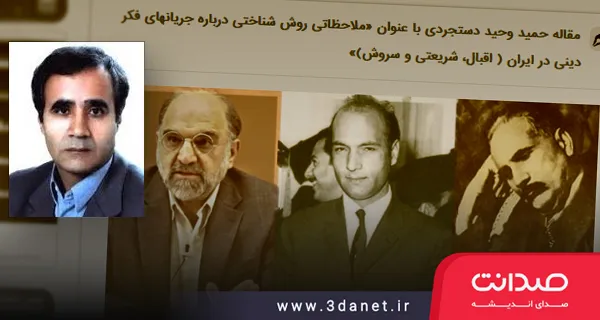
«مقالهی زیر در پاسخ به مقالهی آقای دکتر حمید وحید دستجردی (ملاحظاتی روش شناختی درباره جریانهای فکر دینی در ایران )، که در مهرنامهی شماره ی 34 انتشار یافته بود، فراهم آمد و به آن نشریه ارسال شد و در بالای آن نوشته شد که:
تحریریهی محترم مهرنامه،باسلام و ارادت، مقالهی زیر در پاسخ به یکی از مقالات مهرنامه ی شماره ی 34 ارسال می شود، امید که پای بندی شما به آیین گفت و گو تسهیلات لازم را برای چاپ آن فراهم آورد. اما نشریهی مذکور از چاپ آن سر باز زد و به جای آن، در سالگرد شریعتی به تبلیغات مرسوم خود علیه او پرداخت و حرف های همیشهی سردبیر را – این بار با عکس و تفصیلاتِ استثنایی بر روی جلد نشریه- انتشار داد! این همان نشریهای بود که سردبیر آن ادعای پایبندی به گفت و گو و پرسشگری داشت و در صفحهی اول آن می نوشت: «راهی جز گفت و گو نیست» و دعا می کرد که «در دولت جدید گفت و گو با همه ی روشنفکران ایرانی گسترده شود.»(مهرنامه، همان شماره) اما اینک که مقالهی آقای دستجردی به فضای مجازی راه یافته و دوباره، این جا و آن جا میچرخد، این نوشته را در کنار آن میگذارم و داوری را به مخاطبان میسپارم.
معضل منتقدان شریعتی
محمود درگاهی
بیشتر منتقدان شریعتی در تفسیر آثار و اندیشه های او گرفتار معضلها ودشواری های متعددی بودهاند که پرداختن به یکایک آنها فرصتی فراخ میطلبد و خارج از حوصله ی این مقاله است، اما در این میان، اصلیترین معضلاین نقد نویسان، ناآشنایی با اندیشه و آثار شریعتی و نیز زمینهی کار و اقتضائات روزگار او بوده است. این نقص در نقدنویسیهای چند دهه ی اخیر همواره تکرار شده است؛ چنانکه درآخرین نقدهای نوشته شده بر شریعتی هم، که برخی از آن ها میکوشند تا وجههای علمی و آکادمیک به خود بگیرند، این نقص، نمایان وآشکار است و از آخرین نمونههای آن ، مقالهی آقای حمید وحید دستجردی[1] در شمارهی 34 مجلهی مهرنامه است. این مقاله، برخلاف دعوی نویسنده ی آن، که آن را «ملاحظاتی روششناختی » نام داده است، نه روش شناسی دارد و نه چیز دیگر، و افزون بر معضل یاد شده در بالا، از نقص و اشکال ساختاری نیز آسیبدیده است! در این جا با نوشتهای مواجهیم که همچنان سنّت و شیوه ی نقدنویسان پیش از خود را تداوم میبخشد؛ یعنی نه از متنهای مورد انتقاد خود اطلاعی دارد، و نه پایبند ارائهی سند و مدرک در روایت های خود است و نویسنده ی آن، چنان که خود در آغاز نوشته اذعان میکند «سالهاست که جریان فکر دینی در ایران را بهصورت جدی تعقیب نکرده است.» (همان جا) البته دانسته نیست که این سالها، چند سال بوده است؟ اما از نوشتهی او چنین استنباط میشود که پیش از آن هم این جریان فکری معاصر را بهصورت جدی مطالعه نکرده است! و با این وصف، دست به نقد و تفسیر آن می زند و خود را مجاز به نقد چیزی میداند که بر سر آشنایی با آن وقت چندانی نگذاشته است و در نتیجه نقدی می نویسد که هرچند برخلاف بسیاری از نقدهای نوشته شده در این زمینه ظاهری موجّه و متدیک نشان میدهد، اما در واقع نه متدولوژی دارد، و نه پایبند قاعدههای یک نقد علمی است و این هم تفصیل ماجرا:
1- Mr. Vahid Dastjerdi's article is titled 'Methodological Considerations on the Currents of Religious Thought in Iran'; consequently, it should examine the interpreters of religious thought in Iran. However, this examination begins with a description and report—not a critique and interpretation—of the views of Iqbal Lahori, a thinker belonging to the subcontinent and not Iran! And although the translation of his views has influenced some religious currents in Iran, if the basis of the work is to examine the current of religious thought in Iran, Iqbal is not an Iranian thinker. What methodical research can rely on such irrelevant examples and then bring its results to a conclusion? When we speak of the currents of religious thought in Iran, we mean that we are thinking of the birthplace of this current, and not of every religious writing that has entered Iran from corners of the world through translation. If we examine the current of religious thought in this way, we will inevitably have to involve other thinkers—such as Sayyid Qutb, Maududi, Nasr Hamid Abu Zayd, or others—some of whose works have been translated even more than the works of Iqbal Lahori, in this current.
Furthermore, what has been criticized and examined in this article is not the 'current of religious thought in Iran.' This title could encompass the entire history of religious thought in Iran, from the beginning to the present day, and not be limited to the works of three contemporary religious scholars, one of whom is Pakistani! The title of this piece should have been 'Considerations on the Views of Three Islamic Thinkers,' and not even 'Currents of Religious Thought in Contemporary Iran'! Because one cannot speak of the current of religious thought in contemporary Iran and overlook Bazargan, Taleghani, Peyman, the People's Mojahedin, and later Shabestari, Malekian, and... and even traditional currents of religious studies like Tabatabai, Motahhari, Nasr, and so on. Therefore, this examination of religious thought is, in this respect as well, incomplete and unfinished.
2- These 'Methodological Considerations' are also devoid of any methodological consideration, and in addition to the main error of the article to which we have pointed, it commits a greater error in examining Shariati's views; because to prove and explain what it calls the 'Shariati Problem' and imagines to be a new scientific discovery and invention, it cites only two of Shariati's lectures, namely 'Expectation, the Religion of Protest' and 'Fatemeh is Fatemeh,' and even then, only fragments and excerpts from these two lectures or even general references to them! Whereas adherence to 'methodological considerations' requires that, instead of citing such scattered fragments, the main lines of thought, the foundations of thinking, and especially the course of the evolution of the views of a thinker like Shariati be explained. Shariati is a thinker who has nearly forty volumes of collected works. Some of these works are interpretations of the main lines of his thought, such as Mysticism, Equality, Freedom; some of them are his scientific research and religious studies findings, such as Islamology in Mashhad and Islamology at Ershad; some of them are his interpretations and hermeneutics of religious discussions and topics, such as the very two books 'Expectation, the Religion of Protest' and 'Fatemeh is Fatemeh,' or Hajj, Martyrdom, Ummah and Imamate, and so on. In addition to this, Shariati's thought, by his own admission, was constantly in motion, correcting and interpreting itself, and even providing explanations to prevent misreadings and abuses of it. Can this movement, correction, and explanation be ignored and then, relying on two of his lectures, speak of 'methodological considerations' regarding him? Where in Mr. Dastjerdi's writing has this methodology been lost so that it is not visible to anyone? How can one interpret the writing of someone who, borrowing the language of Gurvitch and describing his own state, said: 'Throughout all these years, I was thinking and changing, and not that I had been left in the refrigerator to freeze,' by relying on fragments of two lectures, and determine his fate? Even if this method of work yields results in examining and recognizing the views of some other thinkers, it is fruitless in examining Shariati's thought!
3- Shariati's critic, just as he conflates the subcontinent with Iran in his examination of "religious thought in Iran," also conflates the intellectual currents within Iran from different periods with one another. While he intends to address Iqbal, Shariati, and Soroush, he suddenly emerges amidst other currents of religious thought, without naming those currents and without having informed the reader unfamiliar with these subjects beforehand: "In these years, the religious intellectual has been more in pursuit of self-validation than in presenting precise propositions concerning the issues of religious thought and striving to solve the problems that may arise from offering a religious interpretation of the world. For this reason, most discussions in the sphere of religious intellectualism are so-called meta-subject discussions. Discussions such as whether religious intellectualism is possible [?] or whether authenticity lies with religious intellectualism or with religious new-thinking [?] and discussions of this sort, such as whether religious intellectualism is something like metallic verjuice]?[" (ibid.)
A reader unfamiliar with the intellectual discourses in today's Iran would think that all these phrases are descriptions of Iqbal and Shariati, and especially with the explanation the author provides in commentary on the above statements, the conflation of the matter is completed: "In explaining the above statements, I will attempt to engage in a methodological analysis of three prominent figures of religious intellectualism, Iqbal, Shariati, and Soroush, and recount their differences from a methodological perspective" (ibid.). But one must ask the author of this methodological analysis what those—in your words—discussions have to do with Iqbal and Shariati? Such debates were neither relevant nor had they arisen in the era of Iqbal and Shariati, for the exigencies of their time were something else. Addressing Iqbal and Shariati with such preliminaries is not only not a methodological analysis, but is precisely an anti-scientific and anti-methodological act, and even a mockery of thought, analysis, method, rule, and law! And the result of this work is that all of the author's claims turn out to be baseless and incorrect. For example, by conflating these currents, it is written that "unlike religious thought in the West, which still seriously draws nourishment from its historical past and background, religious intellectualism [in Iran] has resorted to a complete break from its past. In discussions related to religious intellectualism, one can hardly find a positive sign or reference to the Islamic cultural tradition. Discussions concerning cultural and intellectual traditions have mostly been negative in aspect, aimed at negating and ignoring the relevant traditions." (ibid.)
These baseless claims are full of error, contradiction, and injustice. The author of these lines does not realize at all that if religious intellectualism had reached a complete break from its past, it would no longer be a religious current, and the difference between this current and other intellectual currents—the leftists, the secularists, etc.—lies in its being religious, which is a sign of its lack of a complete break from its past! More importantly, this claim is entirely baseless, especially regarding those figures of religious thought he examines, for among them, Iqbal, whom the critic himself accepts as having a different approach from Shariati and Soroush, and whose works are also full of signs of his reliance on religious and Eastern culture and traditions. Shariati, too, with his proposal of "extraction and refinement of cultural resources," "return to the self," and the exposition and interpretation of dozens of religious and cultural subjects, and his invitation to them, has demonstrated his commitment to the religious values and intellectual heritage of his land! That leaves Soroush, who apparently must be more severed from his past than these two. But this too is the appearance of the matter, for Soroush's astonishing mastery of the culture, religion, mysticism, and literature of his land, and his reliance on them throughout his works, leaves no room for such doubt! Consequently, the question for Shariati's critic is: how can those irrelevant statements be made a prelude to a "methodological analysis" of these three prominent figures of Islamic studies? Let alone the fact that in Mr. Vahid Dastjerdi's writing, no trace of analysis is to be seen either! To prove this point, I refer everyone to his writing, especially to what he has presented about Iqbal Lahori, which is a dry, bare, incomplete, and unfinished report of the book "The Reconstruction of Religious Thought in Islam" and nothing more!
4- Relying on these methodological considerations!, the critic of Shariati approaches the "Shariati predicament" and writes: "My discussion of Shariati will be more extensive — and of course it is not, and even his entire article is not extensive, and in total is less than 4 pages of the journal — the reason is that Shariati is a turning point in the history of religious thought in Iran. He has also provoked two completely different reactions towards himself during his life and after his death (after the revolution). Shariati lived at the peak during his lifetime, and even his death helped strengthen his myth. I think this is the greatest achievement a thinker can wish for in his lifetime: that his words become the criteria for truth and falsehood. But the reactions to Shariati, after the revolution and his death, were different. After the revolution — with a gap of a few years — society's excitement towards Shariati subsides, and people find less motivation to refer to Shariati. How can this difference be explained?... Where was the flaw in his work? On the other hand, despite this reaction, it is still difficult to completely reject Shariati, and despite distancing from him, one still cannot help but find him inspiring and heroic, and not be captivated by his words. How can these inconsistencies be explained? I call these inconsistencies the 'Shariati predicament.'" (ibid)
Now, let us reflect a little on this "description of the predicament" and then move on to the author's other claims. That Shariati is a turning point in the history of religious thought in Iran, and ] of course in general [ has provoked two different reactions to his thought, and lived at the peak [of fame and popularity] during his lifetime, and the manner of his death also somewhat added to this popularity, is all true to some extent. But that Shariati wished for such fame and popularity, and was enamored with his words becoming the criteria for truth and falsehood, is entirely unjust and incorrect and stems from unfamiliarity with Shariati's character and disposition! Anyone who has read Shariati's private writings, and knows his ideas and aspirations, knows how contemptible and worthless these wishes of Mr. Dastjerdi were in Shariati's view. He described all his concerns in his private writings, and according to those writings, thinking about fame and renown was unbearable, and even painful and repulsive to him. Shariati should not be considered of the same ilk as those intellectuals who have often striven for fame, renown, and self-promotion, rather than describing the pains of their society and its people. This is a great error in understanding him, and I do not know from which part of his works the critic of Shariati has derived this one characteristic? Because, precisely from the same point where the psychological gratification of some intellectuals or scholars begins, namely engaging in praise and description of their thought and works, it is precisely from this point that Shariati's mourning also begins, and he finds tolerating such definitions and descriptions difficult and painful for himself! (See: Solitary Conversations) This incident, too, that in a period of contemporary history, his words became the criteria for truth and falsehood, was contrary to Shariati's enlightening and consciousness-raising concerns! If he had such concerns, certainly, the generations of his audience would have seen through him and turned away from him. Shariati did not want his thoughts to become the criteria for truth and falsehood and settle everything once and for all. This is a contemptible and insignificant wish, bestowed upon those enamored with it. Shariati, in his own words, strove to set in motion, to change minds and culture, to teach doubt, questioning, choice, awareness, and freedom of thought..., and for such a person, a thought becoming the criterion for truth and falsehood, even if it is his own thought, is painful and difficult because it is itself a kind of violation of the creed. This truth has been demonstrated throughout Shariati's works as well as his conduct and character. Shariati did not want disciples and devotees; he wanted a conscious, questioning, and truth-seeking audience. That is why he recommended that his words be weighed and considered merely one interpretation and understanding, from one perspective, and not "the criteria for truth and falsehood!" He, as recounted in the reports of his life, gave rein to questionings, reflected upon them, and himself learned points from them, not merely observing a formality or feigning humility and modesty.[2] Where do these concerns stand, and where does making oneself the criterion for truth and falsehood, or taking pride and pleasure in such an achievement, stand?
اما اینکه «واکنشها به شریعتی، پس از انقلاب و مرگ او متفاوت بوده و با فاصلهی چند سال، هیجان جامعه نسبت به شریعتی به شدت فروکش کرده و افراد، کمتر انگیزهای برای رجوع به شریعتی پیدا میکنند.» هم هرچند که تا حدی درست است، با این وصف موضوع باز هم قدری قره قاطی شده است! مرگ شریعتی در سال 56 روی داده، و با این حال او تا سالهایی از دههی شصت، هم چنان بر محافل فکری و دینی سایه داشته است. تعبیر «پس از انقلاب و مرگ او»، نعبیر درستی نیست، زیرا افزون بر خطای تاریخی که ترتیب تاریخی انقلاب و مرگ شریعتی را عوض میکند، واکنشها و پی آمدهای پس از این دو حادثه را هم، از یک نوع نشان میدهد، در حالی که این پی آمدها متفاوت از یکدیگر بوده است؛ یعنی پس از مرگ شریعتی، روی آوری به اندیشه و آیین او گسترش یافته، در حالی که درسالهای بعد از انقلاب، این رویآوری، در اثر عوامل سیاسی، اجتماعی، و فرهنگی پیش آمده، کاهش یافته است. آنچه که در تعبیر این منتقد شریعتی، هیجان خوانده شده، نیز قدری تحریف قضیه است؛ زیرا همه ی آن گرایشها را هیجان نمیتوان خواند، البته آنچه که هیجان است، همان بهتر که فروکش کند و در جریانهایی از هواداران شریعتی نیز چنین هیجانی بوده است؛ اما همه ی ماجرا هم هیجان نبوده است و همه ی ماجرای روی گردانیدن از شریعتی نیز فروکش کردن هیجان نیست! حقیقت این است که در روی گردانی نسل های پس از انقلاب از آیین شریعتی، هم عوامل سیاسی تأثیرگذار بوده است، هم عوامل اجتماعی و فرهنگی و. . . تفکر شریعتی در سالهای آغازین انقلاب، همهی عرصههای فکری را تحت تأثیر خود قرار داده بود، تعدادی از دست اندکاران انقلاب و طراحان نظام سیاسی بعد از آن، این اندیشه را غلط و نادرست میدانستند و در نتیجه برای برچیدن آن تصمیم گرفتند و برای این کار از خطای شریعتی و لغزشهای فکری او سخن گفتند[3] و چون چنین کاری مؤثر نشد، در سال های بعد، به گردآوری آثار او از کتاب خانهها و مراکز فرهنگی دست زدند و حتی کار را به منع چاپ و انتشار برخی از آثار او کشانیدند و سرانجام چاره ی کار را در بایکوت شریعتی و سکوت علیه او دیدند! با این وصف، مهمترین تأثیر را هجوم گسترده ی جریانهای مختلف فکری و روشنفکری علیه شریعتی گذاشت! این جریانهای فکری که از رسوخ شریعتی در اعماق جامعه و از ناکامی خود در این کار، به شدت آشفته و عصبانی بودند ـ از چپ تا راست ـ شروع به تبلبغات گسترده یی علیه او کردند و در این کار حتی همهی دستآورردهای نظام سیاسی بعد از انقلاب را به حساب او نوشتند و از این راه تأثیر گستردهای بر روی نسلهای بعد از انقلاب گذاشتند. زمینه های مساعد اجتماعی و اوضاع فکری جاری در جهان نیز شرایط لازم را برای چنین تبلیغاتی فراهم آورده بود. تحت تاثیر همه ی این عوامل، شریعتی اندک اندک در سایه رفت و آن حضور فراگیر خود را در جامعهی ایران از دست داد. اما این همه به معنی تمام شدن کار شریعتی نبود. زیرا او هنوز هم یکی از پرتیراژترین تأثیرگذاران در جامعهی ایران است، جامعهای که در آن تیراژ مشهورترین نویسندگان به 500 جلد تقلیل یافته است. جامعهای که در آن فرهنگ و فکر و تلاش فکری مرده و آسانگیری و راحتطلبی جای آن را گرفته است. این جامعه در مقایسه با جامعه ی عصر شریعتی یک جامعهی مرده و بی رمق است. بنابراین در چنین وضعیتی سخن گفتن از مراجعه یا عدم مراجعه به شریعتی، بیمعنی است. مگر به آن دیگران مراجعه میکنند که شریعتی از این افتخار محروم مانده باشد؟ چه کسی امروز بیشتر از شریعتی مورد مراجعه قرار میگیرد؟ وقتی میتوان از عدم مراجعه به شریعتی سخن گفت که آن دیگران از کثرت مراجعه کنندگان فرصت سر خاراندن نداشته باشند؛ در حالی که همه ی آن ها از بی کاری مشغول خاراندن سر خود هستند! نقدنویس شریعتی میپرسد که «چگونه میتوان توضیح داد که چرا دیگر شریعتی قانعکننده نیست» خُب به جای شریعتی شما کسی را نشان دهید که برای همه قانع کننده باشد! این چه سؤال پرت و بی ربطی است که میکنید؟ تازه مگر بنا بر آن است که یک نفر برای همیشه قانع کننده باشد؟ در این صورت پس دیگران چه کارهاند؟ البته اگر شریعتی درست خوانده شود و ابعاد متعدد اندیشهی او به دور از تحریف و دورغ شناسانده شود، هنوز هم حرفهای بسیار برای زمانه ی ما دارد، به ویژه برای نسلهایی که در این چند دهه، حرف چندان دندانگیری از کسی نشنیده اند و قهر و رویگردانی آن ها از شریعتی هم، نتیجه ی آشنایی با او و شناخت عمیق او نیست؛ زیرا این نسل با شریعتی از طریق نقدهایی نظیر همین نقد روششناختی، و یا مقالات مغرضانه ی نشریه هایی مانند مهرنامه آشنا شده است! غیر از این چه میتوانست بکند؟
The author of the critique of Shariati considers this turning toward and turning away as a kind of inconsistency in Shariati's work and has called it Shariati's predicament; whereas this affair, even if it were a predicament, is not Shariati's predicament, but the predicament of those who turn toward and those who turn away. But beyond all this, our methodologist here is himself caught in contradictions and far greater predicaments! On the one hand, he says Shariati is no longer convincing, and on the other hand, he says that "it is difficult to completely reject Shariati, and despite distancing oneself from him, one still cannot help but consider him inspiring and a hero, and not be captivated by his words." How can someone not be convincing and yet remain inspiring and a hero? Is this double-dealing and hedging not a sign that the author still does not know what to write in describing Shariati?5- Now let us see how this methodologist critic resolves the predicament of Shariati. Addressing the "predicament of Shariati" leads Mr. Dastjerdi to examine and critique Soroush's views in interpreting Shariati's ideology, wherein he makes several valid points regarding Soroush's views, which are valuable in their own right and not to be overlooked. But when he arrives at the predicament of Shariati—and the main weight of his critique of Shariati lies in this very section of his writing—he says: "I believe the 'predicament of Shariati' is rooted elsewhere. Unlike Iqbal, who was bound to the Islam of truth, Shariati is more in pursuit of explicating 'applied Islam' or 'instrumental Islam.' To explain this point, as many individuals have noted, one must consider that Shariati's main goal was to present Islam as a revolutionary theory, and indeed the primary theory of revolution, in opposition to Marxism and the like." (ibid.) As the author acknowledges, numerous critics before him have accused Shariati of instrumentalizing religion, and the author of this critique is in fact repeating their statements; therefore, he should not claim that "in my opinion, the predicament of Shariati is the instrumentalization of religion," because this is not his own particular view, but rather one he has taken from those "many individuals"! Consequently, he should say that he too considers this criticism of him to be correct. But let us move past this dispute and see to what extent the original claim holds truth, and how Shariati made religion an instrument of revolution, or, in the words of other critics, politicized it, and how does the application or politicization of religion occur? And is religion itself a means or an end, anyway?
As I said at the beginning of this piece and have also mentioned in several other writings, the problem of Shariati's critics, besides unfamiliarity with his views, is also unfamiliarity with religion and religious thought, and yet, in criticizing Shariati, they rely on a religion of which they themselves have no knowledge! Otherwise, they would not accuse Shariati of politicizing or instrumentalizing religion merely because of certain socio-political interpretations of it; for religion itself is both political and a tool and means for human beings to attain lofty goals and existential growth and perfection! Of course, religion—as in Shariati's interpretation as well—is a multi-dimensional and composite phenomenon, a mixture of moral guidelines, spiritual values, social and political rulings, and so on. Consequently, parts and elements of it are for application in life and a means for human liberation and the transformation and progress of society, and the history of religion also began with socio-political concerns and attention to the realities of life, and has proceeded by changing the context and conditions of human beings' lives. Thus, religion is not a mysterious, sealed-off spiritual phenomenon that has come solely to be wondered at and bowed before. In the Qur'anic expression as well, religion has come to loosen the bonds and chains from the hands, feet, minds, and consciences of human beings and to transform unjust disparities, injustice, and oppression in their society into equity and justice, and thereby provide the grounds for human beings' growth; therefore, it is a means for liberation and growth, or, in Shariati's expression, a "path"!... In this interpretation of religion, upon which Shariati insists, human beings are not for religion, but religion is for human beings, and this instrumentalization of religion is no defect upon it! That religion which presents itself as unknown secrets and mysteries, where the duty of human beings is to submit and close their eyes and ears before it, is not Islam; it is a mysterious and complex rite and practice whose secrets no one can fathom, nor is anyone supposed to fathom! Unfortunately, the religious knowledge of Shariati's critics—especially in comparison with European Islamologists—is very meager and consequently incorrect! They are not even aware of the religious studies of European Islamologists; otherwise, they would know that renowned religious scholars and Orientalists such as Russell, Stace, R. Keddie, Petrushevsky, Wittfogel, Arberry, Montgomery Watt, and... and especially in recent years, Cristia Patron with her brilliant work, "The History of Political Thought in Islam," have called this religion a political and revolutionary religion, and they have spoken rightly, and those who consider the politicization of religion a great error are, in fact, mistaking Islam for Sufism and ascetic mysticism. Islam is a political religion and has striven to change socio-political equations, and its history shows that parts of the religion and its concerns are a means for lofty and great aspirations in human life, and this being a means is not a defect of religion, but rather a merit! For it is not alien to the lives of its audience and the socio-political conditions of its call. It knows that calling for liberation and perfection to human beings who are trapped in the economic, political, and social chains of their time will lead nowhere without breaking those chains. And imparting spirituality to people whom material livelihood, political power, and cultural disenfranchisement have plunged into degradation will come to nothing. So, to reach these lofty ideals, one must begin from the ground, and ignoring earthly realities is not a sign of perfectionism and transcendence-seeking. But religions and creeds that ignore human beings' immersion in degradation, poverty, and ignorance are ineffective sermons that only serve to narcotize, intensify ignorance, and consolidate superstition, and their presence or absence in the lives of such human beings is one and the same!
Of course, Mr. Dastjerdi offers no explanation as to what the truth of Islam is, of which Shariati's Islamology is supposedly devoid. And where exactly does this truth of Islam reside in the work of Iqbal Lahori? But Shariati, who considered himself a continuer of Iqbal's work, knew how Iqbal's religious studies differed from other schools of religious studies. Shariati had spent years reflecting on Iqbal, and what he found in his creed was a multi-dimensional religion, which he believed the personality of Iqbal and his works represented. Contrary to this misplaced accusation by Mr. Dastjerdi, Shariati did not consider Iqbal a guerrilla; he regarded him as a paragon brimming with love, meaning, thought, philosophy, and culture! Dastjerdi says that Shariati turned Iqbal into a guerrilla. But this is a great lie that Mr. Dastjerdi pins on Shariati, and it is either the result of his unfamiliarity with Shariati's writings on Iqbal — in which case he has no right to address the subject — or it stems from his improper motives to distort Shariati — in which case his writing is devoid of scholarly value — and consequently requires no response. However, since his reader and audience may not detect such a distortion, I will cite here one of Shariati's descriptions of Iqbal's personality — of which there are numerous examples in his writings — so that this audience and reader, while becoming acquainted with these fabrications, may come to know Iqbal through Shariati's words and realize that Shariati did not turn Iqbal into a guerrilla: "It was Iqbal who, after a proper and precise acquaintance with our age, and soaring in the highest horizons of Western thought, and years of mingling and learning in the school of [those] who are the prodigies of the genius of modern culture — such as Hegel, Nietzsche, Kant, Goethe, and others — cast down the invulnerable hero of European thought, philosophy, and culture at the feet of Rostam Dastan of our Book of Kings, Rumi, to blind him with the arrow of the sun of love, and himself, guided by this divine elder, abandoned the soulless, lightless, tuneless steel tower in Paris, and that stone, blind statue of justice in Europe, and heeding the heavenly call of the minaret whose entire being is a throat of outcry, and whose entire life, every morning and evening, is the repetition of a single invitation, the invitation to the ascension of humanity from the mire toward God, set foot on the path of dawn and ascended the white peak, and through the window of daybreak, cast himself into the restless waves of the ocean of mysticism and returned to the East..." (We and Iqbal, 142)
This is the guerrilla Shariati supposedly made of Iqbal! Let the young generation of today see these critiques and think for themselves about the lie that has been prevalent in the critique of Shariati's views for three decades! The astonishing thing here is that Dastjerdi says: Shariati constantly speaks of a paragon that 'ought to be and is not,' and yet accuses him of turning Iqbal into a guerrilla and Fatima (a) into a 'fighter,' without even noticing this self-contradiction! If Shariati is supposed to speak of the 'ought to be and is not' model and think idealistically, then why would he bring Iqbal and Fatima down a notch and turn them into guerrillas and fighters? Guerrillas and fighters were all around him! That would be turning ideal models into ordinary types! Let alone the fact that, fundamentally, one of Shariati's problems was precisely these guerrillas and their guerrilla games[4], and he had repeatedly made scathing criticisms of this mode of thought and political conduct.
Another ignorance in the work of such critics of Shariati is that they accuse him of constructing a 'theory of revolution,' and specifically political revolution, from Islam! Whereas, even if Shariati did construct a theory of revolution from religion, it is a theory of change and revolution in the mind, thought, and culture, not a political revolution, from the various forms of which, and especially its premature type, he repeatedly dissociated himself due to certain existing conditions! And ignorance of these viewpoints is a major flaw in interpreting the thought of someone who repeatedly warned his society against hastiness and, in his own words, the revolutionary and emotionalistic rashness and blunders (M.A., 1/92)!
If Shariati's critics were committed to methodological analysis, they would have taken these statements, which he uttered in the final years of his life, as the basis of their examination, rather than speaking without evidence and seeing no need for documentation to prove their claims! Shariati cries out: I negate all premature revolutions (M.A., 20/500) and think only of cultural transformation and a change in minds (M.A., 4/295), yet these people cover their ears with both hands and still say that he only constructed a theory of revolution from Islam! Shariati was not constructing a theory of political revolution against Marxism; rather, he was presenting a different culture and thought that had deep roots in the depths of his society and, as it happens, also possessed revolutionary and political substance. Nevertheless, his critic, with complete disregard for the subject, accuses him both of severance from his homeland's past and of revolutionary-izing religion, and in doing so, relies solely on one of his lectures—Expectation, the Religion of Protest—as if he knows nothing beyond this!
But let us see how sound this citation itself is? This writer's most important pretext in criticizing Shariati's thought is this very single lecture. In this lecture, Shariati says that "we must see what value this belief in the Imam of the Age holds from the perspective of our social life today."[5] He then proceeds to interpret this issue, arguing that expectation, from a social and political standpoint, is a form of protest against the status quo, and that by raising it in various periods, the Shi'ites intended to negate the existing political systems. His critic, thinking he has found Shariati's Achilles' heel, maneuvers around this lecture and imagines that he has solved the Shariati problem and that henceforth, the task of Shariati studies has become easy. But he pays no attention to the fact that, firstly, Shariati cannot be understood by relying on a single lecture; secondly, this interpretation of expectation was a response to religious people who, using expectation as a pretext, considered every kind of misery and wretchedness natural and even desirable, and in Shariati's words, would say, "Be patient, he himself will come and set everything right." Thirdly, it is an interpretation and understanding of an issue that is susceptible to different interpretations, and it is the right of a religious thinker to present his desired interpretation of it, as long as it does not harm the core of religious belief. Fourthly, speaking of the truth of the Occultation and the issue of natural lifespan and the lifespan of the Imam was neither necessary nor feasible in the context of a traditional society, and addressing it would have yielded no result other than fueling bigotry and sectarian conflicts. Therefore, Shariati saw it expedient to derive a fresh and mobilizing reading from this source of conservatism, superstition, and stagnation. Where is the flaw in this? For instance, if instead of this, he had engaged in a scientific interpretation of it or had left it as it was, would he then have been closer to the truth of Islam? And in this one specific case, what exactly is the "truth of Islam" that Mr. Dastjerdi trumpets so much? I do not think he has anything to show for it! Yet, most astonishing of all is that he says: "I do not think Shariati was even able to show why belief in the Imam of the Age leads to the elevation of the goal of struggle." (ibid.)
But where in this lecture did Shariati speak of the elevation of struggle? He merely presented this new and different understanding of his, that expectation means not accepting the status quo, and this single point is sufficient to set the thought of a religious society in motion. It does not require much intelligence for his audience to grasp his intent from the very three-word title of his lecture—Expectation, the Religion of Protest!
6- Another methodological flaw in Mr. Dastjerdi's methodological critique is the conflation of the revolution and the political events that occurred in Iran with Shariati's thought, and equating the two. Dastjerdi says: "The occurrence of the revolution in Iran provided an opportunity for some social, religious, and political theories to be subjected to judgment and evaluation, such that the confirmation or lack of confirmation of these theories (or at least specific interpretations of them) in experience, more than anything else, indicated their correctness or incorrectness to the educated class. The victory of the revolution entailed widespread social consequences and outcomes, but at the same time, it was an opportunity for the correctness and accuracy of the claims and predictions of pre-revolution individuals and groups to be tested and measured. Everyone was waiting to see what shape and form the promised utopia would take..." (ibid.)
As was shown in the preceding pages, Shariati's thought was eliminated from the post-revolutionary system at the earliest opportunity, and thereafter, it played no role in determining the events that transpired. This is yet another shortcoming in a methodological observation: reading what happened in the years after the revolution as being of the type of Shariati's thought. Of course, Shariati was influential in the occurrence of the revolution and the transformations of the 1970s, but someone who wants to critique Shariati, specifically a methodological critique, and attribute the post-revolution political events to his record, must at least know this truth: Shariati was opposed to premature political transformations, he had no concern for religious government (M.A., 22/196), he called democracy the most Islamic and most humane form of government (M.A., 5/48), and so on. And whenever he knows these truths, he will not attribute what was brought about by the hands of the opponents of his thought to him! Where had Shariati promised a religious utopia, the shape and form of which his critic has seen in the years after the revolution? If this critic knows of such promises, let him not leave his readers uninformed! He only passionately praises the governance style of Ali (AS) and considers it a government unparalleled throughout history in its execution of justice and commitment to human freedom—especially that of opponents—but he does not consider its implementation feasible or possible in our time. This is why, in a marginal note he added two years after the 'Ummah and Imamate' lecture, he considers the system of Ummah and Imamate specific to the first century AH and limited to the Twelve Imams: "Imamate is not a permanent system. It is a regime that, in any form, according to the belief of Twelver Shi'ism, is limited to the era of twelve specific individuals, and there is no doubt that there are no more than these [twelve individuals]. Therefore, it cannot be a permanent regime, for if it were, its individuals could not be specified in this lineage... Secondly, it pertains to a specific period of social evolution, namely the period of the city and the Islamic society of the seventh and eighth centuries [AD]" (M.A., 15/42). And for the new world, he considers democracy the only solution, but since he finds its realization impossible in backward countries and sees achieving it as requiring difficult prerequisites, he proposes a committed revolutionary democracy for a transitional period—something that, in Shariati's view—as in the view of a number of political leaders of his era—was implemented only to achieve democracy.
7- The final claim of this methodological article is that "Shariati's historical figures bear little resemblance to reality." (ibid.) And since he himself anticipates the possibility of this claim being baseless, he adds that "or at least there is no evidence at hand for this resemblance." (ibid.) Then, when he wants to cite one of Shariati's works, he says: "The beautiful image Shariati paints of Hazrat Fatemeh in 'Fatemeh is Fatemeh' bears little affinity with the historical Hazrat Fatemeh." And he adds again that "or at least he provides no evidence for this affinity." (ibid.) But after that, he makes his claim somewhat grander and says: "What he depicts in this book is the image of an ideal woman who could be anyone; even if we swap the feminine pronouns with masculine ones, the book could be about an ideal man." (ibid.)
Our critic’s claim is that “Shariati was not overly concerned with the correspondence of his historical explanations to historical facts, and this is entirely consistent with his core methodological principle. It does not matter how much his Fatemeh corresponds to the historical Hazrat-e Fatemeh. What matters is the extent to which the description provided can serve the advancement of the struggle’s goal. Shariati did the same thing in the book Iqbal and Us [actually Us and Iqbal]. The Iqbal described in this book is a political activist, an anti-colonial fighter, and a guerrilla, and of course any other activist could have been the referent of this book. In this way, Shariati permits himself to reconstruct all historical references. It does not matter how much they correspond to reality; it is sufficient that accepting them leads to the advancement of the revolution’s goal.” (ibid.)
I have previously demonstrated Iqbal’s being a guerrilla, and I will also demonstrate the measure of validity of Mr. Dastjerdi’s other claims by referring to the book Fatemeh is Fatemeh, and then we will see that it is this critic of Shariati who has permitted himself, without even consulting the two aforementioned books, to write whatever suits his critical intentions against Shariati, and sees no need whatsoever for a single reference or the provision of an example! But before that, it is necessary to point out that some of the sentences in this one paragraph are completely copied from Fatter than Ideology, and only the referent indicated by the author differs from its referents.
Mr. Dastjerdi’s first claim in this paragraph is that Shariati’s interpretation of Fatemeh’s life and personality does not correspond to historical facts. Yet he does not deem it necessary to demonstrate this lack of correspondence by providing even a single historical fact, or by citing a historical text, and merely speaks in generalities! Whereas Shariati, at the very beginning of this same book, says: “The present treatise contains a documented account” of the life of Fatemeh (PBUH), and in its reporting and writing, “my primary reliance has been on ancient historical documents.” (Fatemeh is Fatemeh, p. 4) It is obvious that neither Shariati’s faith—which his critic also acknowledges—would permit him to deviate from the realities of Islamic history, nor would the critics and opponents of his day, who constantly monitored his behavior and speech and, in confronting Ershad, were—so to speak—splitting hairs, have allowed him to fabricate a Fatemeh without evidence and from his own imagination, and then claim reliance on the most ancient historical documents! Just as Fatemeh is Fatemeh, in this respect, provoked no controversy or uproar, and it was even well-known that one of the traditionalist jurists—the late Meshkini—had greatly admired it! But the error of Shariati’s critic lies in confusing a lecture with historical research. A lecture is the presentation of an interpretation or exegesis of a specific subject, and for such a task, providing references is not always necessary. As can be seen in most lectures (such as the lectures of Isaiah Berlin or Thomas Mann, etc., or the intellectuals of today’s Iran). A public lecture differs from scientific and historical research and even academic seminars, although it may sometimes rely on historical documents. Even if Dastjerdi had reviewed the introduction to Fatemeh is Fatemeh for writing his critique, he would have seen that, as it happens, Shariati had come to Ershad to present a scholarly report on “Louis Massignon’s research on the complex personality of Hazrat-e Fatemeh (PBUH)” (ibid., p. 2), but upon seeing the composition of the gathering’s attendees, he changed the subject of his lecture and presented it in a more general form. That being said, throughout his lecture, he strives to remain faithful to historical realities and documents, and even where he deems it necessary, he provides references to such documents. (For example, see: pp. 10, 116, 117, and 111, etc.) To the extent that he does not even forget to mention some minor points. In this examination of his, he possesses such scholarly concern that he even went looking for a map of Ali and Fatemeh’s life at one point (ibid., p. 147). How could such a person reconstruct historical references? Unless he intends to distort the matter?
Although a lecture has its own particular requirements, and in delivering it certain historical subjects must be elaborated and brought closer to contemporary language and culture, in none of Shariati's elaborations are the historical facts altered. In the book Fatemeh as well, there is not a single unsubstantiated claim. Yet Shariati's critic, who finds fault with him from this angle, himself offers not a single piece of evidence in his critique of Shariati's book, and contents himself merely with generalizations and vague insinuations! A lecture must be critiqued according to the protocols and principles of lecturing, not with scholarly and scientific foundations, and Shariati's critic overlooks this point!
Shariati's concern in this book is, above all, to fill the void of a text about Fatemeh (AS), but a text that presents a picture close to reality of the Prophet's daughter's life and strips away the superstitions and superfluous or fabricated myths of friend and foe from her character, thereby offering a model of life and belief for the women of his time. Therefore, such a model cannot be turned into a man by changing the pronouns. I do not know who first raised this issue of 'changing the pronouns' and set it in circulation, so that afterward it became a pretext for those who, whenever they have nothing to say, resort to it to discredit a text or its critique. But even if some have occasionally been able to benefit from this pretext, Shariati's critic has employed it very clumsily in this piece, because Shariati's descriptions of Fatemeh are so interwoven with feminine characteristics and values that changing her name and pronoun to a masculine name and pronoun ruins the entire subject along with many historical facts. For instance, reflect on these descriptions and accounts by Shariati of Fatemeh, in which he seeks to speak of the transformation of feminine values among the Arabs of the Prophet's era, and then see what calamity befalls the book's content if, as this critic of Shariati advises, we change them to masculine pronouns: 'With Fatemeh, the daughter, as the inheritor of her family's glories, the possessor of her ancestors' values, and the continuation of the lineage of descent and prestige, replaces the son.' (p. 119) Or 'Now a daughter becomes the criterion of her father's values—previously only sons had been the criterion of these values—the last daughter of a family that was waiting for a son.' (p. 118) Or 'The Prophet's behavior toward Fatemeh signifies more than the affection and caressing of a daughter by her kind father. A father kisses his daughter's hand—previously fathers buried their daughters alive—and his youngest daughter at that... Such behavior from the Prophet teaches all human beings, and human beings of all times, to free themselves from historical and traditional customs and illusions; it teaches man to descend from the throne of his harsh, pharaonic arrogance and tyranny before woman, and it indicates to woman that she should ascend from her ancient and modern degradation, where she is merely a plaything of life, to the lofty peak of human splendor and dignity.' (p. 120, and also see: pp. 128, 131, 132, 134, 136, 139, 149, etc.) Now change the names and pronouns and see what an uproar ensues? With this description, I could not make sense of Mr. Dastjerdi's other claim: if Shariati's description of Fatemeh presents the image of an ideal woman, how can an ideal woman be transformed into an ideal man by changing the pronoun? If he could guide us in this matter, we would be most grateful!
8- This methodological critic, who imagines that all of Shariati's interpretations can be unlocked with the key he provides, also considers Shariati's criticisms of philosophers such as Ibn Sina to be the result of Shariati thinking about revolution, and says: "Shariati's methodological principle can explain his usual impatience with philosophers and theologians, such as Abu Ali. In his view, truth is not attained through scholarly discussions and philosophical scrutinies. One must see to what extent the claim in question can contribute to the advancement of the revolution's goal." (Ibid.) These criticisms, written based on one of Shariati's interpretations of the philosopher and philosophy, are correct to some extent. Shariati considered philosophical work to be an abstract and mental endeavor that never leads to truth, and he contrasted it with prophetic work or intellectual work, which, in society, is interwoven with the pain and suffering of the masses and, in solitude, through inner reflection and connection with the source of truth, can lead somewhere. This abstract and mental condition of philosophy has been repeatedly ridiculed by intellectuals whose hearts were tied to society and the lives of its people; a famous example is Nima Yushij's mockery of Mir Damad and his philosophy.[6] But the truth is that Shariati mocks traditional philosophy not because it is of no use to the revolution—we saw that Shariati did not conceive of revolution in the way his critic posits—but because it is of no use to life and is caught up in its own mental and abstract preoccupations and abstruse terminology; and if a philosophy does not suffer from these ailments—like some contemporary philosophical schools—Shariati has no problem with it. As in his works, he repeatedly affirms and recounts views from contemporary Western philosophers and appreciates the socio-political concerns of some of them, such as Sartre. Furthermore, Shariati's criticism of Ibn Sina also targets his dependence on political power, and Shariati says that through this dependence, Ibn Sina reduced himself to the level of a state fountain pen and ruined the value of knowledge and thought, whereas he could have preserved his value and freedom by relying on his knowledge. That being said, this criticism, which has inflamed many pretext-seekers and given them a pretext to attack Shariati as much as they can, accusing him of radicalism, extremism, and ignoring science, civilization, and philosophy, is far milder than the criticism leveled at Ibn Sina's work by a contemporary researcher of philosophy. The aforementioned researcher, in his monumental philosophical work, with admirable mastery, has examined all the ancient philosophical schools and figures of Iran—as required by his work—and without thinking of revolution or being preoccupied with ideology, and solely through historical and philosophical inquiry, has reached a point in his critique of Ibn Sina that Shariati himself had not reached! He has accused Ibn Sina of "misuse of Greek philosophy and Iranian rational principles," "megalomania," "mental dullness and stupidity," and even "crookedness and philosophical theft," "insolence, deceit, trickery, espionage, conspiracy, and treason in favor of the government..." and to avoid prolonging the matter, I end this writing here and refer seekers of truth in this regard to the mentioned book: Azkaei, Parviz: Hakim Razi, Natural Wisdom and the Philosophical System of Mohammad ibn Zakariya al-Sayrafi, Tarh-e No, 2005, pp. 762-767
.
.
[1] A few months after writing this article, we were one day at the home of Professor Shafi'i Kadkani. When the doorbell rang, the professor rose to greet the guest and introduced the newcomer thus: Dr. Vahid, the philosopher. Those present rose in respect for this great philosopher... A few minutes passed. Dr. Vahid spoke a little about his work and contemporary philosophy... One of those present asked: "By your definition of philosophy, who in Iran today can be called a philosopher?" He replied: "Anyone who has published a few reputable articles at the global level." He was asked who had written such articles. The answer came: "Myself and two or three of my young colleagues at the association of..." He was asked: "Besides you?" He said: "I know of no one at that level!... For instance, Seyyed Javad Tabatabai? I have heard his name, but I do not know him." A few more minutes passed, and other topics were discussed. In the midst of this, Dr. Vahid, addressing Professor Shafi'i, said that Iranian intellectuals know nothing of the West and that is why they fall into error when confronting it. The professor appeared to confirm this statement... With that, I began to doubt his being a philosopher right then and there! For how can a philosopher, an analytic philosopher at that, make such sweeping generalizations and lump all Iranian intellectuals together in the face of the West, so to speak? These intellectuals fall into at least three major currents—opponents of the West, proponents of the West, and critics of the West—and our philosopher, whatever his creed, would logically have to align with and agree with one of these three currents!... A few more minutes later, Dr. Vahid rose to say goodbye, and the professor saw him out, and just after closing the door behind him, he said that he was Dr. Hamid Vahid Dastjerdi. Having just then placed this analytic philosopher, I told Professor Shafi'i about his shallow critique of Shariati's views, but alas, it was far too late!
[2] After the revolution, a mechanic from Zanjan who also had some studies in theology recounted that he had attended one of Shariati's classes, and when Shariati began interpreting a sentence from the Nahj al-Balagha, he interjected during Shariati's talk, saying that he thought one interpretation of that sentence could also be: . . . Upon hearing this, Shariati praised him, noted his explanation in his notebook, and said, "Bravo to you, such a thing had never occurred to me!" Those who were around Shariati witnessed many such scenes.
[3] The affair began in the very days of the revolution. On 6 December 1977, the late Bazargan, together with the late Motahhari, issued a joint statement in which they warned readers of Shariati's works about his errors, intending to purge his thought and works from post-revolutionary society! This statement was issued with such haste, in such a rushed and unexpected manner, that it recalled the warning notices from the health department cautioning people against consuming contaminated and poisoned foodstuffs distributed nationwide! And of course, this act, due to the dominance of Shariati's thought in Iran at that time, inflicted irreparable damage on the political and intellectual standing of Bazargan and Motahhari! Examples of such efforts were repeated many times in subsequent years, in various forms and from different factions.
[4] How can these ideas be reconciled with guerrilla and armed struggle ideologies? Even if Shariati said something in favor of the armed approach, it was in fact out of necessity and to express solidarity with the guerrillas of his time, and nothing more! I do not know why Mr. Mohammad Mehdi Jafari fell into the trap of the Mehrnameh people, so that they could extract from him the statement: "Shariati advocated armed struggle?" (Mehrnameh 36)
[5] Professor Mostafa Malekian, in interpreting the meanings and instances of secularism, considers one of them to be the efficacy of religion in the world. (Tape: Personal Experiences)
[6]. See: Nima's Collected Poems, poem: I have heard that Mirdamad / When he chose the foundation of the homeland's soil ...
.
.

Discussion2 comments
« مهرنامه »ای ها روشنفکرانی روشنفکر ستیزند و کین گستر ؛ دشمنی آنان با شریعتی که قلم را توتم خود می دانست و نوشته بود « بیندیش چه می گویم پیش از آن که بیندیشی که چه بگویی » ، خلاف انتظار نیست ، هر چند گاهی فکر می کنم آنان ـ روا یا ناروا ـ از کسان دیگری دلخورند و چون نمی توانند آن ها را نقد کنند ، به بهانه نقد شریعتی ـ که لابد دیوارش کوتاه است یا دیوار ندارد ـ ، حرف خود را می زنند . بهترین نقدها بر شریعتی را کسانی نوشته اند که متأثر از او بوده اند و از او آموخته بودند که از « تقلید » بیزار باشند .
سلام به جا بود جناب درگاهی در این مقاله آنچه را دکتر شریعتی به دلیل فضای سخنرانی ها کم گذاشتند جبران می کردند و مثلا برخی مستندات کتاب فاطمه فاطمه است را می آوردند.آقای پرویز خرسند همفکر و همراه دکتر شریعتی در برنامه شوکران شبکه چهار به صراحت گفته اند ایشان در پاسخ به این درخواست منتقدین که مستندات تارخی مدعیاتش را ارائه دهد به گفتن این جمله اکتفا کرده است که "مگر سوز و صداقت مرا نمی بینند همین کافی نیست." که البته بدیهی است که کافی نیست. وقتی محل نزاع مستند نبودن ادعاهای تاریخی شریعتی است استاد به گفته خود وی که مستند سخن می گوید، بی آن که مدرکی ارائه دهد، مشکلی را حل نمی کند. اگر از ماسینیون و دیگران هزاران برگ تحقیق درباره چهره های اسلامی به جا مانده و مدام به آن ها تمسک جسته می شود جای آن است این برگ های برنده رو شودو یک بار برای همیشه در معرض ارزیابی قرار گیرند.شاید سرانجامی بهتر از کتاب مغز متفکر جهان شیعه مرحوم ذبیح اله منصوری نداشته باشند.