Political Science
Malekian and the Theoretical Foundations of Reformism
Mostafa Malekian defines reformism as democratic, peaceful, and gradual social change resting on four presuppositions: from the inefficacy of the status quo to the avoidance of solutionless utopias and a reliance on objective beliefs in reforming institutions.
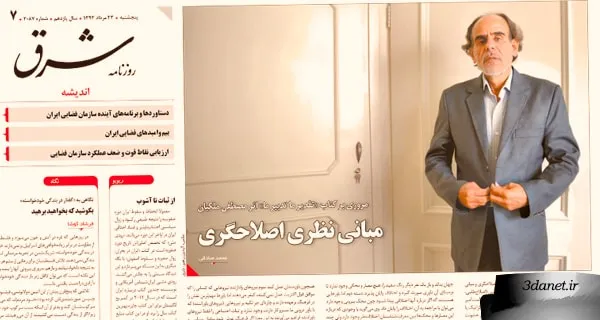
Mostafa Malekian, in his book Taqdir-e Maa, Tadbir-e Maa (Our Fate, Our Prudence), addresses the subject of reformism and the theoretical foundations of reform-seeking. He begins with a definition of reformism (reformism is advocacy for social change using a democratic, peaceful, and gradual method) and adds: 1- The method of social change must be democratic or based on popular sovereignty, 2- This social change must be carried out peacefully and without violence, 3- It must be gradual, not sudden and instantaneous. He divides opponents of reform and reformism into two categories: 1- Opponents of change, 2- Proponents of change. With this classification, he places those who wish to preserve the status quo and those who seek to revoke the changes that have been achieved (retrogressives) in the first category, and those who desire undemocratic (top-down), non-peaceful (violent), and non-gradual (sudden and instantaneous) change among the opponents of reformism in the second category. He then attempts to answer the important question posed at the beginning of the book (What presuppositions do the theoretical foundations and proponents of reformism have, and what are their theoretical foundations?). He states that the first presupposition of reformism is that the existing situation is not the desirable situation. For this reason, reformists seek change. The reasonable probability as to why the existing situation is not desirable is, in his view, clarified by the argument that what exists could be the result of ignorance, ill intent, or error, and is therefore defensible. Thus, those who oppose this presupposition must prove that the grounds for ignorance, ill intent, and error have been entirely eliminated; that is, the human beings who constitute our society no longer suffer from ignorance, ill intent, or error, or that while the grounds for ignorance, ill intent, or error have not been entirely eliminated, these three factors have had no effect on our current situation. On this basis, it can be said that we are distant from the desirable situation. He also provides a definition of these three factors: "Ignorance is when I do not know something, and this not-knowing of mine may have been effective in what I do and the social order I bring about. Ill intent is when I do not have a pure intention. I will say in brief that we lack ill intent in only two states: one is when our intention is the discovery of truth; the other is when our intention is the reduction of the overall pain and suffering of human beings. Any intention that is not an instance of one of these two can, to varying degrees, be considered a case of ill intent. Error is when I do not know, but I do not know that I do not know. In error, I consider something to be true that is not true; I consider something to be expedient that is not expedient. The state of error is even more difficult than the state of ignorance. Ignorance is in fact a single ignorance, but error is a double ignorance, and for this reason our predecessors called error compound ignorance or double ignorance. In ignorance, a person says, I do not know whether A is B or not. But in error, they say, I know that A is B. While in reality this is not the case. That is, they neither know that A is not B, nor do they know that they do not know that A is not B." In his view, if the probability of error, ignorance, and ill intent is a reasonable probability, then this situation must change. In the second presupposition, Malekian considers the existence of a utopian blueprint for which a path to reach it has also been specified to be outside the framework of reformism, and with this presupposition, he distinguishes the path of reformists from the path of those who believe in non-peaceful and violent changes (as well as a utopian blueprint). Here he addresses an important point, that these two matters must be separated and then examined: "One is that a utopian blueprint exists, and the other is that a path is found to reach from the existing non-utopian situation to the desirable utopian situation." In his view, the most important problem for all those who have imagined utopias has been presenting the path that must be traversed to cover the distance between the existing situation and the desirable situation. Reformists believe that those who present a utopian blueprint and those who place a path to reach it before us can neither prove the truth, nor the justifiability, nor the reasonableness of their own opinion. Hence, we cannot submit to an opinion whose truth, justifiability, and reasonableness are not clear to us. Because none of those who believe in a utopia have been able to provide a reason for it and for reaching it that demonstrates the justifiability and reasonableness of their claim. In the third presupposition, he emphasizes that one must not dismantle all institutions based on theoretical and ideological goals. Because those who believe in revolutionary and non-peaceful methods act in this way based on their own theoretical and ideological goals, whereas these goals are theoretical and have not been tested in the arena of practice, and are ideological, and one cannot provide a reason for the correctness of these goals.
He adds: “Although in the first presupposition we said it is possible that all institutions and the social order are the result of error, ignorance, or ill intent, there is always the possibility that in a particular order, even in a small part, we are dealing with something that is not, in fact, the result of ignorance, error, or ill intent.” The fourth presupposition is raised with the question: on what basis should these non-revolutionary changes take place? Malekian says all our beliefs are divided into two categories: 1- Subjective or internal beliefs 2- Objective or external beliefs. Beliefs of the first category are those about which, if a disagreement arises, this difference of opinion cannot be resolved, because in these beliefs there is no criterion, touchstone, or scale that would satisfy both parties to a single judgment. For example, if someone says blue is the most beautiful color in the world, and another person considers green the most beautiful color in the world, and yet another person considers white, there is no criterion or touchstone on the basis of which to judge and end the disagreement. The second category, however, consists of beliefs about which, if a disagreement arises, since an external touchstone exists, the disagreement can be ended by referring to it. He says that although there is disagreement among epistemologists about these criteria and touchstones, several have been accepted as arbiters: 1- Sense perception 2- Reason, in the sense of the power of reasoning 3- Memory (with two conditions, of course: first, that it be real memory, not apparent; second, that it be collective memory, not individual) 4- Intuitions 5- Testimony 6- Introspection. He goes on to say that objective beliefs are also divided into two categories. One category is external beliefs whose scale theoretically exists but, in the current state of human knowledge, has not yet come into being. For example, when the disagreement is about whether oxygen exists on a planet five billion light-years away from Earth. Here, the disagreement is not over a subjective matter, nor is it a matter of taste, preference, likes, or dislikes. It is possible that human knowledge, with the passage of time, could discover it. This type of matter is potentially objective, meaning their scale is potential. But sometimes the disagreement is over an objective matter for which the scale of judgment exists right now; for example, when the disagreement is over whether a type of mushroom is poisonous or not. This disagreement over an objective matter is resolvable in a laboratory. Malekian then considers the impact of these beliefs (subjective beliefs and objective beliefs: potential and actual) on private and collective life to be examinable. To make actual objective beliefs the basis for decision-making in social life, there is only one way, and that is to refer to the criterion and judgment that demonstrates their truth. In such beliefs, referring to public opinion is not permissible, and polling is irrelevant. For example, if there were three different statements about the weight of a glass: 1- The weight of this glass is one hundred grams 2- The weight of this glass is more than one hundred grams 3- The weight of this glass is less than one hundred grams, referring to public opinion is irrelevant because a measure and criterion exist for arriving at the correct statement. When the truth of verifiable actual objective beliefs is determined based on their relevant criteria and standards, it must form the basis for collective decision-making. But sometimes a conflict arises between two subjective opinions or two verifiable potential objective opinions, and since there is no scale for judgment, the two opinions are, epistemologically, in the same situation. Here, if these opinions are to become the basis for collective decision-making, one must turn to those who stand to gain or lose from this decision. Malekian says: Apart from mathematical sciences and natural empirical sciences, and to a lesser extent human empirical sciences, in other matters we are dealing with potential objective beliefs or subjective beliefs. It is only in natural empirical sciences and, to a lesser extent, human empirical sciences that we deal with actual objective beliefs. In all other cases and in every field of other sciences (whether philosophical sciences, historical sciences, religious sciences, etc.) we are dealing with subjective beliefs or verifiable potential objective beliefs. When faced with potential objective or subjective matters, we cannot accept that a system composed of a series of verifiable potential objective or subjective beliefs should determine the direction of social change. The reason for this is that this epistemic system has no epistemological preference whatsoever over its rival belief systems. With this explanation, he addresses the fifth presupposition, and that the direction of social change must be determined and specified by public opinion. From the sum of the fourth and fifth presuppositions, he also concludes that the democratic system is the only system that is epistemologically and morally justified, without any qualification being attached to it. In the sixth presupposition, Mostafa Malekian opens the discussion of the primacy of culture. By the culture of a society, he means the totality of the inner states of its citizens, and these states are divided into three categories: 1- beliefs (whether justified or unjustified, and among justified beliefs, whether true justified beliefs or false justified beliefs) 2- feelings and emotions (that from which we feel pleasure or pain; our pains and sufferings, our joys and angers, our hopes and wishes, etc.) 3- wills and resolves (or, more simply, our desires). The important point in his view is that the second and third parts are influenced by the first. That is, feelings, emotions, and wills are always nourished by beliefs, and our beliefs give rise to feelings, emotions, and also desires within us. He says that in confronting those who oppose the general direction of society, as charted by the majority, there are three paths forward; first, persuasive forces: forces that change people's beliefs by resorting to reason. Second, motivational forces: these forces, by their nature, do not entail changing beliefs and do not alter them, but they provide grounds so that even someone who lacks belief might desire to act like the believers. Third, coercive forces: forces that punish those who do not act in accordance with the majority's word. But beliefs play the most important role in culture, and there is no alternative but to rely on forces (persuasive forces) that deal with our inner belief, and social stability is provided only by persuasive forces; in this sense, if culture changes, political and economic order will also emerge. In Malekian's view, those who, through the use of violence and non-peaceful methods, imagine that if they change the political system of a country everything will be transformed (and think that changing the political system creates many changes in other sectors) are afflicted with politicism, because they imagine that the only problem or the greatest problem of a society is the political regime ruling over that society. Reformism, in one sense, is the negation of politicism, because for reformists nothing is more important than persuasive forces. Forces that lead to a deep and effective cultural transformation and emphasize reasoning against opponents, because "wherever the door of reasoning is closed, the door of violence is opened," and Malekian, as always, does not permit violence at any cost or under any pretext. In the seventh presupposition, he says that the social system or society is not a machine, but an organism. In the sense that if a part of a machine is removed, no change occurs in its other parts, and they are left to their own devices, although their functioning will be disrupted. But in organisms, this is not the case; any change in any part of it affects the functioning of the other parts. Like the human body. Hence, he emphasizes that reformists must be careful about which direction society moves in after any change occurs, the desirable or undesirable direction, and to clarify the state of this direction, he turns to the eighth presupposition. In his view, reformism is, ethically speaking, consequentialist, not deontological, and within consequentialism, it is utilitarian, and likewise, within utilitarianism, it is hedonistic. In deontology, the positive and negative values attributed to actions belong to the actions themselves and have nothing to do with their effects and consequences. When we say "truth-telling is good," this goodness is in truth-telling itself, not in its effects and consequences. Hence, goodness and badness and other moral values such as rightness and wrongness, etc., are all predicated of the actions themselves, and it is the actions themselves that are characterized by these values. But consequentialists say that no action is good or bad in itself, except by virtue of its effects and consequences. On this basis, reformism does not say that judgment about an action itself is permissible; rather, it looks to the effects and consequences that action leaves on the entire social fabric and the texture of society. He also adds that benefit, from the hedonists' perspective, means the reduction of pain and suffering and harm, and the increase of pain and suffering. So we must see whether every action we take leads to the reduction of human beings' pain and suffering or the increase of human beings' pain and suffering. Thus, every reduction of pain and suffering is a benefit, and every increase of pain and suffering is a harm. He then adds that when speaking of the reduction of pain and suffering, this question arises: whose pain and suffering?The ninth presupposition (the final presupposition) concerns this point: “Reformism has in view the pain and suffering of flesh-and-blood, living human beings, not the pain and suffering of an entity that we ourselves have first created and then attributed pain and suffering to.” He emphasizes the avoidance of all forms of reification, where we create an entity and then attribute profit and loss, friendship and enmity to it, and this occurs when we imagine that for every word, there is a corresponding entity in the world. When reformism speaks of pain and suffering, it does not mean “society” or similar concepts, but has the human being in view. Those who are incapable of understanding and accepting deficiencies take another path and create something (a fabricated identity) to solve their problem, and by stating that they are concerned with the pain and suffering of this imaginary entity, they comfort themselves, whereas the first step should be to prove whether such a thing exists or not. In his view, if this point is not heeded, the result will be that the lives, property, and dignity of flesh-and-blood human beings will be ignored and will always be exposed to harm and damage—and that, on the charge of harming an entity that supposedly has an external identity and objectivity! The book “Our Destiny, Our Prudence” contains three chapters (Theoretical Foundations of Reformism, The Ethics of Reforms, and Violence), and this article was a review of its first chapter... Perhaps some individuals and thinkers who deem political development or economic development more important for the country’s progress and the reduction of its multitude of problems may not be aligned with Mostafa Malekian’s perspective, which emphasizes cultural development and the reform of society’s culture. In his conversation with the Shargh newspaper (23 Aban 1392 / November 23, 2013), he also points to this very issue: “While I accept the influence of economics and, perhaps even more so, the influence of politics on the quality of managing and administering social affairs, I say that the agents are, one by one, individuals who, if their culture has not changed, will, in any society, engage in negligence, malfeasance, and deceit, and will resort to violence. In both socialist and liberal regimes, there are those who are prone to deceit and violence; political regimes cannot bring about a substantive change in this regard unless they use all their persuasive power, not their motivating and coercive power.” In any case, in this book as well, Malekian shows that he recognizes and makes known the responsibility of philosophy, and in the work of the intellectual, he has the long term in view and does not intend to simplify matters with off-the-cuff prescriptions..
.
PDF file of The Theoretical Foundations of Reformism (Shargh Newspaper)
.
.
Shargh Newspaper, No. 2087, dated 14/8/2014, page 7 (Thought)
.
.





Discussion0 comments
No comments yet; let yours be the first voice.