Philosophy
Mapping Varieties of Atheism onto Friendly and Unfriendly Atheisms: A Look at William Rowe's Theory
William Rowe divides atheism into friendly and unfriendly varieties; the friendly kind rejects broad theism but deems narrow theism possible. An examination of atheism types based on the origin of belief assesses their alignment with Rowe's model.

Mapping Varieties of Atheism onto Friendly and Unfriendly Atheisms;
With a Look at William Rowe's Theory
Author: Hadi Hakim Shafaei
In this article, we will first present his model for explaining the concept of friendly and unfriendly atheism as follows, and then, by proposing three types of atheism based on the origin of belief, we will examine the possibility and degree of inclination of each type of atheism toward friendly and unfriendly atheism, and offer some hypotheses.
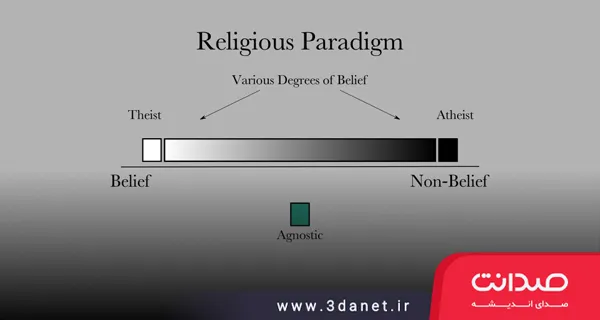
According to William Rowe's model, atheism can be divided into three categories based on its degree of openness to theism:
1. Unfriendly atheism 2. Indifferent atheism 3. Friendly atheism
Theism can also be divided into two categories based on the characteristics and degree of God's dominion over the world:
1. Broad theism 2. Narrow theism
Unfriendly atheism is a type of understanding of existence that denies any sacred or supernatural being and considers belief in any concept of God to be unjustified.
Indifferent atheism is, for the most part, a psychological state in which the individual belonging to it holds no particular position between friendly atheism and unfriendly atheism and is indifferent.
Friendly atheism is a type of understanding of existence that does not believe in the existence of God, yet at the same time believes that a specific type of theism can be justified and that believers in a specific type of God have a basis for their belief.
Thus, in this classification, the term friendly or unfriendly has no relation to friendly or unfriendly behavior. An individual belonging to unfriendly atheism can be very tolerant, forbearing, and patient with theists.
On the other hand, broad theism is a type of theism characterized by belief in a God who is omnipotent, omniscient, perfectly free, and omnibenevolent. This type of understanding of God is found in the Abrahamic religions. Narrow theism is simply belief in a sacred and supernatural being without the aforementioned absolute attributes.
Now, by comparing the types of theism and atheism, William Rowe believes that friendly atheism only denies broad theism with absolute attributes, but does not negate narrow theism and accepts belief in a supernatural being without absolute attributes.
To reject broad theism with absolute attributes (attributes of perfection), William Rowe turns to the problem of evil. To challenge the omnipotent, omniscient, and omnibenevolent God (the broad concept of God), he focuses on the vast amount of suffering that humans and animals apparently endure without any justifying reason. This type of suffering is called "gratuitous suffering."
William Rowe argues that there are instances of intense suffering in the world that an omnipotent, omniscient, and omnibenevolent God could have prevented without:
1. Losing a greater good 2. Creating an evil equal to that evil 3. Creating a greater evil
In defense of his argument, he enumerates examples of pointless or intrinsic evils. For instance, he cites the example of a fawn trapped under a burning tree trunk, taking four or five days to die. The occurrence of such suffering and evil seems pointless and devoid of any good. So, if the God in question is omnipotent, omniscient, and omnibenevolent, why does He not prevent this evil?!
On the other hand, broad theists might respond that in the case of pointless sufferings like the example mentioned, we may not currently know the reason for that suffering and do not have access to its dimensions, but the reason might become clear in the future. Therefore, William Rowe does not claim to have been able to "prove" that belief in an omnipotent, omniscient, and omnibenevolent God is unwarranted; rather, he tries to say that he has a "rational basis" for negating the broad concept of God. So, his emphasis is on having or not having a rational basis.
Now, the various responses that theists who believe in an omnipotent, omniscient, and omnibenevolent God can offer to justify seemingly pointless or intrinsic sufferings are as follows:
Radical responses:
1_ Pointless or intrinsic sufferings are seemingly pointless, but in reality, they bring about a great good of which we are currently unaware.
2_ If an omnipotent, omniscient, and omnibenevolent God were to prevent seemingly pointless sufferings, another evil or suffering of equal or greater magnitude would be created.
The cautious response:
The cautious response of broad theists is such that, instead of claiming to prove an omnipotent, omniscient, and omnibenevolent God, they emphasize the existence of a "rational basis" in defense of a broad God, similar to William Rowe's appeal to a rational basis in negating a broad God.
Conclusion of William Rowe's discussion:
William Rowe knows that theists also have a rational basis for their belief in God. For this reason, he defends friendly atheism and accepts belief in a sacred and transcendent being (narrow theism), and considers himself to have a rational basis for negating the broad concept of God—that is, an omnipotent, omniscient, and omnibenevolent God—but does not claim to have proven the non-existence of God.
Now, it must be examined which types of atheism, based on the origin of belief, have a greater tendency toward friendly atheism and unfriendly atheism.
Types of Atheism Based on the Origin of Belief
According to the origin of belief, three types of atheism are conceivable: 1_ Philosophical-scientific (scholarly) atheism 2_ Atheism based on lived experience (experiential) 3_ Emotional-psychological (non-scholarly) atheism
In philosophical-scientific atheism, which seems to encompass a small number of atheists, the individual, by maximally avoiding emotional interventions and by studying the philosophical and scientific arguments presented and reflecting on their strength and validity, arrives at the conclusion that atheism is justified and defensible. On the other hand, in atheism based on lived experience, arguments are irrelevant to the individual; rather, their lived experience is the criterion for their belief in the absence of God. In this state, the individual believes that they do not feel the presence of God in their life, and without belief in an agent called God, the affairs of life—good or evil, just or unjust—proceed. However, in the third type of atheism, neither scientific-philosophical arguments nor lived experience are relevant to the individual; rather, their belief in the absence of God is often an emotional-psychological reaction to the surrounding situation, which is usually perceived by them as painful, deplorable, irrational, and unjust. In the modern era, and especially in societies where official religion and the consequences of powerful religion have led to religious aversion and anti-religion, atheism has become more of an emotional and fashionable trend than an epistemic and scholarly one. Social intuitions show that the vast majority of those who claim atheism, even the educated and enlightened, have not engaged in serious study, research, or reflection on this matter and are not very aware of the philosophical or scientific arguments presented for and against theism, yet they insist that they are atheists or prefer an atheistic life. It seems that atheists of the second and third types constitute the largest number of atheists. However, the third type of atheism (emotional-psychological), compared to the first and second types, is often temporary, fluctuating, emotional, superficial, and imitative. Reasons for the superficiality of emotional-psychological atheism:
1_ One of the signs of the superficiality of this type of atheism in individuals is their citation of the most superficial reasons against the existence of God. For example, it is stated that: "God does not exist because He cannot be seen or heard"!
or
"God does not exist because there is so much suffering and injustice"!
Citing the senses to deny the existence of God is the same argument that, according to sacred texts and history, the Children of Israel presented against Moses and the ignorant Arabs against Muhammad:
"If God exists, then where is He? Show Him to us if you are truthful"! And citing the absolute existence of evil and suffering to deny God stems from a superficial expectation of an "active and intervening" God and a "passive and irresponsible" human being.
2_ Another reason for the superficiality of this type of atheism is the anger and emotionality of their speech when talking about belief in God. The use of unscholarly and angry words when expressing disbelief in God or when challenging God's justice in the face of the problem of evil indicates that this tendency in most individuals is "motivated" rather than reasoned. Furthermore, emotional-psychological atheists, in addition to the surrounding situation, are also greatly influenced and indoctrinated by writings, hearsay, and widespread, fashionable beliefs. Emotional-psychological atheism becomes a kind of fashion in some societies, which sometimes emerges as a "value," and on the other hand, theism and prayer are considered anti-values. Assessing the relationship between the varieties of atheism and William Rowe's friendly/unfriendly atheism model
With an a priori-rational approach, we examine the relationship between the three types of atheism based on the origin of belief and the friendly/unfriendly atheism model as follows:
Philosophical-scientific atheists provide a philosophical or scientific basis, or a mixture of both, for their atheism. The followers of this type of atheism are generally philosophers and scientists. Since this type of atheist has a reasoned basis for their belief, based on reasoning, they may incline towards either friendly or unfriendly atheism.
Empirical atheists do not engage in argumentation; rather, they arrive at the belief that God does not exist based on their lived experience. Since the basis of these individuals' atheism is their lived experience and their assessment of God's practical role in their lives, they have difficulty with the concept of an omnipotent, omniscient, and omnibenevolent God who, in the common interpretation, is capable of intervening in and influencing the world. However, they would likely have no objection to accepting a narrower concept of God as a non-interventionist, intelligent transcendent being. It seems that empirical atheists tend more toward friendly atheism.
As for emotional-psychological atheists, they offer no serious argumentative or empirical lived-experience basis for their atheism, nor do they feel any need to provide reasons; their belief has psychological, environmental, or political causes. Anger and despair are two common signs in this type of atheist. Emotional-psychological atheism, which is on the rise in societies like post-revolutionary Iran, will likely tend more toward unfriendly atheism and the rejection of any interpretation of God.
The present article is structured with an a priori-rational approach, and the likelihood and possibility of the various types of atheists tending toward either friendly or unfriendly atheism has been evaluated philosophically, and a hypothesis has been presented. To test the hypotheses and examine the current state of atheists—specifically, the extent to which the three types of atheists currently belong to friendly and unfriendly atheism—a posteriori-empirical research appears necessary.


Discussion1 comments
چرا هر کالای غرب برای ما حجت است۔