Literature
Michel Houellebecq and the Crisis of Man in the Contemporary World
Michel Houellebecq, the controversial French novelist, is one of the most incisive chroniclers of loneliness and the crisis of meaning in modern life. In his novels, he pays particular attention to the plight of men who, in a world brimming with freedom and choice, struggle to find love, belonging, and meaning. This article explores Houellebecq’s intellectual world, the crisis of contemporary man, and his most important works.
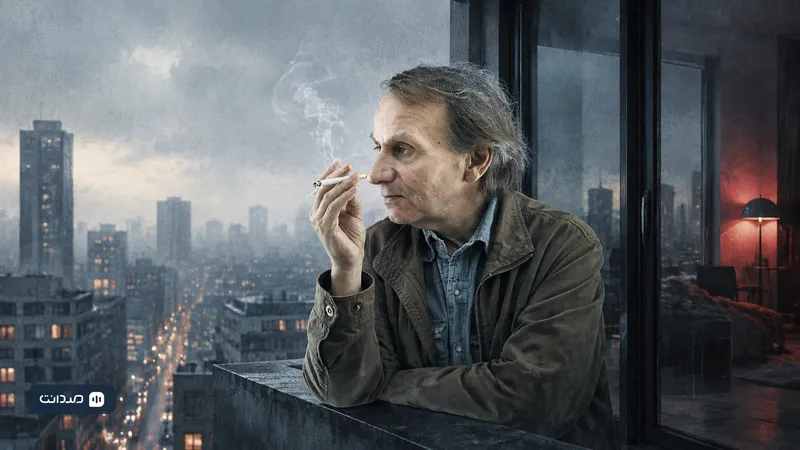

Michel Houellebecq
اندیشمند مورد بررسیWhy does a man who is no longer commanded by any tradition, religion or authority, and who is free to choose or abandon any relationship, still feel lonely, defeated and adrift in meaninglessness? Few writers have approached this question with as much bluntness and coldness as Michel Houellebecq, the controversial French novelist. His novels are full of men who are neither heroes nor antiheroes in the classical sense: grey, exhausted men, usually middle-aged clerks, engineers or scientists, who have been hollowed out from within amid the relative prosperity of Western societies. It is this very portrait that has made Houellebecq's work provoke admiration and outrage at once, both in France and around the world.
Michel Houellebecq: Chronicler of the Hidden Crises of Modern Man
Michel Houellebecq, whose real name is Michel Thomas, was born in 1956 on the island of Réunion and has been, since the 1990s, one of the most influential and at the same time most scandalous writers in France. His first full-length novel, «Whatever» (1994), offered a bitter portrait of a lonely computer engineer wandering through a world that is noisy on the surface but empty within. From there, Houellebecq found his own language and subject: a dry, unceremonious prose, at times clinical and statistical, which, without any literary ornament, draws an existential crisis out of the everyday life of the middle class.
What sets Houellebecq apart from many critics of modernity is that he criticizes modernity neither from a religious nor from a conservative standpoint, but from within modern experience itself. He is a child of the very world he criticizes; he stands neither outside it nor pines for a golden past. His central preoccupation is this question: when society frees the individual from the constraints of tradition, family, religion and commitment, and promises that he may freely build whatever life he wishes, does this freedom really make him happier? Or, on the contrary, does it leave him alone before a ruthless market of choices, a market in which, as in any other, some win and many lose?
Modern Man in Houellebecq's World: From Desire to Loneliness
The male characters in Houellebecq's novels are usually middle-aged, relatively successful in their careers or at least untroubled by them, but emotionally in a state of quiet collapse. They suffer neither from poverty nor from political repression; their suffering is of another kind: a sense of being superfluous, the loss of their standing in the market of desire and relationships, and the inability to build a bond that lasts. Here Houellebecq moves beyond a merely French or Western subject and approaches an experience whose traces readers of any culture, including Iranian readers, can find in their own societies: the spread of individualism, the fading of traditional institutions that bind people together, such as the extended family or the neighborhood, and the gradual replacement of lasting commitments by temporary, terminable relationships.
Houellebecq usually explains this situation through an economic metaphor: just as the Industrial Revolution and the market economy fueled economic inequality, the sexual revolution of the 1960s and 1970s, instead of bringing universal liberation, produced a new kind of inequality in the sphere of desire and relationships. In a world where arranged marriages and compulsory commitments have vanished, attractiveness, youth and social capital have become the main criteria of "emotional success"; and just as in the economy some are rich and some are poor, in this new market too some are perpetually popular and some are perpetually rejected.
The Market of Love and Emotional Relationships in Houellebecq's View
This image of a "market of love" may be the harshest and at the same time the most accurate aspect of Houellebecq's outlook. He no longer sees emotional and sexual relationships as a purely private or sentimental matter; instead he analyzes them within a quasi-economic framework: supply and demand, competition, valuation, and exclusion. In this view, sexual freedom, which was supposed to liberate everyone, has in practice worked like economic liberalization; it has fueled a competition in which some people - usually younger, more attractive, or possessed of greater social capital - claim a larger share of others' desire and attention, while many others remain on the margins.
The important point is that Houellebecq neither celebrates this situation nor defends it; he simply describes it with an almost clinical precision. His characters are often caught between two poles: on the one hand they have a deep longing for love, intimacy and belonging - the very thing that in earlier generations was to some extent guaranteed through marriage and family - and on the other hand they live in a system that has left no guarantee of attaining it. Love is no longer destiny but achievement; and like any other achievement, it may never be attained.
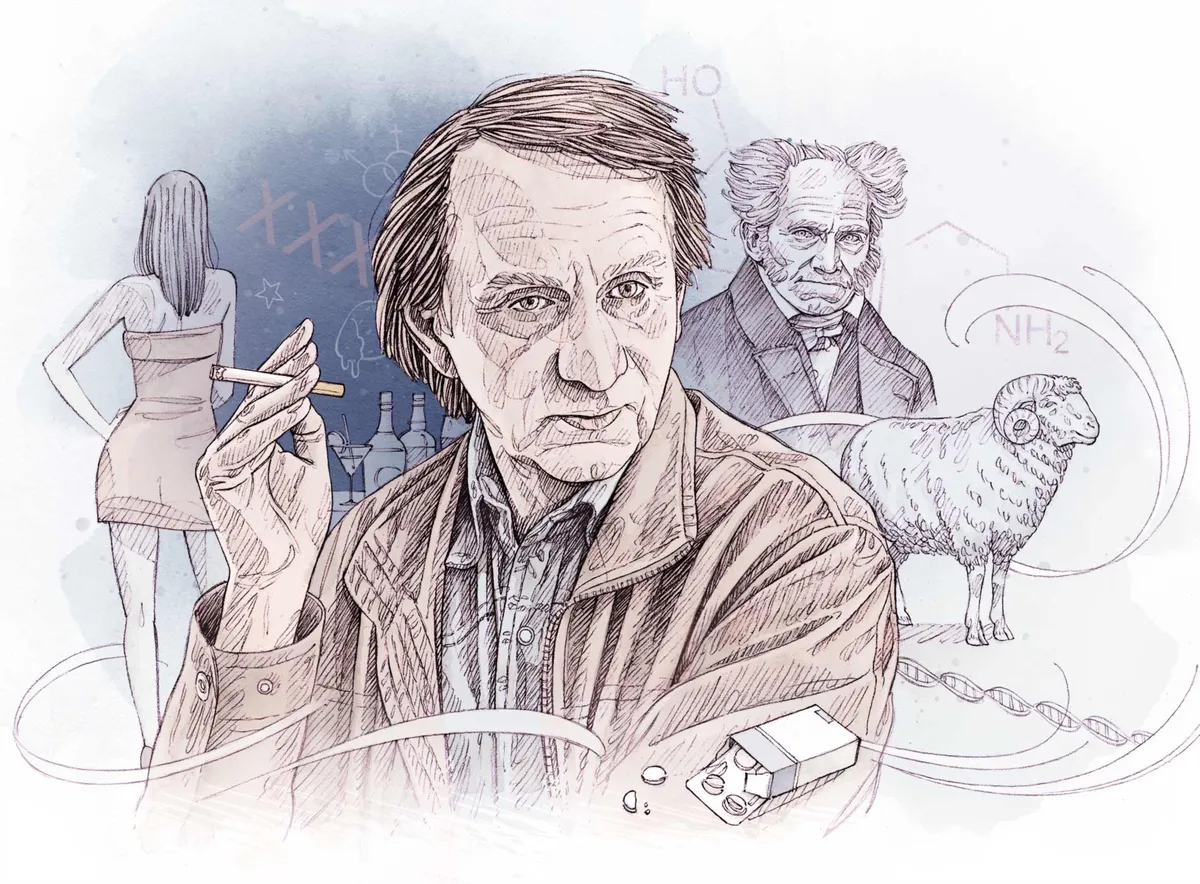
Why Are Houellebecq's Male Characters Failures?
The failure of Houellebecq's male characters cannot be attributed merely to their personal weakness. Houellebecq portrays them more as victims of a historical transition than as its culprits. The generations before them lived within frameworks that were more limited but more predictable; marriage, career and social standing were largely determined in advance. Houellebecq's characters, however, have grown up in a world where everything must be "chosen," and it is precisely this abundance of choice that paralyzes them. They have neither the tools needed to succeed in this new game - attractiveness, social self-confidence, skill at self-presentation - nor a traditional framework in which they could take refuge.
Seen from this angle, their failure is structural rather than moral. They are often not bad people; they are indifferent, weary, and somewhat narcissistic, but they are not villains. Their tragedy is that they live in a system that tells them "you can have whatever you want," yet in practice has given them no means of reaching it. With a precision that is at times uncomfortable, Houellebecq shows that when society removes all constraints without resolving the underlying inequalities, the result is not necessarily universal liberation; it can also be widespread loneliness.
The Most Important Books by Michel Houellebecq
Atomised (Les Particules élémentaires)
Published: 1998
This novel, which brought Houellebecq worldwide fame, tells the story of two half-brothers who each confront, in a different way, the consequences of the cultural transformations of the second half of the twentieth century. One has withdrawn into the world of science and personal isolation, while the other, in search of love and desire, is caught in loneliness and frustration.
«Atomised» is one of Houellebecq's most explicit works on the collapse of traditional bonds, modern individualism, and the difficulty of finding a lasting relationship in the contemporary world. The novel shows that greater freedom in human relationships does not necessarily lead to greater satisfaction and happiness, and may create new forms of loneliness and alienation.
The Map and the Territory (La Carte et le Territoire)
Published: 2010; winner of the Prix Goncourt
This novel, regarded as one of Houellebecq's most mature works, tells the story of an artist named Jed Martin, a lonely man who, in the course of his professional and personal life, confronts the question of meaning, loneliness, and the gradual decay of human bonds.
Unlike some of Houellebecq's earlier works, which have a sharper tone, «The Map and the Territory» is calmer and more contemplative. The book presents a portrait of a human being who is pushed into isolation not by some great catastrophe, but through the accumulation of the distances, losses and small ruptures of modern life.
Serotonin (Sérotonine)
Published: 2019
«Serotonin» - published in Persian under the title «The Little White Pill» - is the story of Florent-Claude Labrouste, a middle-aged agricultural engineer caught in a deep emotional and psychological crisis. By taking an antidepressant, he tries to come to terms with the gradual collapse of his personal life, and along the way he returns to the past, to lost loves, and to a world in which he no longer feels he belongs.
This novel can be considered one of Houellebecq's most direct works on the crisis of the middle-class man in the contemporary world: a man who is worn down not by poverty and deprivation, but by the absence of meaning, intimacy and hope.
Houellebecq: Critic of Modernity or Pessimist About Humanity?
A question that is always raised about Houellebecq is this: is he merely a pessimist about human beings, or truly a serious critic of modernity? His critics have accused him of bleakness, misogyny, and even Islamophobia, particularly in works such as «Submission», which deals directly with Islam and French politics. These criticisms are not baseless and deserve attention; Houellebecq's view of women and of certain societies and beliefs has been challenged many times and from many angles.
But alongside these criticisms, many literary commentators believe that Houellebecq cannot be called merely a pessimistic writer. He is more like a diagnostician than a preacher: someone who describes a social illness without necessarily offering a prescription for its cure. Perhaps it can be said that he neither rejects modernity entirely nor praises it unconditionally, but raises an honest question about its hidden costs: costs that the official discourse of progress and freedom usually pays less attention to.
Conclusion
Michel Houellebecq is a writer who portrays some of the deepest and least spoken-of wounds of contemporary humanity, especially the wounds that men have suffered in the era of transition from traditional orders to individual freedoms. His works remind us that freedom, on its own, is no guarantee of satisfaction or meaning, and that the expansion of individual choices, if accompanied by hidden inequalities, can lead to isolation rather than connection. Houellebecq may offer no definitive answer to this crisis, but with a cold and merciless honesty he puts on the table questions that every reader - of any culture and language - has faced in some corner of their own life: the longing for love, the fear of loneliness, and the search for a meaning that grows harder to find with each day in today's fast-moving world.

Related articles
All articles Psychology
The Psychology of Love: A Lecture by Dr. Seyed Mohsen Fatemi
 Sociology
A Lecture by Dr. Yousef Abazari: “Rationality and Moderation in the Contemporary World”
 Religion
Reza Babaei's Lecture: 'Religion and Religiosity in the Contemporary World'
 Religion
Roundtable: “Religiosity in the Contemporary World” with Mostafa Malekian and Abdolhossein Khosropanah
 Sociology



Discussion0 comments
No comments yet; let yours be the first voice.