Religion
Mohammad Ghotbi's essay 'A Model for the Theology of Two-Foundation Theology'
In dual-foundation theology, after examining Malekian's classification of conceptions of God and the inadequacy of the impersonal personal God, Abolghasem Fanaei resolves the problem of relation by proposing a 'supra-personal God'—a being beyond determination that takes on personhood.

A Model for the Theology of Two-Foundation Theology
Mohammad Ghotbi
The present writing is the fourth essay from the third chapter of this volume, that is, the collection of essays "An Introduction to Two-Foundation Theology." In previous writings, the model of religious studies, worship, theological approach (analogy and transcendence), types of theism (varieties of theism), and soteriology (the phenomenon of religious diversity) were examined. In this essay, the conception of God, the relationship between humanity and God, and the theological model of Two-Foundation Theology will be addressed.
The Conception of God
Mostafa Malekian believes that "the conception of God precedes the affirmation of Him, and affirmation of God is impossible without a conception of Him. Regarding God, 29 conceptions have been extrapolated, of which Ian Richard Netton, in his book 'Allah Transcendent,' enumerated 9 conceptions of God in Islamic culture, but logically, conceptions of God are limited to three." He divides common conceptions of God into two categories: personal and impersonal. From his perspective, a personal God is itself divided into two types: anthropomorphic and non-anthropomorphic: "A) God as an impersonal existence. Is God something individuated or impersonal? In simple terms, is God one among existents or not? If so, we are dealing with a personal God; otherwise, not. An impersonal God, such as when they say God is the very existence and being itself, not an existent among other existents. Of course, the impersonal God has conceptions other than being existence itself. But the most prominent conception is this. However, if we say God is one among existents, this means a personal God. A personal God also has two conceivable states: Anthropomorphic (Personal) and Non-anthropomorphic (Impersonal). A non-anthropomorphic God is a God who, while being personal, does not possess our moral characteristics such as anger, pleasure, will, aversion, etc. It does not have our emotional, volitional, and affective characteristics. Naturally, it also lacks our moral characteristics. Like Hegel's Absolute: both Hegel and the Hegelians believed in The Absolute: a personal but non-anthropomorphic entity. The attributes of this God are only metaphysical. For example, it possesses the attributes of the Necessary Being, the Cause of causes, the Unmoved Mover (in Aristotle's terms), self-subsistence, infinity, beyond time, beyond space, etc. (Metaphysical attributes), but this God does not have human attributes (Moral attributes), meaning emotional, volitional, affective, and ethical attributes."
The Inefficacy of the Personal Non-Anthropomorphic God
Much has been said by religious intellectuals about the problems of the anthropomorphic personal God. But regarding the non-anthropomorphic personal God, Malekian believes that this God has the logical problems of the anthropomorphic personal God but lacks its facilities: The feeling that a believer in a non-anthropomorphic personal God has in relation to themselves is similar to the feeling Kafka expresses in all his works. The feeling of being caught in the grip of an invisible power, because one cannot communicate with that being, nor reason with it, nor persuade it, etc. Since that being has emotions, affections, and excitements different from humans and other beings, one can no longer converse with this being, nor supplicate to it, nor express remorse and repentance before it, etc. Considering what has been stated, it is clear why this view has the fewest adherents. Because positing such a God has the logical problems of the anthropomorphic personal God but lacks its facilities. In other words, denying God is logically easier than believing in God; now, someone who accepts belief in God, meaning they have accepted the logical problems of this belief, but by believing in a non-anthropomorphic personal God, they have both borne the logical problems of God's existence and deprived themselves of the facilities of accepting an anthropomorphic personal God. Hence, humans are psychologically very predisposed to not believing in such a God, and it can only be accepted by rugged individuals like Hegel (rugged not in its negative sense).
The God Beyond Personhood
The varieties of theism were discussed in the previous essay. It was also noted that the pioneers of late modern religious thought believe in a radical apophatic theology; in Yaser Mirdamadi's words, "...Soroush has called God 'formless' and Shabestari, 'wholly other,'" and from the critics' perspective, connecting with such a God is difficult. It was further stated that two-foundation theology believes in combining similarity and transcendence. But how does this combination become possible? Through the supra-personal God.
Abolqasem Fanaei believes that, contrary to the views of Soroush and Malekian, the mystical God is not impersonal but suprapersonal. Regarding the definition and the disagreement among philosophers and mystics over the definition of God, he writes: 《..From the perspective of Islamic philosophy, God is a "personal" and "determinate" being, because existence is "equivalent" to personhood. And everything that exists is also personal. And we have no impersonal existent, meaning that, in their view, it is impossible for something to exist that is impersonal and indeterminate or suprapersonal and supradeterminate, even if its conception is not impossible... In Islamic theoretical mysticism, God, in the core of His existence, is considered a reality "beyond" determination and personhood, meaning God is a transpersonal being. In the mystical definition, God is existence itself, not an instance of the instances of existence... In the mystical conception of God, "creation" does not mean the creation of another being that is separate and distinct from its creator and differentiated and personalized from its maker, as the philosophers say. Rather, creation means the descent and manifestation of God and His assuming various modes and states that befall Him. God is a trickster idol who appears in a new color every moment, and as the Quran says: "Every day He is in a [new] state." The outward and the manifestation are, from one perspective, identical, and from another perspective, other... 》. Critics believe that the impersonal God of Soroush, Malekian, and Shabestari, due to not being personal, is not relatable. Hence, to remedy this deficiency, they incline towards a personal God and cataphatic theology. However, the suprapersonal God can solve the problem of relation. Fanaei writes about the difference between the impersonal and the suprapersonal God: 《..The God of mysticism, although in His core is pure inwardness and beyond personhood and determination, descends from this station and, while preserving this station, various determinations and personhoods befall Him, because the Absolute who in His essence is free from every limitation, even from the limitation of absoluteness, can be combined with any limitation (He is with you wherever you are, 57:4) and the formless one whose formlessness is not His form can accept every necessary and possible form, and accepting one form does not prevent or bar Him from accepting other forms, and the colorless light whose colorlessness is not a limitation for Him can appear in all colors. And this is the important and key difference between the "impersonal" God and the "suprapersonal" God. An impersonal existent cannot be personal while remaining impersonal, because this would be an instance of the conjunction of contradictories, but a suprapersonal existent can accept any personhood and yet remain impersonal in its essence. Being suprapersonal is compatible and combinable with being personal, meaning that an existent that is suprapersonal can acquire personhood at another level. From the descent and manifestation of the formless one and His appearance in the mold of various forms, the "arc of descent" emerges, whose beginning is the station of Unity and whose end is the material world and the material and natural manifestations and loci of God; God who is the reality of existence, not an instance of the instances of existence. And the material manifestations and loci of God, through substantial motion and spiritual wayfaring, can return to their origin (Indeed we belong to God, and indeed to Him we return, 2:156), meaning they lose their specific determination and become annihilated in a determination higher than themselves. And this motion, for which no limit or end is conceivable, is called the "arc of ascent." In the mystical worldview, the entirety of existence is the expansion and contraction of a single reality, namely God (He is the Expander and the Contractor). Therefore, the God of mysticism, while being pure inwardness, is also pure outwardness (... the Outward and the Inward ..., 57:3) and while being the First, is the Last (He is the First and the Last ..., 57:3). From the descent and manifestation of God, His names and attributes emerge, meaning the reality that in its essence is indeterminate and impersonal, through descent and manifestation, acquires specific determinations and personhoods, the totality of which constitute the divine names and attributes. God's attributes are, in truth, His manifestations, and although He, in His core, lacks any name or attribute, He can descend from that lofty station and various determinations befall Him and truly accept various attributes. Although the God of mysticism, in His core, lacks any form, various forms can befall Him or He can manifest and appear in various forms, because formlessness is not His form and absoluteness is not a limitation for Him, and the Absolute who in His essence lacks the limitation of absoluteness can be combined with any limitation and accept any limitation, without accepting these limitations casting any dust upon the skirt of His majesty. The forms that befall God are like jars into which the water of the sea is poured, or like colors that befall a light that in its essence is colorless. The transcendence of God from the limitation of absoluteness necessitates this...》.
اما خدای فوق تشخص چگونه با الهیات تنزیهی سازگار است؟ فنایی تنزیه عرفانی را متفاوت از تنزیه فلسفی و کلامی میداند: 《.. یکی از مهمترین نتایجی که بر تلقی عرفانی از خداوند مترتب میشود عبارت است از «تنزیه عرفانی» که کاملاً با «تنزیه فلسفی و کلامی» تفاوت دارد. تنزیه فلسفی و کلامی یعنی پاک شمردن خداوند و منزه دانستن او از داشتن اوصافی که مختص «ممکنات» است و با «وجوب وجود» منافات دارد. این قیود و اوصاف مطلقاً با خداوندی خدای فلسفه منافات دارند و تحت هیچ شرایطی نمیتوان آنها را به نحوی حقیقی به خدای فلسفه نسبت داد، زیرا موجودی که واجبالوجود است و وجوب وجود قید اوست نمیتواند از این قید دامن بیفشاند و قیودی را بپذیرد که با این قید منافات دارند. چنانکه گفتیم، خدای فیلسوفان از همه قیود منزه است مگر قید وجوب و اطلاق. تنزیه فلسفی خداوند نقیض تشبیه اوست و با تشبیه جمع نمیشود. در چارچوب متافیزیک فلسفی، خدا را یا باید تنزیه کرد و یا تشبیه. اما تنزیه عرفانی یعنی منزه شمردن و پاک دانستن خداوند و فراتر دانستن او از داشتن هر قیدی از جمله قید وجوب و اطلاق. چنانكه گفته شد نتیجه چنین تنزیهی این نیست که خداوند مطلقاً و تحت هیچ شرایطی نمیتواند هیچ قیدی بپذیرد، بلکه این است که خداوند در کنه وجود خود از همهي قیود، حتی قید وجوب و اطلاق منزه است، و چون از قید وجوب و اطلاق نیز منزه است، در مراتب نازلتر همهي قیود میتوانند به نحوی حقیقی بر او عارض شوند از جمله قیود امکانی یا اوصافی که مستلزم امکان است. درحالیکه خدای فلسفه خارج اشیاء و به کلی با آنها مباین است، خدای عرفان هم داخل اشیاء است و هم خارج آنها و نه داخل اشیاء است و نه خارج آنها (داخلٌ فی الاشياء لا بالممازَجَه و خارجٌ عَنها لا بالمبايَنَه ـ نهج البلاغه). تنزیه عرفانی نقیض تشبیه نیست، بلکه با تشبیه سازگار و قابل جمع است. معنای «لَيسَ کَمِثلِه شَیٌ» این است که خدا مانند سایر چیزها نیست که در صورت یا صورتهای خاصی محبوس بماند..》.
Hence, Fanāʾī considers Dr. Soroush's God to be a God oscillating between the mystical and the philosophical God, and ultimately deems this God a philosophical God rather than a mystical one: "...In the author's view, the most important critique that can be leveled against Dr. Soroush's theory is that, firstly, in explaining and elaborating his theory, he constantly moves back and forth between the God of mysticism and the God of philosophy—that is, he sometimes speaks of this God and sometimes of that God—whereas the mystical conception of God is incompatible with the philosophical conception of Him. And secondly, it seems that when he speaks of the God of mysticism in explaining his theory concerning the Divine Word, he speaks of a formless entity whose very formlessness is its form, and to which no form can truly be attributed. In other words, Dr. Soroush's conception of God in the discussion of the Divine Word appears to be a philosophical conception, not a mystical one; that is, God in his view is an impersonal entity, not a transpersonal one, and such an entity cannot lose its own determination and assume other determinations. From some of his expressions, it is inferred that in his view, all the forms attributed to God are fabrications of the human mind and the product of the projection of their imaginative faculty—that is, forms cast by human beings upon a formless entity. Yet this is not the case; rather, the God of mysticism has two kinds of forms: His objective forms, which are the product of His descent and self-manifestation in the external world beyond the mind, and the forms that we humans cast upon Him, which are the product of His self-manifestations in the world of the mind. Therefore, God's objective self-manifestations are not the product of the projection of human cognitive faculties and something subjective, but are objective and independent of human minds. And the meaning of declaring God transcendent beyond all forms is that He should not be 'confined' to any particular form; rather, one must always acknowledge and concede that in His essence, He is beyond every form—not that He cannot assume any form and that attributing any form to Him is a figurative and imaginary attribution. If that were the case, then formlessness would be a limitation and the form of God, and we would be obliged to declare Him transcendent beyond all forms except this particular form. Whereas the absolute transcendence of God requires that we also declare Him transcendent beyond formlessness—that is, we should not consider formlessness to be His form. To put it more clearly, if we consider formlessness as a limitation in contrast to form, then we must say that the God of mysticism is not formless, but rather beyond both 'form' and 'formlessness.' Therefore, while it can be claimed that the imaginative faculty of human beings plays a role in the mental forms cast upon God by humans, such a claim regarding the objective forms resulting from God's descent and His objective self-manifestation is not correct. Thus, the problem here is that in Dr. Soroush's statements, firstly, the God of mysticism has been conflated with the God of philosophy, whereas the God of philosophy is determinate and personal and is not formless; rather, the necessity and absoluteness of existence are His limitation and His form—a limitation that grants Him determinacy and personhood and distinguishes Him from other existents. And secondly, the God of mysticism, who in His station of the Unseen of the Unseen is beyond determinacy and personhood, and upon whom, in lower stations, various determinacies and personhoods truly supervene, is, in Dr. Soroush's statements, imprisoned in this station; that is, His indeterminacy and impersonality are assumed as a limitation that prevents the true supervenience of determinacies and personhoods upon Him. In this way, it seems that Dr. Soroush's conception of God in the discussion of the Divine Word is compatible neither with the conception of God held by Muslim philosophers nor with that of Muslim mystics (and God knows best). Of course, this point is not objectionable in itself, for Dr. Soroush is a researcher, not an imitator, and a researcher has the right to hold a third conception of God. However, he explicitly states that his theory has a vast host of philosophers and mystics behind it. And in any case, if one accepts the Muslim philosophers' conception of God, one cannot define God as a formless and impersonal entity, consider 'all' the determinacies and personhoods attributed to Him as figurative, and declare Him transcendent beyond 'all' of them, because the God of philosophy is not transcendent beyond 'all' limitations and determinacies, but is only transcendent beyond 'contingent' limitations, determinacies, and forms; and the necessity and absoluteness of existence are the very reality of His essence and His form. And He cannot and should not be declared transcendent beyond possessing these two limitations. This God is not a formless entity. But if one accepts the mystical conception of God, then one cannot say that God is a formless entity whose formlessness is His limitation.
بلکه باید بگوید خدا امر بیصورتی است که حقیقتاً میتواند صورت بپذیرد و صورتهای گوناگون به نحوی حقیقی میتوانند بر او عارض شوند، یعنی او میتواند در قالب صورتهای گوناگون تجلی کند و در عین حفظ مقام و مرتبه غیبالغیوبی که در آن باطنِ محض است، میتواند ظاهرِ محض هم باشد، چون در همهي صورتها حاضر است و همهي صورتها صورت «او» هستند (وَلِلّهِ الْمَشْرِقُ وَ الْمَغْرِبُ فَأَيْنَمَا تُوَلُّواْ فَثَمَّ وَجْهُ اللّهِ إِنَّ اللّهَ وَاسِعٌ عَلِيمٌ). اینکه خدایی که حقیقتاً نمیتواند سخن بگوید خدای فلسفه است نه خدای عرفان، و از نظر عارفان، خدای فلسفه در حقیقت خدا نیست، بلکه یکی از تعیّنات و تجلیات خداوند است..》. بنابراین صورتهای خداوند یا صورتهایی است که با آنها خود را به ما شناسانیده است و یا صورتهایی که ما خود بر او میزنیم در حالیکه واقفیم خدای ورای این صورتهاست. بنابر آنچه آمد میتوان گفت خدای دینداران مصلحتاندیش خدایی متشخص و انسانوار ، خدای دینداران معرفت-اندیش خدایی متشخص ناانسانوار و یا نامتشخص و خدای عارفان نه خدای نامتشخص که خدایی فوقتشخص است.The Inefficacy of an Impersonal God
After the outbreak of the coronavirus pandemic, Abdolkarim Soroush, 《in response to the question of where God is in the midst of this crisis and why He does not answer our prayers, replied that one can only expect salvation from God in the afterlife, and that in this world God is merely a beloved who solely gives meaning to life, and no particular expectation can be had of Him: "If your entire expectation of your friend is that he should sort out your affairs, that is not called friendship; but if you have a friend whom you simply love, and if anyone asks you what role this friend plays in your life, you say, 'None! My life is not empty because I have such a friend. That is all.' God is essentially like this." Soroush's interview provoked the objection of the New Left tendency among religious intellectuals. For instance, Taghi Rahmani considered Soroush's theological view to be a neoliberal theology that, in order to exonerate God from the evils of the world, sends God on "leave" or "privatizes" Him solely for the elites. In Rahmani's view, this leads to the flourishing of religious fundamentalism, because fundamentalists, by bringing the absent God onto the scene and making Him tangible for the masses, engage in the suppression of the other. According to Rahmani, instead of neoliberal theology or religious fundamentalism, one must speak of liberation theology; a socialist theology with Christian roots, whose Islamic-Iranian version was first elaborated by Nakhshab and then by Shariati. In Rahmani's view, liberation theology seeks neither to exonerate God nor to condemn Him, but is action-oriented and seeks God in the reduction of the natural and moral evils of the world》.
What occurred in this crisis indicated the very point mentioned in previous articles: the later religious intellectuals (Soroush, Shabestari, Malekian), in Hoda Saber's terms, simultaneously with a minimal religion, also made God small-scale. In this dispute, Taghi Rahmani also believed that they had sent God on a historical holiday amidst the coronavirus crisis. They, in turn, accused the opposing side of ideologizing religion and aiding the growth of religious fundamentalism. In future writings, we will demonstrate why liberal and socialist theologies are necessary but insufficient within religious intellectualism. Therefore, it is better, while believing in a formless God in the personal world, to superimpose upon the formless God, in the surrounding world, instead of the form of absence and concealment and a God who goes on leave, a form such as the God who is a path-opening comrade—as elaborated in the writing concerning Hoda Saber—for the journey toward God through the path of creation, while at the same time believing that God is also beyond this very form; a form that differs from that of the fundamentalists and does not serve them either. This matter will be addressed at the end of this writing.
The Relationship Between Human and God
Mostafa Malekian, regarding the various modes of the human relationship with God according to his own classification of conceptions of God, divides the relationship with a personal, anthropomorphic God into three ways: servant and master, lover and beloved, and co-worker and co-worker, the third form of which is itself divided into two parts: horizontal co-worker (Daoism) and vertical co-worker (the caliph in Semitic religions). The other two forms of relationship with God, in his view, are the metaphysical, philosophical, or ontological (impersonal non-anthropomorphic, such as Hegel's "Absolute" or the Necessary Existent or the Cause of Causes or the Self-Subsistent) and the two-stage objectivity of the perceived and the unperceived (the impersonal unity of existence, exemplified by Hossein Mansour Hallaj's utterance of "I am the Truth").
Kadivar considers the relationship of servant and master to be the relationship between God and humanity, which later, through the deification within human social systems, humans transformed into a lord-slave relationship; and Soroush, Malekian, and Shabestari, who view this relationship as derived from the very culture of the people at the time of revelation, consider this relationship to be the same lord-slave dynamic of the social system. Regarding the dominance of this view over the relationship between humanity and God, Shabestari writes: 《...In the Quran, God's relationship with humanity is expressed through certain concepts that not only have no connection to the concept of taklīf (imposing arduous duties) but stand in complete opposition to it. The Quran states that God grants human beings a 'goodly life' (a pure and pleasant life), 'We shall surely make him live a goodly life' (16:97). He brings people out of darknesses and into light, 'He brings them out of the darknesses into the light' (2:257). He makes them taste His love, 'He loves them, and they love Him' (5:54). He is closer to the human than their own jugular vein, 'We are nearer to him than the jugular vein' (50:16). The Quran states that God is the origin and the ultimate destination of human beings, 'Indeed we belong to God, and indeed to Him we return' (2:156). The emphatic recommendation to repeatedly and continuously remember God (dhikr), which is expressed many times in the Quran and is considered a great act of worship, is so that the human being may attain the lofty station of heartfelt assurance, 'Verily, in the remembrance of God do hearts find assurance' (13:28). The Quran states that the friends of God are freed from fear and grief, 'Behold! Verily, the friends of God, no fear shall be upon them, nor shall they grieve' (10:62). The Quran states that the goal of the Prophet's mission is to invite human beings to a new birth and a new life, and to remove the chains from their souls, 'Respond to God and the Messenger when he calls you to that which gives you life' (8:24), 'He relieves them of their burden and the shackles that were upon them' (7:157). All those existential states and conditions and their concepts described above depict the relationship between God and humanity in the form of subtle and delicate realities and truths, and pleasurable states beloved and cherished by the human being, which stand in direct opposition to God imposing hardship (taklīf) upon the human. In the history of Muslims, it was the Mu'tazilite theologians who set aside those transcendent concepts and truths that the Quran expressed regarding the relationship between God and humanity, and in their place, they established the concept of 'taklīf,' making it ever more robust, and organized the relationship between God and humanity on the basis of taklīf.
They called God 'Master' (mawlā) and the human being 'Servant' ('abd) in its jurisprudential and theological sense, and based on the idea of God being Master and the human being Servant, they organized their science of theology (kalām), and even founded eschatology on this very idea of taklīf and Master and Servant. And finally, God being Master and the human being Servant, and the primacy of taklīf in this matter, entered the science of the principles of jurisprudence (uṣūl al-fiqh) as one of its most fundamental ideas and foundations, and the science of uṣūl became the logic of discovering the duties (taklīfs) of the Master, i.e., God. The idea of Master and Servant was an idea heavily exploited by the apparatuses of caliphate and religious despotism, particularly the Abbasids. The despotic caliph, who in the political realm demanded unquestioning obedience from the people, was the very same theologically and jurisprudentially 'necessarily-obeyed Master' (mawlā wājib al-ṭā'ah) clothed in the garb of politics. If, in the history of Muslims, the relationship between God and humanity had been regulated not on the basis of jurisprudential and theological masterhood and servanthood, but on the basis of the transcendent Quranic concepts we mentioned above, we Muslims would have had a different history today.》
Later reformist thinkers have offered proposals to replace the master-servant relationship. Abdolkarim Soroush, in response to a question about the master-servant relationship, writes: "The master-servant relationship is a constructed relationship and has no reality beyond a convention that people established among themselves, like the system of slavery, which was a convention and now no longer exists; when that convention collapsed, it collapsed. Whether we consider God as an owner or a lord, it is not a correct relationship. In my view, today we should speak of the lover-beloved relationship, or the relationship of two friends, or even the father-child relationship... Master and servant and the like are forms for depicting the relationship between God and humanity, and none of them possess authenticity; they are derived from the history and geography of a people. Today, other forms can be found and employed." The form that the majority of later reformist thinkers have chosen for the relationship between humanity and God is precisely the lover-beloved, the adorer-adored relationship. A God who, in Soroush's words, is the Majestic Beloved: "This God of the universe has one very important and magnificent attribute, which is that God is known by the attribute of the Beloved. God has many attributes. God is the Orderer, the Creator, the Disposer, and possesses many other attributes. But the attribute that appears important to mystics is that God is a Beloved whom one can love. The closer you draw to Him, the more beautiful you find Him, and this finding of greater beauty so captivates your heart that you remain eternally in love with Him, and this love, of course, bestows upon you qualities that differ greatly from earthly loves; this love is not of the romantic kind or romantic states in the conventional sense, but rather grants you knowledge, valor, and courage, removes all your flaws, including envy, miserliness, and other weaknesses, and purifies you entirely, like iron tempered in a furnace. Regarding God, one must also point to another attribute, which is that God is an Awe-inspiring Beloved; there is an awe in Him that causes you to be distant from Him even in proximity, and close to Him even in distance. Rumi, in order to show that the amorous play with God occurs by His own permission and that it is not such that the servant or lover takes liberties and oversteps his bounds, brings these two attributes together... This God, whom I have named the Majestic Beloved, is on one hand the Beloved, and on the other, possesses majesty and splendor. This is the God of mystics like Rumi, whom you see throughout the Masnavi looking upon His servants with the eye of kindness and affection, captivating their hearts and providing His servants the opportunity for love-play, so much so that the very terms servant and lord are removed... That religion of love, of which Rumi is the prophet, is precisely this. In the religion of love, they do not speak of servant and worshipped. They speak of lover and beloved, and when one speaks of lover and beloved, categories such as servitude and sovereignty are also set aside. We find an entirely new epistemological and conceptual system in which each of these is placed in its proper position and conveys a different meaning. Such a God, with such a relationship He has with His servants and with such a union He achieves with them, in reality grants unity to this world, and this is the very unifying secret of love. It is from this unity that the human being sees everything as their own, beside them, and united with them, and the separations, enmities, and divisions that exist between religions and people are all removed, and the person reaches a degree and kind of unity they have never perceived otherwise." According to Soroush, the relationship with such a God is formed on the basis of shame and love. A Majestic Beloved before whom the lover feels shame for wrongdoing.
The Majestic Companion
Late post-revolution religious intellectualism took refuge from traditional jurisprudence in the rival camp, namely traditional mysticism, and adopted an amorous conception of God. The love and shame of traditional mysticism are passive love and shame. To live a life of love with God without seeing society and creation—I am in love with all the world, for all the world is from Him. Now, is this love sufficient? Is this shame sufficient? That we be lovers of people and creation, and feel shame before their suffering, yet do nothing for their well-being, only love them and feel sorrow for their condition. This worship of God seeks individual salvation and annihilation in God, whereas the priority of the companion God who opens the way seeks collective salvation and deliverance, subsistence in God and annihilation in creation in order to reach God. The form of lover and beloved can be divided into two modes: traditional and modern, passive and active. Although Soroush, in response to a question, says one must feel shame at injustice and strive to negate discrimination, the performance of late religious intellectuals in the social arena has been passive, like that of traditional mystics. The active lover-beloved relationship can be seen in Chamran's relationship with God, which was discussed in previous essays. The passive lover-beloved relationship with God, like the form of slave and master, is an inefficient form in the modern world. The active lover-beloved relationship can be defined as a collaborative and participatory relationship with God and, as came in Malekian's classification, based on longitudinal cooperation. The companion-companion relationship was a relationship that Hoda Saber defined, based on the companion God who opens the way, for the human-God relationship. He called God the First and Last Companion, the Supreme Companion, the Caring Companion, and the Way-Opening Companion. The companion-companion relationship is beautifully depicted in section 59 of the Jawshan Kabir supplication: 《O Friend of the friendless, O Physician of the physicianless, O Answerer of the answerless, O Kind Companion of the companionless, O Companion of the companionless, O Helper of the helpless, O Guide of the guideless, O Intimate of the intimateless, O Merciful to the merciless, O Associate of the associateless...》. And it is repeated further in section 73: 《O God, I beseech You by Your name, O Kind One, O Companion, O Preserver, O All-Encompassing, O Sustainer, O Helper, O Honorer, O Abaser, O Originator, O Restorer...》. The companion-companion relationship is an active lover-beloved relationship with a maximal God. God here is the Supreme Companion, the August Companion.
As mentioned earlier, the forms of God are either forms through which He has made Himself known to us, or forms we ourselves project onto Him while being aware that God is beyond these forms. The same can be said of the forms of the human-God relationship. In this case, it is better, while believing in the formless God, to project a form like the August Companion God onto the formless God—instead of the form of absence and hiddenness, the God who goes on leave and is small-orbit—for the journey toward God through the path of creation, all the while believing that God is beyond this very form as well.
Based on what has been presented so far in the preceding chapters of this treatise, it can be said that the Companion-Guiding God is a maximal God with whom one has a sincere, continuous, all-encompassing, and strategic relationship, and who is a God of cooperation and partnership. The human being's relationship with God in this conception is a companion-to-companion relationship, which is reciprocal and all-encompassing, and the possibility of the human being benefiting from God's assets and functions is feasible, and the human being must adopt a redoubled and more serious approach in relation to God in order to benefit from God's assets to the same proportion. God's assets and functions refer to how, in the course of the relationship with the human being, God enables the willing and active human being to benefit from His continuous gifts and possibility-creations in existence. The monotheist in this relationship is a participating, role-fulfilling, partnership-seeking member and an active element of existence. In this strategic and partnership-seeking relationship, the active members of existence define a common project with God, and God, by virtue of their contribution and sincerity, will participate in the project. This human being is not only a monotheist in their personal world and in the realm of thought and beliefs, having purified their mind and existence from mental-philosophical polytheism and associating partners with God in "divinizing" (other humans, deities, etc.) as well as from "self-lordship" (ancient self-worship and modern secular humanism); in the arena of the surrounding world and society, they also seek liberation from the factors that shackle them (despotism, colonialism, exploitation, stupefaction, and political, cultural, economic, social, and religious domination) so as not to fall into socio-political polytheism by accepting the domination and servitude of the masters of wealth, force, and deceit. Hence, with their monotheistic worldview and liberating consciousness praxis, they oppose inequality, discrimination, injustice, and any form of human domination over another. Social mysticism is a humanist mysticism based on praxis (thought-based action); the wayfarer in this mysticism acts within the triangle of "God, creation, self," and instead of "annihilation in God" (fanā fi'llāh), they think of "subsistence through creation" (baqā' bi'l-khalq). By choosing the approach of "God-centered humanism," they do not overlook their role within these three sides; they build themselves in the path of helping creation through the dialectic of thought and action and love for the other, and through their sacrifices on this path, they are in a state of perpetual becoming and spiritual evolution until reaching God-likeness and co-suffering in the realm of existence. Social mysticism, unlike traditional mysticism, is not oblivious to political commitment, the negation of submissiveness to domination, and its social commitment in the face of the suffering of fellow human beings, and considers mutual aid, assistance, compassion, sacrifice, and social benevolence for improving people's conditions as requisites of the spiritual path. This human being has become an active member of existence, is the axis of change, is in a strategic, all-encompassing, and partnership-seeking relationship with God, is a role-fulfilling and participating member of existence, has a project, is principled and bears a certain character, and is an enabler. They have a practical approach and are action-oriented. They have attained self-consciousness, have a utopia, and within the triangle of God, creation, and self, through the pain, love, and action arising from liberating self-consciousness, they engage in a loving and spiritual praxis. With their liberating consciousness praxis, they engage in consciousness-raising and the dissemination of utopian energy in society, a consciousness that leads to assistance, empowerment, and utopia-granting to the oppressed within an institution-based social cooperation and collaboration founded on the doctrine of "cooperation for survival." Through their progressive love towards creation, they seek ascending love towards God and seek God's address in the city of creation. With their God-centered humanism, to the extent of their capacity, like a candle, like a firefly, they shed light, and in a partnership-seeking and project-oriented relationship with God, they engage in empowering and alleviating the pains of creation, and through this, they undergo becoming and are placed on the path of God-likeness and co-suffering in the realm of existence. The human being in this journey and wayfaring is in a state of becoming and inner migration from what is to what ought to be. The ceiling of this wayfaring is the attainment of salvation/perfection, which is God-likeness and co-suffering in the realm of existence. In the triangle of God, creation, self, the multi-dimensional monotheist, in addition to "moral responsibility" (self-examination, self-knowledge, and self-cultivation for wayfaring towards God through service to creation), also bears "intellectual responsibility" (self-discovery and attainment of self-consciousness, dissemination of liberating consciousness and utopian energy and active hope among creation), and "civic responsibility" (advocacy, empowerment, and revitalization of creation), and strives for the realization of mysticism, equality, and freedom.
A Model for the Theology of Two-Foundation Theology
According to the teachings of religious new-thinkers, the first table can be presented for the types of theology for different varieties of religiosity.
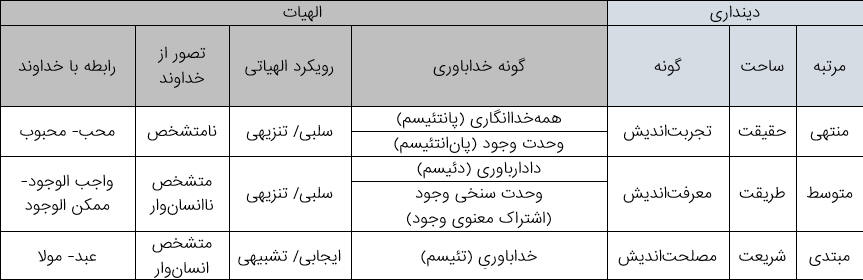
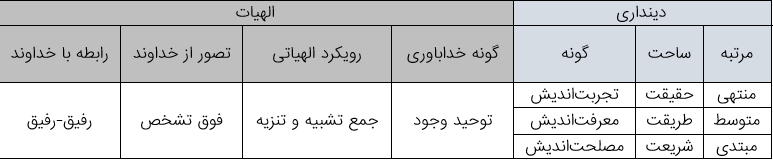
According to what has been presented in this essay, the supra-personal God is a God who can assume personhood, can take the form of a companion, does not fall into contradiction through the combination of similitude and transcendence, and through the unity of existence instead of the oneness of being, preserves human agency and individuality. Hence, experience-oriented, knowledge-oriented, and expediency-oriented believers, according to the understanding and station they attain in religiosity, can organize their theological beliefs within this framework. Table 2 shows the theological model of Two-Foundation Theology. In a subsequent essay, we will address the details of the relationship with God (piety, faith, trust) from the perspective of Two-Foundation Theology.





Discussion0 comments
No comments yet; let yours be the first voice.