Religion
Mohammad Qotbi's essay 'The Religiological Model of Twofold Theology'
The theological model of Two-Tier Theology is an evolved version of Iqbal Lahori's paradigm, grounded in an 'existential view of religion'—an approach that prioritizes 'being' over 'having' and bridges individualist and collectivist tendencies within religious intellectualism.

The Religiological Model of Twofold Theology
Mohammad Qotbi
In the series of 12 essays on Twofold Theology previously published on the Sedanet cultural website, an attempt was made to offer a method for balancing the personal world and the surrounding world of believers in religious matters, and a proposal for the social project of religious intellectualism. Such a person was called a multi-dimensional monotheist, or, in Shariati's terms, a complete Muslim or an Ali-like self. It was also stated that earlier religious intellectuals (pre-revolution) emphasized more the social role of religion, while later religious intellectuals (post-revolution) emphasized the individual role of religion, and finally, a model was presented to explain the theological system of this theology. This essay will address the religiological model of this theology. This religiological model is an evolved version of the religiological pattern based on "religious experience," a model presented by Iqbal Lahori and expanded upon by later intellectuals.
1) The Existential View of Religion
The existential view of religion is a perspective beyond conventional superficial and formalistic demarcations. Reza Alijani considers the existential view of religion as a type of ethical and faithful conduct and "being" beyond status, position, and the "having" of diverse and weighty knowledges:
".. In the 'existential' view of religion, what a person 'is,' especially their ethics, character, and behavior, and the results derived from these, are more important than what a person has in their head (knowledge), or in their pocket (wealth), or in their arm, or on their shoulder and head and title (insignia, medals, and status). Borrowing from Erich Fromm's expression, the individual's 'being,' not their 'having.' In the story of Moses and the Shepherd in Rumi's Masnavi, Moses criticizes the shepherd's 'knowledge' and his conception of God, calling him 'un-Muslim, infidel.' But God (and in fact, Rumi's existential view) tells Moses, 'We regard the inward and the state / Not the outward and the words.' And this emphasis on state and inner condition is the very essence of the existential view. From an 'existential' perspective, whether you have a shepherd-like, personal, anthropomorphic, and entirely embodied conception of God, or a philosophical, theological, pantheistic, impersonal, non-anthropomorphic, and entirely transcendent conception, is not the 'primary' priority and determinant of your religious 'being' or 'non-being.' It is from this same perspective that Iqbal Lahori says of some Western philosophers that their intellect is infidel but their heart is faithful, or Shariati says, 'I look at the world from a balcony and height where I love Abu Dharr and Charlie Chaplin equally,' or considers the Hindu Gandhi more Muslim than a certain Shiite Ayatollah, or Ayatollah Taleghani says, 'Every anti-colonial, anti-despotic, and anti-exploitative revolution is an Islamic revolution.' This does not mean negating the epistemological view and examination, but the main indicator and criterion for the boundary of being a believer and religious, and exiting it, is... I wish in our country, instead of 'having' a massive, weighty amount of religious 'knowledge,' we had a little divine 'existence' and 'being.' God, not merely in its metaphysical and religious sense, but from an anthropological and existential perspective; meaning the peak of subtlety and sublime ethical values that humans have conceived throughout history. It does not matter with what knowledge. The way their hearts were faithful. Whether their intellect is like the shepherd of the Masnavi, or a spiritual philosopher, agnostic, or infidel. These differences would bring about changes in our libraries, but that change in our lives and destiny.. "
Alijani divides believers in the existential view of religion into two categories: the existential-collectivist approach and the existential-individualist approach, and writes about the criticisms these two schools have of each other: ".. Theorists and believers in individualist existential religion and collectivist existential religion have occasionally made explicit and harsh judgments and confrontations with one another. Shariati, while having reverence for mystics and mysticism, and fundamentally considering mysticism one of the three great historical ideals of humanity (freedom, equality, mysticism), has sometimes dealt decisively with some mystics, for instance, calling them confined to their own 'spiritual quarantine'... Shariati, also in an analytical encounter with history, considers 'Shi'ism' against 'Caliphate' and 'Sufism' against 'Jurisprudence,' and sees their spheres of influence in history as one among the broad rural masses and the urban lower class, and the other among the intellectuals of the urban middle class. Thus, he attributes an anti-reactionary function and a critique of rigid tradition to mysticism as an individual existential approach to religion... "
اما اگر به مذهب وجودی در چارچوب نواندیشی دینی نگاه کنیم، میتوان نواندیشان دینی متقدم و پیروانشان را با تسامح باورمند به رویکرد وجودی-جمعگرا و نواندیشان متاخر و پیروانشان را باورمند رویکرد وجودی-فردگرا نامید. علیجانی از باورمندان به این دو رویکرد میخواهد که با وجود تمام انتقاداتی که به یکدیگر وارد میدانند، به دلیل اشتراکات بسیار با یکدیگر همکاری نمایند: «.. اما به رغم نظرات انتقادی که صاحب نظران رویکردهای وجودی جمع گرا و فردگرا می توانند درباره رویکرد دیگری داشته باشند، و یکی دیگری را «سیاستزدهای که هر چند کارهای خوب و انسانی میکند، اما به دنبال «ایدئولوژی» است نه احیای تجربه ایمانی در مردم و یا دیگری آن سوی این طیف را به بیتوجهی و بیمسئولیتی به پیرامون و مردم متهم کند؛ اما مخاطبان این آراء، به دور از این نقدها و حساسیت های قابل تامل روی یکدیگر؛ میتوانند از آراء و راهکارهای هر دو بهره ببرند. این دو رویکرد آن قدر درونمایه مشترک دارند که بتوانند دو سر یک طیف (طیف رویکرد وجودی به مذهب) تلقی شوند و برای معتقدان و علاقهمندان این طیف که خود مستقلا دانه برمیچینند و گرده بر میدارند؛ مواد لازم را برای تغذیه فکری و وجودی و ایجاد شهد معرفتی و معنوی فراهم سازند. این دو رویکرد دو دایره یا بیضیاند که در بخش مهم و قابل اعتنایی همپوشانند. مذهب وجودی فردگرا دایرهای است با یک مرکز؛ محوریت و مرکزیت انسان، معناخواهی، آرامشجویی، امید طلبی و تلاش برای فرار یا کاستن از رنج و مرارت بودن و زندگی. مذهب وجودی جمع گرا یک بیضی است با دو مرکز انسان و مردم (جامعه). و همیشه چشمی به خود و چشمی به جمع و جامعه دارد و بین این دو رابطهای دیالیکتیکی قایل است. مذهب وجودی فردگرا نیز با «دیگری» نسبت برقرار میکند، این نسبت میتواند در اخلاق نوع دوستانهای که به دنبال محبت و خدمت به دیگران است درآید... دو رویکرد مذهب وجودی فردگرا و جمع گرا، در حوزه اخلاق می توانند همپوشانی عملی جدی با یکدیگر داشته باشند. هر دو رویکرد مخاطب خویش را به عشق به جهان و انسان بر محوریت ایمان و عرفان میکشانند. اما اگر این عشق را به عشق به دیگری، محبت به همسایه (در نوع خدمتگرانه این الهیات) و محبت به همه انسانها (به ویژه در الهیات سیاسی و الهیات رهایی بخش)، استمرار بخشند، عینیتر و واقعیتر میشوند و پای از آسمان آرمان بر زمین زندگی مینهند و به جای راهحل برای نخبگان به راهکار برای همگان مبدل میشوند. در میان مسیحیان نیز، حتی در رویکردهای سنتی کاتولیکی، ما شاهد هر دو نوع اخلاق هستیم. مومنانی که به فقیران اطعام میکنند و مومنانی که در آمریکای لاتین با دیکتاتورها و استثمارگران، بر مبنای عشق مسیحی به همنوع و برای نجات آنها و فراهمسازی یک زندگی آزادانه و عادلانه، مبارزه میکنند ».
۱-۱) الهیات دوبُنی؛ سنتز رویکرد وجودی-جمعگرا و وجودی-فردگرا
اما آیا میتوان مومنی بود که هم فقرا را اطعام میکند و هم با دیکتاتورها و استثمارگران، بر مبنای عشق به همنوع و برای نجات آنها و فراهمسازی یک زندگی آزادانه و عادلانه، مبارزه میکند؟ الهیات دوبنی، الهیات این مومن است و این مومن را موحدچندساحتی، مسلمان تمام یا من علیوار مینامد. این الهیات در مجموعه نوشتار الهیات دوبنی، الهیات رهاییبخش تعاونی نامیده شد. الهیات دوبنی میتواند سنتزی برای رویکردهای مذهب وجودی-فردگرا و مذهب وجودی-جمعگرا ایجاد کند. در این نوشتار به مدل دینشناسی این الهیات خواهیم پرداخت.
۲) الگوی دينشناسی مبتنی بر «تجربه دينی»
The religiological model introduced by Iqbal Lahori was later elaborated and expanded upon by Abdolkarim Soroush and later reformist thinkers. Arash Naraghi, who himself authored the book Treatise on Religiology to explicate this religiological model, writes of this model: “… In Soroush’s religiology, religion is a complex phenomenon composed of several pillars. The first pillar is ‘revelatory experience.’ Soroush, like his predecessor Muhammad Iqbal Lahori, considers ‘religious or revelatory experience’ to be the essence of religion. This is the very experience whose highest degree Muslims regard as the revelation that descended upon the Prophet of Islam. The second pillar is the ‘sacred text.’ The Quran, the ‘sacred text’ of Muslims, is considered the linguistically articulated form of the Prophet’s revelatory experience. The third pillar is ‘religious knowledge,’ that is, the understanding that Muslims have derived from that sacred text in light of their knowledge and in proportion to the level of their livelihood. The fourth pillar is the practical interpretation of those religious knowledges. Religious knowledges grant themselves practical interpretation in the individual and social lives of Muslims in the form of various ethical, political, and legal systems.”
This model of the formation of religious thought has been divided into four stages by Alireza Alavitabar: “… A: Arousal: A known individual claims to have attained a direct, unmediated, and non-inferential perception of God or something attributed to Him. After this event, his ‘beliefs,’ ‘feelings,’ and ‘inclinations’ are transformed, and a new ‘will’ takes shape within him. His conduct and speech are renewed and become distinct from the conduct and speech prevalent in his time and place. He considers himself the bearer of a message from God to all human beings (in all times and places).
B: Formation of the revelatory text: The prophets’ experience of encountering God is, firstly, a ‘personal and private’ experience, and secondly, an experience that occurred at a specific point in time, and is therefore a ‘transient’ experience. The prophets recount this experience to the people in the form of language and as propositions. Bringing this experience into the form of language renders it ‘enduring’ and grants it a ‘collective and universal’ quality. In this way, the revelatory text takes shape, and everyone can encounter it; that is, become aware of it and judge it. Language is a part of the life of the prophets’ ‘people’ and a mode of living. Language mirror-like reflects the culture, knowledge, and livelihood of the age. The divine message, which is free of time and place, is clothed in the language of the people and becomes temporal and spatial so that it may reach the ears of the people and become comprehensible to them.
C: Formation of the religious community: Every religion has a ‘focal point.’ The revelatory text and the prophet of each religion are its primary focal point. After the commencement of each prophet’s call, a group of people convert to their message and strive to attune themselves with its focal point (the revelatory text and the personality of the prophet). For this reason, they acquire shared religious beliefs and follow a specific pattern in the realm of religiosity. As long as an individual maintains the concern of attuning their religious life with this religious focal point, they remain within the domain of that religion. Each of the faithful participates in a part of it according to their own existential talents and capacities, and religion flows like a river in the bed of time and place among the community.
T: The formation of religious sciences and knowledge: With the formation of a religious tradition, various 'subjects' arise for discussion and examination. The first subject is the 'specific experience of the prophet'; a transformative perception that, according to the claims of religions, is attained by prophets and also occurs, with less depth, among the sincere followers of religions; what can be termed 'revelatory experience' (in the case of prophets) and 'religious experience' or 'spiritual experience' (in the case of sincere followers of religions). Another subject is the 'theoretical teachings of religion'; a set of propositions that pertain to the revelatory experience of the prophet and possess internal coherence and logical connection with one another. These theoretical teachings (or the system of religious beliefs) themselves become a basis for religious action. It is in relation to religious action and conduct that the subject of the 'practical teachings of religion' arises. Religious action is organized in accordance with the system of religious beliefs and is oriented toward religious ends. In the historical experience of religions, the practical teachings of religions are presented in two branches. One part is responsible for regulating the outward behavior of believers, and the other part for regulating their inner conduct. Hence, the discussion of the practical teachings of religion is itself divided into two parts. Corresponding to these four subjects, four religious sciences or forms of knowledge are formed. The science that studies 'religious experience' and 'spiritual experience' (it can be called mysticism). The science that discusses and examines the 'system of theoretical religious beliefs' (theology or what is called Kalam). The science that discusses and examines the 'practical teachings related to regulating the outward conduct of believers' (the science of jurisprudence). The science that studies the 'practical teachings related to regulating the inner conduct of believers' (the science of ethics). In all major religions, a form of these four sciences can be observed.
Th: The formation of different currents of religious studies and religiosity: Human understanding of religion and their interpretation of revelatory texts, both in the stage of gathering and in the stage of judgment, is influenced by the credible sciences and accepted values of the time, as well as by their social system and mode of livelihood. For this reason, humans have different questions and varying sensitivities when encountering religion, and they also have different criteria and standards for rejecting or accepting various interpretations of religion. Hence, even a methodical and disciplined effort to understand and interpret religion does not necessarily lead everyone to the same point. The formation of different understandings of religion and different styles of religiosity is an event repeatedly observed in the history of all religions."
Alavitabar believes that in the model of religious studies based on religious experience, the human being connects and interacts with religious experience (and revelation) at several levels, and he calls the final stage “theology”: “… The model of religious studies based on ‘religious experience’ also considers revelation a kind of ‘religious experience.’ According to this view, revealed texts are the linguistic formulation of ‘religious experience,’ and in fact, revealed texts are considered the linguistic embodiment of the prophets’ religious experience. In the model of religious studies based on religious experience, the human being connects and interacts with religious experience (and revelation) at several levels. The first level of interaction and connection occurs when the prophetic revelatory experience, which is personal and transient, is cast into the mold of the ‘language of the era of revelation’ in order to become collective and enduring. In fact, God’s transtemporal and transpatial message to humanity is presented to human beings in the linguistic form of a specific people at a specific time and place, and it takes on the color and scent of the time and place of the occurrence of the religious and revelatory experience. At the second level, the addressees of revelation strive to extract for themselves a ‘doctrinal system’ from the ‘linguistified revelatory experience’ (linguistic revelation). That is, they strive to extract a set of propositions that represent religious beliefs, are interconnected, and possess coherence. Naturally, which questions they answer in their doctrinal system, which points they emphasize, and what structure they establish among these propositions and beliefs will be entirely influenced by the theoretical questions, practical problems, knowledge, values, and livelihood system of each era. The third level of interaction occurs when we set out to ‘understand and interpret’ the elements of the doctrinal system and its general and overarching orientation. Although the first step for understanding, interpreting, and explaining doctrinal propositions has already been taken at the system-building stage itself, a detailed, specific endeavor can also be undertaken after the design of this system. Considering what can be understood from hermeneutics as its rules for understanding a text, the understanding and interpretation of a text is also influenced by the intellectual and tangible, sensible contexts in which the individual is situated. At the fourth level, we compare our doctrinal system with rival or opposing doctrinal systems and assess and examine the degree to which our doctrinal system is justified and valid. At this level, defending the validity of the doctrinal system is the goal pursued. Based on what I have explained, at all levels a kind of interaction takes place between the human being and the essence of religion (religious-revelatory experience), and God’s message to humanity is reread and understood within the framework of human minds. What we refer to here as theology pertains to the three levels after the revelatory experience takes linguistic form. Specifically, theology in our usage means ‘the methodical endeavor to extract a system of beliefs, to interpret and explain this system, and to compare it with rival and opposing systems in order to defend its validity’ in relation to the revelatory experience. Accordingly, Islamic theology means the methodical endeavor undertaken to present a system of Islamic beliefs, to interpret and explain this system, and to defend it against rival and opposing systems.”
Therefore, according to this definition, twofold theology can be considered the extraction of a system of Islamic beliefs, the interpretation and explanation of this system according to the views of earlier and later religious newthinkers, and its defense against rival (traditional Islam, political Islam) and opposing (militant secularism) systems.
3) The Proposed Model
1-3) The Levels, Realms, Types, and Qualities of Religiosity
In the traditional model of religiosity, a hierarchy of beginners, intermediates, and adepts in the practice of religion has been discussed. The domains of religious practice, according to this view, are divided into Sharia (Law), Tariqa (Path), and Haqiqa (Truth), which Mohsen Kadivar calls multi-dimensional Islam: "...to better understand multi-dimensional Islam, it is appropriate to refer to the famous division of religion into Sharia, Tariqa, and Haqiqa. I quote this division from the valuable book 'Asrar al-Shari'a, Atwar al-Tariqa wa Anwar al-Haqiqa' by Seyyed Haydar Amoli, the great eighth-century Shiite mystic... The secrets of Sharia, the modes of Tariqa, and the radiance of the lights of Haqiqa are three different domains of religion. Sharia is the outward and worldly form of rulings; Tariqa is the conduct and behavior that an individual chooses, in accordance with their station, to attain Haqiqa; and Haqiqa is the witnessing and reception of the mysteries that are obtained upon reaching the Truth. Seyyed Haydar Amoli, in defining Sharia, Tariqa, and Haqiqa and explaining the manner of their union and unity, resorts to the words of the Messenger of God, who said: Sharia is my speech, Tariqa is my actions, and Haqiqa is my states. He then offers this analogy: The Sharia is like a complete walnut, which has oil, kernel, and shell. The walnut is Sharia, its kernel is like Tariqa, and the oil within it is akin to Haqiqa. And God Almighty has alluded to this in three degrees: 'ilm al-yaqin (knowledge of certainty), 'ayn al-yaqin (eye of certainty), and haqq al-yaqin (truth of certainty)."
Abdolkarim Soroush, in his essay 'Varieties of Religiosity,' in a new formulation, has named the types of religiosity corresponding to these domains as expediency-oriented, knowledge-oriented, and experience-oriented religiosity. Hossein Dabbagh, in explaining this type of religiosity, writes: "...Livelihood-oriented religiosity, which also takes the name goal-oriented, considers the results and consequences of a religious act important. According to Soroush's view, this type of religiosity can be succinctly described as 'causal (non-reason-based), inherited, compelled (arising not from choice and free will), emotional, dogmatic, ritualistic-ceremonial, ideological, identity-based, superficial, collective-liturgical, Sharia-jurisprudential, myth-laden, imitative, devotional, traditional, and habitual.' In the worldview of these religious individuals, an act is more religious if its result yields greater reward, and by the same analogy and measure, an act is less religious if it entails lesser reward, and perhaps an anti-religious act warrants severe punishment. In the worldview of the expediency-oriented religious individual, acts can even be made 'calculable,' and those that possess a greater quantity of reward must be performed. Thus, all attention in the expediency-oriented religious individual can be summed up in two things: the result of the act and the utility of that act. Knowledge-oriented religiosity, in Soroush's terms, is 'reason-based (as opposed to causal), investigative, interpretive, voluntary-selective, perplexity-inducing, theological, non-mythical, without clergy, individual, critical, fluid, and non-imitative.' It is clearly evident that some components of knowledge-oriented and expediency-oriented religiosity stand in opposition to one another. As much as expediency-oriented religiosity insists on imitation and obligation, knowledge-oriented religiosity emphasizes reflection, critique, and truth. In this sense, as its name suggests, knowledge-oriented religiosity seeks to reconcile human knowledge with religion, and for this reason, the requisites and concomitants of 'knowledge,' which is critique, also permeate religion. The knowledge-oriented religious individual is in a constant state of renewal; they subject their own states and thoughts to critique; they question their consistency; they abandon some and expand others. In short, they do not cease questioning and consider it their right to question the obligation placed upon them... Experience-oriented religiosity advances a loftier paradigm than the two previous types. It is mainly the elite who cherish this type of religiosity. Just as moral philosophers draw a pyramid for famous ethical theories (consequentialism at the base of the pyramid, deontology in the middle, and virtue ethics at the apex), in the same manner, a pyramid can be drawn for religiosity as well (expediency-orientation at the base of the pyramid, knowledge-orientation in the middle, and experience-orientation at the apex). The components of this religiosity, as Soroush presents, can be considered 'loving, revelatory, experiential, certain, individual, compelled, essential, conciliatory, blissful, unitive, intuitive, sacred, mystical, and mysterious.' In this type of religiosity, what holds the upper hand is the mystical perspective; in the sense that the religious individual sees themselves before a transcendent and infinite matter that stands before them and addresses them."
One may agree with the general tripartite classification under Dr. Soroush’s supervision yet disagree with all the detailed subdivisions of each category of religiosity and the examples mentioned in the article “Types of Religiosity.” What is utilized in this model is precisely this general tripartite classification. Meysam Badamchi writes about the relationship among the types of religiosity in Soroush’s thought: “... It seems that Soroush accepts livelihood-oriented religiosity only under the umbrella of knowledge-oriented and experience-oriented religiosities and assigns it a primarily instrumental value: ‘Religion is a three-layered identity: it has a core, which is religious experience, an ethical shield, and a jurisprudential shield. If we look from the Prophet’s perspective and from above, experience came first, then ethics, then jurisprudence. But we, who now approach religion, first approach jurisprudence; we pass through the jurisprudential layer and reach the ethical layer, and we also pass through the ethical layer and arrive at religious experience.’ (Rite in the Mirror, pp. 453–456) Livelihood-oriented religiosity, in Soroush’s terms, stops at the first layer, i.e., the jurisprudential layer. Knowledge-oriented and philosophical religiosity passes through the first layer and examines the first and second layers (and I would add the third) from an epistemological perspective. Experience-oriented religiosity pertains only to the third layer, i.e., religious experience. As noted, the precise relationship among these three types of religiosity is not always clear in Soroush’s statements, but from the totality of his remarks it emerges that ultimately, in an ideal Muslim, elements of all three—livelihood-oriented (or, in another formulation, identity-oriented), knowledge-oriented, and experience-oriented religiosity—exist, and these three have somehow (the details of which are not always evident or free of contradiction) reached a balance with one another.”
Multi-dimensional Islam means not neglecting any of the dimensions of religion in any category or type of religiosity. Kadivar introduces multi-dimensional Islam as gnostic-ethical-jurisprudential Islam, that is, Sharia, Tariqa, and Haqiqa coexisting together, and calls any Islam that ignores any of these dimensions one-dimensional: “... Undoubtedly we must seek the truth, the very kernel of the walnut in Seyyed Heydar’s analogy. But by which path? He asks: can one reach the truth outside of Sharia, away from Tariqa? It is a weighty and serious question. Can one set Sharia aside and, without divine commands and prohibitions—in simple terms, without jurisprudential do’s and don’ts—take a shortcut and reach the truth? Seyyed Heydar Amoli’s answer is negative. For most people it is never possible; many people remain within Sharia itself, a few also reach Tariqa, and a handful of them attain Haqiqa. If ‘gnostic Islam’ is prescribed as a universal version, has it been considered that all people, or the majority of them, practically lack the capacity to attain the truth? Let us speak fairly with one another: if the majority of people remain in that first realm and do not even reach the second, let alone the third, then the Islam of the verifiers and gnostics, however excellent it may be, is feasible only for a handful of people and not for the overwhelming majority. ‘Speak to people according to the measure of their intellects’ is among the noble sayings of the Prophet (PBUH). Each of the three realms is suited to the intellect of certain groups of people. Exclusively universalizing and generalizing any one of these realms leads to the destruction of that realm. On the other hand, what does outward without inward mean? How is inward without outward possible? One-dimensional Islam is contenting oneself with one of these two realms without the other. One-dimensional Islam means jurisprudence without gnosis; one-dimensional Islam means gnosis without jurisprudence. In contrast, multi-dimensional Islam means gnostic-ethical-jurisprudential Islam, that is, Sharia, Tariqa, and Haqiqa coexisting together; that is, one cannot content oneself with the outward aspect of Sharia. Those who content themselves with Sharia and neglect Tariqa and forget Haqiqa have, in reality, done injustice to Islam. This becomes a vulgar, superficial, and exoteric Islam that is a refuge for superstition, reaction, and regression.”
2-3) Pillars of Religiosity
Arash Naraghi, in his book Resaleh-ye Din-Shenakht (Treatise on the Knowledge of Religion), which is expounded within the framework of a religiological model based on “religious experience,” writes about his proposed religiological model: “.. According to this religiological theory, religion has three principal pillars: religious experience, the system of religious beliefs, and religious action or conduct. Religious experience is considered the primary foundation of religion and can lead to the formation of a set of religious beliefs (or at least its fundamental beliefs). Of course, the system of religious beliefs, in turn, plays an essential role in understanding and interpreting religious experiences. On the other hand, religious beliefs also, in a way, become the foundation for religious action or conduct. In fact, jurisprudence and ethics are considered theories of religious conduct and organize the actions of the faithful. The ultimate goal of religious conduct is also to attain the realm of religious experiences. Therefore, the structure of this model consists of three pillars (religious experience, religious beliefs, and religious action) that are arranged upon one another in a specific manner.. ”.
This division of the pillars of religion was later formulated by Soroush Dabbagh as the three pillars of religious knowledge, religious action, and religious experience, and this very formulation will be used in this essay. According to the model proposed in this essay, the realms of religious practice (Sharia, Tariqa, Haqiqa) exist within each of the pillars of religion (action, knowledge, experience). The religiosity of each class of the faithful (the expediency-minded, the knowledge-minded, the experience-minded) flows within the realm appropriate to each class, within the pillars of religion. Now, by mentioning an example for each pillar, we will examine the different realms of religiosity within it.
A) Religious Action
If we consider prayer as an example of the pillar of religious action, its realms, in Kadivar’s interpretation, would be as follows: “.. The annotators of Fusus al-Hikam have uncovered the Sharia, Tariqa, and Haqiqa in every action. For example, in prayer, the Sharia of prayer consists of bowing, prostration, standing, and sitting, in the obligatory form of the five daily prayers; the Tariqa of prayer is seeking closeness [to God], which is a recommended matter and is attained through purification and adornment; the Haqiqa of prayer is arrival unto God. Which of us has reached the Haqiqa of prayer? Not every day, but even once in a lifetime? How many of us have approached the frontiers of the Tariqa of prayer? Let us speak more intimately from the heart: how many of us maintain constancy and vigilance in prayer? ‘Those who are constant in their prayer’ [Quran 70:23]. Have we been able to make our children believers in these legal rituals? Our parents had the skill to raise us as people of prayer and fasting; what about us? It seems we are still stuck in the very first realm; as Attar says, we are still in the bend of a single alley. Let alone reaching the Tariqa and Haqiqa of prayer. If my prayer does not lead to ‘restraining from indecency and wrong’ [Quran 29:45], I have certainly not even acted upon the Sharia of prayer. A worshipper who lies has performed nothing more than a hollow form. In Ihya’ ‘Ulum al-Din, Ghazali has tried to examine the outer and inner aspects of acts of worship. You can read these subtleties in Persian in Ghazali’s Kimiya-ye Sa’adat. Its Shi’i rendition is also worth studying in Mahajjat al-Bayda’ by Mulla Mohsen Fayz Kashani. Jami‘ al-Sa’adat by Mulla Mahdi Naraqi – which has also been translated into Persian as Islamic Ethics – contains this same distinction between Sharia, Tariqa, and Haqiqa for all acts of worship. Those who wish to go on the Hajj and pilgrimage to the House of God – the theme of the supplications of this blessed month: ‘O God, grant me the pilgrimage to Your Sacred House in this year and in every year’ – it is fitting that they read such books so they do not remain merely in the outward form of circumambulation, the stoning of the pillars, and the sacrifice, and so they may grasp a hint of the Tariqa and Haqiqa of these actions. If you say ‘Labbayk’ but do not hear its voice and do not attain the pilgrimage to the Master of the House, your Hajj has not been accepted. Of course, this concerns the Haqiqa of Hajj, not its Sharia. Truly, is it possible to separate these three (Sharia, Tariqa, and Haqiqa) from one another? For those who have the capacity and ability for all realms, confining oneself to the lowest and most elementary realm is improper. Just as prescribing the higher realms for the intermediate and beginners who have not yet fulfilled the requirements of the first realm is contrary to wisdom.”
Abdolkarim Soroush divides worship into three degrees: bodily, intellectual, and heartfelt. “Worship is not about volume, but depth... The common people look at the bodily volume of worship—the amount of fasting, prayer, pilgrimage, etc. (bodily worship). Worship without insight leads to the unfortunate events in Islamic history... Much thinking is better than many rituals... Intellectual worship is to reflect upon and act upon the dissemination of the rational teachings of the leaders and of oneself... (intellectual worship). In experiential religiosity, the spirit rules over the body; the body bows in subordination to the spirit... The Prophet and the mystics were like this... In this type of religiosity, besides the body and the intellect, the heart also worships (heartfelt worship)...” According to his classification of the types of religiosity, he assigns a specific form of worship to each type. Soroush considers the worship of livelihood-oriented believers to be formal, a mere fulfillment of duty and adherence to jurisprudential rulings, formulaic and bodily. He considers the worship of knowledge-oriented believers to be remembrance, thought, and intellectual, of the nature of knowing. From Soroush’s perspective, the worship of experience-oriented believers is a transcendence of knowing and an inclination toward vision; it is one of wonder and presence. Seeing is beyond knowing; in his words, what comparison is there between talking about water and drinking water? Experience-oriented believers want to see God, to behold Him, beyond the explanations we give about God. He considers this worship to be the station of prophets and mystics, the door to which is, of course, open to everyone. According to Soroush, the worship of the knowledge-oriented and experience-oriented has not been made obligatory, because it is beyond the capacity of the general public. Only the worship of the livelihood-oriented has been made obligatory, and if knowledge-oriented and experience-oriented believers perform it, it is better, but this religious matter has been waived for them, and in the Quran, no heartfelt matter has been made obligatory, nor does it carry otherworldly punishment unless it is acted upon. In Soroush’s belief, the stages of servitude-slavery, praise, and love can be traversed in Islam, and Islam is a synthesis of Judaism and Christianity, wherein the human being moves from servitude through service to the station of love. In this model, religious action is qualitatively divided into the three realms of Sharia (Law), Tariqa (Path), and Haqiqa (Truth), and the three types of religiosity—livelihood-oriented, knowledge-oriented, and experience-oriented—are respectively divided into the three qualities of formal, reflective, and wondering.
As mentioned in the collection of 12 writings, cooperative liberation theology is a twofold humanist theology. This theology is called twofold because it relies on both types of individual and social religious teachings. One fold pertains to religious teachings related to the personal world of the religious individual, and the other fold pertains to religious teachings related to their surrounding world. Therefore, the worldview and the spiritual conduct based on it in this theology are twofold and are pursued in a balanced manner in the individual’s personal world and surrounding world. Hence, in the religiological model of this theology, each of the aforementioned pillars of religion is also divided into individual and social parts. Thus, in the social section of religious action, social acts of worship such as charity or work are placed. Helping others can be material and physical, epistemic and awareness-raising, or a help toward proximity and spiritual wayfaring. This division can also be applied to the pillar of religious ethics. Contentment and humility can be categorized under moral virtues in the personal world, and trustworthiness and fidelity to promises as moral virtues in the surrounding world.
-Pluralism in Religious Action (Pluralism in Secondary Rituals)
Religious intellectuals have always welcomed pluralism in the pillars of religious knowledge and experience. Meysam Badamchi writes about pluralism in Dr. Soroush's thought: ".. Soroush's modern thought holds that experiential and mystical religiosity is even more open to plurality than knowledge-oriented and philosophical religiosity. This is because experience, whether transcendental or material, is fundamentally pluralistic. If philosophical knowledge admits of plurality — which it does — then, a fortiori, the plurality of mystical experience is even greater. The meaning of the mystics' saying that 'al-turuq ila Allah bi-'adad anfas al-khala'iq' (the paths to God are as numerous as the souls/breaths of human beings) is nothing other than this. That Muslim Sufis have been even more pluralistic in thought than philosophers and, naturally, jurists, stems from the inherent plurality of their religious experiences. Religious wars, killing, excommunication, apostasy, and phenomena like ISIS have all been instigated by livelihood-oriented believers. (This statement by Soroush involves exaggeration, for throughout history we have had no shortage of Sharia-oriented, law-abiding Sufis committed to the social rulings of jurisprudence). In his view, if we move away from the realm of livelihood-oriented religiosity and step into the arena of experiential, blissful-unitive religiosity, the acceptance of plurality naturally emerges." Nevertheless, less has been said about pluralism in religious practice.
Dr. Soroush, however, has also defended diversity and plurality in acts of worship, and in his lectures on Rumi's theology, he spoke of music and Sama as Rumi's forms of worship: ".. Rumi says in Fihi Ma Fihi: Find a form of worship that you enjoy, a worship that brings you ecstasy, a worship that moves you. Hafez, among various acts of obedience, delighted in rising early, but did not derive much pleasure from fasting. Rumi delighted in music and Sama and considered it a form of worship. He would sometimes tell his son: The sound of music is to me like the sound of the gates of Paradise opening. Whereas for some jurists, it is like the sound of the gates of Paradise closing." He also, in his lectures on the Discourse of Contemporary Muslimness, welcomed the addition of new forms of worship: ".. But as to whether we can also add some things to these [acts of worship] or not? Look, of course, in these matters, see now, here we said that someone should come and treat us to a little musical caress... Our Sufis introduced Sama essentially as a form of worship; the jurists opposed them greatly, and they remain opposed to this day, but someone like Rumi, someone like Abu Sa'id Abu'l-Khayr, for these individuals, dance and Sama were truly worship, and they benefited from it... In any case, as to whether another ritual can be added or not? In principle, there should be no problem. But this depends on a figure having an authority behind them who can establish this and have people follow." He also states in his lecture on the Philosophy of Worship: ". Because religious worship pertains to the era of slavery, and the gymnastics of worship, the ritual form, is suited to that era, perhaps today we can institute a praiseworthy innovation, establish new forms of worship, and bring love in place of slavery. Sama, poetry reading sessions, and music, through which the spirit of worship can be preserved while altering the gymnastics of slavery... propose a new form and shape... its content being the purification of the soul, glorification of the Beloved, seeking forgiveness, and instilling humility... which can be suggested alongside obligatory acts of worship, not as a replacement for them." He then adds that he lacks the audacity to institute such forms of worship, a statement likely made in response to criticisms by Akbar Ganji and Arash Naraghi.
It seems that Dr. Soroush sees this plurality only in elite religiosity and considers livelihood-oriented religiosity to be devoid of plurality. According to Dr. Soroush's own views, the realm of Sharia is the realm of the religiosity of these believers, and their attention is more on the ritual pillar of religion. Mohsen Hesam Mazaheri is one of the researchers who has addressed the ritual practices of the common people. From his perspective, the rituals existing in religions are divided into two general categories: primary and secondary, and secondary rituals are the arena of plurality and the emergence of the initiative and creativity of believers: "... the rituals existing in any religious group can be divided into two groups in a general classification: 'primary rituals' and 'secondary rituals.' Primary rituals are the rituals of the founders; sacred rituals that have been legislated in the fundamental texts of the religion. These rituals have a rigid and fixed form, and their limits, boundaries, and the quality of their performance have been precisely stated in the Sharia (jurisprudence) by the founders. In the belief system of every religion, the primary legislator and founder of these rituals is considered the highest sacred authority (God). For this reason, religions are unable to provide a clear and explicit explanation for the reason behind the form of these rituals. The believer must obediently accept a specific and repetitive behavioral form; without being allowed to question it or to interfere in it. In other words, primary rituals have cognizability for the believer, not understanding. Adherence to these rituals is obligatory, and violating them entails punishment... In Islam, specifically, prayer, fasting, and Hajj can be considered primary sacred rituals. But parallel to the primary rituals, other rituals usually form in religious groups, which are the rituals of the followers, and in this respect, we call them 'secondary.' The place of origin of these rituals is in the discretionary area of Sharia; the wider this area, the greater the possibility of the emergence of secondary rituals, and vice versa. Secondary rituals are invented by the believers themselves. These rituals are the field for the emergence of the creativity and inventiveness of believers, and therefore secondary rituals, unlike primary rituals, are intensely plural, fluid, and subject to evolution. From one geography to another, from one historical period to another, from one cultural climate to another, secondary rituals accept numerous and diverse definitions and forms. Secondary rituals cannot be confined to any fixed form, and generation, evolution, and dynamism are inseparable characteristics of these rituals. In the history of religiosity and through a complex process, secondary rituals develop and are gradually recorded and accumulated in religious culture. A set of various environmental factors, from politics and economics to popular culture and folklore, and even climate and ecosystem, are involved in their emergence. As much as primary rituals tend toward purity, secondary rituals—following the character of culture—tend toward eclecticism and mixing. For this reason, the genealogy of these rituals is often extremely difficult. It is because of these characteristics that the common believers have more desire for and pay more attention to secondary rituals compared to primary rituals. Because these rituals are more attractive to them and provide them with the opportunity and possibility to express creativity. In other words, we have as many definitions of secondary rituals as there are believers. Gradually, at each stage, the ritual calendar also expanded. Mourning came out of the monopoly of Ashura and spread to the commemoration of the martyrdom days of other Imams and Shiite elders. Also, in those very early centuries, Shiite festivals such as Ghadir and the Ninth of Rabi' al-Awwal emerged, which were also established as secondary rituals, and their characteristic was distinguishing the 'righteous sect' from the 'common people,' our distinction from others. In all these changes, the main agents and actors were the believers themselves and the leaders of the Shiite community (the scholars) and the holders of power (governments) ".
Mazaheri, however, opposes the inflation of rituals in popular religiosity—which he has termed the expansion of Shiite rituals, the growth of the ritual calendar, and the hardware development of Shiism, formulating it under the title of “ritual obesity”: “…With the change in the political relations of Shiism and the institution of power and the establishment of Shiite states in Iraq and Iran, the growth process of Shiite rituals changed. Shiite states from the Buyids to the Safavids and Qajars introduced themselves as the official patrons and custodians of Shiite rituals and were influential in the obesification and control of the process of establishing and altering these rituals. The greatest interventions and influences of the political institution in Shiite rituals occurred during periods of the Safavid state, the second half of Reza Shah’s reign, and the Islamic Republic. In the last two or three decades, the expansion of Shiite rituals, the growth of the ritual calendar, and the hardware development of Shiism have accelerated at a pace unprecedented in any period of history. The unprecedented proliferation of holy sites (shrines and Imamzadehs), the increase in the number of hey’ats and mourning assemblies, the growth in the number of eulogists and their elevated status, the creation of occasions and ‘decades,’ the expansion of mourning rites, the invention of new widespread rituals such as the Arbaeen walk, and other instances are considered manifestations of this religious inflation… This is the very phenomenon I call ‘ritual obesity.’ This purely hardware development, firstly, in an unwritten agreement, pleases the taste of the religious masses and is sympathized with by the clergy, and secondly, it can hardly be claimed to be accompanied by the software and epistemological expansion of Shiism.”
اما او در عین مخالفت با توسعهی مناسک مذهبی منتقد نوع مواجهه روشنفکران دینی با این پدیده و همچنین دینداری عامه است: «.. توسعهی مناسک مذهبی منتقدان بسیاری داشته و دارد که از نظرگاههای متفاوت درینباره اظهار نظر کردهاند. یک دسته از منتقدان، روشنفکران دینیاند که دین مناسکی را در تقابل با معرفت دینی و نوعی نازل از دینداری میدانند و درنتیجه رشد مناسک را بهمعنای فربهشدن دینداری عامهپسند و افول دینداری معرفتاندیش و مصداقی از فرمگرایی و ظاهرگرایی دینی میدانند و ازین منظر با آن مخالفت میکنند.. در نقد فربهی مناسکی، موضع و انگیزه و غایت من با روشنفکران دینی مبنائاً متفاوت است.. من منتقد ضدیت روشنفکران با دین عامه هستم و در برابر تهاجم و خشونت روشنفکرانه نسبت به دین عامه، از منطق این دین و لزوم فهم و ارزیابی آن در چهارچوب خودش (نه با متر و معیار نخبگانی) دفاع میکنم. به نظر من تغییرات مناسکی (که تابعی است از تغییرات دینداری) کاملاً «طبیعی» است (نه لزوماً مطلوب). تلاش من توضیح آنهاست و نشاندادن مخاطراتی که میتواند برای جامعه داشته باشد. اتفاقاً وقتی روشنفکری دینی یا حکومت دینی یا روحانیت یا هر قدرت دیگری در مقام خشونتورزی و مقابلهی سخت با دین عامه برمیآید، خود را موظف میدانم که در کنار همان عامه بایستم و از او دفاع کنم.. مناسک، در دینداری مردمی مهم است چون وسیله عینی کردن مفاهیم به شمار میرود درحالیکه در دینداری نخبگانی مواجهه با مناسک به صورت حداقلی است. از دید نخبگان مناسک در خدمت یک مفهوم هستند اما از دید عامه نفس مناسک مهم است... در تعریف نخبگانی کاهل بودن در مناسک اولیه باعث خروج فرد از دایره دینداری میشود اما در تعریف عامیانه لزوماً نپرداختن به مناسک اولیه عامل نپذیرفتن فرد نمیشود بلکه پرداختن به مناسک ثانویه مهمتر است ولو اینکه فرد تعلق چندانی به مناسک اولیه نداشته باشد.. مناسک ثانویه عرصه بروز ابتکار و خلاقیت دینداران است، دیندار چهارچوبهای متصلب و محکم مناسک اولیه را مواجه نیست، خودش میتواند ابداعکننده و تغییردهنده باشد، این اختیار برای ابتکار عمل باعث شده است که برای بعضی از دینداران، مناسک عزاداری جذابتر از نماز و روزه باشد، چون عرصه، عرصه بروز خلاقیت و دینورزی شخصی دینباوران است... در بعضی مسائل هرچه آسیبشناسی و مقابله از سوی نخبگان نسبت به آن بیشتر شود، واکنشهایی در میان دینداران برمیانگیزد که رفتارهای مورد انتقاد را بیشتر دامن میزند. این واکنش دینداران عوام، منطق دارد. یکی از دلایل رشد رفتارهایی که آسیب تلقی میشوند، ندانستن همین منطق از سوی کسانی است که داعیه اصلاح دارند... راه اصلاح، این مواجهه و ساختن دوگانه و این که از رسانههای رسمی شاهد هجوم نخبگانی به دینداری عامه باشیم، نیست. چون عوام احساس خطر میکنند و هنگام احساس خطر نیز بر مرزهای خود بیشتر تمرکز میکنند. مثلاً مبارزه با قمهزنی شروع میشود، اما شاهدیم که عدهای مروج قمهزنی میشوند، البته از یاد نبریم که عامه دینداران، پشتوانههایی حوزوی هم برای خود دارند که توجیهکننده اعمال آنها هستند. این دوقطبی باعث میشود که آنها به تئوریزهکردن کار خود بپردازند!، مثلا بعد از انتشار کتاب «التنزیه» علامه امین که در نقد عزاداری عامه بود، چندین کتاب فقهی در رد آن کتاب و در مشروعیت انواع آیینهای عزاداری نوشته شد. یعنی یک عالم دینی با هدف اصلاحگری، کتابی تالیف میکند و با فهم خود از اسلام و تشیع بعضی مسائل را خرافه و یا حرام شرعی اعلام میکند، اما همین باعث میشود که مخالفان، رسالههای فقهی در رد آن بنویسند و زمینه تئوریزهکردن و مشروعیتبخشی به آیینهای مورد انتقاد را فراهم آورند.. به نظر من، در کل، این مسیری که آیینهای عزاداری طی کرده است، از نظر جامعهشناختی، برگشتپذیر نیست یا حداقل در کوتاهمدت نمیتوان آن را اصلاح کرد. آیین مثل خود دینداری از جنس فرهنگ است، هر تغییری که بتوان در فرهنگ ایجاد کرد، در مناسک عزاداری هم قابل اعمال است، تغییر فرهنگی هم مدت زمان مدیدی میطلبد و نمیشود به آن پروژهای نگاه کرد. باید این واقعیت را بپذیریم که هر تغییر فرهنگی مستلزم گذشت زمان است، همان طور که امر فرهنگی در طی زمان شکل میگیرد. پس اگر کسی دنبال اصلاح باشد باید بداند اولاً این کار، امری زمانبر است و صبر و مداومت میخواهد. نکته دوم هم این است که باید زبان مناسب را برای رویکرد اصلاحی خود، شناسایی و از آن استفاده کنند. ما گاهی شاهد بودهایم که بعضی نخبگان حوزوی در دوره معاصر و بعضی روشنفکران دینی در مواجه با عامه مردم، از موضعی بالا به پایین و زبانی غیرهمدلانه سخن گفتهاند که برای آن توده، تحقیرآمیز برداشت شده است.
بسیاری از این مواضع برای عامه مردم خشونت کلامی تلقی شده است، حتی بعضی مواضع در آثار شهید مطهری و دکتر شریعتی؛ وقتی شما بر عمل او، عنوان خرافه میگذارید دیگر باب گفتگو را بستهاید، وقتی میگویی از نظر من خرافی هستی شخص مقابل، نسبت به شما گارد میگیرد و موضع تهاجم پیدا میکند. طرف مقابل میگوید: این، عمل و اعتقادی است که نسل در نسل به من نوعی رسیده و تو نمیتوانی یک برچسب خرافه به آن بزنی. پس نکته مهم این است که زبان اصلاحگران، زبان همدلانه باید باشد و این زبان جز از طریق گفتگو و منطق، امکانپذیر نیست. آن رفتارهایی که از منظر نخبگان، غیرعقلانی و در زمره خرافات است، برای قائلان به آنها، منطق مربوط خود و ریشههای فرهنگی دارد. تا زمانی که آن منطق و ریشهها شناسایی و فهم نشوند و دربارهشان گفتوگوی علمی صورت نگیرد، مشکلی حل نمیشود. دینداری عامه، برای خود منطق دارد. گفتوگو برای این شکل نمیگیرد که نخبگان در فضای مفهومی خود صحبت میکنند غافل از این که طرف مقابلشان هم فضای مفهومی خود را دارد که بنیانهایش با نخبگان متفاوت است. پس ابتدا گفتگو باید در ریشهها باشد، برای روشن شدن مساله مثالی عرض کنم؛ اساساً در قضیه مناسک عزاداری، «امامشناسیِ» کسانی که قائل به نقد عزاداری و اصلاحات هستند با «امامشناسی» کسانی که مورد نقد هستند، متفاوت است، حتی با توجه به بررسیهایی که انجام دادم، برداشت آنها از «توحید» هم با هم متفاوت است!، گویا از دو اسلام متفاوت صحبت میشود، نه فقط دو سلیقه در تشیع. من چطور میتوانم انتظار داشته باشم که طرف مقابل، اصول و فهم خود را کنار بگذارد؟ آن هم با زبانی غیرهمدلانه و توام با تحقیر و طرد خشونت آمیز».Therefore, the best approach is to accept the division of rituals into primary and secondary and to recognize the plurality and diversity in secondary worship across all types of religiosity, which can include the rituals of expediency-minded believers such as hey'at gatherings, rawda-khwani, mourning ceremonies, and ritual walks, etc., as well as the religious study and expansion of religious awareness or meditation, yoga, music, and sama', etc., of knowledge-minded and experience-minded believers.
Mazaheri divides his criticisms of ritual obesity into three parts: the transformation of rituals into a tool of political power, the inflation of rituals and the imbalance between the different dimensions of religiosity, and the intensification of identity-based approaches and sectarian distinctions. Thus, one can defend secondary rituals as long as they have not become a tool in the hands of political power, have not caused an imbalance in the three pillars of religiosity, have not intensified identity-based approaches and sectarian distinctions, and have not exacerbated superstition, the violation or neglect of the teachings of other pillars of religion such as primary rituals (giving more importance to mourning or meditation instead of prayer), or religious knowledge (such as polytheistic acts during pilgrimage). But if they fall prey to any of these conditions, one should strive to reform and improve the situation through dialogue, interaction, and cultural work, as harsh criticism from a position of superiority will only worsen the situation.
b) Religious Knowledge
In the pillar of religious knowledge, if the example of tawhid (monotheism) is considered and, according to the view of tawhid as a worldview, as mentioned in the first essay, we divide tawhid into two parts: mental-philosophical and socio-political, the degrees of tawhid can also be divided into two parts from Motahhari's perspective. Theoretical tawhid, meaning the knowledge of God Almighty and the realization of His existence and attributes through thought and reflection. This part includes tawhid al-dhat (unity of essence), tawhid al-sifat (unity of attributes), and tawhid al-af'al (unity of actions). And practical tawhid, meaning the realization of the oneness of God Almighty in the stage of action and deed, which includes tawhid in worship. Hence, the domains of religiosity for tawhid, as one of the components of religious knowledge, can be formulated in this way: theoretical tawhid is the shari'ah (law) of tawhid, practical tawhid is the tariqah (path) of tawhid, and in the domain of truth, the mystics' view of tawhid is based on the theory of the unity of being (wahdat al-wujud) and the theory of manifestation and emergence according to them. However, as stated in the sixth essay, Iqbal's proposal for tawhid is to choose "tawhid al-wujud" (monotheism of being) instead of "wahdat al-wujud" (unity of being). Tawhid al-wujud in this theology is a humanistic monotheism that stands in contrast to the unity of being of traditional mystics (for further study, refer to the sixth essay).
c) Religious Experience
As stated in the collection of writings on Twofold Theology, the spiritual conduct that is based on the monotheistic worldview of this theology (encompassing mental-philosophical tawhid in the personal world and socio-political tawhid in the surrounding world) includes individual conduct in the personal world and social mysticism in the surrounding world. Therefore, in the pillar of religious experience, for the individual and social dimensions, one can cite examples of spiritual intuitions and collective liberation. For collective liberation, imagine a group that, while performing a God-pleasing deed for the sake of creation, finds itself in a great predicament, and at the peak of the difficulties, suddenly, in the words of Hoda Saber, a path-opening friend and a close companion brings them relief, and collective liberation occurs. Such a collective experience of seeing God's hand in the opening of difficulties can be considered a kind of social form of religious experience.
The most famous and important view on the types of religious experiences is that of Davis (Davis Charles). In his view, religious experience is divided into several classes or levels:
".. a. Interpretive experiences: These refer to experiences whose religious nature is not due to their experiential characteristics; rather, they are considered religious because they are placed in the light of prior interpretations. For example, an earthquake is not a religious phenomenon; but if this experience is perceived as the descent of a calamity or the result of an increase in sin, and based on this interpretation, a religious interpretation is given of it, then an 'interpretive experience' has been realized.
B. Quasi-sensory experiences: In this type of experience, the sensory element plays a significant role. If, in a religious experience, one of the five senses is involved, then we have a quasi-sensory experience. These experiences include dreams, pain and suffering, hearing particular voices, and so on. Of course, religious dreams and the feeling of pain and suffering that arise within the sphere of religious beliefs do not fall into this category.
C. Revelatory experiences: By revelation here is meant inspiration and insight, not the technical term revelation—as applied to the prophets. What guarantees the religious character of these experiences is their content. Such experiences are usually sudden, and their effects are sometimes long-lasting. In these experiences, an unmediated knowledge is granted to the mystic, which, from his perspective, is pure and not obtained through an external (material) agent. As a result of this experience, the mystic attains firm faith.
D. Revitalizing experiences: This type of experience is the most common religious experience and is also accessible to ordinary people. This experience arises during worship and religious practices and brings about hope, strength, security, and motivation. This experience has a broad range, which includes the experience of being healed or the experience of being guided.
E. Numinous experiences: Otto was the first to use the term "numinous." He summarizes the numinous effect in three kinds of feeling: the feeling of absolute dependence and belonging to God; a feeling of religious and awe-inspiring dread that makes one tremble upon beholding God; and the feeling of human longing for that transcendent Being that draws one, irresistibly, into His presence.
F. Mystical experiences: These experiences possess the following characteristics: they give a person an apprehension of ultimate reality; they free a person from the limitations of time and space; they bring about the vision of unity and union (the unity of the world and humanity, and the appearance and manifestation of God in every single thing and its parts); and they bestow blessedness and peace upon the person." The place of each of these experiences, corresponding to each sphere of religiosity, is specified in Table 1.
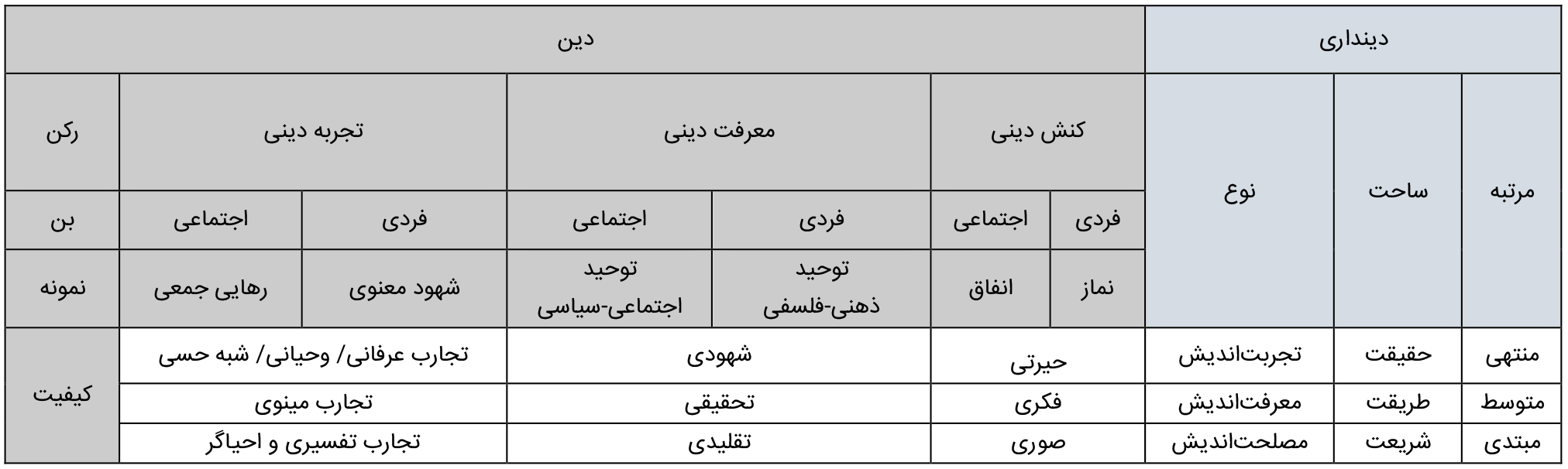
Therefore, what has been said and formulated in Table 1 can be briefly explained as follows. Religion has three "pillars" (experience, knowledge, action), each pillar of which is divided into two "foundations" (individual and social). Religiosity has three degrees (beginner, intermediate, advanced) and three spheres and qualities (Sharia, Tariqa, Haqiqa) of religiosity corresponding to that degree. At each degree, the religious person present at that degree adopts a type of religiosity (expediency-oriented, knowledge-oriented, experience-oriented) and practices religion in the sphere corresponding to that type of religiosity within the three pillars of religion and the two foundations of each pillar.
For example, consider person A; his degree of religiosity is beginner. He is an expediency-oriented religious person and practices religion within the three pillars of religion at the level of the Sharia sphere—that is, in religious action at the level of outward practices, in religious knowledge at the level of imitative beliefs, and in religious experience at the level of interpretive experiences—within both the individual and social foundations, in his personal world and the world around him. Person B is at the intermediate degree of religiosity. He is a knowledge-oriented religious person and practices religion within the three pillars of religion at the level of the Tariqa sphere—that is, in religious action at the inward, contemplative, and reflective level, in religious knowledge at the level of investigative beliefs, and in religious experience at the level of numinous experiences—within both the individual and social foundations, in his personal world and the world around him. Person C is at the advanced degree. He is an experience-oriented religious person and practices religion within the three pillars of religion at the level of the Haqiqa sphere—that is, in religious action at the level of existential, presential, and bewildered connection, in religious knowledge at the level of intuitive knowledge, and in religious experience at the level of mystical experiences—within both the individual and social foundations, in his personal world and the world around him. Each of persons A, B, and C, with an existential view of religion, can, to the extent of their mental-psychological capacity and individual-social situation, be a multi-sphere monotheist and, within the triangle of God, creation, and self, pursue their spiritual wayfaring in both the personal world and the surrounding world and attain salvation.
Shariati says of the difference between the Islam of Salman and that of Abu Dharr: “... The Prophet says: ‘If Abu Dharr knew what is in Salman’s heart, he would surely declare him an infidel’ or ‘he would surely kill him.’ One is Abu Dharr and the other is Salman: no one can doubt the Muslimness of either, nor that the Prophet loved both like his own two eyes and bestowed great praises upon both. Their personalities are known; he is not comparing one with another to say they had any difference in faith; no, both are at the pinnacle of faith and are supreme exemplars of a Muslim, but the difference between the Islam that fits within the heart of Abu Dharr and the understanding of Abu Dharr, and the Islam that fits and exists within the mind, feeling, and perception of Salman, is so great—and both are Islam—that if Abu Dharr were to learn how Salman has understood Islam, how he interprets prophethood, and how he has perceived God, he would immediately excommunicate him, or in another narration, he would immediately kill him as an infidel and apostate. Yet both, Abu Dharr and Salman, are Muslims. Why? Because the declaration of this statement’s value lies in: granting possibility to all thoughts and intellects to strive and roam freely in the arena of movement, creativity, progress, and intellectual and spiritual cultivation. That the Prophet himself would acknowledge—not in a scientific matter but in a matter of belief—and confess that a religious truth in two minds may have a distance between them akin to that between unbelief and Islam, yet both are Islam, both are true, and both are great Muslims, the proclamation of this principle (the principle of freedom of thought, freedom of inquiry, freedom of interpretation, and independence of understanding) for every discerning thinker is a prevention of uniform understanding and intellectual imitation, and is a factor which, had it been able to continue among Muslims, we would have attained today’s civilization not three hundred years ago but a thousand years ago.”
Therefore, if every individual within their own class of religiosity, which is the extent of their capacity, wishes to attain their own perfection and be a complete Muslim, and if they wish to consider a model and benefit from the models of early Islam in this path, one can name the top student of the Muhammadan school, namely Imam Ali (peace be upon him), as the best model for those who have reached the end. The religiosity of Salman can be a model for the intermediate, and the religiosity of Abu Dharr can be a model for beginners. In this religiological model of cooperative liberation theology, every believer in whatever class of religiosity they are placed according to their intellectual and spiritual capacity can attain perfection and salvation. In this paper, the religiological model of cooperative liberation theology—whose general coordinates within this theological system were previously addressed in the twelve-part series on Twofold Theology—has been elucidated. In the future, continuing these discussions and in a new series of writings, the topic of well-being and virtuous living within the geography of this theology will be addressed.




Discussion1 comments
این قسمت ها برای من خیلی جالب بودند: بنابراین بهترین راه پذیرش تقسیمبندی مناسک به اولیه و ثانویه و به رسمیت شناختن تکثر و تنوع در عبادات ثانویه در تمامی اصناف دینورزی است که میتواند مناسک دینداران مصلحتاندیش نظیر مجالس هیئت، روضه، عزاداری و پیادهرویهای آیینی و.. باشد و چه دینپژوهی و بسط آگاهی دینی یا مدیتیشن، یوگا، موسیقی و سماع و.. دینداران معرفتاندیش و تجربتاندیش. میتوان از مناسک ثانویه تا جایی که ابزار دست قدرت سیاسی نشدهاند، موجب عدم تعادل در سه رکن دینداری نشدهاند، موجب تشدید رویکردهای هویتی و تمایزات فرقهای نشدهاند، موجب تشدید خرافهپروری، زیر پا گذاشتن یا نادیده گرفتن آموزههای سایر ارکان دین نظیر مناسک اولیه ( اهمیت بیشتر به عزاداری یا مدیتیشن به جای نماز)، معرفت دینی ( نظیر اعمال مشرکانه حین زیارت) نشدهاند، دفاع کرد. اما اگر مبتلا به هر کدام از این وضعیتها شدند با گفت وگو، تعامل و کار فرهنگی به اصلاح و بهبود وضعیت همت گمارد که انتقادات شدید و از موضع بالا تنها به وخیمتر شدن اوضاع خواهد انجامید. بله، واقعا هم باید مناسک مردم عامی را به رسمیت شناخت و هم مناسک خواص را. البته تا جایی که حد و اندازه نگه داشته شود و به خرافات و اباحهگری و فساد و شرک و غیره آلوده نشود. به شخصه، هم با هیئت و مجلس های ذکر اهل بیت و قرائت قرآن، تجربههای دینی عمیق و تاثیر گذار داشتم هم با موسیقیهای عرفانی اساتیدی مانند شجریان و ناظری. ای کاش و ای کاش، یک جورایی مداحهای ما هم آپدیت بشن و فرهیخته و با شعور بشن و یه مقدار سطح کارشون رو متعالی بکنن. چه اشکال داره مجالسی تشکیل بشه که مثلا نصفش مدح و ثنای خداوند باشه و نصفش ابراز محبت و عشق به اولیای خداوند مانند بزرگوارانی حضرت عیسی و محمد و فاطمه و مریم و غیره. خود سینه زدن و دست زدن و هروله و غیره هم یکنوع رقص است، چه اشکال دارد رقص هم، به رسمیت شناخته شود. البته میدانم از میان همه انواع هنر، بیشتر از همه، این رقص است که به ابتذال کشیده شده است. ولی خوب، هنر مردان و قهرمان های فرهنگی و معنوی اینجاست که روی دیگه سکه را نمایش بدهند. و ای کاش، شادی و سرور و جشن هم مثل عزا و ماتم و اندوه، به رسمیت شناخته شود. محرم و فاطمیه، سه ماه تقریبا عزاداری می کنیم ولی اعیاد شعبانیه که پشت سر هم تولد هستن، انگار نه انگار. این انصافا درست نیست. یا حق