اندیشهفلسفهخردگفتگوحکمتمعناپرسشفرهنگ
Political Science
Morteza Mardiha: Why Should One Love Iran?
In response to Foroughi's question, Morteza Mardiha defends a moderate nationalism: patriotism is neither fascism nor an obstacle to globalization. He argues that nationalism erases petty distinctions and that intellectuals should emphasize commonalities.
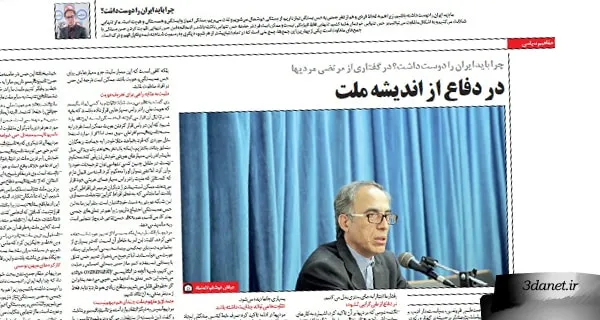
Mohammad-Ali Foroughi, the literary politician and distinguished scholar-diplomat, in a speech published in the Medhi memorial volume in Bombay (1930), addressed the question “Why should one love Iran?” and wrote: “In my view, national sentiment does not conflict with international feelings, patriotism, or love of humankind, and they are easily reconciled.” On this basis he concluded: “We Iranians have the right to be patriots and lovers of our nation, just as every foreigner who has properly examined the circumstances of this people has acknowledged that its existence has been and remains beneficial to the world of humanity, and has expressed kindness and affection toward our nation and country—and we recognize the value of those kindnesses and keep them in mind.” More than 85 years have passed since those lines were written, and now the debate over nationalism is one of the hottest topics in Iranian intellectual circles. While some, like Javad Tabatabai and his students, defend it wholeheartedly and, through the narrative they present, even speak of a form of national sentiment spanning the entire history of Iran from ancient times to the modern era, Mostafa Malekian and his like-minded colleagues critique the concept and in some cases even deem its defense unethical. The emphasis on this debate may be due to the conditions that Iran and the region are grappling with these days, raising the question in society’s mind: what are the functions and consequences of nationalism? Morteza Mardiha, a researcher in philosophy and ethics, in a talk presented at the “Goftar-e Andisheh” lecture series at the Islamic Iran Nation Union Party in Fars province, has once again taken up Foroughi’s question and sought to respond to some criticisms of nationalism and to defend what he calls a moderate form of nationalism.
Emphasizing commonalities rather than points of divergence
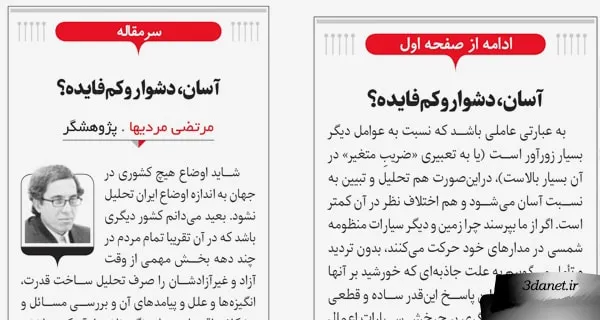
Morteza Mardiha Researcher and professor of philosophy
Morteza Mardiha began his talk by making two preliminary points, first voicing a grievance against the intellectual class, saying: My concern about intellectuals is that they seem eager to emphasize the aspects of difference and divergence between themselves and their colleagues. Diversity and plurality in the intellectual sphere is, of course, unavoidable, but in many cases individuals can still be regarded as companions and allies. Yet among our intellectuals, even those who share the greatest similarities, when they encounter one another, instead of stressing the similarities, they emphasize the points of distinction and pursue a kind of singularism and self-aggrandizement. Whereas I believe it is better to stress our common ground, to have a larger constituency, and to be able to claim that numerous people are aligned with this way of thinking. A more fundamental problem arises when not only do these particularizations occur, but those who are not aligned are treated inappropriately. It is as if some people feel they need to attack those who think differently and their critics in unfriendly ways in order to consolidate their own position. I therefore wish that those who largely fall within shared intellectual frameworks would seek to highlight their commonalities, rather than emphasizing points of disagreement, offering a radicalized and amplified account of them, and subjecting them to fierce and intense criticism. Ultimately, we want to make the world a place where life is easier; with these behaviors, we are turning the world into a worse place. In Defense of an Open Nationalism The second point Mardiha stressed was a reference to his previous work on nationalism (such as the article The Paradox of Nationalism): My discussion today is not a repudiation of that article; there I laid out certain theoretical paradoxes within a mode of thought. The manner and content of my speech have never been in conflict with patriotism. Of course, when confronting ethnocentric discussions, I have always emphasized that these affinities should be open toward national affinities and not see them as a rival; I also believe that nationalist approaches should likewise be open toward globalization. Thus, I have never believed that ethnicities must be completely dissolved into national identity, leaving no trace of their own ethnic attachments, nor have I ever believed—nor do I now—that when we arrive at nationalism, we have reached the end of the line. In my view, this path must remain open. Mardiha directed his critique at radical ethnocentrism and radical nationalism, saying: I am neither sympathetic to nor in accord with either of these two, and I say now that for someone to criticize extreme patriotism or radical nationalism does not mean they have abandoned love of country. Those who express at least a minimal attachment to their homeland are still not fascists or extreme nationalists. That is, one can define a measure of nationalism and patriotism that, while satisfying our emotional and functional needs in this regard, does not lead to extreme nationalism and fascism. The philosophy professor also said: The discussion I am putting forward, although it can be considered independent, also glances sideways at some of the remarks of my friend Mr. Malekian; that is, while I accept many of the general points he has made on this subject, I will raise certain peripheral issues in connection with some of his statements that I think warrant further reflection. Nationalism Is Not Always Divisive Mardiha then addressed one of the criticisms leveled against nationalism, saying: This critique argues that there are already so many divisions, demarcations, and distinctions in our world—religious, racial, ethnic, class distinctions, and so on—why should we add yet another? By making these divisions, we split people into sects, and this is not good, because it sets them against one another. I do not agree with this critique. First, it must be noted that nationalism does not only create lines of distinction; it also erases many lines of distinction. In other words, with nationalism, small populations that once lined up against each other, defining their existence in competition with one another... In other words, patriotism and nationalism can, in the first instance, erase and diminish the multitude of dividing lines that existed everywhere and even set the inhabitants of a small region against one another, and ask them to interact with one another in a broader space—and it has been successful in this regard.
He said: When the Great French Revolution occurred, the new government’s announcements were translated and disseminated in 5 languages and 23 dialects, but after a while they decided to publish the announcements in a single language with a Parisian accent, and in this way the French nation was built, or if it existed, it was repaired and strengthened. Therefore, the establishment of a nation does not mean drawing new lines and distinctions among people; if such a distinction has been created, its function is to dissolve and absorb the micro-identities that are still visible in many places. Differences can have appeal Mardiha went on to emphasize: Drawing a line in itself does not create a problem; what matters is how the other side of the line is introduced after the line is drawn. In other words, if after drawing the line, we consider anyone on the other side as an opponent and a danger, the problem begins. Some think nationalism can be the basis for this view. But it does not always have to be this way. Regarding the claim that we should erase distinctions as much as possible so that humans have more alignment and homogeneity, we need to reflect more. After all, all people are different from one another, and incidentally, these differences can have appeal and function and create a kind of empathy after difference. What is worrying is when distinctions place individuals in confrontation with one another. Merely emphasizing a distinction does not mean that the two sides must be in confrontation with each other. Of course, it is usually the case that groups who make distinction the basis for radical encounters make more noise. But this greater reflection of the radicals’ voice does not mean that we should deny any kind of distinction altogether. He said: Therefore, merely because of the existence of extremist approaches to nationalism that consider others as enemies, one cannot reject the entirety of nationalism. The fact that some people defend nationality does not necessarily mean that these individuals want to place different parts of the world in confrontation with one another. Moderate nationalism is kind towards ethnicities Mardiha then stated that a prerequisite for moderate nationalism is being open and receptive towards what lies beyond national borders, and said: There are thoughts that introduce a nationalism which possesses these characteristics: firstly, they completely deny any subcategories that exist for this nation and believe that all of them must dissolve within this larger circle; secondly, this larger circle is defined once and for all and is defined in competition with its other rivals, and they usually define this competition with a kind of serious humiliation, belittlement, and self-superiority. These are the characteristics of radical nationalism, with which I do not agree. On the contrary, I believe a moderate nationalism should be kind and compassionate towards ethnicities and treat them with kindness and leniency. That is, if they wish to preserve some degrees of their identity, it should not be considered bad, as long as these ethnic identities do not stand against the national identity, are not at its level, and fall under it. On the other hand, this balanced nationalism, after defining nationality, should not emphasize humiliating and hostile competition. Mardiha said: Each of us can resort to multiple factors and, through them, find a sense of togetherness and collective identity. We can also define identities for ourselves through which we feel individuality. That is, on one hand, a person likes to define themselves with specific attributes alongside others in a collective and satisfy one of their spiritual needs with this sense of belonging and attachment, and on the other hand, they like to emphasize some of their individual characteristics and define them as the foundations of their individual identity. These two do not contradict each other. A person can create an identity pyramid for the need for a sense of belonging and solidarity, meaning they can attach themselves to different degrees in different places and forms. This is what happens to each and every one of us. Therefore, many of us appear with our different identities at various junctures; in other words, if an individual wants to be bound with those for whom national identity is a part of their identity criteria, they do not need to be exactly like them; rather, it is enough that this criterion of nationality is among their criteria for a sense of solidarity and identity. The degree of this feeling may vary among individuals. Nationality as a way to define identity He said: It seems perhaps we cannot fault someone who has placed national identity at the top of the criteria under which the rest of the pyramid falls. Of course, this criticism might be raised that this placing of identity at the top might push the individual towards extreme nationalism.But if we set aside exceptional cases, such as when an individual wants to belong to a community of criminals, for instance, it is not condemnable for someone to place a characteristic like nationality at the top of their identity criteria. Against such a person, one can only express one's own preferences. But one cannot condemn them. Of course, I accept that those who place nationality at the top of their identity criteria may be more prone to extremism than others. But as long as it does not lead to the danger of extremism, the architecture of this identity network is in the hands of the individual. Therefore, we need this sense of solidarity, because we function better in collective belongings, and it also seems to be a kind of escape from loneliness and gives us hope. Mardiha, noting that he usually does not use the term identity, said: This is because in many places, identity has been the basis for fighting, meaning people wanted an identity for war. But I prefer to use the term sense of belonging or attachment. We feel satisfaction from a sense of attachment, similar to what is called community in English. This sense of belonging gives people a good feeling. Therefore, if we draw lines, it also has many benefits, and we should not look at it only from a negative perspective. The referent and concept of nation are not so ambiguous Mardiha then addressed another criticism leveled against nationalism and said: This group of critics says the concept of nation cannot be made precise. I also accept this point; the country I speak of as Iran has undergone various political and geographical transformations throughout history. But I have two responses to this critique or objection; first, are not many other terms like reason, love, and so on the same? Which of us can define the concept of reason with precision? Concepts have contraction and expansion, and different meanings are intended from them in different conditions. Fundamentally, one of our most important tasks (if not the most important task) in any scientific and intellectual discussion is to be careful to define concepts within certain limits, so that our audience understands in what sense the word is being used in the relevant discussion; otherwise, a dialogue of the deaf occurs. From this perspective, fluidity and ambiguity are not exclusive to the concept of nation. The second response, however, returns to the referential aspect. From a referential aspect, it is not a difficult task to point out the referent of a nation. Of course, it is true that we want to rely on a long historical background, but we cannot say this historical background has had no common points. Not to mention that even if there is no common point, this very transformation has given it a unified identity. More importantly, it can be said that now, what is recognized in the current world by ourselves and others to refer to the referent of a nation is sufficient. Patriotism is not instinctual Mardiha, in expressing another objection raised against nationalism, said: Some have also said that patriotism is an instinctual matter, like love for mother, father, and child, and something that is instinctual is not attributed with moral characteristics; in other words, this critique considers nationalism a form of selfishness and, from this perspective, places it in opposition to morality, because we define morality with the presence of desire and within the framework of other-regarding. This critique is not entirely wrong, but one can negotiate over it. We have instincts that are generally and normally considered our instincts, and from this perspective, affirmation, denial, praise, and blame are meaningless regarding them. But sometimes, strengthening or weakening these instincts becomes a moral matter and a subject of praise or blame. The same is true of patriotism. We all have a sense of patriotism in a general, instinctual way, but we can strengthen or dilute it. This thickening or diluting can be a moral matter. From this perspective, it is morally appropriate to encourage the strengthening of the sense of patriotism, provided it does not lead to its extremist aspect. He said: Also, under this same point, it is necessary to mention that the patriotism that is instinctual in us is mostly directed towards the house, neighborhood, or at most the village or city where we live, and it is unlikely that we are instinctively interested in borders that are millions of kilometers long. Because the object of instinct is usually something tangible. Therefore, instinctual patriotism most likely does not include the nation in the sense of nation, but rather, instinctively, an individual might even be averse to it. As a result, instinctive patriotism mostly returns to the small spheres of people's lives, but patriotism in the sense of nationalism returns to more encompassing spheres that are, incidentally, not instinctive and can even be counter-instinctive in borderline and marginal cases. Just as I feel that all nationalities, beyond their patriotism, should also have a sense of kinship with humankind, with human beings—a sense that, fortunately, is not scarce in our society. In our society, the fact that we have a sense of nationalism has not led us to feel threatened or to think that our nationality has confined us and established a hostile relationship with other nations. That is, our people have been able to preserve their national identity, ethnic identity, and global identity simultaneously. Of course, creating connections among these requires management and engineering. Moreover, the manner of this management differs for each individual. Moderate nationalism "wants" to be the best nation Mardiha cited another objection raised against nationalism: some say nationalism asks us, as a nation, to call ourselves the greatest nation in the world. These critics say this claim is both contrary to fact and a form of arrogance and pride, and is undesirable in both respects. In response to this criticism, he said: It is possible that those who defend nationalism do not say that our nation is the greatest nation in the world, but rather that we want to become the greatest nation in the world. There is no problem with this claim. Of course, it might be said that this claim is not realistic because the potential for it does not exist. But those who claim they want to become the greatest country in the world are not necessarily going to reach that point; rather, it is a destination toward which this nation moves. Therefore, the unreasonable claim of being the greatest nation in the world can be replaced with this reasonable and harmless claim that we want to become the greatest nation in the world. In the competition among nations, all countries strive to have a better position, and this rivalry is not a bad thing. The functions of patriotism In summarizing his discussion, Mardiha answered the question of why one should love Iran, saying: We must love Iran because, both individually and collectively, we need a sense of belonging; we are made happy by belonging and derive pleasure from it. Belonging encompasses attachment, solidarity, and identity. We complain of loneliness and can overcome our sense of loneliness in different ways; loneliness is not only physical, and a person may feel lonely in society. The cure for this sense of loneliness is to strengthen the sense of belonging to various collectives. One of the best of these collectives is the national collective, which is recognized and understandable throughout the world more than any other method. He said: The second reason for the necessity of loving Iran is its functional benefits. People who feel a sense of belonging to a collective, since they consider the efficacy of that collective as something of their own, make greater efforts. The sense of solidarity and collective work increases the efficacy of the whole more than the mere sum of the efforts of each individual. In the same way, if we can strengthen this feeling that exists in most people and bring it to consciousness, greater efficacy will be achieved. The third reason for the necessity of this love is that, despite its shortcomings, our country's history is something we can take pride in. We are not saying it has been the best, nor is it sayable; we are not saying it has not had strange and peculiar weaknesses. But if we consider only the Persian language and literature, we have a heritage of which we can be proud on a global level. I am not saying our literary culture is superior to English literary culture, but in any case, it is a respectable heritage, and both we ourselves and many outside these borders have reached the judgment that one can be proud of this heritage. That is, we can say that we have made a significant contribution to the table of world culture over the long course of history. Even now, we can strengthen those same foundations, so that when conditions become favorable, we can make up for the delay. Denial is not the solution. In conclusion, he said: Of course, it is good for us to immerse ourselves in the global body in terms of affection, sympathy, and understanding, but while loving others, we also preserve ourselves. We have a country that emphasizes its differences, identities, and contributions, and rises to compete with other countries, but does not rise in enmity or humiliation stemming from arrogance and pride with other countries. Therefore, I believe that a good and clear path lies ahead of us. Of course, we may not be in good conditions at present, but one of the things we can do in this regard is cultural work.البته كار فرهنگی جایگزین كار اجتماعی و سیاسی نیست، بلكه بحث این است كه در كنار تلاشهایی كه در زمینه سیاسی و اجتماعی میكنیم، ذهنیت خودمان و دیگران را نیز بهبود بخشیم. یكی از راهها این است كه ببینیم پدیدهای به نام ملیت و وطن دوستی برای آتیه ما از چه جهاتی فوایدی داشته باشد و دیگران را نیز از این حیث متقاعد بكنیم..
.
Audio of the lecture "Why Should We Love Iran?"
PDF file of the Etemad newspaper report on the lecture "Why Should We Love Iran?"
.
.
Lecture title: "Why Should We Love Iran?"
Speaker: Morteza Mardiha
Shiraz - with Q&A - 22 Ordibehesht 1396
Text source: Etemad newspaper (Mohsen Azmoudeh) Monday 1 Khordad 1396
.
.




Discussion0 comments
No comments yet; let yours be the first voice.