Philosophy
Mostafa Malekian in Response to Farnaz Jafarzadegan’s Letter: Spirituality Is the Fruit of Deep Rationality
A letter to Mostafa Malekian questioning suffering, dualities, and absurdity finds a reply on the meaningfulness of suffering and a critique of narcissism. Malekian stresses that life's problems must be approached solely through reason and rationality, and that spirituality is the fruit of deep rationality.
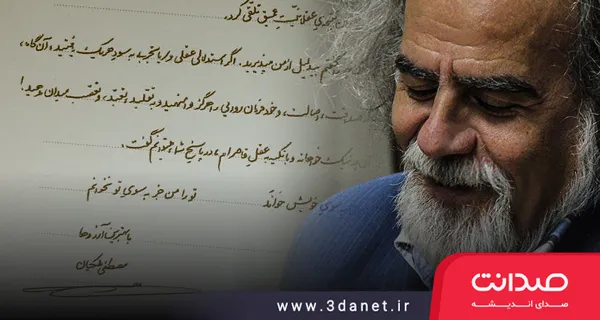
Greetings to the great and esteemed master, Professor Malekian. I hope you are well and breathing in step with the days. For a long time, I have intended to tell you a few unspoken things, but Corona has left no room for living and thinking well, and I know that perhaps Corona is also an excuse for not being well, for it knows how to do its work and dominate human life. The ennui of these days is not born of Corona but born of human life. It is as if our umbilical cords were cut with pain and suffering; now, in each person, this degree differs, but it must be so that a person may taste life, a suffering rooted in our blood without there being a well to offer hope with a glance. As far as my eyes can see, everything in the world revolves around gender and a duality born of our thought. Male, female – good, bad, positive, negative. Woman, man. Ugly, beautiful. But whenever I turn to myself, there is nothing in me called gender, and I see everyone as equal. For me, gender is secondary to substance. The principle is the essence and core of existence, without any superiority. In truth, it is our imaginary and narcissistic aspect that considers existence and gender a source of power, and my existence is nothing but a collection of contradictions, and perhaps it is this very 'I' of existence that has cast a prison within us. And if there is an external existence, has the inner world been predefined for us? Must we seek mystical wayfaring to address the crisis of meaninglessness in today's world? Or turn to philosophy? Or should we deem everything absurd and seize the moment? In this transient world, for me, of course, it is only art that prevents me from sacrificing existence at the altar of non-existence. The issue for all humanity is the passage through absurdity, that life finds meaning through effort? But what is this passage? What is this liberation and freedom? Can one overcome it by being free? Ayn al-Quzat says: 'Freedom is bound to man as heat is bound to fire,' but why do we not find it? Where is this liberation? For no matter how we struggle, we remain bound. I do not know; perhaps this life itself is a kind of liberation. When we look to the past, we feel regret, even if it was bitter. In ennui, too, beauty is hidden, and in joy as well! These 'perhapses' and 'whys' have been with me for a long time and breathe within me. Forgive me if I have taken your precious time. Be happy and healthy, and in closing, this poem for you
I fell with a season that had risen from autumn when the branches of its blare were blowing into me and my hands were knotting in the prayer of soil I stripped suffering from the thorn because the sorrows of suffering were something to be grown I became greater than my sufferings
With respect and remembrance, Yours affectionately, Farnaz Jafarzadegan, 30 December 2020
.
Mostafa Malekian's Response to Farnaz Jafarzadegan's Letter
Dear Ms. Farnaz Jafarzadegan, With greetings and respect, I respond to your esteemed letter in three parts:
1) It seems that no one has been able to spend their life without enduring suffering, and attention to this universality of suffering may well deliver a person from the illusion that they are the sole victim of suffering, and in this way, reduce the intensity and duration of the feeling of being afflicted. At the same time, one can reduce the amount of suffering one endures, and since this can be done, morally, it must be done, because the first category of our moral duties are the duties we have towards ourselves, to meet our true needs, and one of the true needs of each of us is the need to suffer less. To suffer less, there is no alternative but for sufferings to become meaningful, and for sufferings to become meaningful, one must choose a goal that is entirely self-motivated, spontaneous, and self-conscious, not imposed from without, one that is completely compatible and harmonious with our desired personality and character, and then, organize our active life—that is, all our voluntary actions—in such a way that they converge towards that goal and ultimately lead to it. If the entirety of active life, that is, all voluntary actions, are means that, through one, two, three, or several intermediaries, bring us to that self-chosen goal compatible and harmonious with our desired personality and character, then all the sufferings that befall us for the sake of preserving that goal and moving towards it become meaningful, and the meaningfulness of suffering is itself its reduction,
I want to say that to the exact extent that the active life of each of us—that is, the voluntary actions of each of us—is directed toward a goal, our passive life—that is, the experiences that befall us and in whose emergence and persistence we have no part—will be less painful. What makes suffering dreadful and terrifying is that it leads us nowhere; therefore, if suffering is the necessary means and instrument for us to reach a specific place, namely the aforementioned goal, it loses all its dreadfulness and terror. If we do this—and we must strive to do this—our passive life, that is, our inner and subjective mental-psychological experiences and states, will move toward greater calm, stillness, and tranquility, greater steadfastness and stability, and greater freedom from vacillation, and greater happiness, joy, and gentleness. In addition to these three, our life will become the manifestation and showcase of inner harmony (reconciliation with oneself) and outer equilibrium (reconciliation with others). That others find our life a place for the display and spectacle of this inner harmony and outer equilibrium can be the greatest encouragement for them on this same path.
2) In this servant's opinion, the origin of a polarized view of existence, the world, and humanity, and the birthplace of the concepts of positive/negative, good/evil, beautiful/ugly, insider/outsider, self/other, and even I/you, is egotism, self-regard, and narcissism. The more we advance in the direction of weakening and negating individual, group, and species-level narcissism, the less we will encounter these polarizing concepts. From the boiling cauldron of narcissism, no nourishment accrues to us other than these dualistic concepts; and this is a nourishment that, when swallowed, digested, and absorbed into our existential structure, has no result other than ruin, destruction, and annihilation. This nourishment is poison; but a sweet poison, and its antidote is nothing but the healing, yet bitter, medicine of weakening and negating the threefold narcissisms. The feeling of oneness with all beings is identical to the disappearance of polarizing concepts.
3) In my opinion, for solving theoretical problems and resolving practical difficulties, whether in the realm of individual and personal life or in the realm of collective and public life, one must rely solely on reason and rationality. Relying on reason means resorting to the reasoning power that is inherent in all of us, and relying on rationality means theoretical and practical commitment to the findings and achievements of reason. For rationality, recourse to reason is a necessary condition; but it is not a sufficient condition. One can hear the judgment of reason, but not submit to it. Before proceeding further, I find it necessary to emphasize that the power of reason is not infinite, and therefore there are many things whose epistemic comprehension is beyond the capacity of reason; but here, two fundamentally destructive errors must be avoided. One is that no authority other than reason itself can or should declare the limitation of reason. The limitation of reason can only be discovered and revealed by reason itself. Reason is the sole judge in the world whose dismissal can only be issued by itself, and no other being has the power or permission to do such a thing; that is, it is only reason itself that discovers that in certain domains and realms it lacks the power of cognition and judgment, and therefore must refrain from entering those domains and realms and confine itself to other domains and realms. The second is that no authority can or should, after reason has discovered and revealed its own limitation, claim to be the successor to reason in modes beyond the mode of reason. It is not the case that when the scope of reason's cognition and judgment is declared by reason itself, anyone who comes along can claim that to enter the expanses beyond reason's scope, one must place one's hand in his and pledge allegiance to him and follow in his wake. Fundamentally, the limitation of reason, in and of itself, never means that something exists in the world that can henceforth guide and lead humanity. Therefore, the joy of those who, upon learning of reason's confession of its limitation, see the field as empty for themselves and wish to deduce the necessity of their own presence from the absence of reason, is the joy of fools and charlatans. A few of the findings and achievements of reason, which are more prominent, are as follows:
a) Every being, in the world of existence, is connected and interdependent with all other beings, such that the slightest alteration in any other being brings about an alteration in that being. Thus, the quality and quantity of the existence and the continuation of the survival of every being depends on the quality and quantity of the structure and function of the whole universe. Understanding this firm connection and unbreakable interdependence with the whole causes each of us to see ourselves as a blossom blooming on the tree of existence, owing everything to this tree. The result: "Love for the whole." Be in love with that in whose embrace you always are!
b) No being possesses stability or permanence, and does not remain in the same form and character in two consecutive moments. An infinitely immense storm rages in the four corners of the universe, subjecting everything to change, alteration, transformation, transmutation, flux, and becoming, and leaves nothing in the state and condition it is in; everything comes in order to go, and nothing has come in order to stay. Only the whole remains. Each part, at the very moment it greets you, bids you farewell. Greeting is the same as parting. The result: "Non-attachment to the parts." Do not attach your heart to that which disappears as soon as you open your arms to it!
c) Although no part of the universe possesses stability or permanence, it is not the case that the transformation of all parts is within the power of the human individual. For every human individual, some things are alterable by their own hand, and the rest are unalterable. Accept the unalterable ones in the best possible way! And correctly understand and discern the difference between these two, lest you mistake the alterable for the unalterable and/or the unalterable for the alterable. Altering the alterable in the best way requires courage; accepting the unalterable in the best way demands patience; and understanding and discerning these two categories requires insight and attentiveness. So be courageous, and patient, and insightful, and attentive.
d) No human being can attain all of their desires. Therefore, one must make a selection among one's desires, pursue the chosen ones, and abandon the rest. But every selection requires a criterion and standard based on which we understand what to choose and what to forgo. This criterion and standard is solely the need of the body, mind, and psyche. Therefore, choose only those desires that your body and/or mind and/or psyche needs, and abandon the rest. And, of course, abandoning desires whose fulfillment does not satisfy any need multiplies your reconciliation with the world a hundredfold.
e) It is not the world itself that gives human beings well-being, or happiness, or joy, or contentment, or pleasure, or withholds and denies any of these from them. It is the human being's attitude toward the world that does this. Why does one person go through fire and water, knock on every door, and not even turn away from injustice and oppression to attain power or fame, while another person shuns and flees from power or fame? Because their attitudes toward power or fame are different. For one, having power or fame brings pleasure, and for the other, not having power or fame does. Therefore, transformation must not be limited to the transformation of the world. Transforming one's worldview is more important and vital than transforming the world.
These very five rational findings and achievements lay the groundwork for what we interpret as spirituality, and it is for this reason that I have repeatedly said that spirituality can be considered the fruit of deep rationality.
Do not accept any of what I have said from me without reason. If you find a rational and/or empirical argument in favor of each, then accept it. I mean to say: never abandon honesty, authenticity, and self-governance, and do not give ground to imitation, blind submission, and prejudice! This is what I can say to you in response, benevolently and relying on my deficient reason.
Everyone calls you toward themselves; I call you only toward yourself.
With best wishes, Mostafa Malekian

Discussion4 comments
درد و رنج لازمه زندگی و شرط بقاء است .
نامه اخیر استاد مصطفی ملکیان به خانم فرناز جعفرزادگان از دو وجه کلیِ متن و حاشیه برای من آموزنده و خوشایند بود. متن را شاید بتوان به نحوی «مانیفست اخلاقی ملکیان» تلقی کرد. عصارهای از آنچه به زعم ایشان میتوان شناخت و دانست (و آنچه نمیتوان شناخت و دانست) و با آن زیست. متن در اختیار است (اینجا) و فرد علاقمند میتواند خود با آن مواجه شود، بسنجد و به برداشت و فهم خاص خود برسد. از این رو، هدف من در اینجا نه پرداختن به متن بلکه نگاهی به حاشیه است که اهمیت آن شاید کم از متن نباشد. در انبوه هیاهوی اصوات و گفتارهای شفاهی که همه روزه با آن محاصره شدهایم، نفْسِ پرسشوپاسخِ مکتوبِ یک شاعر و فیلسوف، برای من دلپذیر و فرحبخش بود. شاید از این رو که چنین مراودهای خاطرهای محو از سنت فراموش شدۀ نامهنگاری فیلسوفان، حکما، دانشمندان، عرفا و هنرمندان را در ذهنم تداعی میکرد. شاید هم علت همان دلیل سلبی فرار از هیاهوی گفتارهای بیپایانی است که دائم به گوش هجوم میآورند و احتمالا پس از تاثیری آنی از گوش دیگر خارج میشوند تا جا برای استماع گفتاری دیگر، باز شود. همان غلبۀ گفتار بر نوشتار دریدا که دیگر جایی برای سکوت، که لازمۀ تامل است، باقی نگذاشته است. در این وضعیت، حتی بسیاری از مکتوبات فیلسوفانه نیز نسخۀ نوشتاری گفتارها هستند. از این رو، در چنین شرایطی من نفْسِ نامهنویسی را میپسندم چه از طرف فیلسوفی مثل ملکیان باشد که دغدغهاش اخلاق و عقلانیت است، چه از طرف شخصیتی مثل محمود احمدینژاد که سودای مدیریت جهان به سر دارد! علت دیگر خوشایندی نامۀ استاد ملکیان برای من، شاید تداعی آن نوع از فیلسوف و فلسفهای بود که برایم اصالت بیشتری دارد: فلسفهای که نوعی شیوه و هنر زیستن است و فیلسوفی که با فلسفۀ خود زندگی میکند. من در موضعی نیستم که تحقق این را در استاد ملکیان داوری کنم. فقط میتوانم گفت که صورتِ نامۀ ایشان با محتوای آن هماهنگ است. وقت گذاشتن برای پاسخی نسبتا مفصل به پرسش یک مخاطب دغدغهمند، در این محاصرۀ سارقان زمان، خود نمونۀ شاخص و شاید نادر عملی اخلاقی است. این تعهد اخلاقی بیشتر نمایان میشود وقتی که با یک نامۀ دستنویسِ پاکنویس شده مواجه میشویم که قاعدتا نیازمند صرف وقت و دقت بیشتری است. وجه خوشایند دیگر این نامه برای من، همان دستنویس بودن آن است که باز تداعیگر سنت و هنری رو به فراموشی است. ظاهر تمیز و آراستۀ نامه، کاملا در هماهنگی با آراستگی ظاهری نویسنده، وجه زیباشناختی خوشایندی دارد. یک اثر هنری فیلسوفانه. آراستگی و انسجام فکر و محتوا در تناسب با آراستگی ظاهر و فرم. اهمیت توجه به تناسب، آراستگی و زیبایی، سادگی و فروتنی وقتی مشخص میشود که محیطِ زیستی، اجتماعی و فرهنگی را غرق در خلاف این ویژگیها مییابیم. و از آنجا که رخساره خبر میدهد از حال درون، میتوانیم به حال بدِ جمعی خود پی ببریم. نامۀ سرشار از خردمندی، تعهد، آراستگی، حسننیت و فروتنی استاد ملکیان چون افروختن شمعی بود در میانۀ این زشتی و سیاهی. شمع وجود و اندیشهشان هماره افروخته باد! موسی توماج ایری ۲۵ بهمن ۱۳۹۹ تهران منبع: https://mousatoumaj.ir/blog/%d9%86%d8%a7%d9%85%d9%87-%d8%a7%d8%b3%d8%aa%d8%a7%d8%af-%d9%85%d8%b5%d8%b7%d9%81%db%8c-%d9%85%d9%84%da%a9%db%8c%d8%a7%d9%86-%d8%a8%d9%87-%db%8c%da%a9-%d8%b4%d8%a7%d8%b9%d8%b1/
جمله بیقراریت از طلب قرار تست طالب بیقرار شو تا که قرار آیدت مولوی هر که دلارام دید از دلش آرام رفت چشم ندارد خلاص هر که در این دام رفت سعدی معنای زندگی در همراهی و هماهنگی قرار و بیقراری، دلآرام و رفتن آرام است. اما متاسفانه، جناب مصطفی ملکیان بزرگوار، در دایره خودفروبسته صیرورت محض، بدون گشودگی به افق آرامشبخش ثابت هستی، میخواهند برای زندگی معنایی دست و پا کنند.
چه پاسخ حکیمانه ایی...