اندیشهفلسفهخردگفتگوحکمتمعناپرسشفرهنگ
Philosophy
The Relation Between Awareness, Suffering, and Pleasure in a Proposal by Mostafa Malekian
Mostafa Malekian sees the relationship between awareness and suffering as both positive and negative: awareness sometimes reduces suffering, while ignorance can sometimes be a source of pleasure. A conversation on this complex relationship in human life.
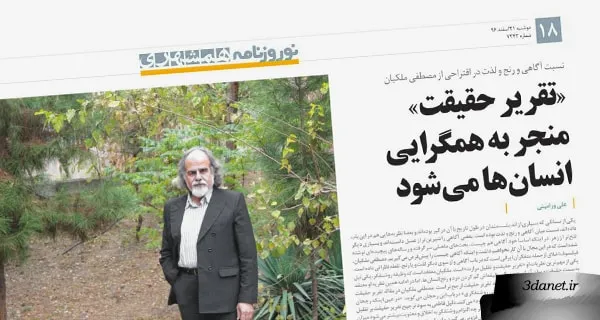
Ali Varamini/ One of the issues that many thinkers throughout history have grappled with, and on which they have occasionally offered theories, is the relation between awareness, suffering, and pleasure. Some have deemed awareness sweeter than honey, and many others more bitter than poison. As to what awareness itself fundamentally is, extensive debates have arisen and complex treatises have been written, which we will not deal with in this space, and we will take what awareness is as a given. Mostafa Malekian, a moral philosopher, is among the Iranian thinkers who has offered viewpoints on awareness on the one hand, and pleasure or suffering on the other. One of his most important theories is “The Statement of Truth and the Reduction of Suffering.” Malekian believes that the intellectual’s duty is, on the one hand, to strive toward truth and express it, and on the other hand, to reduce the pain and suffering of human beings. However, in the continuation of this very theory, he believes that if a conflict arises between the two, the statement of truth takes precedence. In his article “The Statement of Truth and the Reduction of Suffering: The Moral and Tragic Aspect of Intellectual Life,” Mostafa Malekian says of this precedence: “While he ‘intuits’ the precedence of the duty of stating the truth over the duty of reducing suffering, he has no conclusive reason in favor of preferring the statement of truth to the reduction of suffering. Nevertheless, he emphasizes that the more the intellectual’s commitment to ethics and spirituality increases, the greater the importance and urgency of this (seemingly) insoluble problem becomes in his view. And this is the tragic aspect of intellectual life.” Given these approaches, in a proposal, I asked Malekian to express his viewpoints on the relation between awareness, suffering, and pleasure. He believes that the precedence of stating the truth over reducing suffering can only be preferable for those who wish to cultivate the specific characteristics of their humanity and achieve perfection in them. Although he believes there can be no rational reasons for this precedence, he holds that stating the truth brings human beings closer to one another, something that is not possible through the reduction of suffering, for reasons he explains.
Is there a relation between awareness and suffering, and awareness and pleasure? If there is a relation, what is this relation?
There is a relation between awareness and suffering, and this relation is both positive and negative. Or, to put it better, the relation has both a direct proportion and an inverse proportion. That is, in cases I will mention, the more awareness, the less suffering; and in other cases, the more awareness, the more suffering. I will explain both of these states. The human individual (you, me, that gentleman, that lady) is one of the parts of the whole universe, and their nature and destiny are not absolutely separate from the rest of the parts. In the sense that, firstly, the fact that I possess these mental, physical, or psychological characteristics is entirely due to the influence the world has had in bringing about these characteristics in me. From this perspective, as I have said elsewhere, every being, including every human being, is a nodal point of the universe. Here, the universe has knotted together in such a way that I have emerged; there, it has knotted together in such a way that you have emerged. Each of us is a nodal point of the universe. Therefore, if the circumstances of my emergence had been altered by a hair’s breadth from these actual circumstances of my emergence, a different situation would have arisen in my physical, mental, and psychological abilities, in my latent potentials and potentialities, in my talents, in my powers, and in everything about me. Thus, my nature is as it {now} is because I am in {this nodal point} of existence.
But this also holds true regarding our destiny. That is, in these few decades that we live, depending on how I interact and transact with the natural climate surrounding me and the cultural and social climate that environs me, and what actions and reactions I have, our situation becomes different.
So whether I spend my life in pain and suffering or in pleasure and delight depends on two things: first, my innate structure and functioning (which is the result of the universe coming together at this particular nexus), and second, my interactions and reactions with my entire surrounding environment. This being the case, merely wishing to enjoy myself is not enough for me to enjoy myself. Rather, my knowledge of myself and my knowledge of my surrounding environment must increase so that I can learn the ways of living a happier life. For example, when you buy a household appliance like a television or a refrigerator and bring it home, merely wishing that this refrigerator or television will serve you for fifty years is not enough. You must be fully aware of the structure and functioning of this television and refrigerator. The materials and components used in it, the structure and function with which each of these parts was created, what changes pressing this button will cause in this refrigerator, and so on...
The more these things increase, the more your interaction with the refrigerator will naturally prolong its lifespan. But if you throw the appliance's instruction manual in the trash and do not read a single word of it, despite all your wishes for this refrigerator to last fifty years, it may not even last fifty days for you. Because you are dealing with this device ignorantly. For instance, you open a door that should not be opened, you turn on a light that should not be turned on, and similar actions that cause the refrigerator's lifespan to decrease. We are far more complex than a refrigerator, so just as I would destroy the refrigerator if I lacked proper knowledge of it, if I also lack knowledge of myself, I will destroy myself as well. And the environment I inhabit is also far more complex than the environment a refrigerator inhabits. This means that since both my nature and my destiny depend on the environment, the more my knowledge of my surroundings and my knowledge of myself at this particular nexus increases, the more successful my interaction with my surrounding environment will be, and one aspect of this success is a happier life. A happier life can also be translated as experiencing more pleasure, having more satisfaction, and greater contentment. Therefore, from this perspective, the more aware I become of myself and my surrounding environment, the more successful a life I will have, one dimension of a successful life being a happier life.
But there is a second point as well; a human being is born into the world with an immense ignorance of existence. Even if you disregard the Maya of the Hindu tradition (cosmic illusion), which in our culture also appeared as: "The warp and woof of this world, O soul, is heedlessness," and even if we do not concern ourselves with understanding the metaphysical roots of this ignorance, this ignorance also creates a series of positive feelings and emotions within us. In the previous point, I said that the more ignorant we are of ourselves and our surrounding environment, the more unpleasant our interaction and reaction will be; here, on the other hand, many of the ignorances we have regarding existence create positive feelings and emotions within us. That is, many of a person's hopes are due to their ignorance, or many of the meanings they find in life, many of the inner satisfactions they have with themselves, and their joys are due to their ignorance. If this is so, and my knowledge of matters gradually increases and my ignorance decreases, those positive feelings and emotions that existed within me will turn into negative feelings and emotions.
For example, children who think their father is abroad engaged in trade and will return with an immense fortune earned from that trade have a set of positive feelings and emotions toward life, and if one day they learn that their father perished on the trip abroad, all those positive feelings and emotions will be replaced by negative feelings and emotions. So it was their ignorance that created that joy, hope, etc., in them. Now suppose something like this occurs regarding deeper issues; well, in that case, we lose many of our positive feelings and emotions. Whether due to psychological defense mechanisms, Darwinian evolutionary biological laws, or some third factor, whatever it may be, these positive feelings and emotions usually persist in life because we do not poke and pry into their origins. It is as if we have been informed from somewhere that if we go poking around here, we might become aware of realities that would destroy our positive feelings and emotions. Now, if someone did poke around, and acknowledged that they had possessed these positive feelings and emotions until now because of their ignorance, and it then turned out that some of what they considered reality was illusion, some of their truths were errors, and some of the propositions they held as true were false, then of course they will develop negative feelings and emotions, and these negative feelings and emotions make life more unpleasant. The upshot is that the interactions and reactions we have with existence are such that, as a rule, the more our knowledge of ourselves and our surroundings increases, the more it increases the pleasantness of life, because the interactions and reactions will be more successful. Yet, at the same time, there is a set of ignorances upon which the coherence of our positive feelings and emotions depends. If someone dares and ventures into those ignorances and proceeds toward investigation, and the result of their investigation is that those were compound ignorance, well, then of course the person's suffering increases. After this suffering increases, there are two paths. One is that we remain in this suffering. Most of those who undertake the investigations mentioned, after their illusions are destroyed, remain in that suffering. But someone might say that beyond this, there is a higher awareness, that after these illusions are destroyed, one might find more important supports and handholds in existence, so we continue our work. 'Mystics,' according to their claim, believe that they have emerged from the initial illusions, but because they have attained something more important, the pleasantness of their lives has not been lost. It is like those children, when they learn their father has died, realize that their grandfather has left them an enormous inheritance. Mystics believe they have emerged from the illusions that made their lives pleasant, yet they have not lost the pleasantness of life, because they believe there is something higher that you would have reached had you continued. Regarding this claim of the mystics, I have nothing to say, either in denial or affirmation.
They say Socrates was asked, 'Would you rather be a satisfied pig or a dissatisfied Socrates?' and Socrates replied, 'I would rather be a dissatisfied Socrates than a satisfied pig.' You, too, have always prioritized the statement of truth over the reduction of suffering. In the work of the intellectual, you have also always emphasized that the intellectual's task is both the statement of truth and the reduction of suffering, but you have deemed the statement of truth prior within it. Since the audience of intellectual work is all human beings, one can infer from your views that for every human being, the statement of truth takes precedence over the reduction of suffering. What are your ethical and rational reasons for this? That a dissatisfied Socrates should be preferred over a satisfied pig?
This statement you quoted is from John Stuart Mill. When Mill sought to refine and correct Jeremy Bentham's system of valuation regarding pleasures, and naturally this refinement required critique—he had to critique where its strengths and weaknesses lay—the upshot of his argument there is that Bentham spoke in such a way that the result is that a satisfied pig is preferable to a dissatisfied Socrates, whereas John Stuart Mill believed that a dissatisfied Socrates is preferable to a satisfied pig. But let me address your main question. Look, if we do not wish to actualize the specific characteristics of human beings and want to develop our animality (note that I do not mean this in a negative sense), that is one discussion, and no one can ask the person who has made this choice, 'Why?'
There are potential and actual characteristics specific to human beings that elevate us from mere animality to being a particular animal called a human. If someone says, "I do not want to attain those special human endowments; I want to be a happy animal," we have nothing to say in response. We can only say, "You are a happy animal." But if you want to be a happy human, you must advance in those endowments that are specific to humans. In that case, one must consider what those endowments are. I have said in an article that, from this perspective, the interpretation of felicity as well-being must be distinguished from the interpretation of felicity as happiness. If we take felicity as happiness, it means that whatever you desire is present in your life and whatever you do not desire is absent. If someone favors this characteristic and the conditions are realized for them, they are a happy human. But in the second interpretation of felicity and fulfillment, felicity means well-being, not happiness. The meaning of well-being is that you, {the human}, proceed to the utmost in those few characteristics that distinguish your line from other animals. One might say that characteristic is self-actualization. Thus, in the second interpretation, a fulfilled human is one who advances in self-actualization to the point of perfection. Another might consider morality to be the specific characteristic of humans, or yet another might consider loving, the pursuit of beauty, and so on. I myself believe in four characteristics specific to humans, which, as I have said elsewhere, are: 1- Truth-seeking, which leads us toward various forms of knowledge; 2- Benevolence, which leads us toward being moral; 3- The pursuit of beauty, which leads us toward art; 4- Love and friendship, which lead us toward loving and friendly human relationships.
In this sense, if, for example, you surpass me in these characteristics, you are more felicitous (possessing greater well-being) than I am. If someone pursues happiness and says, "I want to be a happy animal," we have no argument with them. But if they want to be human, one must ask them, "What has made you human?" Then, to become felicitous, you must reach the end in the paths you believe your humanity depends upon. (Of course, "reaching the end" means advancing in this path as far as you are able). From this perspective, I have always said that one cannot tell someone to abandon happiness and move toward well-being, or to abandon well-being and move toward happiness. Someone might say, "I do not believe in any specific human characteristic at all," or, "Even if I do, I do not want to grow in its direction." My statement that the articulation of truth takes precedence over the reduction of suffering was for this second type I mentioned. In this case, if a truth is articulated and increases our suffering, since truth-seeking is one of the specific components of being human, we have advanced in that direction. Therefore, when we prefer the articulation of truth over the reduction of suffering, it is as if we have preferred well-being over happiness, advancement in human specificities over being a contented animal.
The second reason is that if it could be guaranteed that people's ignorance would persist until the last moment of their lives, we could say that we have concealed a truth, but in return, we have not increased that person's pain and suffering. However, there is absolutely no such guarantee. Thus, the fate of our audience becomes like that of many of us, who for a time considered many things that were illusions to be truths, but became aware in a single moment. In that moment of awareness, we feel deceived, and the suffering caused by being deceived equals and overwhelms all the pleasure we derived from those years of deception. I have lived happily with illusions for thirty years and now realize I have been deceived; the bitterness and unpleasantness of this deception far outweigh the pleasures of those years of deception. Unless we can guarantee that someone will remain in illusion until the very last moment of their life, and such a guarantee can never be given.
But the third point is that the articulation of truth plays a tremendous role in bringing us human beings closer to one another, a role that the reduction of suffering does not play. Because there is only one universe, therefore all those who strive for the articulation of truth gradually find a convergence. (Of course, I do not believe in the attainment of truth, but in approximation to truth.) All those who reach the mountain peak find their distance from one another lessened; even if one of them does not reach the peak, as they move toward the peak, the closer they get to it, the more their distance from one another diminishes. If at the foot of the mountain my distance from the nearest person is three kilometers, near the summit everyone moves close together toward the peak. The articulation of truth and valuing truth creates a kind of convergence for human beings, for there is not more than one truth; the truth-seeking person, even if they do not attain truth, draws closer to other truth-seeking individuals. The reduction of suffering does not have this property, for human beings do not agree in their desires. Our human desires are highly conflicting, and if I want to reduce the suffering of person A, I can no longer reduce the suffering of person B. The world is not a world of abundance for our material desires, and because there is no abundance for material desires, competition naturally arises among us.
.
.
Subtitle:
But if I want to be human, then one must ask him: what has made you human? Then, in order to attain well-being, you must reach the end in those paths upon which you think your humanity depends.
.
.
PDF file of this interview
.
.
The Relation Between Awareness, Suffering, and Pleasure in a Proposal by Mostafa Malekian;
The Articulation of Truth Leads to the Convergence of Human Beings
Published in the Hamshahri Nowruznameh
.
.




Discussion2 comments
سلام .واقعا هر بار مطالب آموزنده استاد ملکیان را می خوانم ،لذت می برم. به نظر من دو دسته از انسانها در این جهان به واقع زندگی می کنند ،صرف نظر از هر عنوانی که دارند. 1-عارفان واقعی اللهی 2-فیلسوفان و حکیمان اللهی چرا که هر دو خود را از قید و بند دنیا و مقامات دنیوی خلاص کرده اند.و فقط یک هدف دارند و آن لقاالله است. که اولین گروه با سیروسلوک تلاش می کنند به خدا برسند ودرمسیر انسان بودن و انسان شدن قرار می گیرند و دومین گروه با تعقل و فلسفیدن درست در مسیر صراط قرار می گیرند. بقیه انسانها فقط دچار روزمرگی هستند.در واقع دور خودشان می چرخند وبه جایی هم نمی رسند.
و با خود مختاری عقل و مغرور شدن به خود تفرق و جنگ