Mr. Malekian, Your Words Deprive the Youth of Religious Beliefs and Consequently Peace of Mind
Responding to the critique of religious consolation, Malekian distinguishes philosophy from theology: the comfort of illusion must not obstruct the articulation of truth. He holds that religious belief rests on reasoning, not birth, and rejects the concealment of truth.

Regarding religious beliefs, we must consider that being born in a particular geographical area cannot and should not necessarily be considered an acceptable reason for that religious belief. The primary condition for believing in a specific religion must be the existence of reason, proof, and argument. In other words, adherence to a particular religion should be based on epistemological reasons, not the exigency of being born in a specific place. Unfortunately, this is not the case for most of us. The most important reason most of us believe in Twelver Shi'ism is that we were born in a Shi'a city or family, not due to epistemological inquiry or research. For this reason, if I had been born in the city of Sanandaj into a Sunni family, I would currently be a Sunni. Do you believe that a Sunni, after researching and comparing their religion with other religions and denominations, has concluded that Shafi'i Sunni Islam is the truth and then chosen it?
Now, if we accept that the reason you believe in this particular religion is that you were born into, for example, a Sunni family, and that I believe in Twelver Shi'a Islam is because I was born into this particular family, and not because I have conducted serious research into this religion and denomination, my manner of behavior towards you will differ, and it will cause me to treat you with greater tolerance. But if I say, "No, sir, you must either believe in what I believe or you will be suppressed," then it is clear that I am no longer a person of a philosophical disposition, because the requirement of a philosopher's disposition is to request and present arguments; they will not be convinced without reason, and will not try to convince without reason.
Question: What is the application of Islamic philosophy among the religious? Given that one of the functions of Islamic philosophy, at least for those who are religious and believe in Islam, is to create peace of mind, if we take Islamic philosophy away from Islamic philosophers and say this is not philosophy, don't you think that taking this belief from individuals or creating doubt in their religious beliefs will deprive them of peace of mind? And on the other hand, if we take this belief from them, what alternative can be offered to them that provides the peace of mind you seek? And if we have no such thing, don't you think that destroying what we do have, which is currently working, is contrary to rationality?
The first point I would like to make is that all the issues you raised are important and vital discussions, but in this regard, the discussion of philosophy must be separated from the discussion of theology. I did not speak about theology; my discussion was about philosophy. You said that religious beliefs create peace of mind in the believer, and if these beliefs are taken away, their peace of mind will naturally also disappear. I accept that "Verily, in the remembrance of God do hearts find rest" (Ala bi dhikr Allahi tatma'inn al-qulub), and the remembrance of God calms hearts, but I do not accept that "Verily, in proving the existence of God do hearts find rest" (Ala bi ithbat wujud Allahi tatma'inn al-qulub). I believe that when reason enters the scene (and in philosophy, this is undeniable. The philosopher has the right to doubt everything), given that reason introduces a kind of skepticism and a kind of dialectical process to every matter, this issue causes it to place an antithesis against every thesis, and when you want to resolve the conflict between this thesis and that antithesis with a new synthesis, it creates a new thesis against that synthesis as well. I accept that religious beliefs are comforting, and religious beliefs should not be taken from people without reason. But religious beliefs are one thing, and a philosophy that claims to be defending religion is another; these two must be separated from each other. And I see no benefit in establishing a connection between the two. Those who truly have a serious philosophical disposition actually lose their initial peace of mind. Because it is religion that brings peace, not a philosophy that claims to defend religion.
The second point I would like to make is that if your religion or your philosophy merely gave you peace of mind, I would welcome it, but when your philosophy or your religion takes peace of mind away from others, that is what I take issue with. When your religion, in addition to giving you peace, also gives you peace in killing another person, that is where it becomes a source of intimidation. If religions and denominations said, "Fine, we have our own peace of mind and we do not concern ourselves with those who do not believe in our religion," I would have no argument. But when I see that some people, because of their religious beliefs, aggress against others, then I too set out to show that their position is not superior to that of others or their rivals. If there were no aggression and everyone could freely live their own life, there would be no problem. Therefore, I accept the generation of peace of mind here in the context of religious beliefs (not philosophy), but even here I say that this generation of peace of mind has coincided with the deprivation of peace of mind from others.
Another point, which I have of course presented in the article "The Articulation of Truth and the Reduction of Suffering," is that peace, tranquility, and serenity are only desirable when the peace results from truth, not from illusion. This is, of course, an important discussion, and if you ever see that the articulation of truth causes suffering, what should be done then? If the reduction of suffering has moral precedence, then this truth must be concealed, but if the articulation of truth has moral precedence, then this truth must be articulated, even if it causes suffering. Among moral philosophers and even among moral psychologists, this is a very complex debate about what, in fairness, should be done in such cases. For example, imagine there is a mother who thinks her child is alive, and we know that this mother will pass away within a year and that her son was killed on a trip abroad, but we falsely tell the mother, "Your son is alive and has a good life," and we know that as long as the mother is alive, she will not find out about this matter, and we tell her that her son cannot come from abroad for another two years. Now, if an issue arises—and I emphasize, if a case arises—should we tell the mother the truth and increase her suffering, or should we conceal the truth so as not to increase her suffering? There are many such discussions in these cases, and various positions have been taken in different ways by different people. But what I want to convey to you is that whatever position you adopt, you must ultimately accept that if an illusion is a source of peace, we should not say, "Well, since this illusion brings peace, let us preserve it." It is an illusion[1], a delusion, and ultimately something that is not true, and we cannot encourage, advocate for, or promote it even for the reason that it brings them peace. For instance, if people believe that if they shed a tear for Imam Hussein on the day of Ashura, all their sins for the year will be cleansed, well, I know this is an illusion and I cannot remain silent about it. Of course, shedding this tear will give them peace of mind because they say, "Well, for 365 days, whatever we did, we unfortunately did, but now, for half a day, we have fortunately shaken off our bones and been absolved." Well, in my opinion, this is an illusion, but it has given them peace of mind. I do not accept this peace; I want the peace that is attained through truth, not through illusion.
Another point I should have made earlier but will now present to you is that you said defense is a good thing! I also accept that defense is a good thing, but defense in some cases is carried out in such a way that one sees that for a person who is compassionate toward human beings, this defense has on the whole been of no benefit to them. Allow me to give an example in this regard: Suppose I have a greenhouse and you have a greenhouse over there. I claim that the fragrance of my flowers is far better than the fragrance of the flowers in your greenhouse; you also claim that no, the fragrance of the flowers in your greenhouse is better than mine. Then we quarrel over this issue, come to blows, fight, and so on... until, battered and bruised, each returns to his own greenhouse. The point is that in this grappling, I have sweated so much that in my greenhouse I can no longer smell anything but the smell of my own sweat. We were, in fact, arguing over the fragrance of our greenhouses' flowers, but now we sense nothing but our own stench. This example shows, in a way, that when we want to mount an external defense of religion, we commit so many rivalries, dominations, and deceptions in this external defense that even after we have proven God exists and crushed the person who claimed God does not exist, we return and see that we now actually loathe ourselves and do not experience the serenity we should have derived from God's existence. I say this seriously based on my own experience. I once taught in Qom at the Shahid Mahallati School, which belonged to the Revolutionary Guards, in the years '66 or '67 [1987 or 1988]. There was a student there who said there is no proof for the existence of God, and I set out to prove this matter. He was also a very stubborn person, and we were forced to hold numerous sessions—I don't remember exactly how many—until finally, in the last session, he declared that this argument Malekian presented convinced him that God exists. Well, at that time I was very happy that I had convinced him, but when the driver came to take me back, as I was sitting in the car, I saw that I truly loathed myself. Why? Because in these discussions I had committed several fallacies, and I myself was aware that this reasoning I had employed here had flaws, but the other party did not know and did not realize. On the other hand, a sense of pride and vainglory had arisen in me from having overcome this student in the presence of the other students. Now, I want to say that a person who is sensitive about their psychological health or moral perfection, or both, in such situations becomes an instance of that greenhouse example, where in the end I proved that the fragrance of my greenhouse's flowers is better than yours, but now the stench of my own body is so strong in my nostrils that I no longer smell anything from my greenhouse. For this reason, I do not accept that anyone who has great skill in external defense enjoys inner delight. In my opinion, in these discussions, much envy, much rivalry, and issues of this kind arise that cause a person to dislike themselves and develop a kind of inner turbidity. For this reason, we should not be overly concerned with external defense, because if this external defense causes my inner self to be ruined, it is not worth it. We had a clerical friend who was a student of my father years ago, and I also studied under him. He once told me, 'So-and-so, when I go up to the pulpit, as I climb the steps I feel that I am truly ascending to the heavens, I am so luminous, my inner self is so pure, and I have such a tender heart, and overall I feel very good. But after speaking for an hour and coming down, I feel that I am descending to the lowest depths of hell, because I say to myself: here I said something wrong, I interpreted a verse incorrectly, I lied, I committed a fallacy, and so on.'
In my opinion, this is an important matter, and for someone who is a secular this-worldly person and cares about their psychological health, or someone who cares about both their psychological health and their moral perfection, such individuals are honestly averse to many of these external defenses, because a kind of turbidity and a kind of inner unhealthiness always creeps into them after those external defenses.
Regarding your point that if you take away a person's beliefs, what do you give them in return and what justification do you provide for it? In an article I wrote in defense of Fakhr al-Din al-Razi, I argued that reform is one thing and planting the truth is another. As you know, Fakhr al-Din al-Razi is known as the Imam of the Skeptics, someone who doubted everything and left nothing standing, and was even accused of offering nothing in its place. My claim is that if, for our spiritual perfection, we must take two steps: one is to prune the forest of our thoughts of error, and the other is to plant a few trees of truth within it. Now, if someone does the first task for you but not the second, you should not say that they should not have done the first task either. The very act of saving you from a series of errors is a service to you, even if they cannot put anything in its place. If they had the ability to plant the tree of truth, so much the better, but if that ability is lacking, exposing errors should not be considered a wrong action.
Regarding the article by you that was also published in the Iran newspaper, you stated that worshipping belief is a form of idolatry. Concerning the worship of belief, if my belief is God and I worship this very belief, what is the problem with that? Since, ultimately, I have worshipped God.
As you also accept, God is One, and nothing other than God should be worshipped. On the other hand, in my view, the belief that exists in my mind, even if it is the belief in the existence of God, is not God Himself. The belief in the existence of God is other than God. Therefore, if I am to worship God, I must not even worship the belief in the existence of God, because the belief in the existence of God is not God; it is other than God, let alone other beliefs. Thus, even the word 'Allah' must not become a rival to Allah. To me, this matter is very clear: our belief is our belief, and our belief is other than God. Just as we ourselves are not God, our belief is also not God, and for this reason, it should not be worshipped. But there is a point here, which is that when we say the belief in the existence of God should not be worshipped, it does not mean we should cease worshipping God. It means that since our beliefs are other than God, we should not be fanatical about our beliefs, and if someone criticizes our beliefs, we must allow them to express their opinion. In my latest article, I stated that understanding whether I am worshipping a certain belief or not does not mean I should immediately abandon my belief, because a person's most important cultural identity is their belief. But the point is that not worshipping a belief means that if that belief is subjected to criticism, you listen to the critique, and if it proves compelling, you accept it, and if it does not, you hold onto your belief.
.
.
[1] Illusion
delusion
.
.
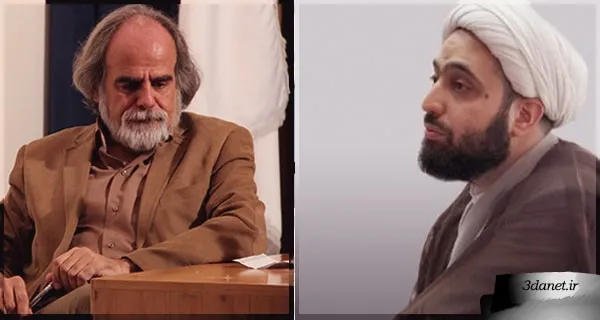
This photo clip is part of the sessions of the Roundtable on the Critique of Islamic Philosophy.
A question about peace of mind and religious beliefs . . .
Download Audio File
Download Photo Clip
Watch Photo Clip on Aparat
Watch the photo clip on YouTube
Full link to the debate
.
.
With thanks to Mr. Hossein Jalili for transcribing the text of this talk
.
.





Discussion1 comments
انساني كه در يك محيط ايزوله و بدون خط قرمز بدونِ پيش زمينه فكري راجع به اديان تحقيق مينمايدنتيجتا جه دين را انتخاب ميكند